Centric Software

Search documents
2025中国消费人群心智地图与品牌未来战略白皮书
Sou Hu Cai Jing· 2025-09-21 07:50
Group 1 - The core viewpoint of the report is that the Chinese consumer market is undergoing a profound transformation, influenced by economic fluctuations, technological innovations, and cultural confidence, leading to a reconfiguration of consumer psychology and behavior [1][15][20] - The report highlights the dual existence of "rational consumption" and "emotional consumption," where consumers seek both value for money and emotional satisfaction, indicating a shift in consumer priorities [1][15][20] - Generational differences and regional disparities shape the market landscape, with distinct consumption values and behaviors emerging from different age groups, such as Baby Boomers, Generation X, Millennials, and Generation Z [1][24][30] Group 2 - Approximately 90% of future consumption growth is expected to come from non-first-tier cities, necessitating brands to adopt localized and refined operational strategies rather than a one-size-fits-all approach [2][26][29] - The report identifies four differentiated development models for cities: emerging hotspots, public service advantage cities, tourism-driven cities, and cities facing housing price pressures, each requiring tailored marketing strategies [2][29] - The emotional connection and cultural recognition are becoming increasingly important for consumers, particularly among Generation Z, who prioritize brands that resonate with their values and interests [1][25][30] Group 3 - Technological innovations are reshaping consumer experiences, with personalized recommendation systems evolving from "precision" to "understanding," enhancing engagement and satisfaction [3][4] - The report emphasizes the importance of brands becoming "spiritual partners" for consumers, especially during economic downturns, by focusing on cultural and emotional fulfillment rather than mere material possession [3][4] - Six brand case studies illustrate the growth logic in the new consumption era, showcasing how brands leverage emotional value, cultural empowerment, and innovative strategies to connect with consumers [4][5]

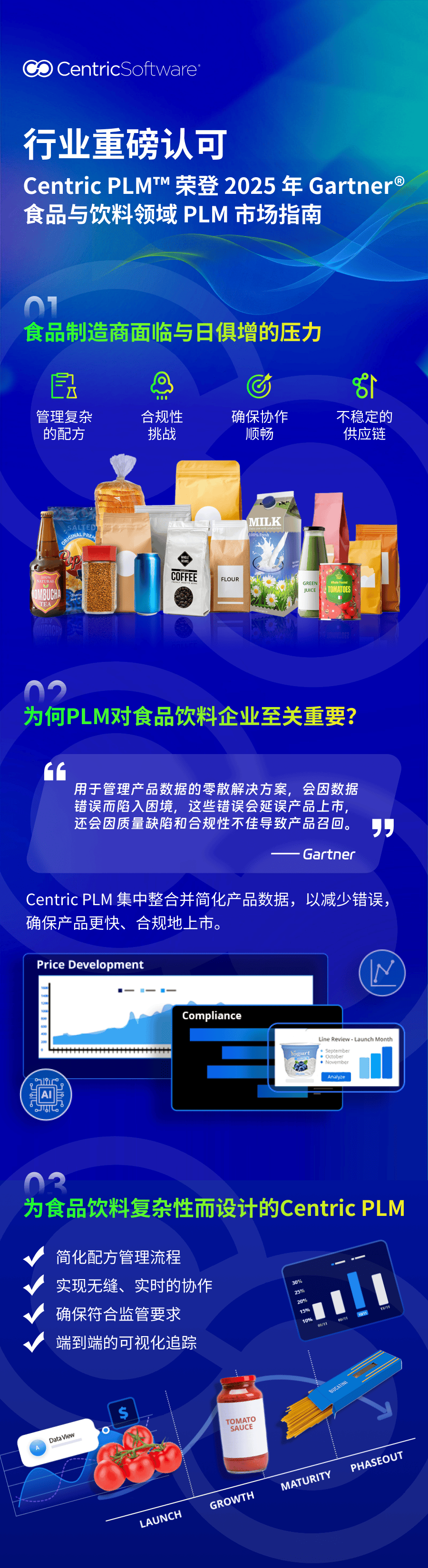
赛趋科|Centric PLM荣登Gartner2025年《食品饮料行业PLM市场指南》
Sou Hu Cai Jing· 2025-08-26 15:03
Core Insights - Centric PLM™ has been recognized in Gartner's 2025 Market Guide for PLM in the Food and Beverage sector, highlighting its relevance and effectiveness in addressing industry-specific challenges [2][9] - The food and beverage industry faces increasing pressures related to management complexity, compliance, and supply chain stability, necessitating specialized PLM solutions [3][4] - Traditional PLM systems are inadequate for the unique demands of the fast-moving consumer goods sector, which requires agility, shorter time-to-market, and robust compliance tracking [9] Industry Challenges - Food manufacturers are under pressure to manage complex product data and ensure compliance with evolving regulations, which can lead to product recalls if not handled properly [4][11] - Many manufacturers still rely on disparate software applications to manage different aspects of the PLM value chain, leading to inefficiencies and increased error rates [9] Centric PLM Features - Centric PLM integrates and simplifies product data management, reducing errors and accelerating time-to-market for compliant products [5][11] - Key functionalities include specifications and formula management, version control, lifecycle workflow management, ingredient data management, and real-time supplier collaboration [10] - Advanced features such as AI-driven formula matching and seamless integration with ERP, LIMS, and MES systems enhance operational efficiency [10] Strategic Importance - The solution enables brands and manufacturers to create a unified digital platform for centralized product data management, facilitating cross-team collaboration and real-time visibility [11] - Centric Software's CEO emphasizes the importance of Centric PLM in helping companies navigate product complexity and regulatory challenges through digital transformation and innovation [11]