
引力波

Search documents
我科学家揭示星系中心物质分布关键信息
Huan Qiu Wang Zi Xun· 2026-02-09 01:54
Core Insights - The research team from Shanghai Jiao Tong University's Li Zhendao Institute has detected gravitational waves in the nanohertz frequency range, providing key insights into the mass distribution at the centers of galaxies [1][2] - The findings indicate that the evolution of supermassive black hole binaries may be influenced not only by gravitational wave radiation but also by their surrounding environment [1][2] Group 1: Gravitational Wave Detection - The detection of nanohertz gravitational waves is primarily attributed to the slow orbit and proximity of supermassive black hole binaries, serving as a crucial window for studying the largest black hole systems in the universe [1] - The pulsar timing array data shows a slight deviation from traditional models in the lowest frequency range, suggesting that environmental factors may play a significant role in the orbital evolution of black hole binaries [1][2] Group 2: Environmental Effects on Black Holes - The study systematically analyzes the impact of stars and dark matter around black hole binaries, indicating that gravitational interactions can alter the orbital energy and material distribution in the galaxy center [1][2] - The research demonstrates that the environmental effects on black hole evolution can produce observational effects similar to those of high eccentricity orbits, complicating the differentiation of these factors in gravitational wave signals [2] Group 3: Future Implications - The research highlights the potential of gravitational wave astronomy to provide measurable information about the material environment at the centers of galaxies, marking a new frontier in this field [3] - With advancements in observational technology, such as the Chinese FAST telescope, future gravitational wave data is expected to enhance sensitivity and improve the understanding of galaxy dynamics and dark matter properties [3]
真相来了丨“地球将失重7秒”是真的吗?专家辟谣
Yang Shi Wang· 2026-02-01 15:05
Core Viewpoint - The viral "doomsday warning" claiming that Earth will experience weightlessness for 7 seconds on August 12, 2026, is a baseless rumor with no scientific foundation [2][5][6]. Group 1: Rumor Details - The rumor states that on August 12, 2026, the world will experience 7.3 seconds of weightlessness, allegedly based on a leaked NASA document called the "Anchor Plan," which supposedly costs over $80 billion to address this gravitational anomaly [2][4]. - It describes a catastrophic scenario where unanchored people and objects would rise 15 to 20 meters, crash into ceilings, and then fall back, resulting in an estimated 40 to 60 million casualties and a global economic collapse lasting over 10 years [2][4]. Group 2: Scientific Analysis - Experts from the Chinese Academy of Sciences assert that the claim of "Earth losing gravity for 7 seconds" is entirely false and lacks scientific basis, as gravity is determined by Earth's mass and cannot simply disappear [5][6][8]. - The assertion that people and objects would slowly rise contradicts physical laws; if gravity were to vanish, they would be ejected at high speeds rather than rising gradually [9]. Group 3: Gravitational Waves - The rumor attributes the supposed event to the collision of gravitational waves from two black holes, but experts clarify that the impact of such waves on Earth is negligible and requires highly sensitive instruments to detect [10][12]. - The energy changes from colliding gravitational waves are so minimal that they can be disregarded in terms of any potential harm to Earth [10][12]. Group 4: Astronomical Events - The date of August 12, 2026, coincides with a predicted solar eclipse, a common astronomical event that has been accurately forecasted by astronomers [13][15]. - Solar and lunar eclipses occur regularly and do not affect Earth's gravitational field; they merely cause temporary changes in surface temperature and tidal forces [16]. Group 5: Public Awareness and Rumor Prevention - Similar doomsday rumors have circulated in the past, often exploiting public fear of the unknown and misunderstanding of astronomical events [17][19]. - Experts recommend verifying claims through authoritative sources, applying basic scientific knowledge, and being cautious of sensationalized language associated with "leaked documents" [19].

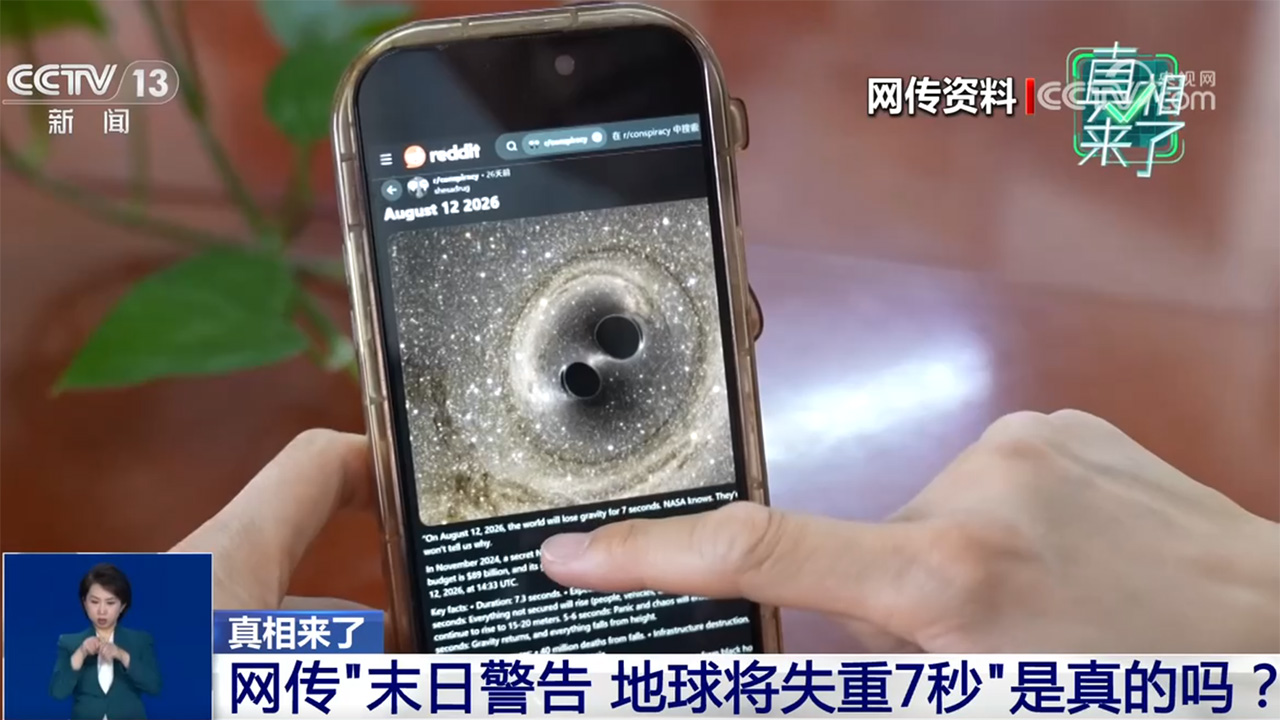
网传“地球将失重7秒”,真相来了!
Xin Lang Cai Jing· 2026-02-01 14:09
Core Viewpoint - The viral "doomsday warning" claiming that Earth will experience weightlessness for 7 seconds on August 12, 2026, is a baseless rumor with no scientific foundation [1][3][7]. Group 1: Rumor Details - The rumor states that on August 12, 2026, the world will experience 7.3 seconds of weightlessness, leading to millions of casualties and infrastructure damage, with an estimated 40 to 60 million deaths [3][5]. - It attributes the cause to the collision of gravitational waves from two black holes, which was supposedly predicted with a 94.7% probability in 2019 [5][12]. - The rumor has been circulating since early this year, having been revived from a 2024 leaked NASA document [5][17]. Group 2: Scientific Analysis - Experts from the Chinese Academy of Sciences assert that the claim of Earth losing gravity for 7 seconds is entirely false, as gravity is determined by the mass of the Earth, which cannot simply disappear [7][9]. - The assertion that people and objects would slowly rise to 15-20 meters contradicts physical laws; if gravity were to vanish, objects would be ejected at high speeds rather than rising slowly [11][20]. - The impact of gravitational waves on Earth is negligible, requiring extremely precise instruments to detect, and the effects of two colliding gravitational waves are minimal [14][16]. Group 3: Astronomical Events - On August 12, 2026, a total solar eclipse will occur, which is a common astronomical event that has been accurately predicted [17][18]. - The eclipse will not affect Earth's gravitational field; it will only block sunlight temporarily, leading to minor changes in surface temperature and tidal forces [20]. Group 4: Public Awareness and Rumor Prevention - Similar doomsday rumors have appeared in the past, exploiting public fear of the unknown and misunderstanding of astronomical events [22]. - Experts recommend verifying claims through authoritative sources and applying basic scientific knowledge to discern the truth [22].
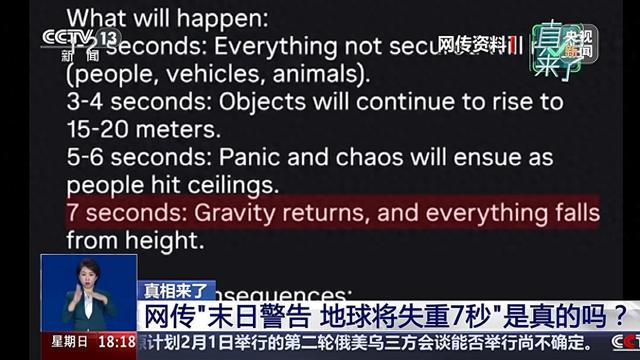
“地球将失重7秒致千万人死亡”?专家辟谣
Xin Lang Cai Jing· 2026-02-01 07:59
Core Viewpoint - The recent doomsday warning regarding a gravitational anomaly caused by a black hole merger during the solar eclipse on August 12, 2026, is identified as a complete "science fiction story" with no scientific basis [1]. Group 1: Misinterpretation of Events - The only real event referenced in the rumor is the solar eclipse occurring on August 12, which is a natural phenomenon where the moon temporarily blocks sunlight from reaching parts of the Earth, affecting light but not gravitational forces or orbital mechanics [1]. - The narrative surrounding the solar eclipse has been misleadingly framed as a potential "gravitational collapse," which is scientifically unfounded [1]. Group 2: Clarification of Gravitational Concepts - The term "gravitational anomaly" mentioned in the rumors does not equate to "gravitational collapse." For instance, astronauts in the Chinese space station experience weightlessness not due to a lack of gravitational force but because they are in free fall, creating a sensation of floating [2]. - Einstein's theory posits that gravity is a result of mass causing curvature in spacetime, meaning that as long as mass exists, gravitational effects will persist [2]. Group 3: Exaggeration of Gravitational Waves - The rumors exaggerate the impact of gravitational waves, which are extremely weak signals that require highly sensitive instruments for detection. The idea that gravitational waves could cause global disasters is a significant distortion of physical reality [2]. - Historical patterns show that similar doomsday rumors, such as those involving planetary alignments or artificial black holes, have repeatedly been debunked by scientific facts [2].
8月12日末日是谣言
Xin Lang Cai Jing· 2026-02-01 04:54
Core Viewpoint - The recent "doomsday warning" regarding a gravitational anomaly caused by a black hole merger during the solar eclipse on August 12, 2026, has been debunked as a rumor by scientists, emphasizing that the only factual element is the occurrence of the solar eclipse itself [1] Group 1 - The rumor claimed that a gravitational wave would cause a global gravity anomaly lasting 7.3 seconds, potentially resulting in 40 million casualties [1] - Scientists clarified that a solar eclipse only affects light and has no impact on the Earth's gravitational field [1] - The gravitational waves mentioned in the rumor are significantly exaggerated, as they are extremely weak by the time they reach Earth [1]
转发!辟谣!8月12日末日是谣言
Xin Lang Cai Jing· 2026-02-01 02:48
Core Viewpoint - The recent "doomsday warning" regarding a gravitational anomaly caused by a black hole merger on August 12, 2026, is a rumor that has been debunked by scientists, emphasizing that the only factual element is the occurrence of a solar eclipse on that date, which will not affect Earth's gravitational field [1] Group 1 - The rumor claims that a gravitational wave from a black hole merger will cause a global gravity anomaly lasting 7.3 seconds, potentially resulting in 40 million casualties [1] - Scientists clarify that the solar eclipse will only affect light and has no impact on Earth's gravitational field [1] - The gravitational waves mentioned in the rumor are exaggerated, as they are extremely weak signals that do not have the capacity to cause catastrophic events on Earth [1]
辟谣!8月12日末日是谣言
Xin Lang Cai Jing· 2026-02-01 01:43
Core Viewpoint - A recent rumor about an impending apocalypse on August 12, 2026, due to a solar eclipse and gravitational waves has been debunked by scientists, emphasizing that the only factual element is the occurrence of the solar eclipse itself, which will not affect Earth's gravitational field [1] Group 1 - The rumor claims that a gravitational wave from a black hole merger will cause a global gravitational anomaly lasting 7.3 seconds, potentially resulting in 40 million casualties [1] - Scientists clarify that the solar eclipse will only affect light and has no impact on Earth's gravitational field [1] - The notion of gravitational waves being a significant threat is exaggerated, as the signals from such waves are extremely weak by the time they reach Earth [1]
全释硬科技丨地球会失重7秒?科学家:这是谣言!
Yang Shi Xin Wen· 2026-02-01 01:40
Core Viewpoint - The warning about a global disaster caused by gravitational waves during the solar eclipse on August 12, 2026, is a complete fabrication and has been debunked by scientists [1]. Group 1: Misconceptions about the Solar Eclipse - The rumor claims that a black hole merger will generate gravitational waves leading to a global gravity anomaly lasting 7.3 seconds, potentially resulting in 40 million casualties [1]. - The solar eclipse itself is a natural phenomenon where the moon temporarily blocks sunlight, having no impact on Earth's gravitational field or orbital mechanics [1]. Group 2: Clarification on Gravity and Gravitational Waves - The term "gravity anomaly" is misused; astronauts in the Chinese space station experience weightlessness not due to a lack of gravity but because they are in free fall, maintaining a speed of approximately 8 kilometers per second in orbit [2]. - Gravitational waves are extremely weak signals that require highly sensitive instruments for detection, and the idea that they could cause global disasters is a gross exaggeration [2].
2025年,十大太空发现 | 红杉爱科学
红杉汇· 2025-12-26 00:06
Group 1 - The article highlights ten significant space discoveries in 2025, including gravitational wave echoes from deep space and extreme high-energy particles traversing the Milky Way [3] - The discoveries address long-standing scientific questions and challenge existing assumptions about the fundamental laws of the universe [3] - Key findings include clues to life's building blocks in asteroid samples, the detection of interstellar comets, and the first observation of coronal mass ejections beyond the Sun [3][5][10] Group 2 - The asteroid Bennu, approximately 525 meters in diameter and 320 million kilometers from Earth, yielded samples containing various salts, ribose, glucose, and organic materials, suggesting that the building blocks of life may originate from space [5] - The comet 3I/ATLAS, entering the solar system at a speed of about 152,000 miles per hour, is the third confirmed interstellar object, with ongoing observations to determine its size and physical properties [7] - The first direct observation of coronal mass ejections from an M dwarf star was achieved, marking a significant milestone in understanding solar phenomena [10] Group 3 - A report identified five known microquasars in the Milky Way as sources of high-energy cosmic rays, confirming the existence of natural "particle engines" [13] - An extreme black hole merger event was reported, creating a new black hole with a mass of approximately 225 solar masses, challenging existing theories about black hole mass ranges [16] - The LIGO observatory captured the clearest gravitational wave signal to date, validating Stephen Hawking's area theorem with a confidence level of 99.999% [19] Group 4 - The KM3NeT detector in the Mediterranean reported the detection of a neutrino with an energy of 220 PeV, setting a new record for neutrino energy [22] - Astronomers measured the distribution of ordinary baryonic matter in the universe, revealing that over three-quarters of it is hidden in diffuse gas between galaxies, addressing the "missing baryon problem" [25] - Recent findings suggest that dark energy, previously thought to be constant, may be weakening, which could necessitate significant revisions to the cosmological standard model [26][27] Group 5 - New-generation telescopes, including the Euclid space telescope and Vera C. Rubin Observatory, have released unprecedented cosmic data, paving the way for a new era of understanding in areas such as asteroid and galaxy evolution, dark matter, and dark energy [30]
中国天眼:“聆听”宇宙深处
Xin Lang Cai Jing· 2025-12-19 07:25
Core Viewpoint - China's FAST telescope has made significant advancements in detecting nanohertz gravitational waves, surpassing other telescopes in the number of pulsars discovered, with a total of 1,170 pulsars identified by November 5, 2025 [1][2]. Group 1: Scientific Achievements - The detection of nanohertz gravitational waves marks a new era in observational astronomy, with evidence published in a domestic academic journal, showcasing China's leading position in this field [2][3]. - FAST's precision monitoring of 57 pulsars over 3 years and 5 months has led to the discovery of nanohertz gravitational wave signals with a confidence level of 4.6 sigma and a false positive rate of less than one in fifty thousand [4][5]. - The telescope has also contributed to other significant discoveries, including the shortest orbital period binary pulsar system and the only actively repeating fast radio burst, expanding the boundaries of human understanding of the universe [5]. Group 2: Technological Advancements - FAST's operational efficiency is crucial for supporting scientific research, with an annual observation time of 5,300 hours, despite a competitive approval rate of 1 in 5 for observation time requests [6]. - The maintenance and operation of FAST involve continuous technological upgrades to ensure high performance and stability, which is essential for long-term scientific contributions [6][7]. - Future plans include the development of a hybrid aperture array around FAST to enhance its detection capabilities, addressing the increasing competition in the field of radio astronomy [7].