
诈骗罪

Search documents
打麻将输7万4名牌友全获刑
Xin Lang Cai Jing· 2026-02-18 17:13
Core Viewpoint - A recent case of Mahjong fraud in Guangdong highlights the risks associated with gambling and the legal consequences of organized cheating in recreational activities [1] Group 1: Case Details - The case involved four individuals who conspired to defraud a player named Ren by manipulating Mahjong games over a period of nine days [1] - The group used complex rules, secret signals, and collusion to control the game outcomes, resulting in a total loss of over 70,000 yuan for Ren [1] Group 2: Legal Consequences - The court found the actions of the four individuals constituted fraud, leading to various sentences: Huang received 3 years and 4 months in prison plus a fine of 5,000 yuan; Jian and Qin each received 3 years in prison with a 4-year probation and a fine of 4,000 yuan; Fang received 11 months in prison with a 1-year and 2-month probation and a fine of 4,000 yuan [1] - Huang was also ordered to compensate the victim with 13,600 yuan [1]
打麻将短短几天输了7万多元,4名“牌友”全获刑
Xin Lang Cai Jing· 2026-02-17 05:54
Group 1 - The article discusses a case of fraud involving a group of individuals who cheated a victim out of over 70,000 yuan through a rigged mahjong game [1][2] - The fraud was orchestrated by Huang, who, along with his accomplices, used deceptive tactics to create a false sense of winning for the victim, leading to significant financial loss [1][2] - The court found all four defendants guilty of fraud, with varying sentences based on their roles and prior criminal records, highlighting the legal consequences of such fraudulent activities [2][3] Group 2 - The legal framework for fraud in China is outlined, indicating that fraud involving amounts exceeding 30,000 yuan is classified as "serious" under the law, which applies to this case [3] - The case serves as a warning about the risks associated with high-stakes gambling, particularly in familiar settings, where the potential for fraud increases [3] - The article emphasizes the importance of vigilance in gambling situations, advising individuals to be cautious of unusual patterns in gameplay and to report suspicious activities [3]
“新娘”尹某某,获刑4年半
Xin Lang Cai Jing· 2026-02-14 11:24
Core Points - The case involves a woman named Yin, who was sentenced to 4 years and 6 months in prison for fraud, having deceived multiple men into believing she was a wealthy single woman while concealing her existing marriage status [1][2] - Yin used various deceptive tactics, including fake pregnancy documents and hiring actors to impersonate her parents, to gain the trust of her victims and extract money from them [2] Summary by Sections - **Fraudulent Activities**: Yin created a false identity as a wealthy single woman and solicited money from her victims under the pretense of needing funds for an abortion, while also fabricating family support to facilitate a wedding [1][2] - **Legal Proceedings**: The court found that Yin's actions met the criteria for fraud, as she intentionally misled her victims and concealed her marital status to obtain financial benefits [2] - **Sentencing and Appeals**: After being sentenced, Yin appealed the decision, arguing that her previous marriage was effectively over and that gifts given by her victim should not count as fraud. The court upheld the original sentence, stating that her intent and actions were clearly fraudulent [2]
假千金骗婚案二审维持原判:“新娘”因诈骗罪一审获刑4年半
Xin Lang Cai Jing· 2026-02-14 08:16
Core Viewpoint - The case involves a woman, Yin, who was sentenced for fraud after deceiving multiple men into believing she was single and pregnant, leading to financial exploitation through fabricated claims and false identities [1][2]. Group 1: Case Details - Yin was sentenced to 4 years and 6 months in prison and fined 20,000 yuan for fraud, with a total of 89,140 yuan to be returned to the victim [1]. - The court found that Yin used a false identity to establish romantic relationships, claiming to be a wealthy single woman and fabricating a pregnancy to solicit money [2]. - During the trial, Yin refused to acknowledge her wrongdoing or return the money, indicating a lack of remorse [1]. Group 2: Legal Proceedings - The initial ruling was upheld by the Suizhou Intermediate Court, which dismissed Yin's appeal, affirming that her actions constituted fraud due to her intent to illegally possess the victims' money [2]. - The court noted that the engagement ring valued at 19,839 yuan was also considered part of the fraudulent gains, reinforcing the severity of her actions [2].
成本19元,卖出698元!官方最新曝光,赶紧提醒家里人
Xin Lang Cai Jing· 2026-02-08 15:29
Core Viewpoint - A group of young individuals orchestrated a scam targeting elderly people by selling low-cost kitchenware at inflated prices, leading to financial losses for over 300 victims [1][5][7] Group 1: Scam Details - The scam involved promoting kitchenware as "high-tech" health products, with a cost of 698 yuan, while the actual cost was only 19 yuan for pots and 32 yuan for knives [1][3] - The perpetrators used emotional manipulation, including staged performances, to convince elderly victims to pay a 300 yuan "good faith deposit" under the guise of receiving free products [3][4] - After collecting the deposits, the scammers quickly fled the scene, leaving victims without their money or the promised products [4][5] Group 2: Legal Proceedings - The case was reported to the police by a victim, leading to an investigation that uncovered multiple similar incidents in surrounding villages [5][6] - Undercover operations were conducted to gather evidence, resulting in the arrest of the suspects when they attempted to repeat the scam [6] - The prosecution argued that the crime constituted fraud rather than the sale of counterfeit products, as victims believed they were receiving free items, not making a purchase [6][7] Group 3: Outcomes and Sentencing - The three suspects confessed to their crimes and agreed to return the stolen funds, totaling 97,500 yuan, to the victims [7] - The court sentenced the main perpetrators to prison terms ranging from two years to three and a half years, along with fines [7]
男子自带蟑螂投入饭菜,被判刑
Xin Lang Cai Jing· 2026-01-31 10:14
Core Viewpoint - The rise of professional claimants abusing legal systems for high compensation has become a significant issue, leading to criminal activities such as extortion and fraud, which disrupt market order and harm legitimate business interests [1][2]. Group 1: Case Summaries - Case 1: A defendant named Su was sentenced to six months in prison (with a one-year probation) for extorting restaurant owners by placing cockroaches in food and demanding compensation, totaling 1,663 yuan [1][2]. - Case 2: A defendant named Xiang, along with accomplices, was sentenced to one year in prison and fined 10,000 yuan for inserting hair and steel wires into food packaging to extort money from businesses, successfully obtaining 24,000 yuan [3][4]. - Case 3: Huang and others were sentenced to three years and three months in prison for defrauding a food company of over 90,000 yuan by fabricating quality issues with chicken feet [5][6]. - Case 4: A consumer named Zeng purchased 900 kilograms of bamboo shoots, far exceeding normal consumption needs, and sought punitive damages. The court ruled that only 20 kilograms were reasonable for compensation, resulting in a 2,000 yuan penalty against the producer [6][7].
父亲去世隐瞒不报冒领26万元养老金
Xin Lang Cai Jing· 2026-01-08 19:02
Group 1 - The court sentenced the defendant, Xiao Guo, to 4 years in prison for fraudulently claiming over 260,000 yuan in pension benefits after concealing his father's death [1] - Xiao Guo's father, a retired employee of a company, passed away in March 2015, but Xiao Guo failed to report this and continued to receive pension payments until June 2021 [1] - The fraudulent activities included providing false information and documents to pass survival certifications from 2016 to 2020, leading to a significant financial gain through illegal means [1] Group 2 - The court considered Xiao Guo's confession and remorse, resulting in a lighter sentence of 4 years and a fine of 20,000 yuan [2] - The judge emphasized the legal consequences of concealing a relative's death to fraudulently claim pension benefits, urging the public to report such events promptly to avoid legal violations [2]
男子隐瞒母亲死讯,冒领16万余元养老金,判了
Xin Lang Cai Jing· 2025-12-26 04:42
Core Viewpoint - A man named Zhai concealed his mother's death to fraudulently collect over 160,000 yuan in pension benefits for more than two years, leading to his conviction for fraud and a three-year prison sentence [2][3][4]. Group 1: Case Details - Zhai's mother passed away in April 2022, but he failed to report her death to the social insurance agency, continuing to withdraw her pension from May 2022 [2]. - The pension payments were suspended in June 2024 due to a lack of certification, prompting Zhai to forge documents to cover up the fraud [2][4]. - Zhai was arrested in January 2025 after the social insurance agency discovered the fraudulent activity through verification processes [2][3]. Group 2: Legal Implications - The court ruled that Zhai's actions constituted fraud under Article 266 of the Criminal Law, emphasizing the importance of protecting social insurance funds as public property [3][5]. - The case highlights the legal consequences of attempting to defraud social security systems, which are crucial for public welfare and social equity [4][5]. - The ruling included a fine and restitution, reflecting a comprehensive approach to remedying public property losses and enforcing legal accountability [3][5]. Group 3: Broader Significance - The case underscores the need for improved public understanding of social insurance rights and obligations, as well as the importance of timely reporting of beneficiaries' deaths [5]. - It illustrates the effectiveness of data collaboration between social services and civil affairs in detecting fraud, moving beyond traditional manual verification methods [5]. - The ruling serves as a warning against the trivialization of pension fraud, reinforcing that such actions are serious crimes rather than minor offenses [5].
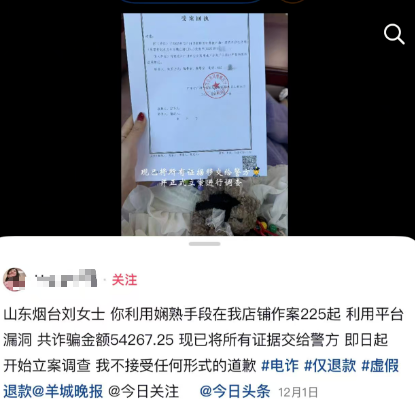
225个快递“仅退款”被曝光后,又有商家发声:也是她
Mei Ri Jing Ji Xin Wen· 2025-12-13 23:26
Core Viewpoint - A woman named Shi has exposed a buyer, Liu, who exploited a platform loophole to request refunds on 225 orders, resulting in a loss of over 54,000 yuan for Shi, who has reported the incident to the police [1][3]. Group 1 - Liu used multiple accounts to purchase various products, applying for refunds before the delivery of high-value items and swapping them with low-value items [3][8]. - The incident has sparked significant online discussion, with the topic trending on Weibo, highlighting the public's interest and concern regarding such fraudulent activities [7]. - Other merchants have reported similar experiences with Liu, indicating a broader pattern of fraudulent behavior affecting multiple businesses [8][9]. Group 2 - Legal experts have stated that Liu's actions constitute fraud, as she had no intention of paying for the items and used deceptive methods to obtain goods [11]. - The estimated financial gain from Liu's fraudulent activities is between 20,000 to 30,000 yuan, with potential legal consequences depending on the total amount involved [11].

金条存款是假的、豪车别墅是租的、父母都是找人演的,“新娘”被判刑
Xin Lang Cai Jing· 2025-12-10 05:56
Core Viewpoint - The case involves a woman named Yin, who was sentenced to four years and six months in prison for fraud, having deceived multiple men into believing she was a wealthy single woman while concealing her existing marriages and using various fraudulent tactics to extract money from her victims [1][5]. Group 1: Fraudulent Activities - Yin created a false identity as a wealthy single woman, claiming to be born in 1994 and working in the beauty industry, to attract male partners [5][6]. - She used a fake pregnancy document to solicit money from her victim, Shen, and employed actors to impersonate her parents during meetings with Shen's family [2][5]. - The total amount involved in the fraud was determined to be 187,840 yuan, with 108,700 yuan being returned or spent on shared expenses [6]. Group 2: Legal Proceedings - The court ruled that Yin's actions constituted fraud, as she had the intent to illegally possess the victims' money while hiding her marital status [2][6]. - The court decided that her actions did not constitute multiple crimes such as bigamy or forgery, as they were all part of the fraudulent scheme [6]. - Yin was not considered to have voluntarily confessed to the police, which affected her sentencing [7].