
AI辅助药物发现

Search documents
港股异动 | 歌礼制药-B(01672)午后涨近8% 歌礼首款口服胰淀素多肽ASC36进入临床开发
智通财经网· 2026-02-20 06:21
Core Viewpoint - The announcement of the clinical development of ASC36, a novel oral glucagon-like peptide-1 (GLP-1) receptor agonist, marks a significant advancement for the company in the metabolic disease sector, showcasing its proprietary oral peptide delivery enhancement technology [1] Company Summary - The company's stock, Gilead Sciences-B (01672), saw an increase of nearly 8%, with a current price of HKD 17.72 and a trading volume of HKD 36.79 million [1] - The board of directors has selected ASC36 for clinical development, with plans to submit an Investigational New Drug (IND) application to the FDA in the second quarter of 2026 for obesity treatment [1] - ASC36 is developed using the company's AI-assisted drug discovery technology (AISBDD), representing a key transition from platform capability to candidate drug [1]
歌礼制药-B:歌礼选定新一代每月一次皮下注射GLP-1R/GIPR/GCGR 三靶点激动剂多肽ASC37进行临床开发
Zhi Tong Cai Jing· 2026-01-20 10:02
Core Viewpoint - The company has selected ASC37, a next-generation monthly subcutaneous injection targeting GLP-1R, GIPR, and GCGR, as a clinical development candidate for obesity treatment, with plans to submit an IND to the FDA in Q2 2026 [1] Group 1: Product Development - ASC37 is developed using the company's AI-assisted Structure-Based Drug Discovery (AISBDD) and Ultra-Long-Acting Platform (ULAP) technologies, showing approximately 5 times, 4 times, and 4 times stronger agonistic activity on GLP-1R, GIPR, and GCGR compared to retatrutide [2] - The designed optimization of ASC37 allows for a longer observed half-life, supporting monthly subcutaneous administration with an injection volume not exceeding 1 milliliter, which also provides scalability advantages in manufacturing [2] - In non-human primate studies, ASC37's proprietary depot formulation has an average observed half-life of about 17 days, which is 7 times longer than that of retatrutide in standard liquid formulation [2] Group 2: Clinical Strategy - The company aims to advance ASC37 into clinical trials, with the Phase I study expected to commence in the second half of 2026, as part of a broader strategy to improve treatment options for obesity [3] - ASC37 is being developed as both a monotherapy and in combination therapies for cardiometabolic diseases, including obesity, diabetes, and metabolic dysfunction-associated steatotic liver disease (MASH) [3] - The company plans to combine ASC37 with its monthly subcutaneous amylin receptor agonist peptide ASC36 to treat obesity, diabetes, and other metabolic diseases [3] Group 3: Technological Advantages - The company's AISBDD and ULAP technologies enable the design, optimization, and development of multiple long-acting peptides for monthly subcutaneous injection, including ASC35, ASC36, and ASC37 [3] - The proprietary ULAP technology allows for the design of various release rate constants for peptides in subcutaneous depots, facilitating precise release of injected peptides within predetermined dosing intervals, thereby improving clinical efficacy [3]
歌礼制药-B(01672):歌礼选定新一代每月一次皮下注射GLP-1R/GIPR/GCGR 三靶点激动剂多肽ASC37进行临床开发
智通财经网· 2026-01-20 10:01
Core Viewpoint - The company has selected ASC37, a next-generation monthly subcutaneous injection targeting GLP-1R, GIPR, and GCGR, as a clinical development candidate for obesity treatment, with plans to submit an IND to the FDA in Q2 2026 [1] Group 1: Product Development - ASC37 is developed using the company's AI-assisted Structure-Based Drug Discovery (AISBDD) and Ultra-Long-Acting Platform (ULAP) technologies, showing approximately 5 times, 4 times, and 4 times stronger agonistic activity on GLP-1R, GIPR, and GCGR compared to retatrutide [2] - The designed optimization of ASC37 allows for a longer observed half-life, supporting monthly subcutaneous administration with an injection volume not exceeding 1 milliliter, which also provides scalability advantages in manufacturing [2] - In non-human primate studies, ASC37's proprietary depot formulation has an average observed half-life of about 17 days, which is 7 times that of retatrutide in standard liquid formulation [2] Group 2: Clinical Strategy - The company aims to advance ASC37 into clinical trials, with Phase I expected to start in the second half of 2026, as part of a broader strategy to improve treatment options for obesity [3] - ASC37 is being developed as both a monotherapy and in combination therapies for cardiometabolic diseases, including obesity, diabetes, and metabolic dysfunction-related fatty liver disease (MASH) [3] - The company plans to combine ASC37 with its monthly subcutaneous amylin receptor agonist peptide ASC36 to treat obesity, diabetes, and other metabolic diseases [3]
歌礼制药-B(01672.HK):选定新一代每月一次皮下注射GLP-1R/GIPR/GCGR三靶点激动剂多肽ASC37进行临床开发
Ge Long Hui· 2026-01-20 10:00
Group 1 - Company Gilead Sciences-B (01672.HK) has selected ASC37, a next-generation subcutaneous injection for monthly administration targeting GLP-1R, GIPR, and GCGR, as a clinical development candidate [1] - The company plans to submit an Investigational New Drug (IND) application for ASC37 for the treatment of obesity to the FDA in the second quarter of 2026 [1] - ASC37 is developed using Gilead's AI-assisted structure-based drug discovery and ultra-long-acting platform technologies, showing significantly higher agonistic activity compared to retatrutide [2] Group 2 - In vitro studies indicate that ASC37 exhibits approximately 5 times, 4 times, and 4 times stronger agonistic activity on GLP-1R, GIPR, and GCGR, respectively, compared to retatrutide [2] - ASC37 has a longer observed half-life, allowing for monthly subcutaneous administration with an injection volume not exceeding 1 milliliter, which also provides scalability advantages in manufacturing [2] - The proprietary depot formulation of ASC37 has an average observed half-life of about 17 days in non-human primates, which is 7 times longer than that of retatrutide in standard liquid formulation [2] Group 3 - The advantages of ASC37 in terms of agonistic activity and observed half-life suggest its potential as a new generation therapy for obesity [3] - The company is advancing ASC37 into clinical stages, with Phase I studies expected to commence in the second half of 2026, marking a significant step towards improving treatment options for the obese population [3]
歌礼制药-B(01672.HK):有望成为同类最佳口服小分子IL-17抑制剂ASC50美国I期研究取得积极的顶线结果
Ge Long Hui· 2025-12-15 08:52
Core Viewpoint - The article highlights the positive topline results of ASC50 from a Phase I clinical trial conducted in the United States, indicating its potential as a leading oral small molecule IL-17 inhibitor [1] Group 1: Clinical Trial Results - ASC50 was evaluated in a randomized, double-blind, placebo-controlled Phase I trial involving 46 healthy subjects [1] - The trial assessed the safety, tolerability, pharmacokinetics, and targeted binding characteristics of IL-17A [1] - Subjects received single doses of ASC50 at varying levels: 10 mg, 30 mg, 100 mg, 200 mg, 400 mg, or 600 mg, compared to a matching placebo [1] Group 2: Company Insights - The CEO of the company expressed encouragement from the data, highlighting ASC50's favorable safety profile and differentiated pharmacokinetic characteristics [1] - ASC50 is noted as the first oral small molecule candidate developed using Artificial Intelligence-assisted Structure-Based Drug Discovery (AISBDD) technology in the immunology field [1] - The findings underscore ASC50's potential as a best-in-class oral small molecule IL-17 inhibitor [1]
歌礼制药-B(01672.HK)选定其首款口服GLP-1R/GIPR/GCGR三靶点激动剂多肽ASC37进行临床开发
Ge Long Hui· 2025-11-30 10:18
Core Insights - The company has selected ASC37 oral tablets as its first clinical development candidate for obesity treatment, expected to submit an IND to the FDA in Q2 2026 [1] - ASC37 is developed using the proprietary Peptide Oral Transport Enhancement Technology (POTENT) and is a multi-target peptide agonist for GLP-1R, GIPR, and GCGR [1] - The CEO emphasized the company's commitment to addressing unmet needs in obesity treatment through its advanced research capabilities and diverse pipeline [2] Summary by Sections Drug Development - ASC37 oral tablets are the first candidate utilizing the company's POTENT technology for oral peptide delivery [1] - The drug was discovered and optimized using Artificial Intelligence-Assisted Structure-Based Drug Discovery (AISBDD) technology [1] Efficacy and Bioavailability - In vitro studies show that ASC37 has approximately 5 times, 4 times, and 4 times stronger agonistic activity on GLP-1R, GIPR, and GCGR compared to retatrutide [1] - In non-human primate studies, ASC37 achieved an average absolute oral bioavailability of 4.2%, outperforming semaglutide, tirzepatide, and retatrutide by 9 times, 30 times, and 60 times respectively [2] - The drug exposure (AUC) of ASC37 was about 57 times greater than that of retatrutide in the same studies [2] - The average apparent half-life of ASC37 in non-human primates was approximately 56 hours, supporting once-daily or less frequent dosing [2] Strategic Vision - The selection of ASC37 for clinical development reflects the company's strong R&D capabilities and commitment to addressing obesity treatment needs [2] - The company aims to build a highly competitive and differentiated pipeline to meet various treatment demands for obesity and other metabolic diseases [2]
歌礼制药-B:每月一次新一代胰淀素受体激动剂ASC36和每月一次新一代GLP-1R/GIPR双靶点激动剂ASC35的复方制剂进入临床开发阶段
Zhi Tong Cai Jing· 2025-11-12 23:44
Core Insights - The company, Gilead Sciences, has announced the initiation of clinical development for its next-generation amylin receptor agonist ASC36 and the dual-target GLP-1R/GIPR agonist ASC35, both designed for monthly administration [1][2] - Gilead plans to submit an Investigational New Drug (IND) application to the FDA for ASC36 and ASC35 in the second quarter of 2026 for obesity treatment [1] Group 1 - ASC36 and ASC35 are developed using Gilead's AI-assisted drug discovery and ultra-long-acting drug development platforms, enabling proprietary formulations for monthly subcutaneous administration [2] - The formulations demonstrate superior physicochemical stability, avoiding aggregation and precipitation issues commonly seen with other amylin receptor agonists at neutral pH [2] Group 2 - In head-to-head studies, ASC36 showed a 32% greater weight loss effect compared to eloralintide in diet-induced obesity (DIO) rats, while ASC35 demonstrated a 71% greater effect compared to tirzepatide in DIO mice [3] - The combination of ASC36 and ASC35 resulted in a 51% greater weight loss effect compared to the combination of eloralintide and tirzepatide in DIO rat studies [3] - The CEO of Gilead expressed optimism about the potential of ASC36 and ASC35 to achieve more significant weight loss effects in obese populations compared to monotherapy, highlighting the company's capabilities in developing long-acting peptide therapies [3]
歌礼制药-B(01672):每月一次新一代胰淀素受体激动剂ASC36和每月一次新一代GLP-1R/GIPR双靶点激动剂ASC35的复方制剂进入临床开发阶段
Zhi Tong Cai Jing· 2025-11-12 23:41
Core Insights - The company, Gilead Sciences, has announced the clinical development of its next-generation amylin receptor agonist ASC36 and the GLP-1R/GIPR dual-target agonist ASC35, both designed for monthly administration [1][2] - Gilead plans to submit an Investigational New Drug (IND) application to the FDA for ASC36 and ASC35 by the second quarter of 2026 for obesity treatment [1] Group 1 - ASC36 and ASC35 are developed using Gilead's AI-assisted drug discovery and ultra-long-acting drug development platforms, enabling proprietary formulations for monthly subcutaneous administration [2] - The formulations demonstrate superior physicochemical stability, avoiding aggregation and precipitation issues that can weaken efficacy and increase immunogenicity risks [2] Group 2 - In head-to-head studies, ASC36 showed a 32% greater weight loss effect compared to eloralintide in diet-induced obesity (DIO) rats, while ASC35 demonstrated a 71% greater effect compared to teriparatide in DIO mice [3] - The combination of ASC36 and ASC35 resulted in a 51% greater weight loss effect compared to the combination of eloralintide and teriparatide in DIO rat studies [3] - The CEO of Gilead expressed optimism about the potential of ASC36 and ASC35 to achieve more significant weight loss effects in obese populations compared to monotherapy [3]
从突围到引领 18A第一股歌礼制药开启发展2.0时代
Zheng Quan Shi Bao Wang· 2025-11-10 10:18
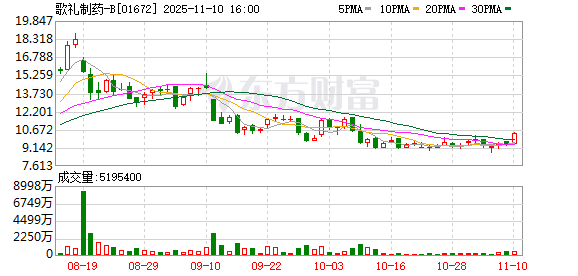
Core Insights - The article highlights the transformative journey of Gilead Sciences (1672.HK) in the Chinese biotech industry, showcasing its resilience and strategic decision-making in the face of challenges [2][11] - Gilead's shift towards a differentiated pipeline in weight loss drugs has led to a significant market re-evaluation and recovery in its stock price [4][9] Group 1: Company Development - Gilead Sciences was listed on the Hong Kong Stock Exchange in August 2018 at an initial price of 14 HKD, reaching a market capitalization of 16 billion HKD, but faced a decline due to setbacks in its core hepatitis C drug [3][4] - By August 2024, the company's stock price had plummeted to 0.76 HKD, resulting in a market value reduction of over 95% [3][4] - The founder, Dr. Wu Jinzi, demonstrated strategic foresight by pivoting the company's focus to the metabolic disease sector, particularly the weight loss drug market, starting in 2022 [3][5] Group 2: Strategic Shift and Market Response - Following the strategic shift, Gilead's stock price surged from 0.76 HKD in August 2024 to 18.75 HKD by August 2025, representing an increase of over 20 times and restoring its market capitalization to the billion HKD level [4][9] - The market's positive response reflects recognition of Gilead's research team's capabilities and strategic execution [4][9] Group 3: R&D and Competitive Advantage - Gilead has adopted a differentiated approach in drug development, focusing on oral small molecule GLP-1 receptor agonists and ultra-long-acting formulations, rather than following mainstream peptide drug development paths [5][8] - The core pipeline, ASC30, has shown promising clinical results, with a maximum weight reduction of 6.5% in U.S. Phase Ib trials, and is expected to complete Phase IIa trials by the end of the year [5][6] - Gilead is also developing ASC35 and ASC36, which are expected to provide significant advantages in terms of dosing frequency and efficacy compared to existing treatments [6][7] Group 4: Global Competitiveness and Valuation - Despite the stock price recovery, Gilead's current market capitalization is still considered undervalued compared to global peers, as evidenced by recent acquisition bids for similar companies [9][10] - Gilead's diverse pipeline, including multiple formulations with the potential for monthly and quarterly dosing, positions it favorably in the competitive landscape [9][10] Group 5: Lessons and Implications for the Industry - Gilead's successful transformation underscores the importance of strong R&D leadership and strategic vision in navigating industry challenges [11] - The case of Gilead serves as a valuable reference for other Chinese biotech companies seeking to innovate and compete on a global scale [11]

歌礼制药-B(01672)在2025年肥胖周(ObesityWeek®)报告 ASC30口服片 Ib期研究的完整分析、ASC30注射剂Ib期研究以及AS...
Zhi Tong Cai Jing· 2025-11-05 00:28
Core Insights - Company announced multiple reports at the 2025 ObesityWeek in Atlanta, Georgia, showcasing the efficacy and safety of its obesity treatment pipeline, including ASC30, ASC31, and ASC47 [1] Group 1: Clinical Research - The complete analysis of the ASC30 oral tablet in Phase Ib trials was presented [1] - A Phase Ib study of ASC30 as a monthly injection was also reported [1] - Preclinical studies on the combination of ASC31 and ASC47 were highlighted [1] Group 2: Technology and Development - The reports emphasize the promising efficacy and safety characteristics of the company's small molecules and peptides for obesity treatment [1] - The proprietary AI-assisted drug discovery platform (AISBDD) and ultra-long-acting drug development platform (ULAP) were validated through these studies [1] Group 3: Strategic Focus - The company is committed to advancing the clinical development of ASC30, ASC31, and ASC47 while engaging closely with strategic partners [1] - The goal is to better meet the treatment needs of obesity patients globally [1]