Option trading

Search documents
Option traders moderately bearish in Citi with shares down 1.7%
Yahoo Finance· 2026-02-25 15:35
Option traders moderately bearish in Citi (C), with shares down $1.89 near $108.86. Options volume roughly in line with average with 19k contracts traded and puts leading calls for a put/call ratio of 1.13, compared to a typical level near 1.05. Implied volatility (IV30) is higher by 0.2 points near 37.58, in the highest 10% of observations over the past year, suggesting an expected daily move of $2.58. Put-call skew flattened, suggesting a modestly bullish tone. Published first on TheFly – the ultimate ...

Webull Corp call volume above normal and directionally bullish
Yahoo Finance· 2026-02-07 15:25
Core Viewpoint - Bullish option flow has been detected in Webull (BULL) Corp, indicating strong investor interest and potential upward movement in the stock price [1] Group 1: Option Activity - A total of 33,070 call options were traded, which is 2 times the expected volume, suggesting heightened bullish sentiment [1] - The implied volatility increased by almost 4 points to 82.96%, reflecting increased uncertainty or potential price movement [1] - The most active options include May-26 12.5 calls and 2/6 weekly 6 calls, with total volume in these strikes nearing 13,200 contracts [1] Group 2: Market Indicators - The Put/Call Ratio stands at 0.13, indicating a strong preference for call options over put options among investors [1] - Earnings for Webull are expected to be announced on March 31st, which may further influence trading activity and stock performance [1]
Popular Cloud Stock Pick for 2026 Option Bears
Schaeffers Investment Research· 2026-01-30 18:18
Core Insights - Oracle Corp (NYSE:ORCL) has experienced a significant price movement, breaking through its December low and reaching 2024 highs, while also failing at its one-year volume point of control (VPOC) [1] - The stock closed below the put support at the 180-strike, indicating a potential delta hedge meltdown, with lower strikes at 160 and 152.5 likely to act as magnets [1] Options Activity - ORCL has a front-month gamma-weighted Schaeffer's open interest ratio (SOIR) of 1.15, suggesting a moderate level of options activity [3] - The Schaeffer's Volatility Scorecard (SVS) for ORCL is 99 out of 100, indicating that the stock has frequently exceeded option traders' volatility expectations over the past year [3] - A recommended March put option has a leverage ratio of 4.9, which means it will double in value with a 17.5% drop in the underlying equity [3]



Chip Stock Breaking Records as Director Snaps Up Shares
Schaeffers Investment Research· 2026-01-16 15:17
Core Insights - Micron Technology Inc's stock has reached a record high of $365.81, up 8.2%, following a significant share purchase by board member Mark Liu amounting to $7.8 million [1] - Barclays and Citigroup have raised their price targets for Micron, with Barclays increasing its target from $275 to $450 and Citigroup from $330 to $385, indicating potential for further price-target hikes as the current consensus target price of $326.94 represents a 9.5% discount to current levels [1] Stock Performance - The stock is on track for an eighth consecutive weekly gain, supported by the $320 level in the past week and bouncing off the rising 60-day moving average in November and December [2] - Year-over-year, Micron has shown a substantial increase of 247.4% [2] Options Market Sentiment - Options traders are currently leaning bearish, as indicated by a Schaeffer's put/call open interest ratio (SOIR) of 1.31, which is in the 97th percentile of its annual range, suggesting that unwinding of this pessimism could provide upward momentum for the stock [3] - The Schaeffer's Volatility Scorecard (SVS) for Micron is 88 out of 100, indicating that the stock has consistently experienced higher volatility than what its options have priced in [3] Trading Activity - In the first half of trading, there have been 190,000 calls and 178,000 puts traded, which is four times the intraday average volume, with the January 2026 360-strike call being the most popular option [4]


Why More Short Covering Could Be on the Horizon
Schaeffers Investment Research· 2026-01-12 13:45
Market Overview - The S&P 500 Index (SPX) has been experiencing range-bound trading, with a peak above prior highs before year-end, but the general sentiment remains that this pattern will continue into 2026 [1][2] - The SPX closed at 6,966.28, indicating a struggle to break through late October and early December highs [2] Job Market Impact - The job market's stability and the absence of negative surprises contributed to the SPX reaching a new closing high above 6,920, which was the late October intraday high [3] Short-Covering Dynamics - A significant factor in the market is the presence of short positions, with 83% of a list of 60 short-covering candidates rallying in 2026, averaging nearly 7% returns [4] - Traders holding short positions may delay covering until 2026 to realize profits and defer tax liabilities until 2027 [5] Technical Analysis - The technical backdrop for stocks may improve due to short covering, with potential for further covering as there is a rotation into lesser-known stocks outside the mega-cap technology sector [6] - The SPX is facing potential overhead resistance at the 7,000 level, which is significant both psychologically and in terms of options-related activity [18][15] Options Market Sentiment - The SPX component buy-to-open put/call volume ratio has decreased, indicating a return of optimism among option buyers, which could support stock prices [11] - The current market sentiment shows that traders are buying more put options than call options, creating a headwind for the SPX during the unwinding of optimism [9][10] Upcoming Events - The upcoming week includes significant events such as the start of earnings season for major financial companies, inflation data releases, and potential Supreme Court decisions regarding tariffs [14]

HOOD Option Trade Could Unlock a 49% Annualized Return
Yahoo Finance· 2026-01-05 12:00
Core Viewpoint - Robinhood Markets (HOOD) is transitioning from a trading app to a broader personal finance platform, with stock bouncing off support at the 110 level [1] Option Trade Strategy - The proposed trade involves selling a February 20 put option with a strike price of $105, trading around $5.55, and implementing a bear call spread by selling a call at $140 and buying a call at $145, with respective prices of $2.90 and $2.20 [2] - The total premium generated from the trades is approximately $625, combining the sold put and bear call spread [3] Trade Position and Scenarios - The initial position has a delta of 25, equating to owning 25 shares of HOOD stock, which will change as the trade progresses [4] - If HOOD stock remains between $105 and $140 at expiration, both options will expire worthless, resulting in a total profit of $625 [6] - If HOOD falls below $105, the sold put will be assigned, leading to a net cost basis of $98.75, which is 14.3% below the closing price on Friday [7] - If HOOD rises above $145, the bear call spread will incur a loss of $500, but the overall trade will still yield a profit of $125 due to the premium received [7] Earnings Risk - The trade carries earnings risk as Robinhood Markets is scheduled to report earnings on February 10th [8] Technical Opinion - The Barchart Technical Opinion rating for Robinhood Markets is an 8% Buy, indicating a weak short-term outlook for maintaining the current direction [9]

Hyatt Hotels Slashes Forecast on Hurricane Melissa Impact
Schaeffers Investment Research· 2025-12-31 15:27
Group 1 - Hyatt Hotels Corporation's stock is down 1.7% to $160.79 after the company lowered its full-year guidance due to damage from Hurricane Melissa, which affected seven properties and will lead to cancellations and closures until late 2026 [1] - The company maintains a 28.8% lead for the nine-month period and is projected to close 2025 with a modest 2.6% gain, but is currently facing a potential third consecutive loss [2] - Short interest in Hyatt has increased by 1.3%, with 6.14 million shares sold short, representing 14.3% of the equity's available float, indicating strong control by short sellers [3] Group 2 - Options traders are exhibiting a more pessimistic outlook, as indicated by a 50-day put/call volume of 1.37, which is higher than 97% of annual readings [3] - The security's Schaeffer's Volatility Index (SVI) is at 25%, placing it in the 4th percentile of its annual range, suggesting that near-term option traders are pricing in low volatility expectations [4]


Eli Lilly Stock in Focus After Slashing Cost of Popular Drug
Schaeffers Investment Research· 2025-12-01 15:56
Core Viewpoint - Eli Lilly and Co is experiencing a decline in share price following the announcement of price cuts for its weight loss drug Zepbound, which may impact investor sentiment and market performance [1][2]. Group 1: Price Changes - The prices for Zepbound's single-dose vials have been reduced to $299 for the 2.5 mg vial and $399 for the 5 mg vial, down from previous prices of $349 and $499 respectively [1]. - The new pricing will be available through the company's direct-to-consumer platform, LillyDirect [1]. Group 2: Stock Performance - Eli Lilly's shares are down 0.8%, trading at $1,066.96, marking the third consecutive daily loss and a pullback from last week's record high of $1,112 [1][2]. - Despite the recent decline, the stock has shown a 34% year-over-year increase, indicating strong long-term performance [2]. Group 3: Options Activity - There has been an increase in call options activity, with a call/put volume ratio of 2.23, ranking higher than 93% of readings from the past year [2]. - The Schaeffer's put/call open interest ratio (SOIR) stands at 0.70, indicating that short-term traders are placing bullish bets [3]. - Eli Lilly's Schaeffer's Volatility Index (SVI) is at 31%, suggesting that near-term option traders are anticipating relatively low volatility [3].


Bitcoin Play Strategy A Candidate For A Bearish Trade As Its Stock Price Sags
Investors· 2025-11-05 17:23
Core Viewpoint - The article discusses the bearish outlook for Strategy stock, particularly in the context of its performance relative to Bitcoin and the implementation of a bear call spread strategy to capitalize on potential declines in stock price [1][10]. Summary by Sections Stock Performance - Strategy stock has closed near its low for the day, remaining below its 21-day, 50-day, and 200-day moving averages, indicating a trend of heavy selling pressure [1]. - The relative strength line for Strategy has been declining since mid-July, suggesting ongoing weakness in the stock [1]. Options Strategy - A bear call spread is being considered for Strategy, which involves selling an out-of-the-money call and buying a further out-of-the-money call, with the expectation that the stock will struggle to rise above $315 by mid-December [2][4]. - The maximum profit from this strategy would be $70, with a maximum loss of $430, representing a potential return of 16.3% if the stock closes below $315 on December 19 [4][5]. Risk Management - The bear call spread is defined as a risk-defined strategy, allowing traders to know the worst-case scenario in advance [6]. - A stop loss could be set if Strategy trades above $305 or if the spread value increases from 70 cents to $1.40 [6]. Market Positioning - Investor's Business Daily rates Strategy stock with a Composite Rating of 37 out of 99, an Earnings Per Share Rating of 80, and a Relative Strength Rating of 12, indicating it ranks 48th in the Financial Services-Specialty industry group [7]. - The industry group itself ranks 36th out of 197 tracked by IBD, suggesting that winning stocks are typically found in the top 40 industry groups [7].

Pros & Cons of Leveraged ETFs When Selling Stock Options
Thebluecollarinvestor· 2025-10-18 01:29
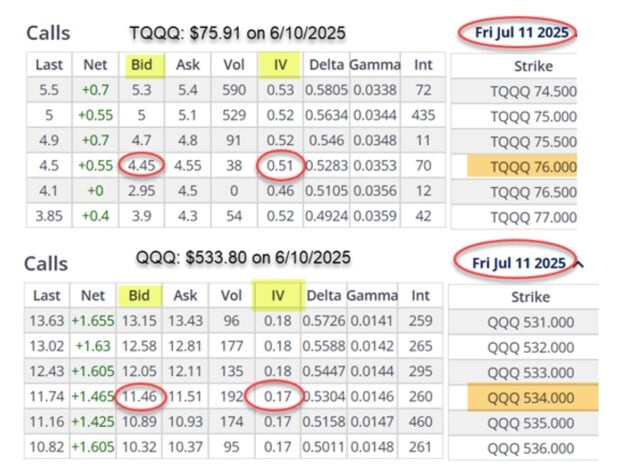
Core Insights - Retail investors are increasingly attracted to leveraged ETFs for enhanced returns when engaging in options strategies like covered calls and cash-secured puts [1][12] - Leveraged ETFs, such as ProShares UltraPro QQQ (TQQQ), aim to amplify the returns of an underlying index, typically by 2x or 3x [3][9] - The article highlights the significant differences in performance and risk between leveraged ETFs and traditional ETFs like Invesco QQQ Trust (QQQ) [6][10] Summary by Category Definition and Functionality - ETFs are securities that track an index or a basket of assets and trade like stocks, providing diversification similar to index funds [2] - Leveraged ETFs utilize financial derivatives to magnify returns, with TQQQ targeting 3x the daily performance of the Nasdaq 100 [3] Performance Comparison - TQQQ exhibits much greater price fluctuations compared to QQQ, leading to higher potential returns and risks [6][10] - Initial calculations show that TQQQ has an expected return of 5.86% over 32 days, annualized to 66.87%, while QQQ has a return of 2.09%, annualized to 23.86% [10][11] Implied Volatility - The implied volatility of TQQQ is significantly higher, at 51%, compared to QQQ's 17%, which aligns with the expected higher returns from leveraged ETFs [9] Investment Strategy Considerations - Leveraged ETFs may be suitable for investors seeking higher returns and willing to accept increased risk, but they may not be appropriate for those focused on capital preservation [12] - The article suggests that most retail investors should avoid leveraged ETFs when implementing low-risk strategies, although they may be applicable for higher-risk investors [12]