
基因疗法

Search documents
Did The FDA Make A Mistake? Sarepta's Elevidys Approval Under Scrutiny
Benzinga· 2025-06-25 18:06
Core Viewpoint - The FDA is investigating the risk of acute liver failure associated with Sarepta Therapeutics' Elevidys treatment, which has resulted in serious outcomes including hospitalization and death [1][2]. Group 1: FDA Investigation - The FDA has received two reports of fatal acute liver failure in non-ambulatory pediatric male patients with Duchenne Muscular Dystrophy (DMD) following treatment with Elevidys [2]. - The agency is evaluating the need for further regulatory action based on these reports [1]. Group 2: Patient Outcomes - In the reported cases, patients exhibited elevated transaminases and were hospitalized within two months after receiving Elevidys [3]. - Both fatalities appear to be directly related to the treatment with Elevidys [2]. Group 3: Analyst Reactions - HC Wainwright has reiterated a Sell rating for Sarepta, maintaining a price forecast of $10, citing the likelihood of the FDA requiring updated warnings regarding liver failure or death [4]. - The worst-case scenario for Sarepta would involve the FDA mandating the withdrawal of Elevidys from the U.S. market [4][5]. Group 4: Company Valuation - If Elevidys were to be withdrawn, analysts believe there would be little intrinsic value remaining in Sarepta [5]. - The skepticism from FDA officials regarding the initial approval of Elevidys suggests potential challenges for the company's continued marketing efforts [6]. Group 5: Stock Performance - Following the news, Sarepta's stock (SRPT) has seen a decline of approximately 9.96%, trading at $17.09 [6].



Krystal Biotech Announces First Patient Dosed in Phase 3 Clinical Trial of KB803 for the Treatment and Prevention of Corneal Abrasions in Patients with Dystrophic Epidermolysis Bullosa
Globenewswire· 2025-06-24 11:00
Core Viewpoint - Krystal Biotech, Inc. has initiated its Phase 3 clinical trial named "IOLITE" to evaluate KB803 for treating and preventing corneal abrasions in patients with dystrophic epidermolysis bullosa (DEB) [1][2] Group 1: Clinical Trial Details - IOLITE is a double-blind, multicenter, placebo-controlled study with a crossover design, focusing on KB803 administered as eye drops [4] - The trial will enroll approximately 16 subjects, with a primary endpoint measuring the change in average days per month with corneal abrasion symptoms while receiving KB803 versus placebo [5][6] - Patients must complete a 12-week run-in period in an ongoing natural history study before participating in IOLITE [4][5] Group 2: Patient Population and Disease Impact - Over 25% of DEB patients are believed to experience ocular complications, with more than 50% of patients suffering from the recessive form of DEB (RDEB) [2] - The estimated number of DEB patients in the U.S. exceeds 750, with over 2,000 affected globally [2] - Current management of DEB-related ocular complications is limited to supportive care and surgical interventions, with no corrective therapies available [2] Group 3: Previous Findings and Compassionate Use - A previous compassionate use case of KB803 demonstrated full corneal healing at three months and significant visual acuity improvement from hand motion to 20/25 by eight months [1][12] - The compassionate use case involved a patient with severe cicatrizing conjunctivitis secondary to DEB, treated with regular B-VEC administration [11][12] Group 4: Company Overview - Krystal Biotech, Inc. is a global biotechnology company focused on developing genetic medicines for diseases with high unmet medical needs [13] - The company’s first commercial product, VYJUVEK®, is the first-ever redosable gene therapy approved by the FDA and EMA for treating dystrophic epidermolysis bullosa [13]


做“足”功课,降低糖尿病并发症风险
Ke Ji Ri Bao· 2025-06-24 01:12
Core Viewpoint - The rising prevalence of diabetes in China is leading to an increase in diabetic foot complications, with innovative treatments showing promise for improving patient outcomes [1][4]. Group 1: Diabetes Prevalence and Complications - The International Diabetes Federation projects that the number of diabetes patients aged 20-79 in China will exceed 164 million by 2030 [1]. - Among diabetes patients over 50, the annual incidence of diabetic foot is 8.1%, with a total amputation rate of 19.3% [1][2]. Group 2: Mechanisms of Diabetic Foot Development - High blood sugar causes progressive damage to foot tissues through vascular, nerve, and immune system impairments [2]. - Long-term high blood sugar leads to vascular damage, resulting in atherosclerosis and reduced blood flow to the feet, which can cause ischemia and necrosis [3][4]. Group 3: Innovative Treatment Approaches - Recent advancements include gene-engineered stem cell technology achieving over 96% wound healing rates in diabetic foot ulcers within 14 days [1]. - Breakthroughs in treatment methods such as antibiotic bone cement, spinal cord stimulation, and vascular reconstruction are providing new avenues for clinical intervention [1][4]. - Stem cell therapy and gene therapy are emerging as promising methods for improving blood flow and healing in diabetic foot patients [4][5]. Group 4: Clinical Symptoms and Warning Signs - Symptoms such as coldness, numbness, and changes in skin color are indicators of potential diabetic foot complications [7][8]. - Patients should be vigilant for signs of ulcers, which often originate from minor injuries, and seek immediate medical attention if systemic symptoms like fever occur [8][9].
Analyst Downgrades Sarepta As Elevidys Safety Clouds Future Demand
Benzinga· 2025-06-20 18:10
Core Insights - Sarepta Therapeutics provided a safety update on Elevidys, the only approved gene therapy for Duchenne muscular dystrophy, following a second case of acute liver failure resulting in death [1] - Investor hesitancy is attributed to uncertainty regarding the number of non-ambulatory patients treated and their risk of developing acute liver failure [2] - Analyst Sami Corwin downgraded Sarepta from Outperform to Market Perform due to concerns over revenue estimates and competition from other gene therapies [2][3] Company Developments - The company is taking steps to strengthen the safety profile of Elevidys in non-ambulatory patients after the reported cases of acute liver failure [1] - There is a growing concern that the penetration of the non-ambulatory population may not meet previous peak revenue estimates, impacting future revenue potential [3] - Sarepta's stock price decreased by 3.18% to $20.11, reflecting investor concerns over the safety profile and revenue outlook [4] Market Context - The potential entry of other AAV gene therapies for Duchenne muscular dystrophy by 2027 could further impact Sarepta's peak revenue estimates [3] - Early clinical data from competitors suggests they may have a safer profile with fewer liver-related side effects, increasing competitive pressure on Sarepta [3] - Despite expected strong interest among commercial ambulatory patients, the uncertainty surrounding non-ambulatory patient treatment is seen as a deterrent for investors [4]

SRPT Stock: What's Happening With Sarepta Therapeutics?
Forbes· 2025-06-17 11:40
Core Insights - Sarepta Therapeutics experienced a significant stock decline of 42% following the announcement of a second patient death linked to its gene therapy, Elevidys, leading to the suspension of its use in non-ambulatory patients for safety reviews [2][3] - Roche's reassessment of the safety profile prompted the immediate cessation of commercial distribution and a pause in ongoing clinical trials until risk mitigation measures are established [3] - Elevidys, which accounted for 43% of Sarepta's total revenues last year, was projected to achieve peak sales exceeding $3 billion, but these expectations are now under threat due to the restricted patient population [5] Financial Overview - Sarepta's financial situation was already precarious, with an operating cash flow margin of negative 25% and a net income margin of negative 11%, despite average revenue growth exceeding 40% over the past three years [6] - The company carries $1.3 billion in debt against a market capitalization of $2.06 billion, resulting in a debt-to-equity ratio of 63% [6] - The stock has seen extreme volatility, dropping from a 52-week high of approximately $172 to around $20, highlighting the risks associated with reliance on a limited number of drug revenues [7] Investment Considerations - The recent safety concerns surrounding Elevidys, combined with the company's heavy reliance on a single revenue source and significant cash burn, create a highly speculative investment environment [8] - While Sarepta's low valuations may attract contrarian investors, the investment carries substantial risks, making it suitable only for those with a high risk tolerance [8] - Investors may consider diversified investment strategies, such as the Trefis High Quality Portfolio, which spreads risk across multiple companies and sectors, rather than concentrating on individual stocks [9][10]

三叶草生物与国光生技终止合作;市场监管总局指导查办一起医药领域重大典型垄断案件丨21健讯Daily
2 1 Shi Ji Jing Ji Bao Dao· 2025-06-17 00:57
Regulatory Developments - The National Medical Products Administration (NMPA) is seeking opinions on optimizing the review and approval process for innovative drug clinical trials, proposing a 30-day fast track for applications of traditional Chinese medicine, chemical drugs, and biological products classified as Category 1 innovative drugs [1] - The application must meet specific criteria, including being a key innovative drug supported by national policies, included in special programs for children's drugs or rare diseases, or part of global synchronized research [1] Company Announcements - Shanghai Aikobio announced that its new drug application for Aizhida (a combination capsule for ADHD) has been accepted by the NMPA and is included in the priority review process [1] - WuXi Biologics announced a placement of 82.94 million existing shares at HKD 26.60 per share, representing approximately 2.04% of its total issued share capital [2] - Jichuan Pharmaceutical disclosed that after a share transfer, Cao Fei and Cao Longxiang became the joint actual controllers of the company, holding a combined 56.07% of the total share capital [3] - Wuhan Dazhong Oral Medical Co., Ltd. has received IPO approval to list on the Hong Kong Stock Exchange, operating 92 dental clinics across Hubei and Hunan provinces [4][5] Market Dynamics - Three Leaf Clover Biotech announced the termination of its exclusive agreement with Guoguang Biotechnology due to significant market changes, ceasing the distribution of a seasonal flu vaccine in mainland China [6] - Sanofi has re-entered the flu vaccine market after receiving approval for its quadrivalent flu vaccine for the 2025-2026 season, following a previous suspension due to efficacy issues [6] - Zhejiang Province's government procurement center announced the results for flu vaccine procurement, with prices as low as 6 CNY per dose, marking a new low for flu vaccine bids [6] Safety Concerns - Sarepta Therapeutics reported a second death related to its DMD gene therapy Elevidys, leading to a suspension of the drug's supply for non-ambulatory patients [7] Regulatory Actions - The State Administration for Market Regulation imposed a total fine of 362 million CNY on several pharmaceutical companies for engaging in price-fixing agreements [8]
Ocugen, Inc. Announces U.S. FDA Clearance of Investigational New Drug Amendment to Initiate Phase 2/3 Pivotal Confirmatory Clinical Trial of OCU410ST—Modifier Gene Therapy Candidate for Stargardt Disease
Globenewswire· 2025-06-16 11:02
Core Viewpoint - Ocugen, Inc. has received FDA clearance to initiate a Phase 2/3 pivotal confirmatory trial for OCU410ST, a gene therapy candidate for Stargardt disease, highlighting the urgency for treatment options for patients with this condition [1][2]. Company Overview - Ocugen, Inc. is a biotechnology company focused on developing gene therapies for blindness diseases, utilizing a unique modifier gene therapy platform [10]. Clinical Trial Details - The Phase 2/3 trial will enroll 51 participants with Stargardt disease, with 34 receiving a subretinal injection of OCU410ST and 17 in a control group [3]. - The primary objective is to evaluate the reduction in atrophic lesion size, with secondary endpoints including improvements in best corrected visual acuity (BCVA) and low luminance visual acuity (LLVA) [3]. Regulatory Designations - OCU410ST has received Rare Pediatric Disease Designation (RPDD) and Orphan Drug Designation from the FDA, emphasizing the need for innovative treatments for ABCA4-associated retinopathies [1][4]. Patient Population - Approximately 100,000 patients in the U.S. and Europe, and 1 million globally, are affected by Stargardt disease, which is characterized by complex genetic mutations [4]. Clinical Data - Positive results from the Phase 1 GARDian trial indicated a 48% slower lesion growth at 12 months in treated eyes compared to untreated eyes, and a statistically significant improvement in visual function [6][7]. Future Plans - Ocugen plans to submit a Biologics License Application (BLA) for OCU410ST in 2027, aiming to file three BLAs over the next three years [5].
Krystal(KRYS) - 2025 FY - Earnings Call Transcript
2025-06-10 19:00
Financial Data and Key Metrics Changes - The company reported a compliance rate of 83% for VYJOVAC, which is significantly higher than the initially expected 50% compliance rate [4][10] - The management expressed strong conviction in the total market opportunity, indicating that the addressable population could be larger than previously estimated [30] Business Line Data and Key Metrics Changes - The company is focusing on expanding its sales force from 17 representatives to potentially 50-75% more to enhance market penetration [11] - The management noted that the ratio of RDEB to DDEP patients in the study is currently 70:30, which may affect future compliance rates as the distribution equalizes [4] Market Data and Key Metrics Changes - The company is preparing for a launch in Europe, specifically in France and Germany, with expectations to launch VIGEFEC in Q3 [31][32] - The management highlighted that the European market may take longer to reach a 50% compliance rate compared to the U.S. due to different regulatory environments [32] Company Strategy and Development Direction - The company is actively working to strengthen its commercial team in the U.S. to accelerate the capture of market opportunities [5] - There is a focus on caregiver self-administration in the U.S. market, which is expected to enhance compliance and utilization rates [21][22] Management's Comments on Operating Environment and Future Outlook - Management views pauses in treatment as a positive indicator for VYJOVAC, as they lead to long-term patient engagement and better outcomes [13][14] - The company is optimistic about the market opportunity in the U.S., with a target of addressing 1,200 patients, and believes that the potential could extend to an additional 1,800 patients over time [30] Other Important Information - The company is conducting human factor studies to support the label change for caregiver self-administration in the U.S. [19] - The management is confident in the safety and efficacy of their products, with no significant safety concerns reported from patients [27] Q&A Session Summary Question: What is the current compliance rate for VYJOVAC? - The compliance rate is currently at 83%, which is higher than the expected 50% [4] Question: How is the company addressing the sales force expansion? - The company plans to increase the sales force by 50-75% to improve market penetration [11] Question: What are the expectations for the European launch? - The company is looking to launch in Q3 and is currently working on administrative preparations [31][32] Question: How does the management view treatment pauses? - Pauses are seen as beneficial, indicating complete wound healing and leading to long-term patient engagement [13][14] Question: What is the addressable patient population in the U.S.? - The management is confident in addressing 1,200 patients, with potential for an additional 1,800 patients over time [30]
股价跌超60%!Rocket基因疗法致患者死亡,FDA紧急叫停
Ge Long Hui· 2025-05-28 02:33
Core Viewpoint - The FDA has paused Rocket Pharma's critical Phase 2 clinical trial for its gene therapy RP-A501 targeting Danon disease due to a serious adverse event resulting in a patient's death [1][2][3]. Group 1: Clinical Trial Impact - A serious adverse event occurred during the Phase 2 trial, leading to the death of a patient from complications related to capillary leak syndrome [2]. - The FDA issued a clinical hold on May 23, requiring further investigation into the cause of the event [2]. - Rocket Pharma is collaborating with the FDA, independent data safety monitoring boards, and clinical researchers to ensure patient safety and aims to resume the trial as soon as possible [5]. Group 2: Financial and Market Reaction - Following the announcement, Rocket's stock price plummeted over 62% in a single day, marking an over 80% decline year-to-date [3]. - Analysts estimate Rocket's quarterly cash burn to be between $40 million to $50 million, with the clinical hold expected to pressure the company's financial situation [7]. - As of the end of Q1, Rocket reported cash and cash equivalents totaling $318.2 million, which is projected to sustain operations until 2027, excluding potential revenues from expedited review vouchers for certain therapies [7]. Group 3: Industry Context - Other companies in the industry have also faced patient deaths in clinical trials, raising concerns about the long-term impact on gene therapy investments [6][7]. - Jefferies analysts suggest that the recent death has damaged the risk-benefit profile of the Danon project, while BMO Capital Markets remains optimistic about the potential efficacy of RP-A501 given the poor prognosis of Danon disease patients [7].
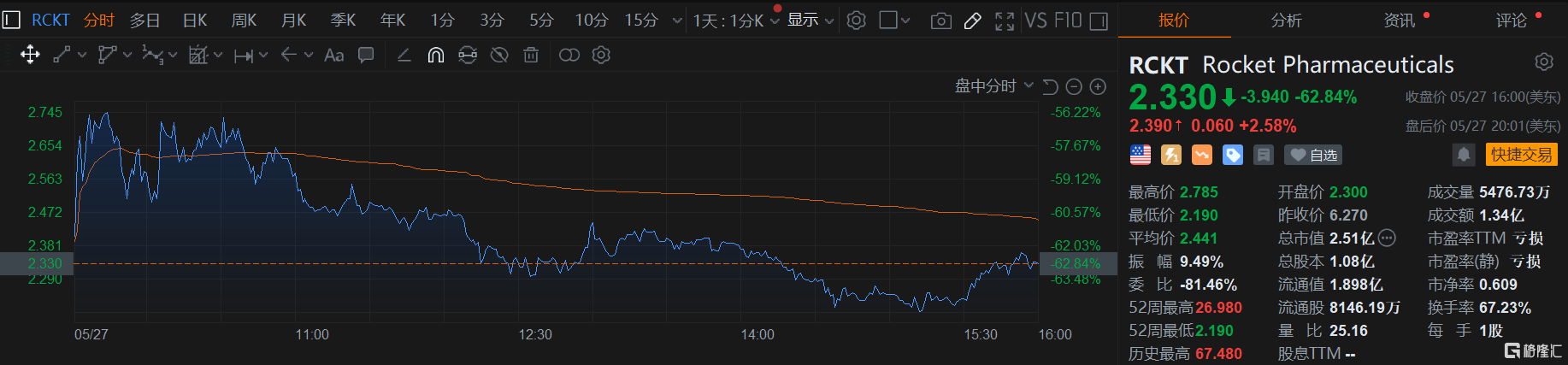
5月28日电,被FDA叫停基因疗法试验,Rocket Pharma股价盘中暴跌逾60%。
news flash· 2025-05-27 19:31
Group 1 - The core point of the article is that Rocket Pharma's gene therapy trial has been halted by the FDA, leading to a significant drop in the company's stock price, which fell over 60% during intraday trading [1] Group 2 - The FDA's decision to stop the gene therapy trial indicates potential regulatory challenges for the biotechnology sector, particularly for companies involved in similar research and development [1] - The sharp decline in Rocket Pharma's stock price reflects investor concerns regarding the viability of its gene therapy programs and the overall market sentiment towards biotech stocks following regulatory setbacks [1] - This incident may prompt other companies in the industry to reassess their clinical trial strategies and regulatory compliance measures to avoid similar outcomes [1]