
GDP Growth

Search documents
I’m a Financial Planner: 5 Wealth Strategies for Retirees in Today’s Economy
Yahoo Finance· 2025-10-17 14:54
Economic Overview - The U.S. economy presents a mixed picture with stock markets reaching all-time highs and better-than-expected GDP growth in Q2, but hiring has slowed and inflation remains above the Federal Reserve's target [1] Retirement Strategies - Retirees are advised to balance growth and safety in their portfolios, maintaining a significant portion in growth investments to combat inflation while holding safe assets for short-term expenses [4] - A long-term perspective is crucial for retirees, as current economic trends should not dictate money management decisions [5] - A flexible withdrawal strategy is recommended to adapt to persistent inflation, moving away from static rules like the 4% rule [7]
IYT: 3% GDP Growth Not Good Enough, Uber Now The Top Transports Holding
Seeking Alpha· 2025-10-16 01:37
Economic Overview - The US economy is experiencing robust growth, with online prediction markets indicating a projected Q3 GDP growth rate of 3.3%, suggesting an acceleration in economic expansion [1] Analyst Insights - The article emphasizes the importance of evidence-based narratives and the use of empirical data to support financial analysis, highlighting the role of charts in simplifying complex financial stories [1]


IEFA: International Stocks To Benefit From Higher GDP Growth In 2026
Seeking Alpha· 2025-10-13 18:21
Group 1 - The individual began investing in high school in 2011, focusing on REITs, preferred stocks, and high-yield bonds, indicating a long-standing interest in markets and the economy [1] - Recently, the investment strategy has evolved to combine long stock positions with covered calls and cash secured puts, reflecting a more sophisticated approach to investing [1] - The investment philosophy is fundamentally long-term, with a primary focus on REITs and financials, while occasionally exploring ETFs and other stocks based on macro trade ideas [1]

X @Bloomberg
Bloomberg· 2025-10-11 10:46
This year alone, the Southeast Asian nation’s stock market has soared, its GDP growth is beating almost all estimates and it’s even managed a trade deal of sorts with the mercurial US president https://t.co/OWatQCRWi8 ...
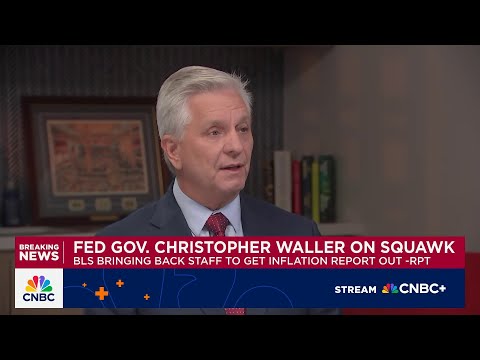
Fed Governor Chris Waller: Still believe we need to cut rates, but need to be 'cautious about it'
CNBC Television· 2025-10-10 12:18
Monetary Policy & Economic Data - The Fed is closely monitoring private sector data to compensate for potential government data delays, but acknowledges it may not be fully representative [4][5] - The Fed considers the labor market weakness as a key factor in policy decisions, with concerns about negative job growth [6][7] - The Fed acknowledges the importance of CPI data for assessing inflation, especially regarding colleagues' concerns [10][11] - The Fed views tariff effects as one-off events and focuses more on the labor market when setting policy [12][14] Labor Market Assessment - The labor market is considered weak, with negative job growth and a lack of hiring plans reported anecdotally [6][7][8] - There is no evidence of a tight labor market, with no wage increases or rising vacancies [15][16] Inflation & Tariffs - Tariff effects are seen as one-time price increases, not causing persistent inflation, consistent with central bank's long-standing view [12][13] - Businesses are passing tariffs through to higher-income consumers but not to lower-income consumers [18][19] - There's an estimated 40% pass-through of tariffs to prices, showing a correlation between tariff size and price changes [19] Future Policy Direction - The Fed is leaning towards cutting rates but cautiously, considering the divergence between a weak labor market and strong GDP growth (close to 4%) [20][22] - The Fed prefers a gradual approach to rate cuts (quarter point) to allow for adjustments based on incoming data [23] Private Credit Market - The Fed does not view the private credit market as a significant systemic risk due to the substantial equity positions involved [24][25]
亚洲新兴市场股票策略 - 大幅估值重估或难持续-Asia EM Equity Strategy-Major valuation re-rating may not be sustainable
2025-10-09 02:00
Summary of Key Points from the Conference Call Industry Overview - The report focuses on the Asia/EM (Emerging Markets) equity strategy, highlighting the current market conditions and future outlook for the region [2][4]. Core Insights - The recent rally in Asia/EM markets is primarily attributed to multiple expansions rather than earnings growth, raising concerns about sustainability [2][10]. - For the rally to continue into 2026, a significant reacceleration in global GDP growth and earnings estimates is necessary [4][14]. - Current downside risks for major Asia/EM indices range from 6% to 13%, while upside potential is limited to 1% to 8% [7][8]. - The 12-month forward P/E multiples have increased by 3.0 to 3.6 points since early April, returning to levels last seen in 2021, which are 1.0 to 1.8 standard deviations above the 10-year averages [11][12]. Earnings and Economic Outlook - Earnings estimate revisions have been flat to down since April, contrasting with the positive revisions seen in the US market [7][14]. - The economic team expresses concerns about growth risks, particularly in trade-dependent economies, with moderate deceleration expected in forward EPS for major markets [14][15]. - The report indicates resilience in domestic demand sectors like Financials and Consumer, while global cyclicals such as Energy and Materials are expected to face weakness [15]. Market Sentiment and Flows - There is a noted gap of approximately 10% between current index levels and base case targets, with markets nearing bull case targets [8][34]. - Sentiment indicators show complacency but not extreme euphoria, with inflows into EM equities increasing from 2 out of 10 weeks at the market trough in April to 8 out of 10 weeks recently [34][36]. Sector Performance - Emerging Markets (EM) equities are characterized as low-quality cyclicals, with historical performance showing sudden bursts of investor interest followed by disappointment [18]. - The report suggests a preference for Financials and domestic Consumer plays over traditional cyclicals like Energy and Materials, which are currently underweighted [25][30]. Conclusion - The report emphasizes the need for cautious optimism regarding the sustainability of the current market rally, highlighting the importance of economic growth and earnings recovery for future performance [2][4][18].
Without data centers, GDP growth was 0.1% in the first half of 2025, Harvard economist says
Yahoo Finance· 2025-10-07 17:15
Group 1 - U.S. GDP growth in the first half of 2025 was primarily driven by investment in data centers and information processing technology, with a mere 0.1% growth when excluding these sectors [1][2] - The dollar value contributed to GDP growth by AI data-center buildout surpassed U.S. consumer spending for the first time, highlighting the significance of technology investment [2] - Investment in information-processing equipment and software constituted only 4% of U.S. GDP but accounted for 92% of GDP growth in the first half of 2025, indicating a disproportionate impact on economic expansion [3] Group 2 - Major tech companies like Microsoft, Google, Amazon, Meta, and Nvidia have invested tens of billions into data centers to meet the rising demand for AI and large language models [4] - Hyperscaler capital expenditures on data centers have increased fourfold, approaching $400 billion annually, with the top 10 spenders responsible for nearly a third of this spending [5] - Data center-linked spending is estimated to be adding approximately 100 basis points to U.S. real GDP growth, underscoring its economic significance [5] Group 3 - The surge in technology-led growth occurs amidst broader economic sluggishness, with job creation slowing and concerns that the economy could have faced recession without technology investment [5]




Dollar Climbs on Hawkish Fed Comments
Yahoo Finance· 2025-10-07 14:32
Group 1: Dollar Index and Economic Commentary - The dollar index (DXY00) has increased by +0.40%, reaching a 1.5-week high, driven by hawkish comments from Kansas City Fed President Jeff Schmid regarding the need to combat persistent inflation [1][3] - Political uncertainty in France and Japan is negatively impacting the euro and yen, thereby benefiting the dollar [1] - The ongoing US government shutdown, now in its second week, poses a bearish outlook for the dollar, with potential stagnation in GDP growth if the shutdown continues [2] Group 2: Eurozone Economic Indicators - The EUR/USD pair has decreased by -0.42%, remaining just above a 1.5-week low, influenced by signs of weakness in the Eurozone economy, particularly following a decline in German factory orders [4] - German factory orders for August unexpectedly fell by -0.8% month-over-month, contrasting with expectations of a +1.2% increase [5] - Market expectations for a rate cut by the European Central Bank (ECB) are minimal, with only a 1% chance of a -25 basis point cut at the upcoming policy meeting [5] Group 3: Japanese Yen Performance - The USD/JPY pair has risen by +0.44%, with the yen hitting a 6.25-month low against the dollar, primarily due to concerns over the election of Sanae Takaichi as the leader of Japan's ruling party [6] - Takaichi's election raises doubts about the Bank of Japan's (BOJ) timeline for policy tightening and increases concerns regarding a potential rise in debt supply due to her support for expanded financial stimulus [6]
Not all market bubbles — or crashes — are the same
Yahoo Finance· 2025-10-05 20:51
Market Timing and Historical Context - The difficulty of timing the market is highlighted, emphasizing the need to exit and re-enter at the right times, which is challenging [1] - Historical stock market crashes illustrate the unpredictability of stocks in the near term, making market timing a risky endeavor [2] - The S&P 500 index's performance during the dot-com bubble and subsequent crash serves as a reminder of the potential for significant losses [3][4] Labor Market Insights - Private sector job losses were reported, with a decline of 32,000 jobs in September, primarily in small and mid-sized businesses [9] - Hiring intentions have weakened, with the lowest job addition plans for September since 2011, indicating a cooling labor market [10] - Job openings increased slightly to 7.23 million in August, suggesting ongoing demand for labor despite a cooling market [11] Consumer Confidence and Spending - Consumer confidence has decreased, with a notable drop in perceptions of job availability, reflecting a cooling labor market [14][15] - Despite weak consumer sentiment, consumer spending data remains strong, indicating a disconnect between sentiment and actual spending behavior [24] Economic Growth and Market Outlook - The long-term outlook for the stock market remains positive, driven by expectations of earnings growth [21] - While demand for goods and services is still positive, economic growth has normalized from previous high levels [23] - The U.S. stock market may outperform the economy in the near term due to companies adjusting cost structures and achieving positive operating leverage [25]