Interest rates

Search documents
BHK: Poor Earnings Lead To Weak Dividend Coverage
Seeking Alpha· 2026-01-23 14:48
Core Viewpoint - The article discusses the investment outlook for BlackRock Core Bond Trust (BHK), noting a previous hold rating due to high interest rates, which have since been cut multiple times, potentially improving the investment outlook [1]. Investment Strategy - The company emphasizes a hybrid investment strategy that combines classic dividend growth stocks with Business Development Companies, REITs, and Closed End Funds to enhance investment income while achieving total returns comparable to traditional index funds like the S&P [1].


Stock Market Today, Jan. 22: Markets Surge Again Today After Greenland Tariffs Are Dropped
Yahoo Finance· 2026-01-22 23:12
Market Overview - The S&P 500 rose 0.54% to 6,912.54, the Nasdaq Composite gained 0.91% to 23,436.02, and the Dow Jones Industrial Average added 0.63% to 49,384.00 as tariff fears eased and risk appetite firmed [1] Market Movers - FuelCell Energy and Enphase Energy jumped 6.10% and 12.54%, respectively, due to relief over scrapped Greenland-linked tariffs, while strength in Meta Platforms and a rebound in Tesla helped extend the Nasdaq's tech-led advance [2] Investor Implications - President Trump's agreement on a framework for a deal related to Greenland and U.S. security contributed to stock market gains, with new European tariffs temporarily off the table, prompting investors to re-enter equities [3] - November personal consumption expenditures (PCE) data showed tame inflation readings, which could support lower interest rates [3] Clean Energy Sector - Clean energy stocks performed strongly as the relief on new tariffs removed a significant overhang, although caution is advised as many renewable energy companies still face challenges from a U.S. administration that has opposed the sector at times [4] - Long-term investors are encouraged to maintain their positions and not react to short-term market fluctuations driven by headlines [4]
Inflation Slowed Before Rising In November, Delayed Data Shows
Forbes· 2026-01-22 15:50
Core Insights - Inflation improved in October 2025, with annual inflation at 2.7%, before rising to 2.8% in November, aligning with Wall Street's expectations [1][2] - The Federal Reserve's preferred inflation measure, the core PCE price index, showed a similar trend, with core PCE at 2.8% for September and matching estimates for October and November [2] Economic Indicators - The Federal Reserve is expected to conclude its policymaking meeting on January 28, with only a 5% chance of interest rate cuts in the upcoming vote, following a reduction to between 3.5% and 3.75% in December [3] - Fed Chair Jerome Powell indicated a likely pause on further cuts, emphasizing a "wait and see" approach regarding economic developments [3] Contextual Background - President Donald Trump claimed significant cooling of inflation, stating there was "virtually no inflation" and that he had "defeated" inflation over the past year [4] - The Federal Reserve aims for a 2% annual inflation rate, which has been exceeded for 57 consecutive months, raising concerns about the labor market and the impact of high inflation on lower- and middle-income Americans [4]
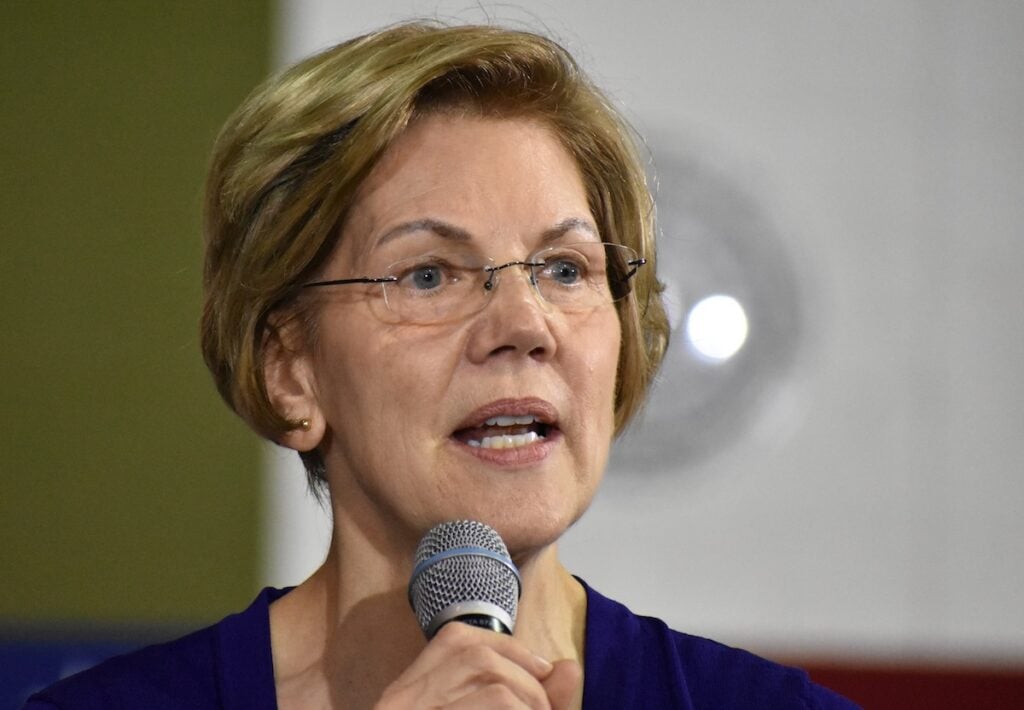
Elizabeth Warren Slams Scott Bessent: 'Huge Deal' If The World Stops Buying US Treasuries — Americans Will Pay Higher Interest Rates On Mortgages
Benzinga· 2026-01-22 02:51
Core Viewpoint - Senator Elizabeth Warren criticized Treasury Secretary Scott Bessent for minimizing the risks associated with declining global demand for U.S. Treasuries, emphasizing that this could lead to higher interest rates for consumers [2][4]. Group 1: Treasury Demand Concerns - The Danish pension fund, AkademikerPension, announced its decision to divest from U.S. Treasuries due to concerns over "poor U.S. government finances" and plans to invest in alternatives like cash and short-dated agency debt [4]. - Foreign governments now hold only 15% of U.S. Treasuries, a significant decrease from 40% in the 2010s, indicating a changing profile of U.S. government debt holders [4][5]. - For the first time in nearly three decades, foreign central banks held more gold than U.S. Treasuries, marking a notable shift in the global financial landscape [5]. Group 2: Market Reactions - The iShares Treasury Bond ETF (BATS: GOVT), which tracks U.S. Treasury bonds, saw a slight increase of 0.22% on Wednesday, closing at $23.00, although it has an unfavorable price trend in the short, medium, and long terms [6].
Tesla Stock to $600 or $300? Here’s What’s Most Likely to Happen in 2026
Yahoo Finance· 2026-01-20 13:40
Core Viewpoint - Tesla's stock has shown resilience despite slowing sales growth and declining profits, with shareholders remaining supportive as long as Elon Musk continues to make promises [2][3]. Group 1: Business Performance - Sales growth for Tesla has significantly slowed, and profits are declining, yet the stock has rallied for nearly two years [3][8]. - Analysts project Tesla's revenue growth to be just over 13% in 2026, following a 3% decline in 2025 [7][8]. Group 2: Market Conditions - Interest rates are decreasing, which could positively impact demand for electric vehicles, as lower rates make financing cheaper [5]. - However, government support for electric vehicles has diminished, with the absence of EV tax credits and a decline in popularity for renewables [6]. Group 3: Future Outlook - The future of Tesla's stock in 2026 is uncertain, with potential for either continued growth or a significant correction [3][4]. - Analysts expect that even with slight decreases in interest rates, the overall negative factors may not be fully offset, leading to low growth expectations through 2026 [7].

Stock Index Futures Plunge After Trump’s Tariff Threats on Europe Over Greenland
Yahoo Finance· 2026-01-20 11:29
Market Overview - Wall Street's major equity averages closed slightly lower, with power suppliers like Talen Energy (TLN) and Constellation Energy (CEG) leading the declines, dropping over -11% and -9% respectively [1] - Mosaic (MOS) fell over -4% after weak preliminary Q4 results, while J.B. Hunt Transport Services (JBHT) reported weaker-than-expected Q4 revenue, leading to a decline of more than -1% [1] - On a positive note, Micron Technology (MU) rose over +7% after a director purchased approximately $7.8 million worth of shares [1] Economic Data - U.S. industrial production rose +0.4% month-over-month in December, exceeding expectations of +0.1%, while manufacturing production unexpectedly increased by +0.2% against an expected decline of -0.2% [6] - The upcoming U.S. core personal consumption expenditures (PCE) price index, a key inflation gauge, is highly anticipated, especially since it was delayed due to a government shutdown [9] Corporate Earnings - The fourth-quarter corporate earnings season is heating up, with major companies like Netflix (NFLX), Intel (INTC), and Johnson & Johnson (JNJ) expected to report. S&P 500 companies are projected to see an average earnings increase of +8.4% for Q4 compared to the previous year [11] International Developments - European equities faced downgrades to Neutral by Citi strategists due to renewed transatlantic tensions, particularly related to President Trump's tariff threats against European nations opposing his Greenland acquisition bid [14] - In Japan, concerns over public finances are affecting market sentiment, with long-term government bond yields reaching record highs amid speculation about potential consumption tax cuts [19]
Week Ahead: Trade War Risks Are Back—and Markets Are Pricing Them In
Investing· 2026-01-20 08:47
Core Viewpoint - US stock futures declined significantly due to renewed trade tensions between the US and Europe, particularly regarding tariffs related to Greenland, ahead of the earnings season [2][3]. Economic Data and Earnings Calendar - Trump's upcoming speech at Davos is expected to focus on housing affordability, proposing measures such as banning large institutional homebuyers and directing Fannie Mae and Freddie Mac to purchase more mortgage bonds to reduce borrowing costs [5]. - Delayed PCE inflation data for October and November will be released on Thursday, providing the Federal Reserve with crucial insights on price pressures before their policy meeting [5]. - The Supreme Court is set to hear arguments regarding Fed Governor Lisa Cook's challenge against President Trump's attempt to remove her, which could impact the central bank's independence [6]. Market Reactions - Asian stocks fell, and US futures dropped by approximately 1% as trade-war fears affected market sentiment [8]. - The MSCI Asia Pacific Index decreased by 0.5%, with most sectors experiencing losses, while futures indicated further declines for US and European equities [8]. - Citigroup downgraded European equities to neutral due to escalating US-EU tensions and tariff uncertainties affecting earnings, while upgrading Japan to overweight and favoring emerging markets for better risk-reward [8]. Commodity and Currency Movements - The dollar remained under pressure, with 10-year US Treasury yields reaching a four-month high of approximately 4.27% [8]. - Gold prices hit a record high of $4,701.23 per ounce, reflecting a more than 70% increase since the beginning of Trump's second term [8]. - Oil prices remained steady as traders assessed the implications of US efforts to control Greenland and the potential for escalating US-EU trade tensions [8]. Earnings Reports - Netflix is expected to report Q4 results with an EPS of $0.55 (up 28% year-over-year) and revenue of $11.97 billion (up 17%), driven by popular content [10]. - 3M Company is projected to show only single-digit sales and EPS growth for 2026, with JPMorgan maintaining a neutral rating [11]. - United Airlines anticipates a third consecutive earnings decline with around 3% sales growth, while Goldman Sachs has reiterated a buy rating [11]. - Charles Schwab is expected to report a 22% increase in revenue and a 50% increase in earnings for the full year [12].

⚠️ BITCOIN 2026 BULL & BEAR CASE PREDICTION
Altcoin Daily· 2026-01-19 20:38
I actually think Bitcoin makes a new all-time high in 2026 and the four-year cycle will be officially invalidated. However, three things before we can move forward. Number one, Fed shakeup and that creates a lot of uncertainty.Although the person they put in afterwards will be bullish for an easing cycle for the markets. Number two, government shutdown. Unfortunately, the government's only open again until I think January 31st in which they will have to talk about reopening the government again.Also, Suprem ...

Best CD rates today, January 19, 2026 (Lock in up to 4% APY)
Yahoo Finance· 2026-01-19 11:00
Core Insights - Today's CD rates are significantly higher than the national average, influenced by the Federal Reserve's interest rate cuts in 2025, which may present a final opportunity to secure these elevated rates with certificates of deposit [1] Group 1: Best CD Rates - As of January 19, 2026, the highest CD rate available is 4% APY, offered by Marcus by Goldman Sachs for a 1-year CD [2] - The competitive nature of CD rates is evident, with various financial institutions providing attractive offers [2] Group 2: National Average CD Rates - The national average CD rate for a 1-year term is currently at 1.63%, which is considerably lower than the best available rates [3] - The current average CD rates are among the highest seen in nearly two decades, primarily due to the Federal Reserve's strategy to combat inflation by maintaining elevated interest rates [3] Group 3: Finding the Best CD Rates - To secure the best CD rates, it is advisable to shop around and compare rates from multiple financial institutions [4] - Online banks typically offer more competitive rates due to lower overhead costs, making them a preferred option for consumers [4] - It is essential to check minimum deposit requirements and review account terms, including early withdrawal penalties and auto-renewal policies, to ensure alignment with financial goals [4]
Polymarket Says There’s a 4% Chance Powell Gets Out of the Fed
Bankless· 2026-01-16 19:43
So the question is what's the probability that Powell [music] gets tossed out still on poly market the probability by the end of March is 4% and the probability by May 14th is 8%. This has not moved all that much. Maybe the market has already priced this in.Actually, David, the best take I read on some of the things happening with Trump, this Fed prosecution, also Venezuela came [music] from Noah Smith this week. You know, economist Noah Smith, he's got a great one. His whole thing was Trump is actually doi ...