Tariffs

Search documents
CNH Industrial N.V.(CNH) - 2025 Q3 - Earnings Call Transcript
2025-11-07 17:30
Financial Data and Key Metrics Changes - Consolidated revenues for Q3 2025 were down 5% at $4.4 billion, with global ag segment sales down 11% and North America down 29% [9][10] - Industrial adjusted EBIT was $104 million, down 69% year over year, reflecting lower industry demands and tariffs [10][16] - Adjusted net income decreased to $109 million, with adjusted EPS for the quarter at $0.08, down from $0.24 [10][16] Business Line Data and Key Metrics Changes - Agriculture Q3 net sales were just under $3 billion, down 10% year over year, primarily due to a 29% decrease in North America [17] - Construction third quarter net sales were $739 million, up 8% year over year, driven by higher sales in North America and EMEA [20] - Adjusted gross margin for agriculture was 20.6%, down from 22.7% in Q3 2024, affected by lower volumes and tariff costs [17][18] Market Data and Key Metrics Changes - North America experienced a 29% decline in agriculture sales, while EMEA saw a 16% increase, particularly in tractors [9][17] - Conditions in South America remain challenging, with geopolitical and market circumstances impacting farmers [5][6] - The overall industry retail demand is expected to be down around 10% from 2024, with construction volumes expected to decline about 5% [27][28] Company Strategy and Development Direction - The company is focused on five strategic pillars: expanding product leadership, advancing iron and tech integration, driving commercial excellence, operational excellence, and quality as a mindset [10][18] - The company is transforming its global supply chain and dealer network to mitigate risks from market volatility [4][6] - Upcoming product launches at Agritechnica are aimed at filling market gaps and gaining ground in EMEA [9][11] Management's Comments on Operating Environment and Future Outlook - Management noted that market fundamentals remain uncertain and challenging for farmers, particularly in North America and South America [5][6] - The company expects to navigate near-term challenges while investing in business improvements and preparing for future product launches [6][7] - The outlook for 2026 anticipates flat to slightly down global industry retail demand compared to 2025 [31][32] Other Important Information - The company has reduced quality costs by over $60 million year to date, reflecting improvements in operational efficiency [15] - The company repurchased $50 million worth of stock at an average price of $11.25 per share during Q3 [24] - The company is maintaining a focus on margin improvement initiatives despite the current trade environment [33] Q&A Session Summary Question: Can you elaborate on the decremental margin on the volume mix? - The decremental margin was primarily driven by the 29% decline in North America, with EMEA up 16% [35] Question: What is the impact of SG&A on the margin? - SG&A increased due to higher variable compensation accruals, contributing to the margin decline [36] Question: Can you unpack the product cost changes? - Product costs were favorable by $33 million year over year, despite $44 million in tariff costs [38] Question: How much of the tariff cost is tied to different tariff categories? - About 20% of the tariff costs are from Section 232, with no reliance on potential relief from the Supreme Court [43] Question: What gives confidence in achieving desired dealer levels in three to four months? - The company expects to achieve a $1 billion inventory reduction by year-end, allowing for increased production in 2026 [41]

Citi CEO: 'The U.S. economy continues to defy the tariff doomsdayers'
CNBC Television· 2025-11-07 17:21
Economic Growth & Resilience - US economy defies tariff doomsday predictions, showing continued growth [1] - AI infrastructure is contributing to economic growth [1] - Corporate balance sheets are healthy, providing resilience and investment power [1] - American companies' investments are powering economic growth [1] Potential Risks & Softening - Potential risks include labor market drops, tariffs passed to consumers, and asset valuation adjustments [2] - Expectation of a period of economic softening [2] Overall Outlook - Reasonably positive outlook for the economy, expecting around 26 (likely referring to a specific economic indicator, but without context, the unit is unclear) [2] - US economy demonstrates resilience and strength compared to other regions [2]


How Trump’s Tariffs Are Crushing Small Businesses While Big Retailers Thrive
CNBC· 2025-11-07 17:00
Impact of Tariffs on Small Businesses - Small businesses are significantly impacted by tariffs, leading to increased supply chain complexity and costs [2][3][7] - Tariff stacking, where multiple tariffs are applied to the same product, further exacerbates cost pressures for small businesses [8] - Small businesses often have lower margins and struggle to pass increased costs onto consumers, potentially leading to layoffs [11][12] - Some small businesses have experienced revenue losses due to tariffs, impacting their ability to compete and scale [13][14] - Retaliatory tariffs from other countries, such as China and Canada, also negatively affect small business exports [24] Strategies and Challenges for Small Businesses - Small businesses are exploring alternative production locations, such as Canada and Europe, to mitigate tariff impacts, but this involves new tooling and setup costs [8][9] - Finding domestic sources for certain ingredients and materials is often not feasible due to climate or technical limitations [15][16][9] - Small businesses face challenges in managing inventory levels due to tariff uncertainties, risking overstocking or missing sales opportunities [11] - Some small businesses may need to discontinue products or close down if they cannot absorb cost increases [19] Advantages of Large Retailers - Large retailers like Walmart and Amazon have seen stock prices surge, indicating their ability to mitigate tariff costs [4] - Large retailers possess economies of scale, negotiating power with suppliers, and the ability to stockpile inventory, giving them an advantage over small businesses [21][22] - Large retailers can use portfolio pricing strategies to absorb some tariff costs while increasing prices on less sensitive products [23]
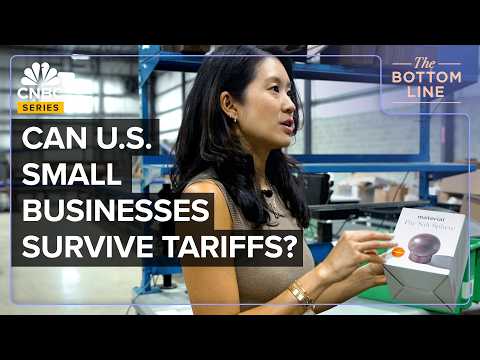
How Trump's tariffs are crushing small businesses while big retailers weather the costs
CNBC· 2025-11-07 16:32
Core Insights - U.S. small businesses are significantly impacted by President Trump's tariffs, struggling to cope with increased costs compared to larger retailers [1][3] - The complexity of supply chains for small businesses has escalated, with some reporting a tenfold increase in challenges [1] - Small businesses account for approximately 43% of U.S. GDP, highlighting their importance to the economy [2] Impact on Small Businesses - Small business owners report a decline in top line revenue year-over-year due to tariffs [2] - The current economic climate, exacerbated by tariffs, poses a threat to the livelihoods of small business owners [2] - Many small businesses lack the resources to stockpile inventory, making them more vulnerable to tariff impacts [2]

Time to reset the Republican clock, says conservative writer
MSNBC· 2025-11-07 16:11
All right. Well, speaking of the fallout from the elections, conservative columnist Kimberly Stell has a new piece for the Wall Street Journal headlined time to reset the GOP clock. And she writes in part this.The Trump team is moving at a furious pace. And doesn't the country's overloaded brain know it. On any given day, voters are pummeled with 50 non-cohesive headlines about Medicaid fraud, National Guard deployments, college compacts, indictments of Trump adversaries, sovereign wealth funds, DEI, Venezu ...

Today's Marketplace discusses state of M&A with Creighton University's Tirimba Obonyo and Moelis's Mark Henkels
Globenewswire· 2025-11-07 13:42
Core Insights - The current state of mergers and acquisitions (M&A) is experiencing a 9% drop in activity during the first half of the year, attributed to market uncertainties, including tariffs and interest rates [2] Group 1: M&A Activity and Market Conditions - Dr. Obonyo highlighted that uncertainties in the market, particularly regarding tariffs, are causing hesitation among companies to commit significant capital for M&A [2] - Key considerations for M&A include identifying the right target, ensuring the right price, and planning for post-merger integration [2] - Mark Henkels noted that higher interest rates are influencing deal activity in the industrial sector, leading to more creative deal structuring beyond all-cash transactions [2] Group 2: Strategic Priorities in the Industrial Sector - The focus in the industrial sector has shifted from pure growth to simplification and allowing investors to decide on diversification [2] - "Through-cycle" performance has become a key theme in industrial boardrooms, emphasizing the need for growth that can withstand uncertainty [2]

X @外汇交易员
外汇交易员· 2025-11-07 10:23
Trade Policy Changes - China's Ministry of Commerce and the General Administration of Customs will suspend the implementation of several announcements related to export controls until November 10, 2026 [1] - The suspension includes measures announced on October 9 concerning export controls on rare earths, lithium batteries, and artificial graphite anode materials [2] - China will continue to suspend the 24% tariff on imports from the United States for one year, while maintaining the 10% tariff [2] - The adjusted tariff measures took effect on November 10, 2025, at 13:01 [2]
DA Davidson Raises PT on Caterpillar (CAT) to $560, Maintains “Neutral” Rating
Yahoo Finance· 2025-11-07 07:26
Group 1 - Caterpillar Inc. (NYSE:CAT) represents 5.97% of Bill Gates's stock portfolio and is among his top 15 stock picks [1] - DA Davidson raised its price target on Caterpillar from $408 to $569 while maintaining a "Neutral" rating, reflecting strong Q3 results [2][3] - The optimism from DA Davidson is driven by strong demand in the Energy & Transportation (E&T) segment, particularly from AI-driven data center expansion [3] Group 2 - Caterpillar reported an earnings beat on October 29, 2025, with shares rising by 12%, and the E&T segment achieved a 17% sales growth to $7.2 billion [4] - The company surpassed analysts' earnings forecasts with adjusted earnings per share of $4.95 compared to the $4.52 consensus [4] - Looking ahead, Caterpillar expects tariff headwinds of up to $1.75 billion this year, but its construction and resource segments are anticipated to remain solid contributors to growth [5]

Temu offers ‘aggressive' payouts to lure US retailers as Chinese company grapples with tariffs
New York Post· 2025-11-06 23:14
Core Insights - Temu is offering $1,000 to middlemen to recruit US retailers to sell on its platform as a response to the end of the "de minimus" exemption, which previously allowed goods valued under $800 to be shipped to the US without duties [1][2][3] Group 1: Business Strategy - Temu is aggressively expanding its network of US sellers to mitigate the impact of tariffs and shipping costs on its products, which include clothing, jewelry, and home goods [2][4] - The company aims to provide an additional sales channel for local merchants, thereby supporting their growth while offering consumers more choices [4] Group 2: Financial Performance - PDD Holdings, the parent company of Temu, has seen its shares rise approximately 40% year-to-date, with revenue growing by 7% to $14.5 billion in the most recent quarter, marking the slowest growth in years due to tariff impacts [4] Group 3: Market Context - The termination of the "de minimus" rule has significantly affected the growth of Temu and its competitor Shein, which previously benefited from this exemption [10][11] - Exports from Shein and Temu surged to $66 billion in 2023, a substantial increase from $5.3 billion in 2018, highlighting the impact of tariff changes on their business models [11]


Lassonde Industries Inc. announces its Q3-2025 results
Globenewswire· 2025-11-06 22:10
Core Insights - Lassonde Industries Inc. reported solid sales and profit growth in Q3 2025, with sales reaching $723.9 million, a 55.6 million increase from the previous year, driven by effective pricing strategies and a favorable shift in Canadian private label sales [2][3] Financial Performance - Sales for Q3 2025 were $723.9 million, up 4.8% from $668.3 million in Q3 2024, primarily due to selling price adjustments and a favorable change in the Canadian sales mix of private label products [3][6] - Gross profit increased to $197.6 million, representing 27.3% of sales, up from $179.8 million in the same quarter last year [3][6] - Operating profit rose to $57.9 million, an increase of $10.7 million from the previous year, attributed to higher gross profit and reduced transportation costs [3][6] - Profit attributable to shareholders was $36.8 million, resulting in an EPS of $5.40, a 24.2% increase from the same quarter in 2024 [6][27] Adjusted Financial Metrics - Adjusted EBITDA for Q3 2025 was $86.4 million, up 24.7% from $69.3 million in Q3 2024 [6][24] - Adjusted EPS was $5.84, reflecting a 28.9% increase from $4.53 in the same quarter last year [6][27] Capital Expenditures and Investments - The company is focused on executing its strategy, including capital investment projects, with the relocation of production lines to its North Carolina plant completed [3][6] - Capital expenditures for 2025 are estimated to reach up to 7.0% of sales, depending on project progress and macroeconomic conditions [15][31] Outlook and Market Conditions - Lassonde anticipates a sales growth rate slightly above 10% for 2025, driven by the full-year impact of Summer Garden results and increased U.S. sales volume [7][14] - The company is monitoring consumer food habits and demand elasticity amid ongoing inflation in key commodities [7][14] Dividend Information - A quarterly dividend of $1.10 per share was declared, payable on December 15, 2025, to registered holders of Class A and Class B shares [18][31]