Economic Uncertainty

Search documents
Equifax Shares Dip as Weaker Hiring and Tariffs Temper Guidance
PYMNTS.com· 2025-07-22 16:55
Core Insights - Equifax's second-quarter earnings exceeded expectations, driven by growth in non-mortgage-related revenues, particularly in consumer lending and government sectors [2][4][5] - Despite positive results, management maintained cautious guidance due to macroeconomic uncertainties, including tariffs and their effects on interest rates and hiring [3][7] - Mortgage-related activities showed a decline, with inquiries down 8% in the latest quarter, and expectations for a further 13% decrease in the second half of the year [4][11] Financial Performance - The company's revenue for the second quarter reached $1.5 billion, surpassing previous guidance by $27 million, with U.S. mortgage revenues increasing by 14% [4][5] - Non-mortgage revenue growth was noted at 4% for B2B segments, with specific growth in auto lending and financial institutions [10] - Workforce Solutions revenues are projected to grow by 5% through fiscal year 2025, while US Information Systems revenues are expected to increase by 7% [5] Market Conditions - Elevated mortgage rates, consistently above 6.7%, along with high housing prices and low inventory, have contributed to historically low home purchase and refinance activities [11] - The economic environment remains uncertain, impacting hiring trends and overall revenue expectations for the second half of the year [8][11] Future Outlook - The company anticipates potential growth in the mortgage business once refinancing activity picks up, particularly through the integration of traditional and alternative data sources [11][12] - New solutions based on consumer-permissioned bank transaction data are set to launch in the third quarter, aiming to enhance verification processes [9]



Netflix Stock To $500?
Forbes· 2025-07-18 12:10
Core Viewpoint - Netflix stock has nearly doubled over the last 12 months, currently trading around $1,270, driven by initiatives like password sharing crackdown and the expansion of advertising-supported streaming [1][6] - Despite strong Q2 results with a 16% revenue growth, there are concerns about potential downside risks due to macroeconomic uncertainties and slowing subscriber growth [1][5] Group 1: Financial Performance - In 2024, Netflix added over 40 million subscribers, reaching nearly 302 million paid users, significantly contributing to the stock's rally [6] - The company's Q2 earnings showed improved margins, but there are warnings that operating margins could trend lower in the second half of 2025 due to rising content amortization and marketing costs [8][7] - Netflix's current stock price reflects a valuation of around 50 times consensus 2025 earnings, which is considered expensive compared to a valuation of about 20 times earnings in mid-2022 [11] Group 2: Subscriber Growth and Market Dynamics - Key initiatives like the password-sharing crackdown and ad-supported plans have been rolled out, but these may have pulled forward demand, leading to potential slower subscriber additions in the future [5][6] - The decision to stop reporting subscriber numbers starting in 2025 may indicate internal expectations of slower growth [5] - Economic factors such as inflation and rising costs could negatively impact consumer spending, which is crucial for Netflix's subscription model [7] Group 3: Historical Context and Volatility - Historical data shows that Netflix stock has experienced significant declines in past downturns, including a 75.9% drop from November 2021 to May 2022 [10] - The stock has shown resilience during downturns, performing slightly better than the S&P 500 in some cases [9] - The potential for a 50% to 60% correction from current levels is highlighted as a possibility based on historical performance [1][2]


More than 1 in 4 Canadians (27%) Say They Can't Pay All Their Bills at a Time When Millions Face Mortgage Rate Increases – TransUnion Study
Globenewswire· 2025-07-17 10:00
Economic Concerns and Consumer Behavior - 51% of Canadians cite recession as a top financial concern for the next six months, with 44% planning to reduce discretionary spending [1][10] - 63% of Canadians are looking for sales and discounts more frequently, while 40% are shopping at more affordable retailers [1][15] - 27% of Canadians report they will not be able to pay all current bills and loans in full, with 68% of those unable to pay indicating credit card payments as a priority [2][9] Mortgage Renewal and Financial Strain - Approximately 60% of Canadians' mortgages are up for renewal in 2025 or 2026, leading to potential payment shock due to rising interest rates [4][10] - Over two million consumers have seen a 25% increase in monthly mortgage payments since March 2022, with the average payment rising from $1,527 to $1,908 [5][6] - 53% of Gen X Canadians feel their financial situation is worse than planned, indicating a generational disparity in financial stress [3][9] Credit and Spending Adjustments - 72% of Canadians are not considering purchasing a home in the next year, reflecting a cautious approach to credit participation [7][10] - 74% of Canadians anticipating a recession plan to reduce spending to maintain financial resilience [11] - 46% of Canadians reported being targeted by fraud attempts, yet 37% took no action in response to cybersecurity concerns [12]


X @Investopedia
Investopedia· 2025-07-15 11:30
Market Trends & Investment Advice - Two-thirds (66.67%) of financial advisors are adjusting retirement investment advice due to market volatility and economic uncertainty [1]
3 Leisure & Recreation Stocks to Watch Despite Industry Woes
ZACKS· 2025-07-11 14:31
Industry Overview - The Zacks Leisure and Recreation Products industry is experiencing challenges due to the ongoing tariff war and soft macroeconomic data, but there is a positive trend in fitness product sales driven by growing health and fitness awareness [1][3] - The industry includes companies that provide a range of recreational products and services, thriving on economic growth that fuels consumer demand [2] Trends Impacting the Industry - The tariff war initiated by U.S. President Donald Trump is affecting the industry, with concerns about its impact on the U.S. economy amid inflation and global geopolitical tensions [3] - The golf industry is booming, with rising demand for golf equipment due to technological advancements and increased participation among young people, particularly in emerging markets like India and China [4] - There is robust demand for fitness-related products in the U.S., driven by health awareness and lifestyle changes, leading to increased investment in home workout equipment and digital fitness platforms [5] Industry Performance - The Zacks Leisure and Recreation Products industry currently holds a Zacks Industry Rank of 204, placing it in the bottom 17% of over 246 Zacks industries, indicating dismal near-term prospects [6][7] - The industry's earnings outlook is negative, with a 13.6% decrease in northbound earnings estimates since January 31, 2025 [8] Stock Market Performance - The industry has outperformed the S&P 500, with a collective growth of 49.8% over the past year compared to the S&P 500's 11.8% increase [10] Valuation Metrics - The industry trades at a forward price-to-earnings ratio of 35.08X, significantly higher than the S&P 500's 22.64X and the sector's 18.45X [13] Notable Companies - **Peloton**: Transitioning to a profitability-driven recovery, with high-margin subscription revenues contributing nearly 70% of total sales. Expected fiscal 2025 earnings growth of 72.9% and a stock increase of 84.8% in the past year [16][17] - **Playboy**: Benefiting from an asset-light licensing model and a rebound in its China licensing business, with a stock increase of 137.5% in the past year [20][21] - **Academy Sports and Outdoors**: Gaining from a growth strategy focused on brand partnerships and digital upgrades, but shares have declined by 2.3% in the past year with expected earnings decline of 1.7% for fiscal 2025 [24]




X @Bloomberg
Bloomberg· 2025-07-11 07:28
Tourism Industry Outlook - Tourism in Spain, Europe's second largest holiday destination, is expected to grow less than previously anticipated [1] - Economic and geopolitical uncertainties are impacting the desire for travel [1]
Prime Day Loses Its Spark as Sales Nosedive 41%
PYMNTS.com· 2025-07-09 23:57
Core Insights - Amazon's sales dropped 41% on the first day of its four-day Prime Day event compared to the first day of last year's two-day event [1] - Momentum Commerce's CEO suggested that the decline in sales was due to consumers adding items to their carts but delaying purchases for potentially better deals [2] - Amazon's Vice President expressed satisfaction with shopper engagement and noted that the extended duration of Prime Day was in response to consumer demand for more time to explore deals [4] Sales Performance - The first day of this year's Prime Day saw a significant sales drop, but there is potential for overall sales to surpass last year's event due to the longer duration [2] - Last year's shorter Prime Day encouraged quicker purchases to avoid missing discounts, contrasting with this year's consumer behavior [3] - Adobe reported that Prime Day's kickoff surpassed Thanksgiving 2024's eCommerce spend of $6.1 billion, with 50.2% of sales made via mobile devices [5] Market Context - Prime Day, alongside Walmart's Walmart+ Week, is viewed as a test for consumer spending amid economic uncertainty and declining consumer confidence [6] - Retailers are closely monitoring consumer behavior changes due to global tariffs and economic conditions [6]


Here's what goes into CNBC's Top States for Business
CNBC Television· 2025-07-09 12:59
CNBC Top States for Business Ranking - Overview - CNBC's annual ranking of America's top states for business has been conducted since 2007, evaluating states based on competitiveness [2] - The ranking methodology involves 10 categories of competitiveness, with weights adjusted annually based on current business concerns and state priorities [2] - The study's methodology and sources are available at topstates.cnbc.com [5] Key Ranking Factors - Economic uncertainty, tariffs, and federal budget cuts have made "Economy" the most important category this year, measuring economic and job growth, housing market, and state finances [3] - Infrastructure, including sites, roads, bridges, and power, is a key consideration [4] - Workforce quality, including the ability to attract top talent, is a significant factor [4] - The cost of doing business, business friendliness, quality of life, technology and innovation (especially with federal research funding reductions), education, access to capital, and cost of living (including insurance costs) are all measured [4] Announcement and Further Information - The top state for business will be revealed on Squawkbox [6] - The full state rankings will be available on cnbc.com [6]

Most US employers not budging on budgets, salary increases remain flat
Globenewswire· 2025-07-08 15:09
Core Insights - Average salary increase budgets for US companies in 2026 are expected to remain stable at 3.5%, matching the actual increases of 2025 [1] - Organizations are becoming more strategic in their pay allocation and investment focus, aiming to align with broader business goals despite economic uncertainty [3] Salary Budget Changes - Three out of five organizations experienced changes in their salary budgets during the last pay cycle, with 53% reporting no difference between anticipated and actual budgets for 2025 [2] - Among organizations projecting lower salary increases, 51% cited anticipated recession or weaker financial results, while 45% mentioned cost management concerns [2] - Tight labor markets (59%) and inflationary pressures (30%) were the main reasons for those projecting higher salary budgets [2] Employee Retention and Stability - Employee stability has improved, with less than one-third (30%) of organizations reporting challenges in attracting or retaining employees, a decrease of 11 percentage points since 2023 [4] - Organizations are taking actions to enhance employee experience, health and wellness benefits, and training opportunities in response to low turnover and concerns about burnout [5] Compensation Adjustments - Employers are adjusting compensation programs to address competitive labor markets and inflation, with 50% conducting a compensation review of all employees and 48% reviewing specific employee groups [6] - Over 40% of organizations have enhanced their use of retention bonuses or spot awards, and 37% have targeted base salary increases for specific employee groups [6] Payroll Expenses - The average annual payroll expense has increased by nearly 4% (3.6%), with 70% of organizations reporting higher total annual payroll expenses compared to the previous year [7] Strategic Investments - Employers are making investments beyond pay raises, focusing on career development, wellbeing, flexibility, and equity to enhance performance, retention, and resilience in a changing market [8] Survey Details - The Salary Budget Planning Report was compiled by WTW's Rewards Data Intelligence practice, with approximately 29,128 responses from companies across 157 countries, including 1,569 from the U.S. [9]


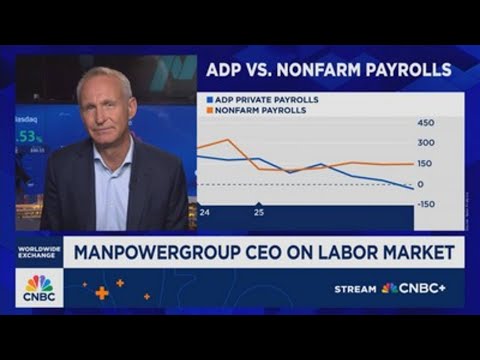
Prising: Employers are cautious, tariffs are adding uncertainty to hiring plans
CNBC Television· 2025-07-08 12:08
Labor Market Trends - The labor market has been cooling for many months [1][2] - June 2025 saw the lowest private sector employment in a long time, with government hiring, particularly at the state level, being unusually high [2] - Employers are being cautious due to tariff threats, leading to a hold on current workforce and limited growth in private sector employment [9][10] AI Impact on Employment - 58% of employees are investing in AI, but a large percentage of their employees aren't sure that they're really ready to jump into it [4] - AI, particularly GenAI, is being used for tasks related to content, communication, and coding [5] - GenAI has a visible impact on employment levels in coding, with software programmers experiencing higher unemployment [6] Hiring Outlook - Manpowergroup Employment Outlook survey expects hiring to increase 24% year-over-year in Q3 [7] - A strong hiring number would be 3,840%, while a weak number would be 10% [8] - The 24% net hiring outlook reflects a solid labor market, but tariff threats are causing employers to hold back [8][9]