全球资产配置

Search documents
方正证券:中国信达拟减持不超1%股份;中金公司现5笔大宗交易,合计成交近13亿元 | 券商基金早参
Mei Ri Jing Ji Xin Wen· 2025-11-05 01:20
Group 1 - China Cinda Asset Management plans to reduce its stake in Founder Securities by up to 1%, amounting to approximately 82.32 million shares, which represents 1% of the total share capital [1] - Currently, China Cinda holds 593.05 million shares in Founder Securities, accounting for 7.2% of the total share capital, with shares acquired through a private transfer [1] - The reduction period is set from November 26, 2025, to February 25, 2026, and is attributed to China Cinda's operational needs [1] Group 2 - Two Brazil-focused ETFs have seen strong demand, with subscription rates exceeding 11% for both, indicating robust investor interest in emerging markets [2] - The total scale of cross-border ETFs has approached 900 billion, highlighting the growing trend of global asset allocation among ordinary investors [2] - This surge in interest may prompt fund companies to accelerate their offerings in emerging market products, benefiting related ETF management firms [2] Group 3 - The fund issuance market has seen a resurgence, with two "sunshine funds" launched in a single day, each raising over 3 billion, indicating increased market participation [3] - Year-to-date figures show significant growth in stock and mixed fund issuance, with increases of 43.86% and 76.04% respectively compared to the previous year [3] - The rapid sell-out of these funds may enhance the valuation expectations for related fund companies and leading brokerages [3] Group 4 - China International Capital Corporation (CICC) recorded five block trades on November 4, totaling approximately 360.86 million shares and nearly 1.3 billion in transaction value [4] - The average transaction price was 36 yuan, reflecting a discount of 0.96% compared to the closing price, indicating active trading among institutions [4] - The recent block trades suggest a potential shift in long-term institutional holdings, although the short-term impact on stock prices may be limited [5]


【申万宏源策略】鹰派预期下美元指数接近100,欧洲新兴市场明显回调—全球资产配置每周聚焦 (20251024-20251031)
申万宏源证券上海北京西路营业部· 2025-11-03 02:33
Core Viewpoint - The article discusses the impact of hawkish expectations on the US dollar index, which is approaching 100, and highlights a noticeable pullback in European and emerging markets [2] Group 1: Market Trends - The US dollar index is nearing the 100 mark, indicating strong dollar performance amid hawkish monetary policy expectations [2] - European markets are experiencing a significant correction, reflecting broader global market dynamics [2] Group 2: Asset Allocation Insights - The article emphasizes the need for global asset allocation strategies in light of the current market conditions, particularly focusing on the implications of a strong dollar and the pullback in European and emerging markets [2]


专访汇丰中国王颖:中国高净值人群的财富管理需求正向多元化、专业化持续转变
Zhong Guo Ji Jin Bao· 2025-11-02 12:14
Core Insights - The wealth management market in China is experiencing rapid growth, driven by the expansion of market size, upgrading investment demands, and favorable policies [1][2][3] - High-net-worth individuals in China are shifting their wealth management needs towards diversification and specialization, moving away from traditional deposit-based strategies to more complex investment approaches [3][4] Market Overview - China is the second-largest asset and wealth management market globally, with a stable and large client base. The number of high-net-worth individuals (net worth over $10 million) in mainland China has reached 470,000, accounting for 20% of the global total [2] - The demand for wealth management is evolving, with investors increasingly seeking diversified investment strategies to navigate a complex market environment [3][4] Investment Trends - Investors are reducing cash holdings by nearly 40% over the past year, increasing allocations to alternative assets and gold, which have seen a doubling in investment proportions [3][5] - Emerging needs among high-net-worth individuals include international asset allocation, family wealth succession, tax planning, and global lifestyle management [3][4] Policy Environment - Regulatory support for foreign institutions in wealth management is increasing, creating a favorable environment for both domestic and foreign financial institutions to collaborate and enhance service offerings [3][4] Asset Allocation Dynamics - The dual impact of ongoing market volatility and a low-interest-rate environment is accelerating the restructuring of asset allocation strategies [5][6] - Investors are shifting from traditional safe assets to higher-risk financial investments, including stocks and alternative investments, in response to low returns on cash assets [6][7] Strategic Initiatives - HSBC aims to become the preferred international bank for high-net-worth clients in China, enhancing its wealth management services through upgraded offerings and a focus on global connectivity [7][8] - The bank is expanding its wealth management footprint in over 20 major cities and has opened new flagship branches to improve service quality and accessibility [10][11] Digital Transformation - The integration of AI and digital tools is a core strategy for enhancing customer experience and improving wealth management processes [12][13] - HSBC is committed to balancing cost and customer experience while rapidly adopting digital innovations to meet evolving investor behaviors [12][13]
盈米小帮投顾团队-第16次信号发车
老徐抓AI趋势· 2025-10-31 06:58
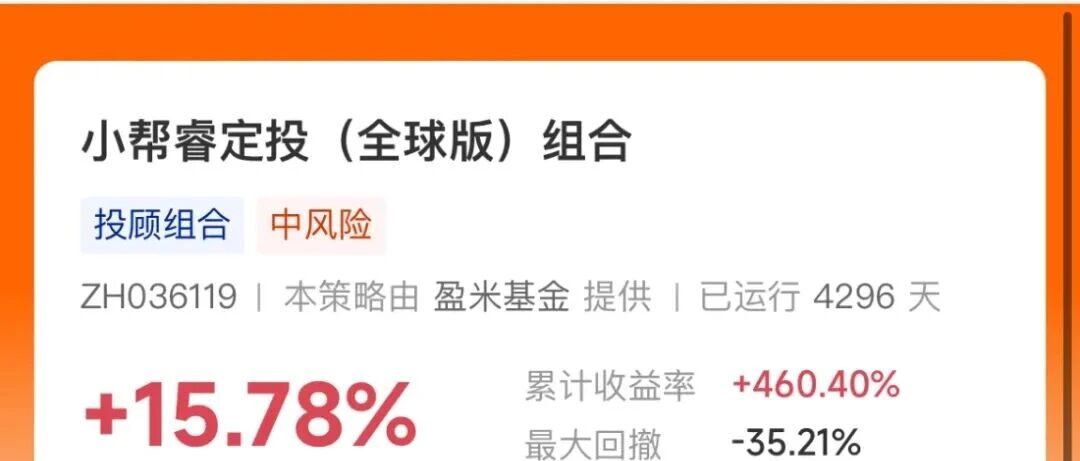
Global Market Performance - The global market has shown a positive performance this week, with major indices in A-shares, Hong Kong stocks, and US stocks all rising, reflecting an optimistic market atmosphere [1] - The A-share market, represented by the CSI 300 index, increased by 3.92%, while the Hang Seng Index rose by 2.22%, and the NASDAQ 100 gained 2.71% [2] Investment Strategies - The global allocation strategy has demonstrated strong resilience and stability, providing investors with a sense of security despite short-term fluctuations in gold prices [1] - The "Rui Global" strategy achieved a weekly increase of 1.52%, surpassing expectations with a cumulative return of over 20% for 2025 [5] - The "Lazy Balanced" strategy, which is more conservative with a higher bond allocation, recorded a cumulative return of 13.91% this year, lower than "Rui Global" but with reduced volatility [8] Performance Comparison - Over the past three years, "Rui Global" has maintained positive returns regardless of A-share market conditions, with some investors achieving cumulative returns of 25% [5] - In comparison to other funds, "Rui Global" ranks in the top 10% among fund managers, while some large funds have reported losses over the same period [5] Future Outlook - The bond market is nearing a bottom, and bonds continue to provide a stabilizing effect and risk buffer within the investment portfolio [8] - The company expresses confidence that annual returns will remain above 15% even if there are potential year-end pullbacks [5]
生活在通缩的国家,赚通胀的钱,还有这好事?
虎嗅APP· 2025-10-28 09:25
Group 1 - The core viewpoint of the article discusses the concept of living in a deflationary country while investing in inflationary assets, highlighting the potential benefits of such a strategy [4][6][8] - The article emphasizes the importance of finding inflationary assets that can maintain or increase value in an inflationary environment, categorizing them into seven types [17][31] - It provides examples of successful cases, such as Swiss and Japanese high-net-worth individuals who have effectively invested overseas while residing in low-inflation environments [10][12][14] Group 2 - The article outlines three conditions necessary for effective cross-border asset allocation: the ability to allocate assets internationally, living in a stable or deflationary country without compromising quality of life, and ensuring investment targets are decoupled from the local deflation [10] - It identifies seven categories of inflationary assets, including precious metals, commodities, high pricing power stocks, emerging market stocks, inflation-linked bonds, rental real estate, and technology stocks in deflationary environments [17][18][20][22][24][26][28][29] - The article concludes that understanding inflation is crucial for making informed investment decisions, as it serves as a fundamental principle that can clarify various investment phenomena [32][34][35]

生活在通缩的国家,赚通胀的钱,还有这好事?
3 6 Ke· 2025-10-27 23:37
Core Insights - The article discusses the concept of living in deflationary regions while investing in inflationary assets, highlighting the potential benefits of such a strategy [1][2][5]. Group 1: Economic Context - Inflation benefits asset prices, leading to capital gains, while deflation can lower living costs [1]. - The article contrasts the experiences of individuals in high inflation countries versus those in deflationary environments, emphasizing the advantages of the latter for investment opportunities [1][2]. Group 2: Case Studies - Switzerland and Japan are cited as examples where residents benefit from living in deflationary environments while investing in inflationary assets [5][7][8]. - Swiss residents have historically invested in USD assets or emerging market funds, capitalizing on the appreciation of the Swiss franc [7]. - Japanese high-net-worth individuals have shifted their wealth to overseas investments post-bubble, favoring US bonds and stocks [8][9]. Group 3: Investment Strategies - Successful investment strategies require cross-border asset allocation, stable living costs, and detachment from local inflation [6][11]. - The article outlines seven categories of inflationary assets, including precious metals, commodities, high pricing power stocks, emerging market equities, inflation-linked bonds, rental real estate, and policy-driven assets like technology stocks in China [12][19][21]. Group 4: Inflation as an Investment Principle - Inflation is presented as a fundamental principle that underpins investment returns, with historical perspectives from notable investors like Ray Dalio and Warren Buffett emphasizing its significance [22].

机构洗盘手法曝光:90%散户都中招
Sou Hu Cai Jing· 2025-10-27 07:32
Core Insights - Morgan Asset Management's report indicates a "strategic window" for global asset allocation, suggesting significant capital movement is imminent due to anticipated interest rate cuts by the Federal Reserve [1][10] - The report highlights that the Asian markets, particularly Northeast Asia, are becoming the "core battlefield" for asset allocation in the new era [3][11] Market Dynamics - The report emphasizes that small investors often react too late to global capital reallocation trends, which are influenced by macroeconomic changes [3][11] - It is noted that stocks often experience volatility due to the presence of both following and profit-taking investors, leading to market manipulation by larger funds [3][10] Trading Behavior - The analysis of stock movements reveals that significant price fluctuations can create false security for investors, leading to potential losses when they enter the market at the wrong time [7][10] - The importance of monitoring institutional inventory data is highlighted, as it reflects the actual participation of large funds in the market [10][11] Investment Strategy - The report suggests abandoning predictive thinking regarding Federal Reserve actions and instead focusing on the real-time reactions of capital to these events [11][12] - Emphasis is placed on the value of quantitative data to reduce information asymmetry in the market, which is a significant challenge for small investors [12][13] Recommendations - Investors are encouraged to prioritize trading behavior data over traditional technical analysis, as it provides insights into the reasons behind market movements [13] - Establishing a personal observation system with suitable quantitative tools for long-term tracking is recommended [13][14] - Maintaining independent thought and not being swayed by market trends or hot topics is advised for better investment decisions [13][14]

【申万宏源策略】黄金大跌后的后市演绎——全球资产配置方法论黄金框架性报告之六
申万宏源证券上海北京西路营业部· 2025-10-27 03:05
Core Viewpoint - The article discusses the recent significant decline in gold prices and its implications for global asset allocation strategies, emphasizing the need for a structured framework to navigate the changing market dynamics [2] Group 1: Market Analysis - Gold prices have experienced a notable drop, prompting a reevaluation of investment strategies in the context of global economic conditions [2] - The article highlights the correlation between gold prices and macroeconomic indicators, suggesting that shifts in interest rates and inflation expectations are critical factors influencing gold's performance [2] Group 2: Investment Strategies - The report outlines various asset allocation methodologies that can be employed in response to the changing landscape of gold prices, advocating for a diversified approach to mitigate risks [2] - It emphasizes the importance of understanding the historical performance of gold in different economic cycles to inform future investment decisions [2] Group 3: Future Outlook - The article projects potential scenarios for gold prices based on current economic trends, indicating that further volatility may be expected in the near term [2] - It suggests that investors should remain vigilant and adaptable, considering both short-term fluctuations and long-term trends in their investment strategies [2]

【申万宏源策略】TACO交易再起,全球权益上涨贵金属回调——全球资产配置每周聚焦 (20251017-20251024)
申万宏源证券上海北京西路营业部· 2025-10-27 03:05
Core Insights - The article discusses the resurgence of TACO trading and the global equity market's upward trend, alongside a correction in precious metals [2] Group 1: TACO Trading - TACO trading has seen a revival, indicating a shift in market dynamics and investor sentiment [2] - The article highlights the implications of this trading strategy on overall market performance and investor behavior [2] Group 2: Global Equity Market - Global equities have experienced an upward movement, suggesting a positive outlook for stock markets worldwide [2] - The article provides insights into the factors driving this increase, including economic indicators and investor confidence [2] Group 3: Precious Metals - Precious metals have undergone a correction, contrasting with the rising equity markets [2] - The article analyzes the reasons behind this pullback, including changes in demand and macroeconomic factors [2]

低利率时代中国资产受青睐,资管巨头共寻全球资产配置新路径
Hua Xia Shi Bao· 2025-10-26 02:57
Core Viewpoint - The low interest rate environment is challenging for asset management firms, prompting a shift towards diversified asset allocation strategies to seek higher returns and manage risks effectively [2][3][7]. Group 1: Low Interest Rate Environment - The Federal Reserve's easing of interest rates has led to a downward trend in domestic interest rates, creating a challenging landscape for active management to achieve excess returns [2]. - The bond market has seen a significant influx of funds, but as rates decline, the appeal of fixed-income products diminishes, leading to a dual demand for yield and safety among investors [3][5]. Group 2: Asset Allocation Strategies - Major asset management firms are focusing on the long-term investment value of Chinese assets, emphasizing the need for innovative strategies in a low-rate environment [2][4]. - The importance of diversified asset allocation is highlighted, with suggestions to include equities, real estate, gold, and global assets in investment portfolios [2][6][9]. Group 3: Passive Investment Trends - The rise of bond ETFs is noted, with their market size growing from 200 billion to over 500 billion, indicating a shift towards passive investment strategies as active management faces challenges [4][5]. - The increasing popularity of passive investment products, such as bond ETFs, reflects a broader trend where investors seek average market returns rather than relying solely on active management [5][6]. Group 4: Global Investment Focus - The shift in China's economic model towards technology and finance is creating new opportunities for asset allocation, with a focus on global investment strategies [6][8]. - The need for structural reforms in asset management is emphasized, particularly in creating diversified global asset allocation products to meet investor demands [9].