
Inflation

Search documents
KG Breaks Down CPI & Jobless Claims, Analyzes Bitcoin's Rebound Rally
Youtube· 2025-12-18 16:00
Economic Indicators - The delayed CPI report showed headline inflation at 2.7% year-over-year, better than the expected 3.1% and the Cleveland Fed's 3% [2][3] - Core CPI came in at 2.6% year-over-year, also below the street's expectations of 3% [3] - Shelter costs remained around 3% year-over-year, while medical care increased by 2.9%, contributing to the CPI adjustments [4] Market Reactions - The better-than-expected CPI results fueled a market rally, impacting both equities and treasuries, with bond yields moving lower [6][7] - Jobless claims were reported at 224,000, aligning with expectations, indicating a stabilizing labor market [9][11] Cryptocurrency Insights - Bitcoin saw a 2.8% increase, indicating a risk-on sentiment in the market, although it remains below the 90,000 level [13][16] - Technical indicators suggest a potential consolidation phase for Bitcoin, with key support around 85,000 [14][16] Energy Market Overview - Crude oil prices rose approximately 8%, influenced by geopolitical tensions and market speculation regarding potential conflicts [19][24] - Despite the increase, there are concerns about a supply glut and lackluster gasoline demand in the U.S. [21][23]


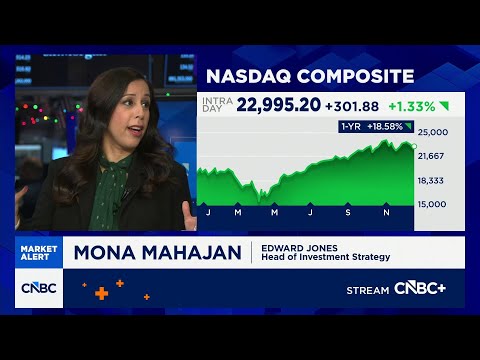
There is a base case of positive returns for 2026, says Edward Jones’ Mona Mahajan
CNBC Television· 2025-12-18 15:51
Let's talk a bit more about the data this morning in the market with Mona Mahajin. Edward Jones, head of investment strategy, joins us here at Post9. Always good to see you.Welcome. Happy holidays. Um, you think there's time for a rally to show up before you're in.>> You know, look, um, Santa Claus came a little bit to town this morning. We enjoyed seeing that CPI print come in well below expectations. What particularly caught our eye was the core CPI reading.Nice to see 2.6%. You know, keep in mind twothir ...
Inflation Slowed To 2.7% Last Month—Below Expectations
Forbes· 2025-12-18 15:40
Group 1 - The Consumer Price Index (CPI) rose 2.7% in November year-over-year, slower than the previous increase of 3% and below economists' expectations of a 3.1% rise [1] - Core CPI, which excludes food and energy prices, increased by 2.6% over the same period, also below the previous pace of 3.1% [1] Group 2 - The release of the CPI data was delayed due to a government shutdown, which affected data collection and led to the cancellation of the October CPI report [2] - There are concerns among economists regarding the accuracy of the CPI report due to the disruptions caused by the government shutdown [2] Group 3 - Capital Economics noted that while the data might indicate a genuine reduction in inflationary pressures, the sudden change, especially in persistent service components like rent, is unusual outside of a recession [3] - The firm emphasized the need to wait for the December data to determine if the current figures represent a statistical anomaly or a true disinflation trend [3]

Dollar Recovers as EUR/USD Weakens
Yahoo Finance· 2025-12-18 15:37
Currency Market Overview - The dollar index (DXY00) increased by +0.09%, recovering from early losses due to Eurozone fiscal concerns impacting EUR/USD [1] - The dollar found support as US weekly jobless claims fell to 224,000, close to expectations of 225,000 [3] - The dollar initially declined due to weaker-than-expected US reports on November CPI and December Philadelphia Fed business outlook survey [1][3] Federal Reserve Actions - The Federal Reserve is increasing liquidity in the financial system by purchasing $40 billion a month in T-bills, which is putting pressure on the dollar [2] - There are concerns regarding President Trump's potential appointment of a dovish Fed Chair, which could be bearish for the dollar [2] Economic Indicators - The US November CPI rose by +2.7% year-on-year, which was weaker than the expected +3.1% [3] - The November core CPI increased by +2.6% year-on-year, also below expectations of +3.0%, marking the smallest pace of increase in 4.5 years [3] - The December Philadelphia Fed business outlook survey unexpectedly fell by -8.5 to -10.2, contrary to expectations of an increase to 2.3 [3] Market Expectations - Markets are pricing in a 27% chance that the FOMC will cut the fed funds target range by 25 basis points at the upcoming January 27-28 meeting [4] Eurozone Economic Concerns - The euro (EUR/USD) decreased by -0.20% as ECB officials indicated that the cycle of interest rate cuts is likely finished based on growth and inflation outlooks [5] - Fiscal concerns in the Eurozone are heightened after Germany announced plans to increase federal debt sales by nearly 20% to a record 512 billion euros ($601 billion) to fund increased government spending [5]
X @Easy
Easy· 2025-12-18 15:36
The market is going to fucking rip here sooner than later imo.CPI came in SO cool.Inflation concerns with rate cuts are out teh window.3-5 rate cuts next year seems like an inevitable situation.Risk On assets will be going much higher.Bottom is in across crypto imo.The Kobeissi Letter (@KobeissiLetter):This is absolutely insane:Inflation in the US just unexpectedly posted one of the largest monthly declines since 2023.While a +10 basis point increase in inflation was expected, it actually FELL by -40 basis ...
Capstone Partners Releases 2025 Middle Market Business Owners Research Survey
Prnewswire· 2025-12-18 15:30
Core Insights - The 2025 Middle Market Business Owners Survey Report by Capstone Partners reveals significant insights into the decision-making processes, growth strategies, and financial outlooks of U.S. middle market companies [1][3] Group 1: Economic Concerns and Business Adjustments - For the third consecutive year, 92.5% of CEOs identified inflation as their primary concern affecting company growth [7] - 39.7% of business owners have reduced company expenses in response to tariffs [7] - CEO perspectives on the One Big Beautiful Bill (OBBB) Act are mixed, with 41.4% expecting no impact, 36.7% anticipating negative effects, and 21.9% viewing it positively [7] Group 2: Capital Markets and Growth Strategies - 57.4% of CEOs have engaged in at least one capital markets transaction in the past year to enhance growth and optimize capital structure [7] - Private equity interest in middle market businesses is rising, with 53.9% of business owners reporting contact from a PE firm in the last year [7] - Over half (55.9%) of business owners plan to implement growth strategies in the next 12 months, indicating a shift towards growth rather than just financial stability [7] Group 3: Performance Improvement and M&A Outlook - The need for performance improvement support among business owners has increased by 3.4% compared to the previous year, as they aim to maintain margins and improve operational efficiencies [7] - A record 75.8% of business owners are preparing for an exit, suggesting a potential surge in middle market M&A activity [7] Group 4: Economic Outlook and Revenue Projections - The percentage of CEOs with a very positive outlook on the U.S. economy has risen to 18.7% in 2025, marking the first increase in five years as clarity around interest rates and inflation improves [7] - Business owners anticipate continued revenue growth, with 26.9% projecting a 1-9% year-over-year increase and 27.2% expecting growth of 10-25% [7]

3 Cheap Dividend Stocks That Can Beat Inflation and Pay You to Wait
Yahoo Finance· 2025-12-18 15:26
Core Viewpoint - Analysts predict that lower interest rates today may lead to a spike in inflation by 2026, making dividend stocks more attractive as they can provide passive income that outpaces inflation [2]. Group 1: Dividend Stocks - Dividend stocks have accounted for 40% of the stock market's total return over the last 90 years, highlighting their importance in investment portfolios [2]. - High-yield dividend stocks trading below $20 are particularly appealing for investors looking to hedge against potential inflation increases [3]. Group 2: Energy Transfer - Energy Transfer (NYSE: ET) offers an attractive dividend yield of 8.1%, supported by its extensive pipeline network of over 140,000 miles across the United States [3]. - As a midstream company, Energy Transfer benefits from fee-based, asset-backed services, ensuring a consistent revenue stream through long-term contracts and service fees, regardless of commodity price fluctuations [4]. - The company is well-positioned to meet the growing demand for natural gas, especially as U.S. production continues to set records to fulfill export demands and data center needs [4]. Group 3: Financial Performance - Despite a 16% decline in ET stock in 2025 and three out of four quarters of adjusted earnings per share falling below expectations, this is attributed to significant capital investments rather than balance sheet weaknesses [5]. - The capital investments made by Energy Transfer were executed without increasing debt or diluting shareholders, indicating a disciplined approach to balance-sheet management [5][6].

Sharp Pullback in November Inflation Likely Won’t Move the Needle for the Fed
Barrons· 2025-12-18 15:17
Investors cheered the news that inflation dramatically slumped in November, but economists caution that this dip may not last. Thursday's CPI report was unusually noisy, due in large part to the fact that the BLS did not publish much of the October price data after staff were unable to collect and process information retroactively. The missing data included the headline and core monthly and annual percentage changes in the index, making it difficult to draw firm conclusions. After headline CPI readings incr ...
美国11月CPI意外偏低 分析师观点分化:数据偏软支撑降息 但需警惕政府停摆影响
Zhi Tong Cai Jing· 2025-12-18 15:16
Core Insights - The November inflation data in the U.S. significantly underperformed market expectations, with the Consumer Price Index (CPI) rising by 2.7% year-on-year, compared to the anticipated 3.1% [1] - The core CPI, excluding food and energy, increased by 2.6%, down from 3.0% in September, indicating a further easing of inflationary pressures [1] - Financial markets reacted positively, with major indices rising, U.S. Treasury yields declining, and the dollar index weakening [1] Group 1: Economic Analysis - Brian Jacobsen from Annex Wealth Management noted that housing inflation, a major component of CPI, has significantly slowed down, suggesting that previous inflation drivers are no longer central to current inflation [2] - Peter Cardillo from Spartan Capital Securities highlighted that the drop in core inflation to 2.6% and overall inflation to 2.7% is favorable for both the Federal Reserve and financial markets, potentially paving the way for multiple rate cuts in the first quarter of 2026 if the trend continues [2] - Jan Nevruzi from TD Securities emphasized that the inflation data fell below nearly all predictions, indicating a clear dovish trend despite potential technical issues in data collection [2] Group 2: Market Reactions and Future Outlook - Kay Haigh from Goldman Sachs Asset Management cautioned against overinterpreting the data due to the noise from missing October data, suggesting that the Fed will likely focus on the December CPI data for clearer signals [3] - Seema Shah from Principal Global Investors stated that the significant drop in November inflation supports dovish views within the Fed, increasing the likelihood of rate cuts occurring earlier than expected in 2026 [3] - Jamie Cox from Harris Financial Group remarked that the inflation impact from tariffs has largely dissipated, making the case for further rate cuts clearer as the rationale for maintaining restrictive monetary policy weakens [3] Group 3: Market Sentiment - Chris Zaccarelli from Northlight Asset Management pointed out that there are currently no signs of sustained high inflation, alleviating concerns within the Fed about the risks of renewed inflation from continued rate cuts [4] - Zaccarelli also suggested that if dovish perspectives prevail, further monetary easing could support stock market performance, with potential for continued market gains as economic growth, corporate earnings improve, and inflation remains controlled [4]
Stock Market Live December 18: A Cool Inflation Report Heats Up the S&P 500 (VOO)
Yahoo Finance· 2025-12-18 15:11
Economic Indicators - November's inflation rate was reported at 2.7%, lower than the expected 3.1% [1] - The "Core" CPI, excluding food and energy prices, increased by only 2.6%, also below the predicted 3% [1] Market Reactions - Investors reacted positively to the inflation report, with the Vanguard S&P 500 ETF (NYSEMKT: VOO) rising by 0.8% in premarket trading [2] - A cooler inflation report increases the likelihood of an interest rate cut by the Federal Reserve in January, which is generally favorable for the stock market [4] Company Earnings - Micron (Nasdaq: MU) reported earnings of $4.78 per share for fiscal Q1 2026, exceeding expectations by 84 cents, with sales of $13.6 billion [5] - Micron's guidance for Q2 suggests earnings could reach $8.42 per share, significantly above the consensus forecast of $4.49, with projected sales of $18.7 billion [5] - Cintas (Nasdaq: CTAS) reported earnings of $1.21 per share for fiscal Q2, slightly beating revenue projections with sales of $2.8 billion [6] - Cintas forecasts full-year profit between $4.81 and $4.88 per share, although sales may be slightly lower than expected at around $11.1 billion [6]

