Recession

Search documents
行业回顾_投资者应如何布局 2026 年上半年-Sector Review_ How should investors position into 1H26_
2025-11-10 03:35
Summary of J.P. Morgan Sector Review Industry Overview - The report discusses the current state of the investment landscape, particularly focusing on the potential for a recession and its impact on various sectors. It highlights the fatigue investors are experiencing due to multiple economic scares over the past few years, including the energy crisis, regional banking crisis, and trade wars [1][2]. Key Points and Arguments Economic Sentiment - Investors are exhibiting "recession exhaustion" after several economic scares that did not lead to downturns, leading to a reluctance to trade based on economic risks [1]. - The report suggests that spreads will likely remain tight and low until a confirmed recession is evident [1]. Sector Recommendations - **Non-Cyclicals vs. Cyclicals**: The preference for Non-Cyclicals over Cyclicals has been removed, with downgrades for IG Healthcare and IG Utilities to Neutral from Overweight. Conversely, IG Retail has been upgraded to Neutral due to signs of demand recovery in luxury goods [2]. - **Cyclicals**: Caution remains in certain cyclical sectors, particularly European manufacturing, which faces high energy costs and competition from low-cost Chinese producers. Underweight positions are maintained in IG/HY Chemicals and HY Autos due to oversupply and refinancing risks, respectively [3]. Financials vs. Non-Financials - A preference for Financials over Non-Financials is maintained, with Overweights in IG Bank Preferred, IG Bank T2, and IG Insurance Senior/Subordinated. The stability of net interest income and solid asset quality are highlighted as positive factors [4][9]. Performance Metrics - The report includes performance metrics for various sectors, indicating that Overweights in Corporate Hybrids and Insurance Subordinated have performed well, while underweights in Chemicals and Consumer Products have lagged [20][21][22]. Specific Sector Insights - **Building Materials**: Strong performance driven by pricing power and potential catalysts from German infrastructure spending [10]. - **Telecoms**: Anticipation of consolidation in the European Telecoms market, with a positive outlook due to regulatory shifts and increased capital expenditure [12]. - **Paper & Packaging**: Demand remains strong, particularly for metal packaging, driven by sustainability trends [13]. - **Autos**: Structural headwinds from Chinese competition and refinancing risks are significant concerns [14]. - **Consumer Products**: A shift towards private-label alternatives is noted, impacting branded goods negatively [15]. - **Chemicals**: Demand remains cyclically depressed, with overcapacity and high energy costs affecting competitiveness [16]. - **Technology**: Increased capital allocation in data centers is expected, with significant planned capex from major tech firms [17]. Conclusion - The report emphasizes a cautious yet strategic approach to sector allocation, with a focus on financial stability and emerging opportunities in specific sectors while remaining wary of cyclical risks and structural challenges in others [1][4][20].
Treasury Yields Snapshot: November 7, 2025
Etftrends· 2025-11-07 22:08
Core Insights - The yield on the 10-year Treasury note was 4.11% as of November 7, 2025, with the 2-year note at 3.55% and the 30-year note at 4.70% [1] - The inverted yield curve, where longer-term yields are lower than shorter-term yields, is a reliable leading indicator for recessions, typically turning negative before recessions [2][3] - The average lead time to a recession based on the first negative spread is approximately 48 weeks, while using the last positive spread date yields an average of 18.5 weeks [4][6] Treasury Yield Analysis - The 10-2 spread has shown a consistent negative trend from July 5, 2022, to August 26, 2024, with the last negative spread recorded on September 5, 2024 [3] - The 10-3 month spread also turned negative recently, indicating potential recession signals, with lead times ranging from 34 to 69 weeks [5] Mortgage Rate Trends - The Federal Funds Rate influences borrowing costs, and while typically a rising FFR leads to higher mortgage rates, recent trends show mortgage rates declining despite the Fed holding rates steady [7] - The latest Freddie Mac survey reported the 30-year fixed mortgage rate at 6.22%, marking one of the lowest levels in over a year [7] Market Behavior and Federal Reserve Influence - Federal Reserve policies have significantly impacted market behavior, particularly in relation to Treasury yields and the S&P 500 [8] - Various ETFs associated with Treasuries, such as Vanguard 0-3 Month Treasury Bill ETF (VBIL), Vanguard Intermediate-Term Treasury ETF (VGIT), and Vanguard Long-Term Treasury ETF (VGLT), are available for investors [9]


Why Resideo (REZI) Shares Are Sliding Today
Yahoo Finance· 2025-11-06 18:56
Financial Performance - Resideo Technologies reported adjusted earnings per share (EPS) of $0.89, exceeding the forecast of $0.69 [2] - The company's revenue for the third quarter was $1.86 billion, slightly below the expected $1.87 billion [2] - For the fourth quarter, Resideo guided revenue of $1.87 billion, which is lower than analysts' estimates of $1.92 billion [2] - Management lowered its full-year adjusted EPS guidance by 6.8% to $2.62 at the midpoint [2] Market Reaction - Shares of Resideo fell 23.6% in the morning session following the mixed financial results [1] - The significant stock price decline indicates that investors were more concerned about the revenue shortfall and weak guidance than the positive earnings surprise [2] - Resideo's shares have shown volatility, with 15 moves greater than 5% over the last year, highlighting the impact of this news on market perception [4] Economic Context - The political stalemate in Washington is causing delays in the release of crucial economic data, affecting investor confidence [5] - Chief Economist at Moody's Analytics warned that 22 states are showing signs of recession, indicating a precarious position for the broader U.S. economy [6] - Rising short-term inflation expectations and deteriorating labor market outlook from consumers are likely to impact discretionary spending [6]

Jim Cramer shares his take on whether the bulls have won the war on sentiment
Youtube· 2025-11-06 17:29
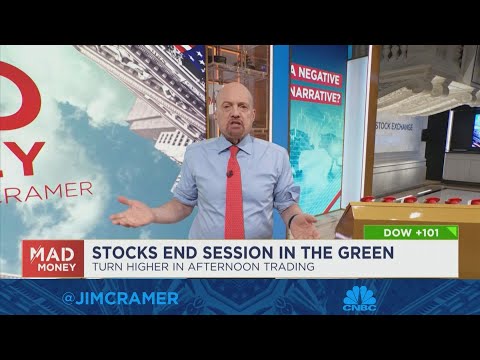
Market Overview - The NASDAQ experienced a significant selloff that quickly affected larger averages, leading to concerns about a potential market decline due to the Federal Reserve's tightening policies [1][2] - Despite initial fears, the market rebounded with the Dow finishing up 100 points, S&P gaining 0.33%, and NASDAQ increasing by 28% [2] Market Sentiment - There is a prevailing narrative among commentators that the stock market is on the verge of collapse, despite the absence of a significant decline since October [3][4] - The market has shown resilience, with new sectors turning bullish after minor sell-offs, contradicting the bearish expectations [4] IPO and SPAC Performance - The IPO market saw nearly 400 launches in 2021, many of which performed poorly, particularly SPACs, with about half trading below $2 [5][7] - The performance of new cloud software companies has disappointed, leading to a shift in focus from revenue growth to actual earnings [8] Economic Indicators - Major banks like Wells Fargo, Citigroup, and JP Morgan reported strong quarterly results, indicating stability in lending units and commercial real estate [17] - Auto loans, home loans, and commercial loans are performing better than expected, suggesting a stable economic environment [18] Market Dynamics - The current interest rate environment allows for attractive returns on cash, with rates around 4.15% for savings accounts, which some view as a bearish signal for equities [10][11] - Despite negative rhetoric surrounding the market, positive economic data continues to be overlooked, with a focus on recession fears dominating discussions [20][21] Future Outlook - There is an expectation that upcoming positive economic numbers will be dismissed, reflecting a pattern in the current bull market where good news is often overshadowed by bearish narratives [22]

Jim Cramer shares his take on whether the bulls have won the war on sentiment
CNBC Television· 2025-11-06 17:29
We start off with the tough NASDAQ selloff, right. And that quickly bled over to the larger averages almost instantly. I'm not kidding.Within 15 minutes of the opening, we heard that the bull last legs. That's right. And here comes the big unwind as large cap tech starts rolling over.We are then told, of course, that the multi-month rally was bogus all along. Just a short squeeze because the Fed's going to crush us again the next time it tightens. We were told the market was about to get its comeuppins.Yet ...
X @Investopedia
Investopedia· 2025-11-05 19:30
Instead of worrying about the economy, take action now. These are five steps you can take to protect your finances in the event of a recession. https://t.co/DYUQZI1EQU ...
X @Anthony Pompliano 🌪
Anthony Pompliano 🌪· 2025-11-05 01:18
I sat down with @JohnPompliano to discuss Scott Bessent’s U.S. outlook, Tom Lee’s bullish call, and Jordi Visser’s take on Bitcoin’s “IPO moment.”We also cover job growth, mega themes, the New York City mayoral race, and my latest thoughts on bitcoin and stocks.Enjoy!YouTube: https://t.co/1uahYJ2DwxApple: https://t.co/Wt47m30r9sSpotify: https://t.co/A7WXLeUP2xTIMESTAMPS:0:00 – Intro0:23 – Are we in a recession?4:22 - Powell vs Bessent: interest rate politics7:35 - The case for an economic boom11:51 - Tom Le ...
Recession Odds, Bitcoin's Future & NYC Mayor Election
Anthony Pompliano· 2025-11-04 22:00
What's going on, guys. Today we got a great episode with John Pompiano. We cover everything.What Scott Besson thinks about the US economy, why Tom Lee is so bullish, how Jordy Visser thinks the Bitcoin market is going through an IPO moment, and then we even talk about job creation, mega AI deals, what's going on with the New York City mayor race, which is happening today, and of course, I give you all my thoughts on Bitcoin stocks, and much more. Here's my latest conversation with John Pompiano. All right, ...

Trump Aides Raise Recession Fears, and Point Fingers at the Fed
Nytimes· 2025-11-04 19:21
Core Viewpoint - Treasury Secretary Scott Bessent indicated that certain sectors are experiencing a recession and advocated for additional interest rate cuts [1] Group 1 - Some sectors are currently in a recession, highlighting economic challenges [1] - The call for more interest rate cuts suggests a strategy to stimulate economic growth [1]

This Bull Market Could Be Headed For The Slaughterhouse
Forbes· 2025-11-04 11:35
Group 1 - The Federal Reserve is facing criticism for maintaining high interest rates, with some arguing that this is constraining lending and economic growth, particularly for small businesses [3][4] - Stephen Miran, a new Fed governor, advocates for a 50 basis point cut in interest rates, emphasizing recession risks over inflation concerns, while Jerome Powell remains cautious about any rate reductions due to economic uncertainty [2][6] - The current high borrowing costs in the U.S. are compared unfavorably to those in Japan and the EU, suggesting that the U.S. economy's fundamentals are stronger than those of these regions [3][4] Group 2 - The article highlights that monetary inflation, rather than external factors like tariffs or production disruptions, is a key concern for the Fed, with gold prices doubling in the past two years indicating potential future inflation [5][6] - The Fed's approach of manipulating interest rates is questioned, as historical data shows that high interest rates did not effectively combat inflation in the past, and ultra-low rates post-2008 did not stimulate significant economic growth [8][9] - A call is made for a stable dollar and lower tax rates and regulations to support stock and bond markets, suggesting that without these measures, the current bull market may be at risk [9]