
加密货币

Search documents
亿万富豪双胞胎,要IPO了
投中网· 2025-08-23 07:03
Core Viewpoint - The article discusses the potential of Gemini, a cryptocurrency exchange, to replicate the wealth creation seen in the industry, especially in light of its upcoming IPO and the recent success of other digital currency companies in the U.S. stock market [3][12]. Company Overview - Gemini was founded in 2014 by Tyler and Cameron Winklevoss, who became billionaires through early investments in Bitcoin and have a notable history linked to Facebook [4][5]. - The company aims to be the most compliant cryptocurrency exchange, having obtained a trust license from the New York State Department of Financial Services in 2015, allowing it to operate legally in New York [6]. Business Performance - As of June 30, 2025, Gemini serves approximately 523,000 monthly transacting users (MTU) and around 10,000 institutions, with total assets exceeding $18 billion and cumulative trading volume surpassing $285 billion [7]. - In 2023, Gemini reported revenues of $98.14 million, which increased to $142 million in 2024, but saw a decline to $68.61 million in the first half of 2025, a 7.6% decrease year-over-year [9]. Financial Challenges - The company has faced increasing losses, with net losses of $320 million in 2023, $159 million in 2024, and $282 million in the first half of 2025 [10]. - Rising operational costs, including an increase in employee count from 500 in 2024 to 650 in 2025, have contributed to the financial strain, with personnel costs accounting for 40% of total expenses [11]. Market Environment - The IPO wave among cryptocurrency exchanges reflects a favorable market trend, with regulatory environments becoming more predictable under the current administration [15]. - Despite the positive regulatory shifts, competition is intensifying from both established exchanges like Coinbase and Bullish, as well as traditional financial institutions entering the crypto space [16]. Future Prospects - Gemini's upcoming IPO is expected to raise over $400 million, with plans to use the funds for debt repayment and business development, emphasizing compliance and global expansion [16]. - The company is also adapting to the regulatory landscape by splitting its operations into two entities to better manage compliance challenges [16].


以太坊深夜暴涨,超16万人爆仓
Zhong Guo Ji Jin Bao· 2025-08-23 03:11
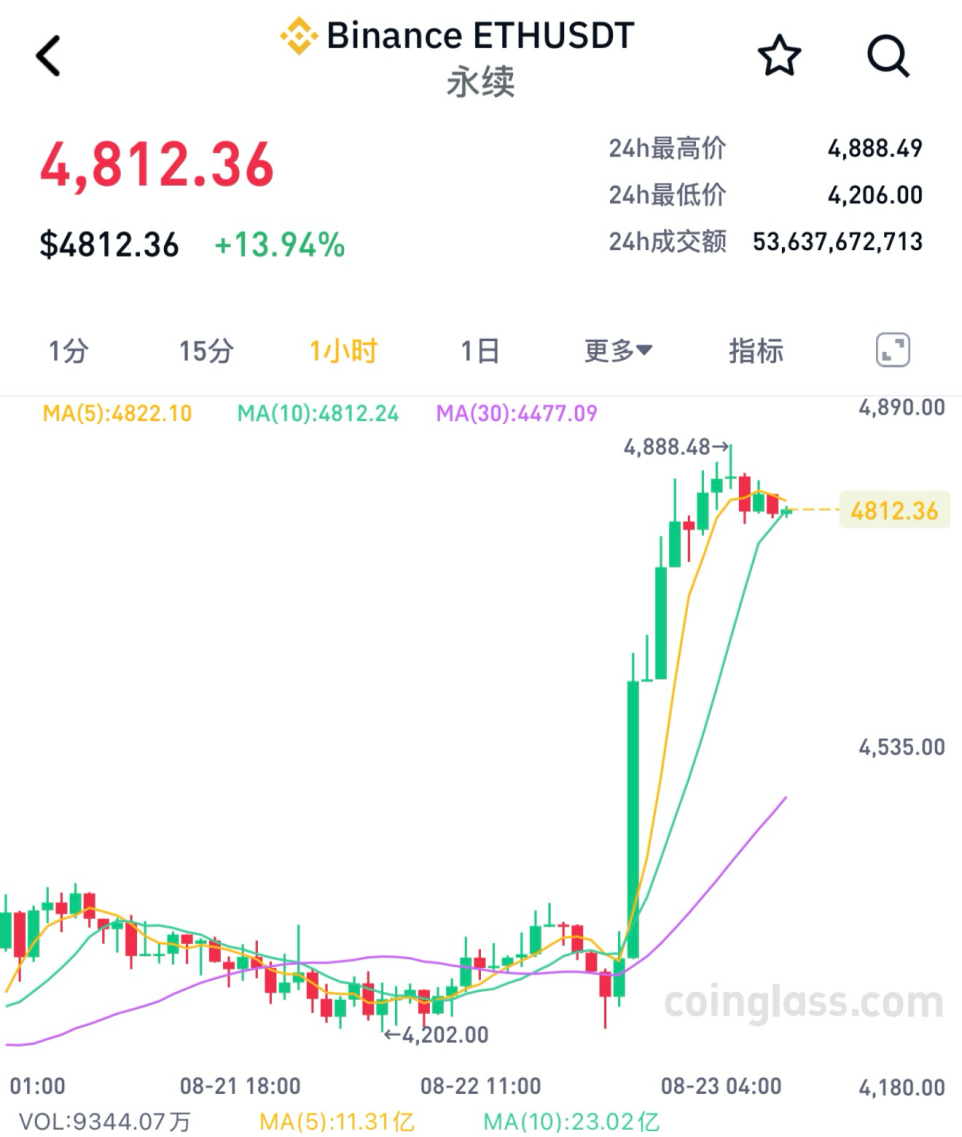
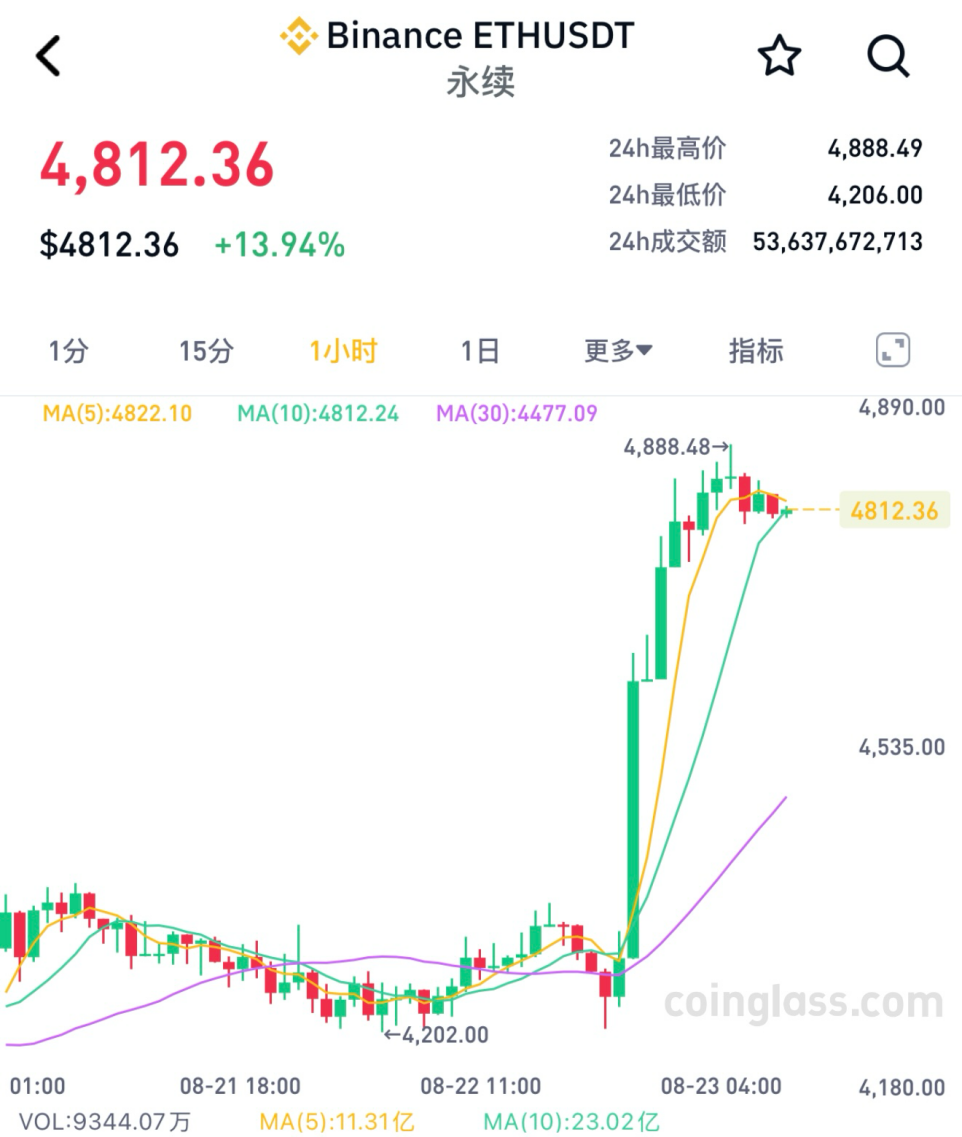
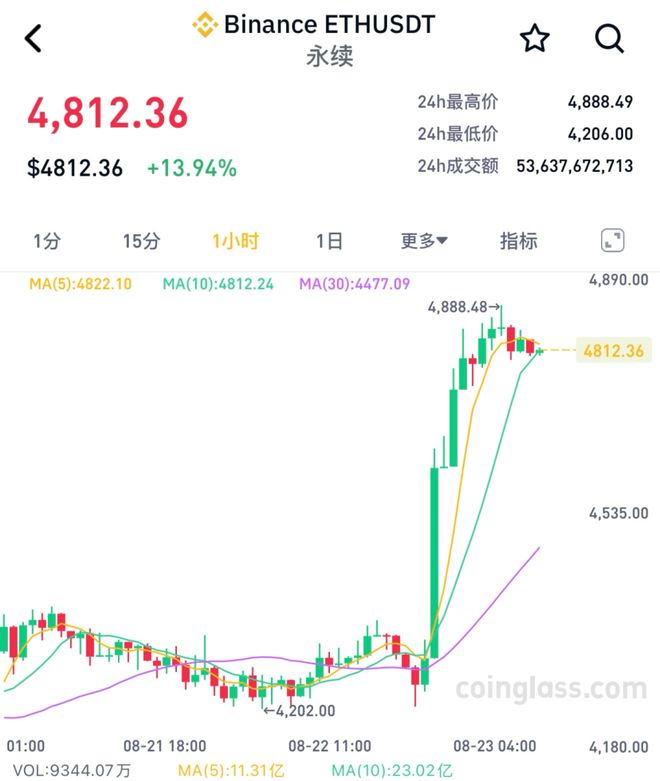
Group 1: Market Reaction to Federal Reserve's Stance - Federal Reserve Chairman Jerome Powell's dovish speech at Jackson Hole led to a significant rally in the cryptocurrency market, particularly Ethereum [1][6] - Ethereum's price surged to $4,888.48, surpassing its previous all-time high of $4,878 set in November 2021 [2] - Other cryptocurrencies, including Bitcoin, XRP, and BNB, also experienced gains of over 3% [3] Group 2: Market Data and Liquidations - Over the past 24 hours, more than 160,000 traders were liquidated in the cryptocurrency market, with a total liquidation amount of $694 million [4][5] - Among the liquidations, long positions accounted for $230 million, while short positions totaled $470 million [4] Group 3: Economic Context and Regulatory Developments - Powell indicated that the Federal Reserve is open to adjusting its policy stance, suggesting a potential for interest rate cuts due to changing economic conditions [6] - The European Union is reportedly seeking to accelerate the launch of a euro-pegged stablecoin, potentially on Ethereum or Solana blockchains, following regulatory developments in the U.S. regarding crypto assets [6] - Recent regulatory advancements in the U.S. have made the Ethereum ecosystem more attractive, according to analysts [7]
以太坊深夜暴涨 “超16万人爆仓”
Zhong Guo Ji Jin Bao· 2025-08-23 02:46
Group 1 - Federal Reserve Chairman Jerome Powell's dovish speech at Jackson Hole led to a surge in the cryptocurrency market, particularly Ethereum, which reached a new all-time high of $4,888.48, surpassing its previous record of $4,878 set in November 2021 [1][6] - Over the past 24 hours, more than 160,000 traders were liquidated in the cryptocurrency market, with a total liquidation amount of $694 million, including $230 million in long positions and $470 million in short positions [1][5] - Other cryptocurrencies also experienced gains, with Bitcoin, XRP, and BNB all rising over 3% [3] Group 2 - Powell indicated that the Federal Reserve may need to adjust its policy stance, interpreting this as a potential signal for interest rate cuts, as the U.S. economy shows resilience despite rising inflation [6] - The balance of risks is shifting, with inflationary pressures easing while employment risks are increasing, allowing the Fed to act cautiously in considering policy adjustments [6] - Reports suggest that EU officials are seeking to accelerate the launch of a euro-pegged stablecoin, potentially on Ethereum or Solana blockchains, following U.S. regulations on crypto assets [6]
深夜暴涨,“超16万人爆仓”
Zhong Guo Ji Jin Bao· 2025-08-23 02:43
Group 1 - Ethereum price surged to $4,888.48, breaking its previous all-time high of $4,878 set in November 2021 [2] - Over 160,000 traders were liquidated in the past 24 hours, with a total liquidation amount of $694 million, including $230 million in long positions and $470 million in short positions [5][6] - Other cryptocurrencies also experienced gains, with Bitcoin, XRP, and BNB rising over 3% [4] Group 2 - Federal Reserve Chairman Jerome Powell indicated a potential shift in monetary policy, suggesting a cautious approach to interest rate adjustments, which was interpreted as a dovish signal by the market [7] - The European Union is reportedly seeking to accelerate the launch of a euro-pegged stablecoin, potentially on the Ethereum or Solana blockchain [8] - Recent regulatory developments in the U.S. have made the Ethereum ecosystem more attractive, with banks expected to play a significant role in the growth of Bitcoin and cryptocurrencies [9]
深夜暴涨,“超16万人爆仓”
中国基金报· 2025-08-23 02:40
Core Viewpoint - The cryptocurrency market experienced a significant surge following Federal Reserve Chairman Jerome Powell's dovish remarks, with Ethereum reaching a new all-time high of $4,888.48, surpassing its previous peak of $4,878 from November 2021 [2][4]. Market Performance - Ethereum's price increased by 13.31% in the last 24 hours and 7.30% over the past week, with a market capitalization of $580.19 billion and a trading volume of $76.08 billion [7]. - Other cryptocurrencies also saw gains, with Bitcoin, XRP, and BNB rising over 3% [6]. Liquidation Data - Over the past 24 hours, more than 160,000 traders were liquidated, resulting in a total liquidation amount of $694 million, with long positions accounting for $230 million and short positions for $470 million [8][10]. - The liquidation breakdown shows that in the last hour, $5.32 million was liquidated, while in the last 12 hours, the total reached $530 million [8]. Federal Reserve Remarks - Powell indicated that the Federal Reserve may need to adjust its policy stance, suggesting a potential for interest rate cuts, as inflation risks have diminished while employment risks have increased [10]. - The current policy rate is 100 basis points lower than a year ago, allowing for cautious adjustments in response to changing economic conditions [10]. Regulatory Developments - Following the U.S. regulations on crypto assets linked to the dollar, EU officials are reportedly seeking to expedite the launch of a euro-pegged stablecoin, potentially on Ethereum or Solana blockchains [11]. - Recent regulatory developments in the U.S. have made the Ethereum ecosystem more attractive, with banks expected to play a crucial role in the growth of Bitcoin and the broader cryptocurrency sector [11].

以太币时隔四年再创历史新高
Jin Rong Jie· 2025-08-23 01:43
Core Viewpoint - Ethereum experienced a significant price increase, rising over 5% in a single day and surpassing its historical high of $4,871.42 set in early November 2021, with a cumulative increase of over 250% since the low point in April 9 of this year, bringing its total market capitalization to approximately $590 billion [1] Group 1 - Ethereum's price surpassed the historical high of $4,871.42 [1] - The cryptocurrency has seen a cumulative increase of over 250% since its low on April 9 [1] - The total market capitalization of Ethereum is around $590 billion [1]
博雅互动游戏主业承压 布局Web3前景几何?
Zhong Guo Jing Ying Bao· 2025-08-22 20:58
Core Viewpoint - The company aims to transform into a pure, leading Web3 listed company while facing challenges in its core gaming business, which accounts for 97.3% of total revenue and is experiencing a decline in revenue and paying player numbers [2][3] Group 1: Company Overview - Boyaa Interactive, established in 2004, focuses on the development of card games and was listed on the Hong Kong Stock Exchange in 2013, with key products including Texas Hold'em and Dou Di Zhu [3] - In 2023, Tencent (20% stake) and Phoenix Capital (15% stake) invested in Boyaa Interactive, providing technical support and overseas channels to assist in its digital transformation [3] - As of mid-2025, Boyaa Interactive had 226 employees, with the majority (182) engaged in game development and operations [4] Group 2: Financial Performance - For the first half of 2023, Boyaa Interactive reported revenue of HKD 223 million, a year-on-year decline of 5.2%, and a net profit of approximately HKD 226 million, down 27.79% year-on-year [3] - The gross profit margin was 68.2%, compared to 71.1% in the same period last year [3] - The decline in net profit was attributed to a decrease in the fair value growth of digital assets compared to the previous year [3] Group 3: Gaming Business Challenges - The performance of key gaming products like Texas Hold'em is declining, with a 3.5% decrease in paying player numbers from Q1 to Q2 2025 [5] - Daily active users were approximately 1.23 million, down 1.0% from Q1, while monthly active users increased by 2.5% to about 4.5 million [5] - Revenue from Texas Hold'em was HKD 140 million, down 2.6% year-on-year, while other card games generated HKD 75.95 million, down 6.7% [5] Group 4: Web3 Transition - Boyaa Interactive is actively pursuing a transition to the Web3 sector, having already made investments in cryptocurrencies, including purchasing USD 5 million worth of crypto in August 2023 [7] - As of mid-2025, the company held approximately 3,353 Bitcoins at an average cost of USD 58,695 per coin and 298 Ethers at an average cost of USD 1,661 per coin, primarily for Web3 game development [7] - The company plans to use 90% of the proceeds from a new share placement, totaling up to HKD 441 million, to further develop its Web3 business, including game R&D, infrastructure, and ecosystem building [8]


比特矿业上涨5.57%,报3.22美元/股,总市值5744.62万美元
Jin Rong Jie· 2025-08-22 16:02
Core Viewpoint - Bit Mining (BTCM) experienced a 5.57% increase in stock price, reaching $3.22 per share, with a total market capitalization of $57.4462 million as of August 22 [1] Financial Performance - As of June 30, 2025, Bit Mining reported total revenue of $11.013 million, a year-over-year decrease of 43.11% [1] - The company recorded a net loss attributable to shareholders of $13.899 million, representing a year-over-year decline of 173.35% [1] Company Overview - Bit Mining Limited (NYSE: BTCM) is recognized as one of the world's leading publicly traded cryptocurrency mining companies [1] - The company's operations include cryptocurrency mining, mining pool, and data center operations [1] - Bit Mining has a theoretical hash rate of 1,425.3 PH/s and operates the entire mining pool business under BTC.com, including the domain and cryptocurrency wallet [1] Strategic Focus - As part of its growth strategy, the company aims to prioritize the development of low-carbon energy [1] - Bit Mining plans to expand its data centers and hash computing capacity globally to strengthen its industry-leading position [1]

加密货币生态圈股票走高 Circle(CRCL.US)涨近8%
Zhi Tong Cai Jing· 2025-08-22 14:58
周五,加密货币生态圈股票走高,截至发稿,比特币概念股Bit Digital(BTBT.US)涨超5%,Hut 8 Mining(HUT.US)涨超6.8%,Strategy(MSTR.US)涨超4%;以太坊概念股Bitmine Immersion Technologies(BMNR.US)涨超8%,Bit Digital(BTBT.US)涨近5%,加密货币交易所Coinbase(COIN.US)涨 超5.9%,Robinhood(HOOD.US)涨近3%;稳定币龙头Circle(CRCL.US)涨近8%。以太坊涨超8.6%,报 4619.75美元;比特币涨超3%,报115972美元。 ...
以太坊突破4500美元,现报4500.4美元,24小时涨幅达到5.12%
Mei Ri Jing Ji Xin Wen· 2025-08-22 14:20
每经AI快讯,以太坊突破4500美元,现报4500.4美元,24小时涨幅达到5.12%。 ...