激光雷达

Search documents
水晶光电(002273) - 2025年5月7日投资者关系活动记录表
2025-05-08 09:48
Group 1: Production Base Adjustments - The company has initiated adjustments to its four major production bases to better align with customer needs, with an expected completion time of one to two years [2] - The Taizhou main plant will serve as the core practice base for North American clients, while the Jiangxi base will focus on domestic circulation [2] Group 2: Laser Radar Window Products - Laser radar is crucial for safe driving, especially in adverse weather conditions, and the trend of integrating laser radar into vehicles is increasing [2] - The company supplies glass-based laser radar windows and maintains a leading market share in this segment, collaborating with major domestic and international laser radar manufacturers [2] Group 3: Waveguide Technology - The company is focusing on reflective waveguide technology, which offers advantages in full color, high resolution, and wide field of view, but faces global mass production challenges [3][4] - Currently, there are no large-scale consumer market applications for full-color reflective waveguide AR glasses in China [3] Group 4: Competitive Analysis of Waveguide Technologies - Reflective waveguides excel in resolution, clarity, and color uniformity, but their mass production remains a global challenge [4] - Diffractive waveguides have advantages in cost-effectiveness and mass production for small field-of-view applications, but struggle with full-color display quality [4] Group 5: Optical Machine Layout for AR Glasses - The company has been involved in optical module development for AR glasses for over a decade and continues to follow advancements in optical machine solutions [6] - The focus is on developing optical components necessary for optical machines, aligning with the company's strategic resource allocation [6] Group 6: Client Collaboration and Market Dynamics - The company is currently in a technical research collaboration phase with major North American clients, focusing on optical innovations for smart devices [7] - Despite potential tariff impacts, the company has not yet faced price adjustment demands from clients, maintaining resilience through ongoing optical hardware upgrades [7]

靳玉志:华为乾崑有一个伟大愿景,把智能带入每一辆车(完整版)|凤凰《封面》
凤凰网财经· 2025-04-29 12:39
出品 | 凤凰网财经《封面》 主持人丨张涛 制片人 | 李念雪 2024 年,中国新能源汽车市场渗透率首次突破 50% ,这意味着每卖出去两辆车,就有一辆是新能源,而智能化也无疑成为车企角逐的核心战场。 在这场浪潮中,华为乾崑用亮眼的成绩单,为行业注入了一剂强心针。 2025 年 4 月,执掌车 BU 一年多的 CEO 靳玉志带着 HUAWEI ADS 4 亮 相华为乾崑智能技术大会,期间,首次在凤凰网财经《封面》专访中完整阐述了华为乾崑的愿景 ——" 把智能带入每一辆车 " 。 这位在华为扎根 20 余年的 " 技术派 " 高管,身上带着鲜明的华为基因:务实、长期主义,忠于技术。也是技术的相通性,支撑了靳玉志从光产品 线到智能汽车赛道的丝滑转型,"我们只是进入汽车行业中智能化的部分,根基还是 ICT 技术,如果一定要说区别,那就在于过去更多面向 B 端, 现在增加了 C 端用户。" 公开年报显示, 2024 年华为研发投入达到 1797 亿元,约占全年收入的 20.8% 。靳玉志向《封面》透露,其中车 BU 的直接投入"已超大几百 亿",面对是否有盈利压力的提问,他从容回应: " 华为乾崑一贯的战略就是帮助 ...
发布“千厘眼”方案及三款新品,禾赛深化“ADAS+机器人”双线战略
Jing Ji Guan Cha Bao· 2025-04-22 01:21
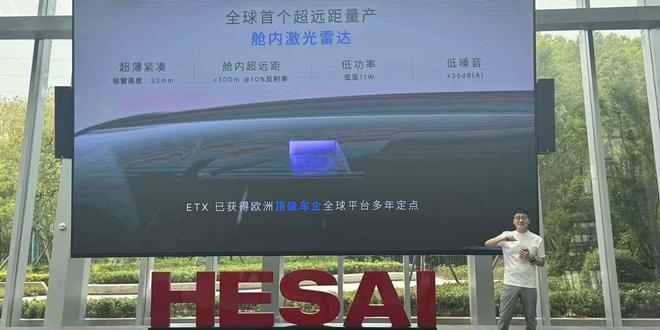
Core Viewpoint - Hesai Technology has launched its "Qianliyan" lidar perception solution aimed at L2 to L4 autonomous driving, introducing three new vehicle-grade products: ETX ultra-long-range lidar, AT1440 ultra-high-definition lidar, and FTX pure solid-state blind-spot lidar [2][4]. Group 1: Product Launch and Market Positioning - The "Qianliyan" solution allows OEMs to adapt to different vehicle needs based on a unified technology platform, reducing development cycles [4]. - The "Qianliyan A" for L4 autonomous driving uses 4 AT1440 ultra-high-definition radars and 4 FTX solid-state blind-spot radars, suitable for Robotaxi and Robotruck scenarios [4]. - Hesai has maintained the top global market share in vehicle-mounted lidar for four consecutive years, with ETX already designated for mass delivery by the end of 2026 to leading European OEMs [4]. Group 2: Technological Advancements - The core of the product iteration is Hesai's fourth-generation self-developed chip platform, which increases the line count to 1440 and achieves a point frequency 45 times that of mainstream products [4]. - The integration of transmission, reception, and processing units into a single chip has improved the core component reuse rate to 85% [4]. Group 3: Diversification and Market Expansion - The expansion into the robotics sector helps mitigate cyclical risks in the vehicle market, providing diverse application scenarios for its technology [6]. - Hesai has developed four product lines based on the fourth-generation chip, covering vehicle, robotics, and industrial applications [6]. - The revenue share from the robotics business is projected to increase from 5% to 15% by 2024, with significant partnerships established across various sectors [6]. Group 4: Challenges and Competitive Landscape - The mass production capability of high-performance products remains a critical challenge, particularly for the AT1440's 1440-line design, which depends on stable supply of the fourth-generation chip [8]. - The long-term stability of the FTX solid-state lidar in extreme environments has yet to be fully validated [8]. - The commercial viability of the "Qianliyan A" solution for L4 autonomous driving is still in its early stages, requiring collaboration across regulations and infrastructure [8]. - Competitors like Suteng Ju Chuang are rapidly advancing, with their recent launch of the 192-line EMX lidar presenting a competitive challenge to Hesai's AT1440 [8].