Tariffs

Search documents
Logistics Data Points To An Imminent Recession
Seeking Alpha· 2025-10-10 13:28
Economic Growth - Economic growth has shown resilience in 2025 year-to-date despite negative macroeconomic conditions caused by the trade war and tariffs [1] - The primary reason for this resilience is likely attributed to frontloading [1]
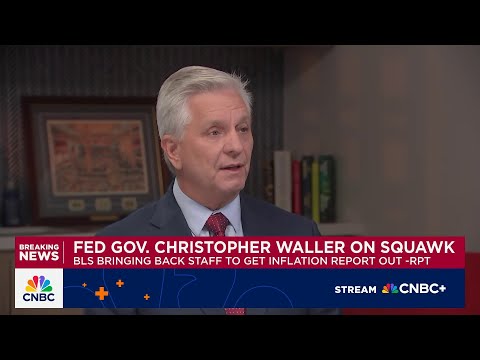
Fed Governor Chris Waller: Still believe we need to cut rates, but need to be 'cautious about it'
CNBC Television· 2025-10-10 12:18
Monetary Policy & Economic Data - The Fed is closely monitoring private sector data to compensate for potential government data delays, but acknowledges it may not be fully representative [4][5] - The Fed considers the labor market weakness as a key factor in policy decisions, with concerns about negative job growth [6][7] - The Fed acknowledges the importance of CPI data for assessing inflation, especially regarding colleagues' concerns [10][11] - The Fed views tariff effects as one-off events and focuses more on the labor market when setting policy [12][14] Labor Market Assessment - The labor market is considered weak, with negative job growth and a lack of hiring plans reported anecdotally [6][7][8] - There is no evidence of a tight labor market, with no wage increases or rising vacancies [15][16] Inflation & Tariffs - Tariff effects are seen as one-time price increases, not causing persistent inflation, consistent with central bank's long-standing view [12][13] - Businesses are passing tariffs through to higher-income consumers but not to lower-income consumers [18][19] - There's an estimated 40% pass-through of tariffs to prices, showing a correlation between tariff size and price changes [19] Future Policy Direction - The Fed is leaning towards cutting rates but cautiously, considering the divergence between a weak labor market and strong GDP growth (close to 4%) [20][22] - The Fed prefers a gradual approach to rate cuts (quarter point) to allow for adjustments based on incoming data [23] Private Credit Market - The Fed does not view the private credit market as a significant systemic risk due to the substantial equity positions involved [24][25]

X @Bloomberg
Bloomberg· 2025-10-10 04:50
Japan’s economy likely contracted in the third quarter after five consecutive periods of growth, as US President Trump’s tariffs campaign took a toll on exports, according to a Bloomberg survey of economists https://t.co/nB3jYfSx5L ...
X @Bloomberg
Bloomberg· 2025-10-10 00:24
Mexican lawmakers will pause discussion of a government proposal to impose tariffs of as much as 50% on cars, steel and other products imported from China and several other Asian nations https://t.co/uYLi28Z5x0 ...
X @The Economist
The Economist· 2025-10-09 23:40
Economic models assumed tit-for-tat tariffs; instead, America’s partners have largely held fire. Rather than retaliate, many countries are diversifying their trade https://t.co/G7x8bPUDlT ...
Levi Strauss forecasts annual profit below estimates as tariffs bite
Yahoo Finance· 2025-10-09 22:38
Core Insights - Levi Strauss raised its full-year profit forecast but fell short of Wall Street expectations due to costs associated with U.S. import tariffs, resulting in a 7.5% decline in shares during extended trading [1] - The company has secured about 70% of its holiday inventory ahead of schedule and has raised prices modestly to mitigate the impact of U.S. tariff policies [1][2] - Despite these efforts, the fourth-quarter gross margin is expected to decline by 130 basis points [2] Financial Performance - Levi now expects fiscal-year 2025 adjusted profit per share to be between $1.27 and $1.32, an increase from the previous forecast of $1.25 to $1.30, although the midpoint is below the analyst estimate of $1.31 [3] - The forecast assumes that U.S. tariffs will remain at 30% for China and 20% for other countries through the end of the year [3] - The company reported a 7% increase in net revenue for the quarter ending August 31, reaching $1.54 billion, surpassing analysts' expectations of $1.50 billion [6] Market Position and Strategy - Merchandise levels increased by 12% compared to the previous year, with the majority of products sourced from South Asia, which faces high tariffs under the current administration [5] - Levi has focused on full-price sales through its direct-to-consumer channel, expanded its product offerings, and maintained strict control over inventory [4]

X @The Economist
The Economist· 2025-10-09 19:20
In parts of America’s economy, the pain caused by tariffs is real. But six months on from “Liberation Day”, the full reckoning has not yet arrived. Why the good news? https://t.co/NBcNzajijl ...
Tariffs cause some China imports to crash 44% in September
Yahoo Finance· 2025-10-09 18:16
Core Insights - Container imports through U.S. maritime gateways in September declined 8.4% from August to over 2.3 million TEUs, marking the third-highest September on record and a 1.9% increase compared to the same period in 2024, indicating resilient demand despite trade uncertainties [1] Import Trends - Imports from China fell 12.3% month-over-month and 22.9% year-over-year, with significant declines in aluminum (43.8%), footwear (33.9%), and electric machinery (31.5%), while plastics saw a minor drop of 1.5% but increased their share of total Chinese exports to 13.5% [1] - The top 10 countries of origin for imports saw a 9.4% month-over-month decline, totaling 169,126 TEUs, with China leading the drop at 106,751 TEUs. Other notable declines were from Italy (15.1%), South Korea (14.1%), Germany (11.6%), Hong Kong (11.2%), and Taiwan (10.2%) [6] U.S. Trade Policy Impact - The Trump administration's restructuring of U.S. trade through tariffs has led to unintended consequences, pushing China to seek alternative export markets in Europe and increasing costs for American manufacturers [2] - The U.S. accounted for 11.9% of all of China's exports in the first half of the year, despite a 10.7% year-over-year decline in shipments [3] Market Pressures - China imports face additional pressures in the U.S. market, including the elimination of Customs import duties for shipments valued under $800 and upcoming costly port fees for China-linked ships [4] - Chinese retail giants like Temu and Shein have adapted by shifting to a model where U.S.-based sellers manage fulfillment and building their own warehouses in North America to maintain competitive pricing for U.S. consumers [5] Port Activity - The top 10 U.S. ports experienced a 7.9% month-over-month decline in containerized imports, totaling a drop of 169,455 TEUs, with notable declines at Baltimore (12.6%), Long Beach (11.4%), and Savannah (9.1%), while Tacoma was the only port to see an increase at 4.7% [7]
X @The Wall Street Journal
The Wall Street Journal· 2025-10-09 16:23
Market Trends - Initial public offerings rebounded in Q3 due to short-term clarity on tariffs and interest rates [1] - Momentum is expected to continue into the next year for IPOs [1]
Holiday Spending: Tariffs May Nudge Prices, but Not Shoppers
PYMNTS.com· 2025-10-09 15:44
Group 1: Consumer Behavior - Consumers are increasingly relying on card installments and Buy Now, Pay Later (BNPL) options to manage higher costs during the holiday shopping season [1][10] - Nearly 22 million U.S. consumers utilized both private-label and general-purpose credit cards for installment payments, reflecting a 5.3% compound annual growth rate [7] - BNPL adoption has been crucial for sustaining sales volumes, with 90% of surveyed merchants indicating it helped maintain sales despite price increases [10] Group 2: Retailer Confidence and Pricing Strategies - 80% of companies across various industries express high confidence in adapting to tariff-related supply-chain disruptions, with goods-sector firms showing even higher confidence at 85.2% [3][4] - Despite confidence, 9 in 10 goods firms and over 70% of services firms raised prices in the past year, yet many experienced margin compression [5] - Retailers are expected to implement modest, selective price adjustments to preserve consumer volume while protecting margins during the crucial December quarter [6] Group 3: Economic Adaptation - Retailers have diversified suppliers and adjusted pricing strategies to navigate tariff impacts, while consumers are managing price pressures through structured borrowing tools [12] - The overall sentiment indicates that while tariffs may increase costs, they do not deter consumer spending intentions [12]