供应链依赖

Search documents
美国贸易逆差减半!特朗普关税有效了?
Sou Hu Cai Jing· 2025-06-15 10:21
Core Insights - Trump's tariff strategy has achieved its intended purpose, as evidenced by a significant reduction in the U.S. trade deficit in April 2023, which fell by 55.5% to $61.6 billion, marking the smallest trade deficit since September 2023 [1][4] - The reduction in the trade deficit was primarily driven by a historic 16% drop in imports, particularly in consumer goods and pharmaceuticals, while exports saw a slight increase of 3% [1][4] Trade Deficit Analysis - The April trade deficit's sharp decline is attributed to a record drop in imports, with consumer goods and pharmaceuticals being key contributors [4][5] - The decrease in imports in April followed a surge in March, where businesses stockpiled goods to avoid the impact of tariffs that took effect on April 2, leading to an unusually high trade deficit of $138.3 billion in March [6][8] Short-term Effects and Structural Issues - While tariffs have temporarily suppressed imports, this has resulted in a high trade deficit in March and potential inventory buildup that could hinder GDP growth in the second quarter [6][8] - Historical data indicates that during Trump's first term, trade tensions led to a 50% increase in the overall trade deficit compared to 2017, as companies found ways to circumvent tariffs through third-country trade [7][14] Economic Consequences - The U.S. labor market showed signs of fatigue in April, with initial jobless claims rising to 247,000, and manufacturing PMI contracting, suggesting that tariffs may contribute to inflationary pressures [8][14] - The fundamental issue of the U.S. trade deficit is rooted in savings-investment imbalance, with low savings rates and high consumption levels, making it difficult for tariffs alone to address the underlying economic structure [14][16] Long-term Outlook - The trade deficit with China is projected to reach $295.4 billion in 2024, indicating persistent reliance on Chinese supply chains despite tariff measures [14][16] - A comprehensive reduction in the U.S. trade deficit appears nearly impossible given the current economic structure, as high labor costs and weak industrial capacity limit the ability to produce domestically [17]

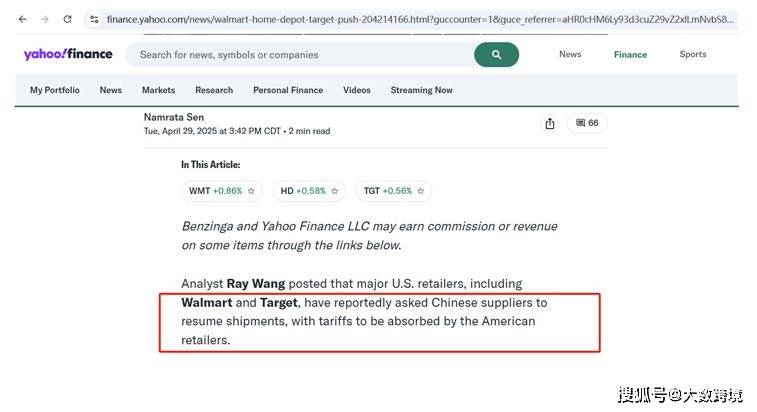
20天大反转!美国零售巨头集体认怂,催促中国供应商发货
Sou Hu Cai Jing· 2025-05-06 09:18
Group 1 - The core viewpoint of the articles highlights the significant impact of tariff policies on the U.S. retail sector, prompting major retailers like Walmart to rapidly adjust their procurement strategies to mitigate supply chain disruptions [1][2]. - Walmart's shift from requiring Chinese suppliers to bear the new tariffs to absorbing the costs themselves occurred within a span of just over 20 days, indicating the urgency of the situation [1]. - The implementation of tariffs has led to a 33% reduction in cargo ships arriving from China at the Port of Los Angeles and a 30% vacancy rate on supermarket shelves across the U.S., highlighting severe supply chain issues [1]. Group 2 - The U.S. Consumer Price Index (CPI) rose by 9.8% in April, with tariffs contributing 43% to this increase, significantly affecting the daily spending of American households, particularly low-income families [2]. - Walmart's CEO warned that if supply issues were not resolved within two weeks, 59% of swing state voters might turn against Trump due to rising prices, indicating the political ramifications of the tariff situation [2]. - The structural weaknesses in the U.S. supply chain have been exposed by the tariff policies, as domestic production capacity is insufficient to replace Chinese manufacturing despite efforts to bring manufacturing back to the U.S. [2]. Group 3 - Countries like Mexico, Vietnam, and India are viewed as potential alternatives to China for manufacturing; however, their production capacity and supply chain integrity are significantly inferior to that of China, making it difficult to meet U.S. market demands in the short term [3]. - The U.S. Customs' strict scrutiny of transshipment trade has resulted in 37% of Chinese goods being seized, further exacerbating market tensions and highlighting the ongoing reliance on Chinese manufacturing [3].