消费品

Search documents
事关促消费、稳外贸,商务部最新回应
Di Yi Cai Jing· 2026-02-27 10:28
Core Insights - The Ministry of Commerce aims to optimize and upgrade goods trade, expand diverse markets, and cultivate new momentum for foreign trade, with a focus on enhancing service trade and digital trade [1][3] Trade Performance - In 2025, China's total goods import and export value is expected to exceed 45 trillion yuan, maintaining its position as the world's largest goods trading nation for nine consecutive years [2] - The import and export value with Belt and Road countries reached 23.6 trillion yuan, accounting for 51.9% of total trade [2] - High-tech product exports amounted to 5.25 trillion yuan, representing 19.5% of total exports [2] Service Trade Development - The total service import and export value is projected to surpass 8 trillion yuan in 2025, with a year-on-year growth of 7.4%, and service exports increasing by 14.2% [2] - The Ministry of Commerce is implementing a negative list for cross-border service trade and promoting a gradual opening of the service market [2] Consumption and Economic Growth - Consumption's contribution to economic growth reached 52%, an increase of 5 percentage points from the previous year [5] - The total retail sales of consumer goods are expected to exceed 50 trillion yuan in 2025, with the "old for new" consumption policy driving sales of 2.61 trillion yuan, benefiting 366 million people [5] - Service retail sales are projected to grow by 5.5%, with significant growth in leisure, tourism, and transportation services [5] Future Initiatives - The Ministry of Commerce plans to implement a dual-driven approach of "policy + activities" to boost consumption and strengthen the domestic market [6]


2026年1月份居民消费价格同比上涨0.2% 猪肉价格下降13.7%
Guo Jia Tong Ji Ju· 2026-02-24 08:31
Core Insights - In January 2026, the national consumer price index (CPI) increased by 0.2% year-on-year, with urban areas rising by 0.2% and rural areas by 0.1% [1] - Food prices decreased by 0.7%, while non-food prices increased by 0.4% [1] - Month-on-month, the CPI also rose by 0.2%, with both urban and rural areas showing a 0.2% increase [1] Year-on-Year Price Changes - In January, the prices of food, tobacco, alcohol, and dining out decreased by 0.2%, contributing to a 0.06 percentage point decline in CPI [2] - Specific food items saw significant price changes: egg prices fell by 9.2% (impacting CPI by -0.05 percentage points), and pork prices dropped by 13.7% (impacting CPI by -0.28 percentage points) [2] - Fresh vegetables increased by 6.9% (impacting CPI by +0.12 percentage points), while fresh fruits rose by 3.2% (impacting CPI by +0.06 percentage points) [2] - Other categories showed mixed results, with prices for other goods and services rising by 13.2% and 2.6%, while transportation and housing prices fell by 3.4% and 0.1% respectively [2] Month-on-Month Price Changes - In January, the prices of food, tobacco, alcohol, and dining out remained stable [3] - Notable month-on-month changes included a 2.7% increase in egg prices (impacting CPI by +0.01 percentage points) and a 2.0% rise in both fresh fruit and seafood prices (each impacting CPI by +0.04 percentage points) [3] - Conversely, fresh vegetable prices decreased by 4.8% (impacting CPI by -0.10 percentage points) [3] - Other categories experienced price increases, with other goods and services rising by 2.7% and living goods and services by 0.9% [3]
春节对全年消费有何指示意义?
Sou Hu Cai Jing· 2026-02-24 00:08
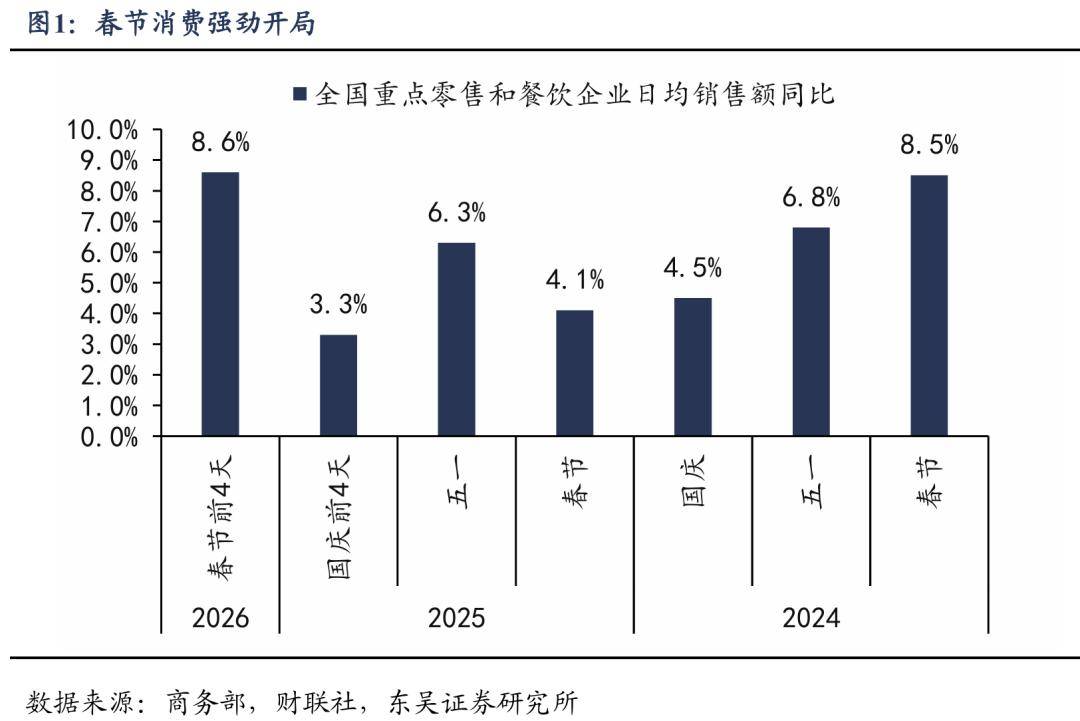
Group 1: Core Insights - The consumption during this year's Spring Festival shows a strong start, with average daily sales of key retail and catering enterprises increasing by 8.6% year-on-year in the first four days, compared to 4.1% last year [6][11] - There is a notable differentiation in service consumption, with a decline in movie attendance but a strong increase in travel [11][25] - The growth in homecoming consumption is significant, particularly in lower-tier cities, which contributed 54.1% to the Spring Festival box office, up from previous years [11][28] Group 2: Spring Festival Implications for 2026 Consumption - The expected recovery in consumption for January-February is projected to be between 5% and 2.5% year-on-year, a notable increase from around 1% at the end of last year [13][14] - There will likely be more supportive policies for consumption, shifting focus from "trade-in" subsidies to other areas such as consumer loan interest subsidies and support for service consumption [14][15] - Service consumption is anticipated to become the main support for the economy in 2026, with a shift in consumer preference from goods to services [15] Group 3: Travel and Migration Trends - The Spring Festival travel saw a record 50.8 billion cross-regional movements, a 5.5% increase from last year, with post-festival travel being stronger than pre-festival travel [16][21] - The travel intensity during the festival was significantly higher, with a 35.4% increase in travel post-festival compared to last year [21] Group 4: Tourism Insights - Domestic tourism has seen an increase, while outbound tourism has declined, with domestic flights increasing by 4.7% and international flights by 3.4% compared to last year [25] - The Hainan Free Trade Port has experienced a notable increase in inbound tourism, with a 24.1% rise in visitors compared to last year [25] Group 5: Movie Box Office Analysis - The Spring Festival box office reached only 4.36 billion yuan, significantly lower than the average of 6.1 billion yuan from 2021 to 2025, attributed to supply-side factors [27][28] - The contribution from lower-tier cities to the box office has increased, indicating a shift in consumer behavior [28] Group 6: Trade-in Program Performance - The impact of the trade-in program on sales has weakened, with total sales driven by trade-ins at 198.02 billion yuan, a significant drop from last year's daily average [33] - The performance of the automotive trade-in program is weaker compared to home appliances, with a notable decline in new energy vehicle sales [33] Group 7: Real Estate Market Trends - New home sales showed signs of recovery during the Spring Festival, with a 2.6% increase in transaction area compared to last year, although overall performance remains weak [35] - Second-hand home sales have decreased by 16.7% compared to last year, indicating ongoing challenges in the real estate market [35]
新春消费亮点纷呈 市场活力加速释放
Yang Shi Wang· 2026-02-20 12:42
Group 1 - The Chinese consumer market remains vibrant during the Spring Festival holiday, with new business formats and immersive experiences emerging, injecting strong momentum into the economy [1] - Key monitored pedestrian streets and business districts saw a 4.5% increase in foot traffic and a 4.8% increase in sales compared to the same period last year during the first three days of the holiday [3] - The tourism and cultural consumption continues to rise, with car rental orders increasing by 26% and cross-regional orders rising by 196% during the holiday [5] Group 2 - Hainan's offshore duty-free sales reached 970 million yuan, marking a 15.8% increase during the first four days of the holiday [7] - Various regions launched special activities with a total funding of 2.05 billion yuan to stimulate consumption through vouchers and subsidies, significantly benefiting consumers [7] - The "old for new" consumption policy has positively impacted the market, with 28.88 million people participating and generating sales of 198.02 billion yuan, including 612,000 vehicles traded in, leading to new car sales of 100.53 billion yuan [5]

加拿大2025年贸易逆差扩至313亿加元 连续三年逆差 对美依赖度明显下降
Sou Hu Cai Jing· 2026-02-20 04:52
Core Insights - Canada experienced a significant trade deficit of 31.3 billion CAD in 2025, marking the largest deficit since 2020 and the highest annual deficit since 1988, excluding the impact of public health measures in 2020 [1][2] Trade Performance - This marks the third consecutive year of trade deficits for Canada, with deficits of 933 million CAD in 2023 and 7.2 billion CAD in 2024 [2] - In 2025, Canada's total exports slightly decreased by 0.2%, with seven out of eleven major product categories experiencing declines, particularly in energy products due to falling prices [2] - Exports of unrefined gold, silver, and platinum group metals surged by 41.7%, which partially offset declines in other product exports; without this category, the annual export decline would have been 3% [2] - Total imports in Canada grew by 2.8% in 2025, driven mainly by increases in metal ores, non-metallic minerals, electronic and electrical equipment, and consumer goods [2] Trade Relations - Canada's trade dependency on the United States decreased significantly in 2025, with exports to the U.S. declining by 5.8% and imports decreasing by 2.9%; the trade surplus with the U.S. narrowed from 101.3 billion CAD in 2024 to 81.6 billion CAD [2] - In contrast, trade with non-U.S. partners showed strong performance, with exports to non-U.S. partners increasing by 17.2% and imports rising by 12.4% in 2025 [2]
【环球财经】加拿大2025年贸易逆差大幅扩大 对美依赖下降
Xin Hua She· 2026-02-20 04:02
Core Insights - Canada is projected to experience a significant trade deficit of 31.3 billion CAD in 2025, marking the largest deficit since 2020 [1] - This will be the third consecutive year of trade deficits for Canada, with deficits of 933 million CAD in 2023 and 7.2 billion CAD in 2024 [1] Export Summary - In 2025, Canada's total exports are expected to decrease by 0.2%, with seven out of eleven major product categories experiencing declines [1] - The most significant drop in exports is attributed to energy products due to falling prices, while strong growth in precious metals partially offsets the decline in other exports [1] - Excluding precious metals, the annual export decline would reach 3% [1] Import Summary - Canada's total imports are projected to increase by 2.8% in 2025, driven primarily by growth in metal ores, non-metallic minerals, electronic and electrical equipment, and consumer goods [1] Trade Dependency on the U.S. - Canada's trade dependency on the U.S. is expected to decrease in 2025, with exports to the U.S. declining by 5.8% and imports decreasing by 2.9% [1] - The trade surplus with the U.S. is projected to narrow from 101.3 billion CAD in 2024 to 81.6 billion CAD in 2025 [1] Trade with Non-U.S. Partners - In contrast, trade with non-U.S. partners is expected to perform strongly, with exports increasing by 17.2% and imports rising by 12.4% in 2025 [1]
加拿大2025年贸易逆差大幅扩大,对美依赖下降
Sou Hu Cai Jing· 2026-02-20 03:33
Core Insights - Canada is projected to experience a significant trade deficit of 31.3 billion CAD in 2025, marking the largest deficit since 2020 and the third consecutive year of trade deficits [1] Export Summary - In 2025, Canada's total exports are expected to decline by 0.2%, with seven out of eleven major product categories experiencing a decrease. The most significant drop is seen in energy products due to falling prices [1] - Strong growth in precious metal exports partially offsets the decline in other product categories. Excluding precious metals, the annual export decline reaches 3% [1] Import Summary - Canada's total imports are anticipated to increase by 2.8% in 2025, driven primarily by growth in metal ores and non-metallic minerals, electronic and electrical equipment and parts, as well as consumer goods [1] Trade Dependency on the U.S. - The trade dependency on the U.S. is expected to decrease in 2025, with exports to the U.S. declining by 5.8% and imports decreasing by 2.9%. The trade surplus with the U.S. narrows from 101.3 billion CAD in 2024 to 81.6 billion CAD [1] Trade with Non-U.S. Partners - In contrast, trade with non-U.S. partners shows strong performance, with exports increasing by 17.2% and imports rising by 12.4% in 2025 [1]
美媒:春节前夕,中国工厂和港口热闹非凡
Xin Lang Cai Jing· 2026-02-14 06:11
Group 1 - The core viewpoint of the articles highlights that despite the high tariffs imposed by the U.S. on Chinese goods, Chinese factories and ports remain busy, particularly ahead of the Lunar New Year, with increased shipping costs observed [1][2] - Chinese factories are operating at near full capacity, with manufacturers rushing to complete orders before the Spring Festival holiday, indicating strong demand despite tariff pressures [1] - The total container throughput at major Chinese ports increased by 40% year-on-year as of February 1, marking the fastest growth in 12 months [1] Group 2 - The shipping rates have risen significantly, with the Shanghai export container freight index in early January ranging between 1400 and 1656, which is notably higher than the 15-year average of 1337 to 1568 [2] - There has been an increase in the volume of large container ships transporting goods from China to the U.S. compared to the same period in 2024 and 2025, indicating robust export activity [2] - Many manufacturers in South China, including those in automotive, consumer goods, and sports equipment sectors, are busy handling backlogged orders and responding to inquiries from foreign buyers, including those from the U.S. [2]
1月份越南货物进出口同比增长39%
Shang Wu Bu Wang Zhan· 2026-02-11 17:36
Group 1 - In January 2026, Vietnam's total goods export and import reached $88.16 billion, a year-on-year increase of 39.0% [1] - Exports amounted to $43.19 billion, growing by 29.7%, while imports were $44.97 billion, increasing by 49.2%, resulting in a trade deficit of $1.78 billion compared to a surplus of $3.17 billion in the same period last year [1] - Domestic enterprises' exports decreased by 1.3%, accounting for 22.0% of total exports, while foreign-invested enterprises' exports increased by 42.2%, making up 78.0% of total exports [1] Group 2 - Major export products included processed goods ($38.43 billion, 89.0% of total exports), agricultural and forestry products ($3.65 billion, 8.5%), aquatic products ($1.01 billion, 2.3%), and fuels and minerals ($0.1 billion, 0.2%) [1] - In terms of imports, domestic enterprises saw an 18.2% increase, while foreign enterprises experienced a 66.8% growth [1] - The primary imported goods were production materials, totaling $42.3 billion, which constituted 94.0% of total imports, with machinery, tools, and components accounting for 56.1% and raw materials, fuels, and construction materials for 37.9% [1] Group 3 - The United States is Vietnam's largest export market, with exports to the U.S. reaching $13.9 billion and a trade surplus of $12 billion, reflecting a year-on-year growth of 28.6% [2] - China is the largest import market for Vietnam, with imports from China totaling $19 billion, resulting in a trade deficit of $12.7 billion, which is a 52.1% increase year-on-year [2] - Trade with the European Union resulted in a surplus of $3.9 billion, a 3.9% increase, while trade with Japan saw a surplus of $0.2 billion, down 59.9% year-on-year [2]
花花公子出售中国业务50%股权
Zhong Guo Neng Yuan Wang· 2026-02-11 03:49
Core Viewpoint - Playboy has signed a final agreement to sell 50% of its business in China to United Trademark Group (UTG), which will manage Playboy's operations in mainland China, Hong Kong, and Macau after the transaction is completed [2] Group 1: Transaction Details - Playboy will receive a total of $122 million in cash, including $45 million paid over two years for the 50% stake, $67 million as guaranteed dividends over eight years, and an additional $10 million in brand support over the next three years [2] - UTG has already paid a $9 million deposit, with the first phase of the transaction expected to be completed by March 31, 2026, subject to customary closing conditions [2] - Playboy will receive a minimum dividend guarantee based on the current net cash flow from its Chinese operations, with potential for additional annual dividends as UTG expands its business [2] Group 2: Company Background - UTG is a leading global consumer brand management group headquartered in Shanghai, managing over 10 international brands, including Jeep and several Italian brands [3] - Playboy, founded in 1953, is a well-known entertainment and leisure brand with a focus on brand licensing, digital media, and consumer products, having shifted to a light-asset strategy for global brand value expansion [3] - The Playboy magazine, which once had 19 global editions, ceased print publication in March 2020, transitioning to digital content, but is set to return to print in a quarterly format in February 2025 [3] Group 3: Financial Performance - For the first half of the fiscal year 2025, Playboy reported cumulative revenue of $57.02 million, a 7.18% increase from $53.20 million in the same period last year [3] - The company recorded a cumulative net loss of $16.72 million, a 49.48% reduction from a net loss of $33.09 million in the previous year [4] - The basic earnings per share for the current fiscal year is -$0.18, compared to -$0.45 in the same period last year [4]