
军备扩张

Search documents
日本加速提高防卫开支引发担忧
Xin Hua She· 2025-11-30 11:21
Group 1 - The Japanese government has approved a supplementary budget for the fiscal year 2025, increasing defense spending to 2% of GDP, raising concerns across various sectors [1] - The supplementary budget includes defense-related expenses of 1.1 trillion yen (approximately 49.8 billion RMB), bringing total defense spending for the fiscal year 2025 to about 11 trillion yen (approximately 498.2 billion RMB) [1] - The government aims to increase total defense spending to approximately 43 trillion yen (about 1.95 trillion RMB) from 2023 to 2027, with a target of achieving 2% of GDP by the fiscal year 2027 [1] Group 2 - The new "Security Three Documents" propose a fundamental strengthening of defense capabilities, including the ability to attack enemy bases, which undermines Japan's principle of "defensive defense" [2] - Concerns have been raised regarding the heavy burden of over 10 trillion yen in defense spending on the Japanese economy, which may neglect public welfare [2]
视频丨民众在东京集会 反对日本政府扩张军备
Yang Shi Xin Wen· 2025-11-20 02:05
Core Viewpoint - The protests in Tokyo against the Japanese government's plans to expand U.S. military bases in Okinawa and the southwestern islands reflect significant public concern over military buildup and its implications for local security [1][3]. Group 1: Public Sentiment - Protesters are holding signs with messages like "Stop the construction of the Henoko base" and "Stop militarism," indicating widespread opposition to the government's military expansion plans [3]. - Participants express fears that the military buildup in the southwestern islands could threaten local security, emphasizing that Okinawa may become a frontline in potential conflicts [3]. - There is a strong sentiment that the government is not respecting the opinions of Okinawa residents, which could lead to increased burdens on the local population [3]. Group 2: Specific Concerns - Protesters highlight that the construction of the Henoko base is part of a broader military reinforcement strategy, which they believe will exacerbate the situation in Okinawa [3]. - Concerns are raised regarding the lack of media coverage in Japan about the military base construction and missile deployment, which adds to the fear among residents [3]. - The recent controversial statements by political figures regarding Taiwan are viewed as irresponsible and dangerous, with calls for Japan to refrain from military expansion to maintain peace [3].

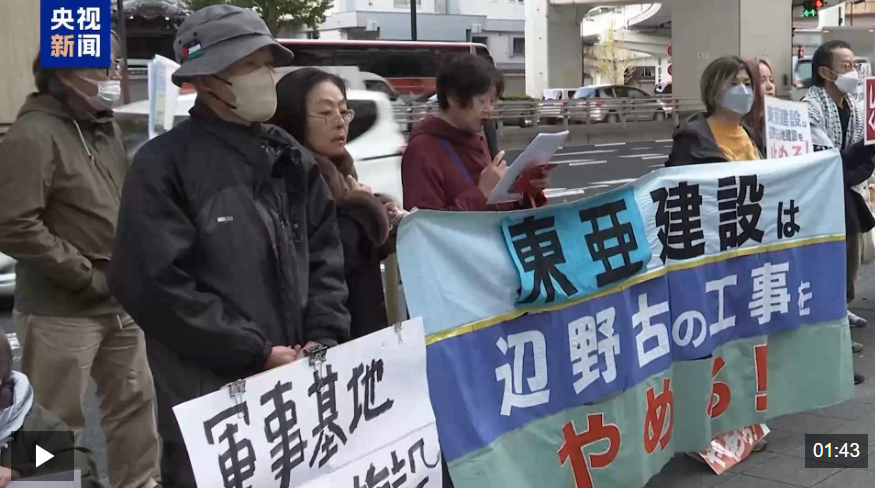
民众在东京集会 反对日本政府扩张军备
Yang Shi Xin Wen Ke Hu Duan· 2025-11-19 21:46
Core Viewpoint - The article highlights public protests in Tokyo against the Japanese government's plans to expand U.S. military bases in Okinawa and other southwestern islands, with concerns over increased militarization and potential threats to local security [1][2]. Group 1: Public Sentiment - Protesters are holding signs and chanting slogans demanding the government halt the construction of the U.S. military base in Henoko, Okinawa, expressing fears that military expansion could escalate local security threats [1]. - Participants argue that the construction of the Henoko base is part of a broader militarization effort that will further burden Okinawa [1]. - There is a strong sentiment among protesters that if the government ignores local opinions and continues militarization, Okinawa could become a frontline in potential conflicts [1]. Group 2: Concerns Over Military Expansion - Protesters are alarmed by the ongoing construction of military bases and missile deployments in southwestern islands, noting that such developments are underreported in Japanese media, which adds to their fears [1]. - High-profile comments from politicians, such as those from Seiko Noda regarding Taiwan, are viewed as irresponsible and dangerous by the protesters [2][4]. - The sentiment is that Japan must cease military expansion to maintain peace, emphasizing that the Taiwan issue is a matter of China's internal affairs and should not involve Japan or the U.S. [3][4].
警惕!日本提出122.4万亿日元创纪录防务预算,“加快军备扩张”
Huan Qiu Shi Bao· 2025-09-04 22:45
Core Viewpoint - Japan's fiscal budget application for the fiscal year 2025 has reached a record high of 122.4 trillion yen, driven by rising prices, increased defense spending, and higher debt financing costs [1][2]. Group 1: Budget Overview - The budget application amount has increased significantly for the third consecutive year [1]. - The Ministry of Finance, Ministry of Health, Labour and Welfare, and Ministry of Defense are the three departments with the most notable budget increases [1]. - The Ministry of Health, Labour and Welfare has requested the largest budget of 34.8 trillion yen due to rising medical and pension costs associated with an aging population [1]. Group 2: Defense Spending - The Ministry of Defense's budget application is 8.84 trillion yen, surpassing the current fiscal year's 8.7 trillion yen, marking the largest defense budget request in Japan's history [2]. - Japan is increasing its military spending to 2% of GDP and is focusing on enhancing its "counterattack" capabilities [2]. - The defense budget will fund the development of the "SHIELD" defense system, which includes deploying drones and producing hard-to-detect hypersonic missiles [2]. Group 3: Economic Context - Japan's debt level is currently twice its economic output, ranking among the highest in developed economies [3]. - Concerns about the government's ability to manage fiscal spending are heightened due to the fragile political position of Prime Minister Kishida [3]. - The rise in government spending and global long-term bond yields has led to a record high in Japan's 30-year government bond yields [3].
【环球财经】日本2026财年防卫预算申请额创新高
Xin Hua She· 2025-08-29 15:34
Group 1 - The Japanese Ministry of Finance announced a record-high defense budget request of 8.8454 trillion yen for the fiscal year 2026 [1] - Japan plans to enhance its coastal defense system by significantly investing in drones, with a total procurement budget of 312.8 billion yen [1] - The government aims to increase total defense spending to approximately 43 trillion yen over five years from 2023 to 2027, with a target of reaching 2% of GDP by fiscal year 2027 [1] Group 2 - Concerns have been raised regarding the justification for the high defense budget, with calls for transparency from the Ministry of Defense being denied [2] - Criticism has emerged about the potential use of national debt to fund military expansion, recalling historical lessons from past military conflicts [2]
广岛核爆80周年 日本民众抗议政府实施军备扩张
Xin Hua Wang· 2025-08-06 10:51
Core Viewpoint - The 80th anniversary of the atomic bombing of Hiroshima was marked by protests against Japan's military expansion policies and calls for adherence to the peace constitution [1][2] Group 1: Protests and Public Sentiment - A large gathering of citizens took place at the Hiroshima bombing site, expressing strong concerns over Japan's ongoing military expansion and the implications of the Japan-U.S. alliance [1] - Protesters held signs with messages such as "The Japan-U.S. alliance is a war alliance" and "Prevent nuclear war," indicating widespread public anxiety regarding military policies [1] Group 2: Government Response - Japanese Prime Minister Kishida Fumio reaffirmed Japan's commitment to the "Three Non-Nuclear Principles" during the memorial ceremony [1] - Hiroshima Mayor Matsui Kazumi emphasized the importance of remembering the nuclear bombing experience and inheriting the peace philosophy, although both officials did not address the historical context of the bombing [1]