刺激内需

Search documents
梦百合(603313):2024年年报及2025年一季报点评:北美业务止跌企稳,欧洲业务延续增长,一季度业绩表现超预期
EBSCN· 2025-04-30 06:14
Investment Rating - The report maintains a "Buy" rating for the company [1] Core Views - The company's performance in North America has stabilized, while European operations continue to grow, with Q1 results exceeding expectations [1][5] - In 2024, the company achieved revenue of 8.45 billion yuan, a year-on-year increase of 5.9%, with a net profit attributable to shareholders of -151 million yuan [5][15] - The company is expected to see profit recovery, with projections for 2025-2027 indicating a gradual increase in revenue and net profit [15] Revenue Performance - In Q1 2025, the company reported revenue of 2.04 billion yuan, a year-on-year increase of 12.3%, and a net profit of 58.72 million yuan, up 196.2% [5][15] - Domestic and overseas sales for 2024 were 1.48 billion yuan and 6.75 billion yuan, respectively, with year-on-year growth of 3.5% and 6.7% [6] - The company's self-owned brand achieved revenue of 1.13 billion yuan domestically, reflecting a 3.6% increase [6] Profitability Analysis - The overall gross margin for 2024 was 36.9%, a decrease of 1.5 percentage points year-on-year [10] - In Q1 2025, the gross margin improved to 39.4%, an increase of 0.8 percentage points year-on-year [12] - The gross margin for the company's self-owned brand in 2024 was 46.0%, down 0.7 percentage points [10] Cost Structure - The company's expense ratio for 2024 was 35.0%, an increase of 0.7 percentage points year-on-year [13] - In Q1 2025, the expense ratio decreased to 34.8%, down 0.7 percentage points year-on-year [13] Future Outlook - The report highlights the potential for profit elasticity due to the return of manufacturing to the U.S. and domestic demand stimulation [14] - Revenue forecasts for 2025-2027 are maintained, with 2027 revenue projected at 12.73 billion yuan [15] - The company is expected to benefit from reduced reliance on major clients, with the top five clients accounting for 16.2% of revenue in 2024, down 5.7 percentage points year-on-year [14]

无论如何,我们的出路就只有一个——刺激内需
Sou Hu Cai Jing· 2025-04-15 19:13
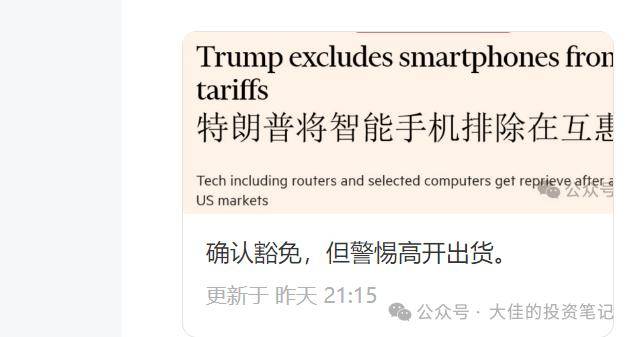
Group 1 - The article highlights the volatility in the consumer electronics sector, indicating that the market is experiencing high openings followed by declines, suggesting a lack of clean chips in the sector [2] - The example of Luxshare Precision is provided, noting that it only faced two limit-downs despite being a leader in the Apple supply chain, indicating resilience amidst market fluctuations [3] - There is a significant amount of capital waiting for a good opportunity to either take profits or cut losses, particularly in light of the recent tariff exemption news [5] Group 2 - The article emphasizes the importance of stimulating domestic demand, especially as the bond market remains strong despite stock market fluctuations [7] - It suggests that upcoming monetary policy adjustments, such as interest rate cuts, are likely to occur soon, which could signal a shift in market focus towards domestic consumption [9] - The consumption ETF 510150 is highlighted as a balanced investment option, incorporating essential and discretionary consumer sectors, which has shown resilience since the market bottom in January [11] Group 3 - The consumption ETF 510150 has demonstrated a gradual upward trend, indicating that there is a market pricing in the potential for stimulating domestic demand [14] - The article notes that despite recent market downturns due to tariffs, there has been a recovery, suggesting that the market is adjusting to the new tariff landscape [16] - It is anticipated that as key economic meetings approach, more capital will flow into the consumer sector, leading to outperformance compared to the broader market [18] Group 4 - The article concludes that the market's focus will shift from external factors, such as tariffs, back to domestic responses, particularly the need for stimulus measures to support domestic demand [20] - It is expected that various measures to stimulate domestic demand will be introduced following the economic meeting in April, presenting opportunities for excess returns in the market [20]