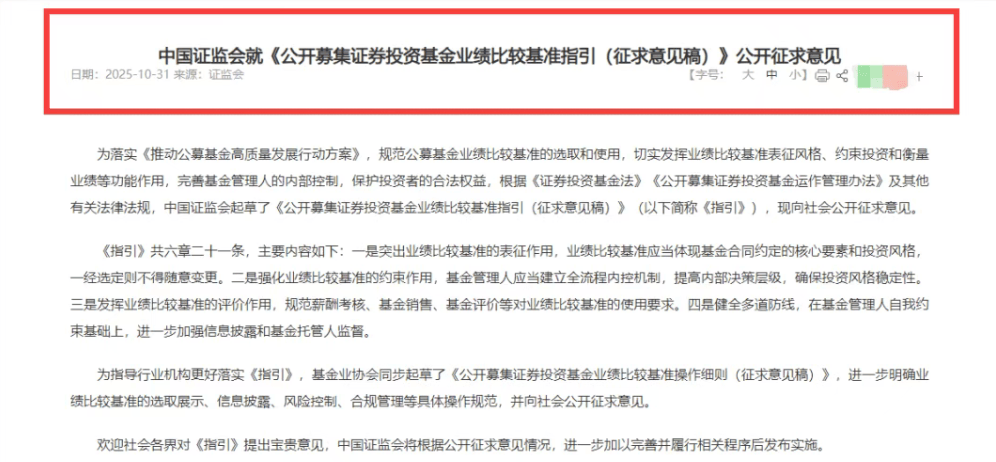
基金业绩比较基准

Search documents
基金经理,不能“旱涝保收”了
3 6 Ke· 2025-12-15 04:03
Core Viewpoint - The recent draft guidelines from the China Securities Regulatory Commission (CSRC) propose a performance evaluation mechanism for fund managers, emphasizing a tiered adjustment of performance compensation based on the past three years' performance against benchmarks and fund profitability [1][2]. Performance Evaluation Mechanism - Fund managers' performance compensation can be adjusted in four scenarios: a decrease of no less than 30% if performance is more than 10% below the benchmark with negative profitability, a decrease if performance is more than 10% below the benchmark with positive profitability, no increase if performance is less than 10% below the benchmark with negative profitability, and a reasonable increase if performance significantly exceeds the benchmark with positive profitability [1][2]. Current Fund Performance - Among 20 actively managed billion-level equity funds, 8 funds outperformed their benchmarks by over 10%, while 6 funds underperformed by over 10% as of December 9 [2]. Notable Fund Performances - The top-performing fund, Galaxy Innovation Growth A, managed by Zheng Weishan, achieved an excess return of 49.38% over three years, with a total return of 243% and an annualized return of 20.58% since its management began in May 2019 [4][5]. - Other notable funds include Dachen High Growth A, managed by Liu Xu, with a total return of 417.29% and an annualized return of 17.16% over 10 years, and Xingquan Business Model Preferred A, managed by Qiao Qian, with a total return of 203.42% and an annualized return of 16.11% over 7 years [5][7][8]. Investment Strategies - Zheng Weishan's strategy focuses on heavily investing in technology stocks, maintaining a high concentration in top holdings, while Liu Xu adopts a diversified approach across various sectors, balancing between well-known blue-chip stocks and smaller companies [5][7][9]. - Qiao Qian employs a flexible trading strategy with shorter holding periods and a diversified sector allocation, aiming to balance long-term investment judgments with short-term market fluctuations [9][10]. Implications of New Guidelines - The proposed guidelines aim to address the issue of fund managers' compensation being disconnected from performance, encouraging a stronger link between fund performance and manager remuneration [1][2][10].


“消费基”异常大涨遭质疑 业绩比较基准正待精准校表
Zheng Quan Shi Bao Wang· 2025-12-14 23:08
Core Viewpoint - The recent surge in consumer-themed funds amidst a rising technology stock market has led to confusion among investors regarding the underlying assets of their funds [1] Group 1: Fund Performance and Market Reaction - Some funds have shown significant deviation from their performance benchmarks, sparking market discussions about their investment strategies [1] - There are funds that have benefited from the technology sector's rise, while others have maintained long-term positions in financials, leading to a drift in investment styles [1] Group 2: Regulatory Response - Regulatory authorities have introduced measures such as benchmark guidelines, the establishment of a benchmark library, and performance assessment linkage to ensure that performance benchmarks return to their intended purpose [1] - The performance benchmark, which is a key metric for evaluating fund managers' capabilities and style stability, is undergoing the strictest calibration in history [1] Group 3: Industry Adjustments - In response to regulatory pressures, some funds have begun to actively adjust their portfolios to realign with their benchmarks [1] - Fund companies are also submitting plans to revise the performance benchmarks of existing products, indicating a trend towards the standardization and restructuring of performance benchmarks in the industry [1]
90%基金用错基准?你看到的“超额”可能只是假象
Morningstar晨星· 2025-12-11 01:05
Core Viewpoint - The article emphasizes the importance of using appropriate performance benchmarks for funds, highlighting that many funds currently use price indices, which may misrepresent their performance compared to total return indices [1][22][49]. Group 1: Investment Returns - Investment returns primarily come from three components: price returns, dividend returns, and reinvestment returns [3][4][5]. - Price returns reflect market price changes, while dividend returns include cash earnings from stocks and bonds, and reinvestment returns generate additional earnings through compounding [3][4][5]. Group 2: Impact of Dividends on Returns - The difference in returns between price indices and total return indices is significant; over the past 20 years, the annualized return for the CSI All Share Total Return Index was 10.84%, compared to 9.31% for the price index [15]. - In bond investments, the annualized return for the CSI Comprehensive Bond Wealth Index was 4.19%, while the net price index only yielded 0.39% [15]. - The contribution of dividends and reinvestment to total returns is substantial, accounting for approximately 30% of stock investment returns and over 90% of bond investment returns over the past 20 years [19]. Group 3: Inappropriate Benchmark Selection - Approximately 75% of funds use price indices as their performance benchmarks, which is inappropriate since fund returns are essentially total returns [22][25]. - The issue is particularly pronounced in equity and mixed funds, with almost no funds using total return indices as benchmarks [25]. Group 4: Lowered "Passing Line" - Using price indices as benchmarks lowers the difficulty of outperforming the benchmark, creating a misleading perception of fund performance [30]. - For instance, 68% of actively managed equity funds outperformed the CSI 300 price index over the past five years, but this figure dropped to 55% when using the total return index [30]. Group 5: "Inflated" Excess Returns - Many index funds and ETFs appear to generate excess returns compared to their benchmarks, but this is largely due to the use of price indices, which overlook dividends and reinvestment [37][40]. - If benchmarks were switched to total return indices, many funds' reported excess returns would significantly decrease or even disappear [40]. Group 6: Need for More Standardized Benchmark Usage - The article calls for the industry to adopt total return indices as performance benchmarks to provide a clearer and more objective assessment of fund performance [49][50]. - The current regulatory focus aims to enhance the role of performance benchmarks in determining product positioning, clarifying investment strategies, and measuring performance [49][50].

下周一提交!事关存量基金业绩比较基准
Zhong Guo Ji Jin Bao· 2025-12-09 14:37
Core Viewpoint - Multiple fund companies have initiated a review of performance benchmarks for existing funds in response to new regulatory guidelines aimed at enhancing the quality of public funds and protecting investor rights [1][2]. Group 1: Regulatory Changes - The new guidelines require fund companies to submit a plan for revising performance benchmarks for existing products by December 15 [2]. - The review will cover all existing funds except index funds and public REITs, categorizing active equity funds into full market funds, thematic funds, and broad thematic funds [2]. Group 2: Benchmark Adjustment Criteria - Fund companies must analyze which funds require benchmark adjustments based on their actual holdings and provide thorough justification for any changes [2]. - Specific indicators to be reported include investment strategy descriptions, fund size as of Q3, average positions over the past two or three years, and various performance metrics [2][3]. Group 3: Reasons for Adjustments - Reasons for adjusting benchmarks include mismatches between existing benchmarks and actual investment styles, asset allocation, and investment strategies [3]. - If a benchmark change results in a coverage rate drop of over 20 percentage points or an increase in excess returns of over 10 percentage points, detailed explanations must be provided [3]. Group 4: Industry Response - Fund companies are currently working intensively to meet the upcoming submission deadline, with many departments involved in the process [4]. - Adjustments are seen as necessary to align benchmarks with actual investment strategies, with some funds needing to increase equity index proportions based on current holdings [5]. Group 5: Long-term Implications - The implementation of these guidelines is expected to fundamentally transform the performance assessment mechanisms within the public fund industry, shifting focus from short-term relative performance to long-term excess return stability [6]. - Fund companies will need to be more cautious in selecting benchmarks to ensure alignment with investment themes and risk-return characteristics, with strict procedures for any future changes [6].
告别“基金盲盒” 业绩比较基准不再“随便写写”
Zheng Quan Ri Bao· 2025-12-04 23:04
Core Viewpoint - The public fund industry in China is undergoing a significant transformation, with a focus on aligning performance benchmarks with actual investment strategies, moving away from the previous "blind box" approach to a more transparent and accountable system [1][10][16] Group 1: Regulatory Changes - The China Securities Regulatory Commission (CSRC) has issued guidelines to strengthen the role of performance benchmarks, emphasizing that they must accurately reflect the fund's investment style and risk characteristics [2][11] - As of December 4, 2023, 220 funds have changed their performance benchmarks, marking a 73.23% increase compared to the previous year, with a notable acceleration in changes since May [2][11] Group 2: Industry Response - Fund companies are proactively responding to regulatory requirements by adjusting their performance benchmarks to better reflect their actual investment strategies, enhancing industry professionalism and credibility [3][12] - The trend of changing benchmarks is seen as a move towards a more competitive environment based on genuine strategies and capabilities, rather than superficial labels [3][12] Group 3: Impact on Fund Products - Adjustments to performance benchmarks are aimed at ensuring they match the actual risk-return characteristics of the funds, leading to clearer product identities and expectations for investors [4][13] - For example, a fund previously benchmarked against the "CSI 300 Index" has shifted to a more relevant index that better represents its investment focus, enhancing clarity for investors [4][13] Group 4: Long-term Industry Development - The refined benchmarks are expected to guide funds towards specific sectors, aligning investments with national industrial policies and enhancing the efficiency of capital allocation [6][14] - The evolution of performance benchmarks from mere formalities to core governance tools is shifting the industry's focus from short-term gains to long-term value creation [6][14] Group 5: Stakeholder Relationships - The enhanced clarity of performance benchmarks is fostering a more transparent relationship among fund companies, fund managers, and investors, moving away from luck-based investment decisions [7][15] - A well-defined benchmark system is anticipated to attract long-term capital from institutional investors, thereby injecting vitality into the capital market [7][15]
2025年以来,基金公司着手检视并调整产品业绩比较基准与投资策略的一致性 告别“基金盲盒” 业绩比较基准不再“随便写写”
Zheng Quan Ri Bao· 2025-12-04 16:15
Core Insights - A significant transformation involving 37 trillion yuan public funds is reshaping the investment landscape, emphasizing the importance of performance benchmarks for mutual funds [1][2] - The regulatory push for high-quality development in the mutual fund industry is leading to a systematic review and adjustment of performance benchmarks to align with actual investment strategies [2][3] Group 1: Regulatory Changes - The China Securities Regulatory Commission (CSRC) has mandated that performance benchmarks must accurately reflect the investment style and risk characteristics of funds, moving away from being mere formalities [2][3] - As of December 4, 220 funds have changed their performance benchmarks in 2023, marking a 73.23% increase compared to the previous year, with a notable acceleration in changes since May [2] Group 2: Industry Response - Fund companies are actively responding to regulatory requirements by recalibrating their performance benchmarks to better reflect their actual investment strategies, enhancing industry professionalism and credibility [3][4] - The adjustments are seen as a move towards eliminating the "blind box" phenomenon in funds, where the actual investment did not align with the stated themes [3][4] Group 3: Impact on Fund Management - The refined performance benchmarks are expected to guide fund managers towards more focused investment strategies, enhancing the stability of fund styles and promoting in-depth research in specific sectors [5][6] - The new benchmarks will help fund managers align their investment decisions with national industrial policies, directing funds towards key economic sectors such as technology and renewable energy [5][6] Group 4: Investor Benefits - Clear performance benchmarks will enable investors to better understand the risk-return profile of funds, fostering rational expectations and trust in fund companies and managers [8] - The transformation is anticipated to attract long-term capital from institutional investors, enhancing the vitality of the capital market [8]
中美基金基准对比与启示:基准库落地,工具化时代或将全面来临
Western Securities· 2025-11-20 13:24
- The report does not include any specific quantitative models or factors for analysis[1][2][3]
基金业绩比较基准应与基金业绩盈亏配合使用
Sou Hu Cai Jing· 2025-11-12 22:42
Core Viewpoint - The China Securities Regulatory Commission (CSRC) has released a draft guideline for the selection and use of performance benchmarks for publicly offered securities investment funds, aiming to standardize practices and protect investors' rights [1][2]. Group 1: Regulatory Framework - The guideline is necessary for regulating fund performance and management fees, as it ties the floating management fee mechanism to the performance benchmark [1][2]. - The draft emphasizes that fund managers must compare their actively managed equity fund performance against the benchmark and conduct performance attribution analysis [2]. Group 2: Performance Assessment - The performance benchmark is crucial for assessing fund performance but should not be the sole criterion; it must be combined with the fund's net profit or loss [4][5]. - In cases of investment losses, even if a fund outperforms its benchmark, the fund company cannot charge higher management fees, and fund managers should not receive high performance bonuses [5]. Group 3: Investor Protection - The guideline aims to ensure that fund performance assessments are fair and responsible, protecting the legitimate rights of fund holders [4][5]. - The CSRC's initiative is designed to prevent situations where fund companies benefit from management fees despite poor fund performance [5].
基金量化观察:《公开募集证券投资基金业绩比较基准指引(征求意见稿)》解读
SINOLINK SECURITIES· 2025-11-04 14:15
- The report discusses the performance of various enhanced index funds, including the Huashang CSI 300 Enhanced Index A (166802.OF), which achieved the best performance among CSI 300 enhanced index funds last week with an excess return of 1.05% relative to its benchmark[54]. - The report highlights the performance of the China Europe CSI 500 Enhanced Index A (015453.OF), which achieved an excess return of 0.79% relative to its benchmark last week, making it the best performer among CSI 500 enhanced index funds[54]. - The China Europe CSI 1000 Enhanced Index A (017919.OF) achieved an excess return of 0.75% relative to its benchmark last week, leading the CSI 1000 enhanced index funds category[54]. - The Xin Yuan Guozheng 2000 Enhanced Index A (018579.OF) was the top performer among Guozheng 2000 enhanced index funds last week, with an excess return of 0.33% relative to its benchmark[54]. - Over the past year, the Ping An CSI 300 Quantitative Enhanced A (005113.OF) achieved the highest excess return of 12.32% among CSI 300 enhanced index funds[55]. - The Penghua CSI 500 Enhanced Index A (014344.OF) achieved the highest excess return of 19.01% among CSI 500 enhanced index funds over the past year[55]. - The Boda CSI 1000 Enhanced Index A (017644.OF) achieved the highest excess return of 29.68% among CSI 1000 enhanced index funds over the past year[55]. - The Huixianfu Guozheng 2000 Enhanced Index A (019318.OF) achieved the highest excess return of 32.22% among Guozheng 2000 enhanced index funds over the past year[55].
公募基金改革再“落子”,基金业绩或将告别“盲盒”时代!
Sou Hu Cai Jing· 2025-11-04 09:47
Group 1 - The phenomenon of style drift in A-share market is prevalent, where funds claiming to focus on consumer themes are heavily investing in technology stocks, leading to confusion regarding their actual investment strategies [1] - A specific mixed strategy fund has changed managers six times in nine years, resulting in inconsistent investment styles and poor performance during critical market events [1] - As of October 31, 2023, 63.46% of actively managed equity funds have underperformed their benchmarks over the last three years, indicating a significant issue within the fund management industry [2] Group 2 - The China Securities Regulatory Commission (CSRC) has released a draft guideline emphasizing the importance of performance benchmarks in mutual funds, stating that benchmarks should reflect the product's positioning and investment style [3] - The new regulations aim to prevent funds from changing their benchmarks arbitrarily due to manager changes or short-term market fluctuations, promoting more stable investment strategies [4] - As of October 31, 2023, 183 funds have announced changes to their performance benchmarks this year, a notable increase from 144 in the same period last year, indicating a proactive approach to comply with upcoming regulations [4] Group 3 - The selection of performance benchmarks is now strictly regulated, requiring strategy funds to use corresponding strategy indices, which aims to enhance accountability in fund management [5][6] - Funds without a clear thematic focus have more lenient requirements, but investors are advised to pay close attention to fund managers' styles and past performance when selecting these funds [7] Group 4 - Index funds are considered a safer investment option for ordinary investors due to their lower susceptibility to manager biases and more precise industry positioning [10] - Historical data shows that actively managed funds often underperform index funds over the long term, suggesting that index funds may be a more reliable choice for wealth accumulation [11]