
公开募集证券投资基金

Search documents
锚点重塑(一):基准新规落地,当前基准格局如何变?
Changjiang Securities· 2026-01-28 05:42
- The report primarily discusses the new regulatory guidelines for performance benchmarks in public funds, issued by the China Securities Regulatory Commission (CSRC) on January 22, 2026, which will take effect on March 1, 2026. These guidelines aim to standardize the selection, adjustment, disclosure, and supervision of performance benchmarks, filling a long-standing gap in the industry for systematic benchmark management [7][15][16] - The guidelines emphasize that performance benchmarks must align with the fund's investment objectives, scope, and style. Selected indices should meet requirements for representativeness, liquidity, and continuous disclosure. Once selected, benchmarks cannot be arbitrarily changed unless specific conditions are met, such as the benchmark becoming non-operational, and changes must be announced 30 days in advance [11][18] - Fund managers are required to establish internal control mechanisms covering benchmark selection, monitoring, correction, and accountability. Independent departments must monitor investment deviations, set differentiated thresholds, and take corrective actions or escalate to the investment decision committee when thresholds are breached. Additionally, fund managers' performance compensation will be adjusted if active equity funds underperform their benchmarks over the long term [11][18] - External supervision and information disclosure are also strengthened. Custodian institutions must monitor fund operations and alert regulators to any violations. Sales institutions must present benchmark performance alongside fund performance, and evaluation agencies must incorporate benchmarks into performance rankings and evaluations. Fund contracts and periodic reports must detail the rationale for benchmark selection, its alignment with the fund's strategy, and performance differences. For one year after a benchmark change, both old and new benchmarks must be disclosed for comparison [11][18] - The guidelines provide a one-year transition period for existing products to adjust benchmarks that do not meet the new requirements. Custodian responsibilities and system upgrades are given a six-month transition period, allowing sufficient time for industry adaptation [11][18] - The report highlights that the new guidelines will lead to clearer product positioning, reduce style drift, and shift industry competition towards compliance and professional investment capabilities. This will provide investors with better tools for evaluating fund performance and reduce the complexity of investment decisions. The industry is expected to transition from a scale-driven to a quality-driven approach, encouraging long-term capital inflows and promoting stable capital market development [16][19] - As of January 25, 2026, 11 active equity funds have adjusted their benchmarks since the draft guidelines were released on October 31, 2025. Adjustments include shifting from broad-based indices to sector or style-specific indices (e.g., consumption, growth, value) and adding Hong Kong stock indices to A-share indices. However, the majority of benchmarks remain concentrated in broad-based indices like CSI 300, CSI 800, and CSI 500, which collectively account for approximately 62% of active equity fund assets [2][19][20] - In the Hong Kong stock market, benchmarks are also concentrated in broad-based indices, with the Hang Seng Index and Hong Kong Composite Index (in RMB or HKD) accounting for about 85% of active equity fund assets. The Hang Seng Index is the most commonly used benchmark, representing approximately 7.94 trillion yuan in assets across 972 funds [23][24] - For fixed-income benchmarks, the most commonly used index is the ChinaBond Composite Full Price Index, followed by the CSI Comprehensive Bond Index and the National Bond Index [26][27]
西部证券晨会纪要-20260127
Western Securities· 2026-01-27 01:42
Group 1: Fund Performance Benchmark Guidelines - The China Securities Regulatory Commission released the "Guidelines for the Performance Benchmark of Publicly Raised Securities Investment Funds," effective from March 1, 2026, with a one-year transition period for existing products [1][7][9] - The guidelines emphasize the selection of benchmarks based on four principles: representativeness, objectivity, constraint, and continuity, and authorize the establishment of a benchmark element library by the fund industry association [7][8] - Strict requirements for benchmark changes are outlined, ensuring that benchmarks remain consistent and can only be changed under specific circumstances [7][8] Group 2: Mijiu Group (2097.HK) Performance and Outlook - Mijiu Group is expanding its main brand into overseas markets, with expectations of exceeding previous forecasts [2][11] - The company has opened three new stores in key U.S. cities, enhancing brand recognition and adapting its menu to local tastes, which is expected to increase customer retention [11][12] - Profit forecasts for 2025-2027 are raised to 6.1 billion, 7 billion, and 8.1 billion yuan respectively, with a current PE ratio of 25, 22, and 19 times [2][13] Group 3: Greenland Island Event and Investment Implications - The U.S. faces legal and public opinion barriers in acquiring Greenland, with four potential outcomes: agreement, long-term strategic lease, free association, or military intervention, with the first two being more likely [3][16][17] - The potential agreement may involve U.S. military bases and critical minerals, benefiting European defense giants and highlighting the importance of mineral resource autonomy in the context of great power competition [3][17] - The U.S. critical mineral supply chain resilience policies may present long-term investment opportunities [3][17] Group 4: Nonferrous Metals Industry Insights - The National Bureau of Statistics reported a 5.9% year-on-year increase in industrial added value for 2025, with a 5.2% increase in December [4][19] - The report indicates a growing preference for precious metals as a hedge amid rising risk aversion [4][19] - Zijin Mining announced the completion of the second phase of the Jilong Copper Mine, which will significantly increase its production capacity and is expected to become the largest copper mine in China [22]
《公开募集证券投资基金业绩比较基准指引》核心要点梳理及解读:强化基金投资之锚,助力公募高质量发展-20260126
Western Securities· 2026-01-26 06:32
Report Summary 1. Report Industry Investment Rating No industry investment rating is provided in the report. 2. Core Viewpoints On January 23, 2026, the China Securities Regulatory Commission issued the “Guidelines for Performance Comparison Benchmarks of Publicly - Offered Securities Investment Funds” (hereinafter referred to as the “Guidelines”), and the Asset Management Association of China released the “Operating Rules for Performance Comparison Benchmarks of Publicly - Offered Securities Investment Funds” (hereinafter referred to as the “Rules”). The implementation of the Guidelines starts on March 1, 2026, and a one - year implementation transition period is given for existing products with non - compliant performance comparison benchmark settings. The Guidelines aim to standardize the selection and use of performance comparison benchmarks for public funds, strengthen their role as an “anchor” for fund investment, and promote the high - quality development of the public fund industry [1][6]. 3. Summary by Directory Background The performance comparison benchmark is a reference standard set by fund managers for funds based on product positioning and investment objectives. It plays important roles such as determining product positioning, clarifying investment strategies, representing investment styles, measuring product performance, and restricting investment behaviors. Currently, there are problems in the performance comparison benchmarks of public funds, such as the lack of systematic regulatory systems, ineffective use and supervision by institutions, and “style drift” of funds. To address these issues, the China Securities Regulatory Commission issued the Guidelines to protect the legitimate rights and interests of investors [7]. Core Content - **Selecting Benchmark Specifications**: The selection of benchmarks should follow the principles of representativeness, objectivity, constraint, and persistence. The Asset Management Association of China is authorized to establish a benchmark element library, and fund managers can select benchmark elements from it [3][8]. - **Strict Benchmark Change Requirements**: Benchmarks should be persistent and cannot be changed casually. Specific situations and procedures for benchmark changes are clearly defined, and sales institutions are required to inform investors of benchmark changes in a timely manner [9][17]. - **Enhanced Benchmark Information Disclosure**: Information about benchmarks should be disclosed in fund legal documents and regular reports, and the fund trustee should strengthen the review and supervision of the disclosed content [9][10]. - **Strengthened Benchmark Constraint**: Fund managers should establish a full - process control mechanism for benchmarks, strengthen style stability management, and trustees should strengthen investment supervision responsibilities [10]. - **Highlighted Benchmark's Role in Measuring Performance**: Performance assessment, performance display, and fund evaluation should all be carried out in combination with the performance comparison benchmark, and different types of equity funds should not be directly ranked [11]. - **Transition Period Settings**: A one - year transition period is given for existing products with non - compliant benchmark settings. To ensure the objectivity and accuracy of related information, the relevant requirements are aligned with the one - year transition period. A six - month transition period is given for trustees to supervise the stability of fund investment styles [11]. Main Impacts - **Fund Managers**: They should establish an internal control and management system covering the entire process of benchmark selection, disclosure, monitoring, evaluation, correction, and accountability. Benchmark selection should follow four principles, and a department independent of the investment department should be established to monitor style stability. Information about benchmarks should be clearly stated in legal documents and regular reports, and the performance comparison benchmark should be displayed when showing past performance [12][14]. - **Fund Trustees**: They should carefully review the fund investment style library, establish a supervision mechanism for the stability of equity fund investment styles, and clarify rights and obligations with fund managers through agreements [14]. - **Fund Evaluation Institutions**: They should establish a fund evaluation system around the performance comparison benchmark, adjust the fund classification in a timely manner when the benchmark changes, and retain different stages of evaluation results [15]. - **Fund Sales Institutions**: When displaying a list of funds containing investment performance, they should distinguish funds of different investment styles based on the performance comparison benchmark and should not directly rank different types of equity funds [15].

重大新规,最新解读来了!
中国基金报· 2026-01-25 04:34
Core Viewpoint - The recent release of the "Guidelines for Performance Comparison Benchmarks of Publicly Raised Securities Investment Funds" and "Operational Details" by the China Securities Regulatory Commission and the Asset Management Association of China marks a significant milestone in the high-quality development of the public fund industry, focusing on long-term value and addressing industry pain points such as "ambiguous benchmarks" and "style drift" [2][4]. Group 1: Regulatory Framework - The new regulations establish a comprehensive control system around performance comparison benchmarks, focusing on four dimensions: representation, constraints, assessment, and supervision, along with a transitional period and benchmark database construction [3]. - The guidelines require that performance benchmarks accurately reflect product positioning and investment style, aligning with the fund contract's investment goals and strategies, and that once set, benchmarks cannot be changed arbitrarily [7]. Group 2: Industry Impact - The introduction of these guidelines is seen as a critical step towards the maturity and professionalism of the public fund industry, providing a clear direction and framework for high-quality development [4][10]. - The new rules are expected to shift the industry focus from "scale competition" to "ability competition," fostering a differentiated competitive landscape [4]. Group 3: Investor Protection - Fund companies have committed to ensuring investor interests are considered when adjusting benchmarks, promising to inform investors through announcements and customer service [5]. - The new regulations aim to enhance the clarity and stability of performance benchmarks, serving as a practical reference for investors in selecting funds that align with their long-term investment goals [11]. Group 4: Long-term Development - The guidelines are designed to create a robust ecosystem that encourages fund managers, custodians, sales institutions, and evaluation agencies to fulfill their responsibilities, promoting a positive transformation in the industry [10]. - The regulations emphasize the importance of linking fund manager compensation to long-term performance against established benchmarks, thereby aligning the interests of fund managers with those of investors [11].


公募基金业绩比较基准改革再迎新规
Xin Lang Cai Jing· 2026-01-24 05:11
Group 1 - The core viewpoint of the news is the release of the "Guidelines for Performance Benchmarking of Publicly Raised Securities Investment Funds" and the "Operational Details for Performance Benchmarking" by the China Securities Regulatory Commission (CSRC) and the Asset Management Association of China, which aim to enhance the accountability of fund managers and establish a comprehensive control mechanism around performance benchmarks [1][2] - The new regulations emphasize the representation role of benchmarks for products, strengthen the constraints on investments, provide guidance for assessments, and enhance external supervision [1] - This release is a significant outcome of the "Action Plan for Promoting High-Quality Development of Public Funds" issued by the CSRC in May of the previous year, which focuses on investor-centric principles and proposes a series of reform measures related to performance benchmarks [1] Group 2 - The CSRC will work with the fund association to ensure a smooth transition, guiding industry institutions in optimizing and changing benchmarks for existing products during the transition period [2] - A benchmark library will be established to encourage and guide industry institutions in the standardized selection of benchmark elements that represent equity assets [2] - Specific indicators for the remuneration assessment of fund managers will be clarified to strengthen the binding relationship between fund managers and investors [2]
新华财经早报:1月24日
Xin Hua Cai Jing· 2026-01-24 01:03
Group 1: Regulatory Updates - The China Securities Regulatory Commission (CSRC) released new guidelines for public offering securities investment fund performance benchmarks, emphasizing the need for clearer benchmarks, enhanced regulatory oversight, and linking performance to compensation [1][1][1] - The CSRC has also announced the addition of 14 specific futures and options products for domestic trading, including nickel futures and options, and lithium carbonate futures and options [1][1][1] Group 2: Market Performance - The banking wealth management market is projected to reach a scale of 33.29 trillion yuan by the end of 2025, reflecting an 11.15% growth from the beginning of the year [1] - The Shanghai Stock Exchange reported a significant number of abnormal trading behaviors, with 152 cases of market manipulation and false reporting under investigation [2][2] Group 3: Company Earnings Forecasts - Shannon Chip Innovation expects a net profit increase of 81.77% to 134.78% year-on-year for 2025 [5] - Anshuo Information anticipates a net profit growth of 52.44% to 98.83% year-on-year for 2025 [5] - Changrongda forecasts a net profit increase of 57.23% to 83.43% year-on-year for 2025 [5] - Jingfang Technology expects a net profit growth of 44.41% to 52.32% year-on-year for 2025 [5] - Zhongwei Company projects a net profit increase of 28.74% to 34.93% year-on-year for 2025 [5] - However, several companies, including Baiyin Nonferrous and Chip Origin, are expected to report losses in 2025, with Baiyin Nonferrous projecting a loss of 450 million to 675 million yuan [5][5]
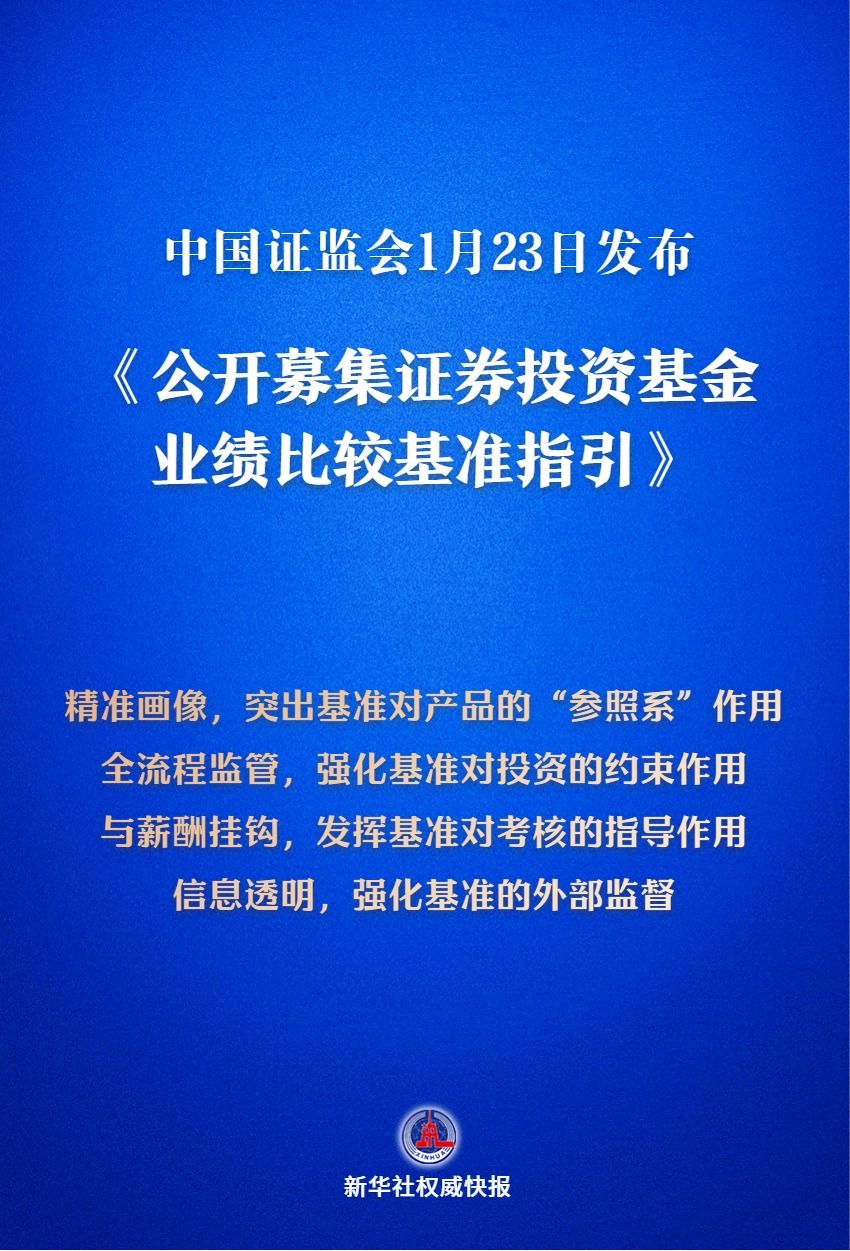
新华社权威快报|公募基金业绩“参照系”将全面升级
Xin Hua She· 2026-01-24 00:36
Core Viewpoint - The China Securities Regulatory Commission (CSRC) released the "Guidelines for Performance Benchmarking of Publicly Raised Securities Investment Funds" on January 23, aiming to address industry issues such as "ambiguous benchmarks," "style drift," and "fund blind boxes" to promote high-quality development in the public fund sector [4]. Group 1 - The new regulations emphasize four key areas: precise profiling to highlight the benchmark's role as a reference for products [4] - Full-process supervision is introduced to strengthen the benchmark's constraints on investments [4] - The guidelines link benchmarks to compensation, enhancing their role in performance assessment [4] - Increased transparency is aimed at reinforcing external supervision of benchmarks [4] Group 2 - The CSRC's reform is part of a broader initiative to optimize the market ecosystem for long-term investments, injecting sustainable momentum into the high-quality development of the capital market [4]
中国公募基金业绩“参照系”将全面升级
Sou Hu Cai Jing· 2026-01-23 13:22
Core Viewpoint - The China Securities Regulatory Commission (CSRC) has announced the implementation of the "Guidelines for Performance Benchmarking of Publicly Raised Securities Investment Funds," effective from March 1, 2026, to standardize the selection and use of performance benchmarks in public funds [1][2]. Group 1: Guidelines Overview - The guidelines consist of six chapters and twenty-one articles, emphasizing the representation role of performance benchmarks and the seriousness and stability of their application [1]. - Performance benchmarks are defined as reference standards set by fund managers based on product positioning and investment objectives, typically comprising indices, contract prices, and interest rates [1]. Group 2: Internal Control and Management - Fund management companies are required to establish robust internal control mechanisms and management systems to ensure the stability of investment styles by fund managers [2]. - The decision on performance benchmarks should be made by the company's management, reinforcing the need for internal governance [2]. Group 3: External Constraints and Transition Period - The guidelines specify the supervisory responsibilities of fund custodians and regulate the behavior of fund sales and evaluation institutions regarding the display and use of performance benchmarks [2]. - A one-year transition period is granted for existing products that do not comply with the new guidelines and self-regulatory rules set by the fund industry association [2].
大动作!公募重磅新规,落地!
Zhong Guo Ji Jin Bao· 2026-01-23 12:19
Core Viewpoint - The China Securities Regulatory Commission (CSRC) has officially released the "Guidelines for Performance Benchmarking of Publicly Raised Securities Investment Funds," aimed at addressing existing issues in the industry and enhancing investor experience [1]. Group 1: Industry Pain Points - Current public funds face several issues regarding performance benchmarks, including a lack of specialized and systematic regulations, leading to weak constraints [5]. - Many fund managers have not established comprehensive internal control mechanisms covering performance benchmarks, and custodians and sales institutions have not effectively supervised or utilized these benchmarks [6]. - Some actively managed equity funds have significantly deviated from their performance benchmarks, with certain products experiencing "style drift," negatively impacting investor satisfaction [7]. Group 2: Key Features of the Guidelines - The guidelines emphasize the serious and stable application of performance benchmarks, ensuring they align with the core elements of the fund contract and investment style, and cannot be changed arbitrarily once selected [9]. - They strengthen the internal control and management of fund managers, requiring benchmarks to be determined by company management and necessitating the establishment of robust internal control mechanisms [9]. - The guidelines enhance external constraints on performance benchmarks, clarifying the supervisory responsibilities of custodians and regulating the behavior of sales and evaluation institutions regarding benchmark usage [9]. Group 3: Implementation Timeline - The guidelines will take effect on March 1, 2026, with a transition period set for existing products that do not comply with the new regulations [10]. - A one-year transition period is provided for existing products to align their performance benchmarks with the guidelines and self-regulatory rules [11]. - Custodians are given a six-month transition period to adjust their supervision of fund investment style stability, considering the need for system adjustments and data interactions [11]. Group 4: Additional Regulations - On the same day, the China Securities Investment Fund Industry Association released the "Operational Guidelines for Performance Benchmarking of Publicly Raised Securities Investment Funds," which will also take effect on March 1, 2026 [12].
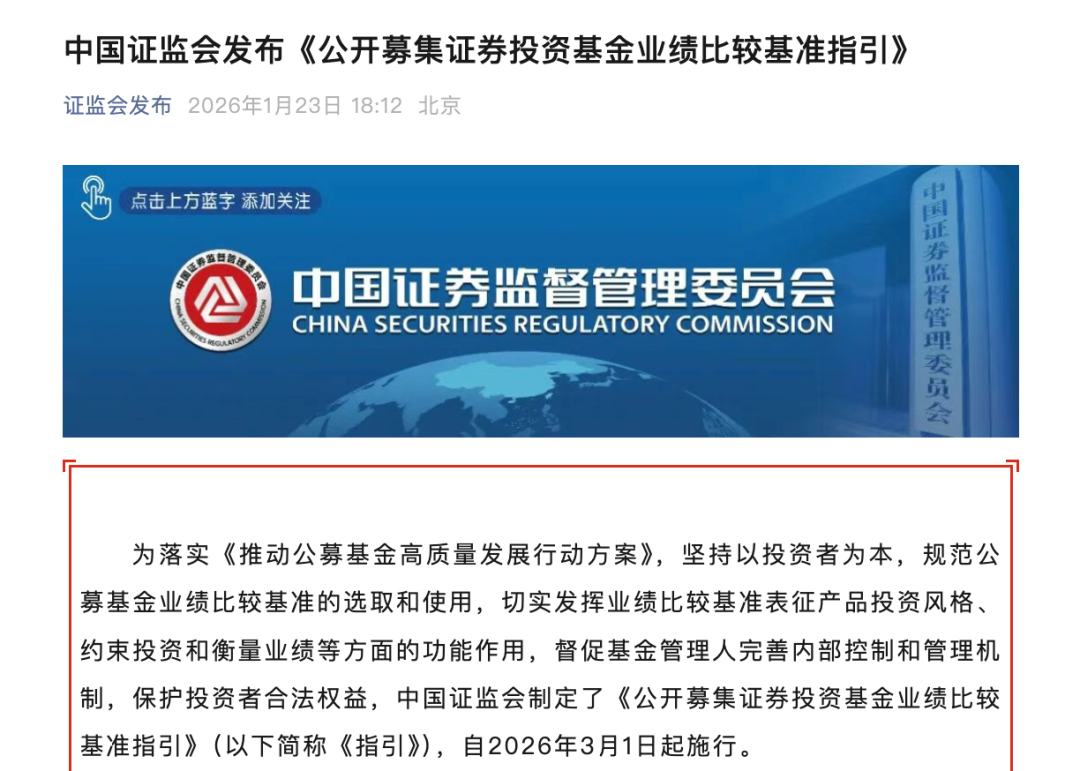
证监会发布指引 规范公募基金业绩比较基准选用
Zhong Guo Jing Ying Bao· 2026-01-23 11:51
Core Viewpoint - The China Securities Regulatory Commission (CSRC) has issued the "Guidelines for Performance Benchmarking of Publicly Offered Securities Investment Funds," effective from March 1, 2026, aimed at enhancing the quality of public fund development and protecting investor rights [1][2]. Group 1: Key Aspects of the Guidelines - The guidelines emphasize the representational role of performance benchmarks, highlighting the seriousness and stability of their application, and stipulating that benchmarks must align with the core elements of the fund contract and investment style, with no arbitrary changes allowed once selected [1]. - The guidelines strengthen internal controls and management for fund managers, mandating that performance benchmarks be determined by company management and requiring the establishment of robust internal control mechanisms to ensure the stability of fund managers and investment styles [1]. - The guidelines enhance external constraints on performance benchmarks, clarifying the supervisory responsibilities of fund custodians and regulating the behavior of fund sales and evaluation institutions regarding the display and application of benchmarks, while also emphasizing the importance of investor education [1].