
幼儿园收费政策完善

Search documents
新政来了!清单之外不许乱收费,看看你家幼儿园怎么变
2 1 Shi Ji Jing Ji Bao Dao· 2025-12-23 12:34
Core Viewpoint - The recent notice issued by the National Development and Reform Commission, Ministry of Education, and Ministry of Finance aims to standardize kindergarten charging policies, promoting transparency and reducing costs for families while addressing issues of arbitrary fees in private kindergartens [2][3][4]. Summary by Relevant Sections Kindergarten Charging Policies - The notice establishes a flexible government-guided pricing system for public kindergartens instead of fixed government pricing, allowing differentiated pricing for nursery classes to enhance quality and encourage participation [2][12]. - It strictly regulates charging in private kindergartens, particularly targeting arbitrary fees to lower the cost of childcare education for families [2][4]. Fee Structure - The notice outlines specific charging items, including education fees (tuition), accommodation fees, service fees, and additional fees for nursery classes [5]. - A directory system for charging items is mandated, requiring localities to create lists of allowable service and additional fees, ensuring kindergartens cannot charge beyond these lists [6][7]. Regulation of Fees - The notice categorizes kindergartens into public, inclusive, and for-profit private institutions, with different pricing regulations: public and inclusive kindergartens follow government-guided pricing, while for-profit kindergartens can set market-adjusted prices [12][14]. - It emphasizes the need for regulatory oversight on for-profit kindergartens to prevent excessive profit-seeking tendencies, with some institutions reportedly charging significantly higher fees than inclusive kindergartens [15]. Encouragement of Nursery Services - The notice encourages kindergartens to provide nursery services, addressing the current shortage of such services and the declining number of new enrollments due to decreasing birth rates [16]. - It allows kindergartens to set nursery fees based on the education fee standards, promoting differentiated pricing in regions with successful inclusive nursery services [16]. Financial Support and Challenges - The notice highlights the lack of a national financial support system for nursery services, leading to high costs for families [17]. - The draft nursery service law proposes that local governments include nursery service development in their economic plans and budgets, aiming to establish a sustainable financial support mechanism [18]. - There are disparities in financial support for inclusive kindergartens across different regions, necessitating improved monitoring and timely funding [19].

规范幼儿园收费!三部门发文
Xin Lang Cai Jing· 2025-12-23 11:52
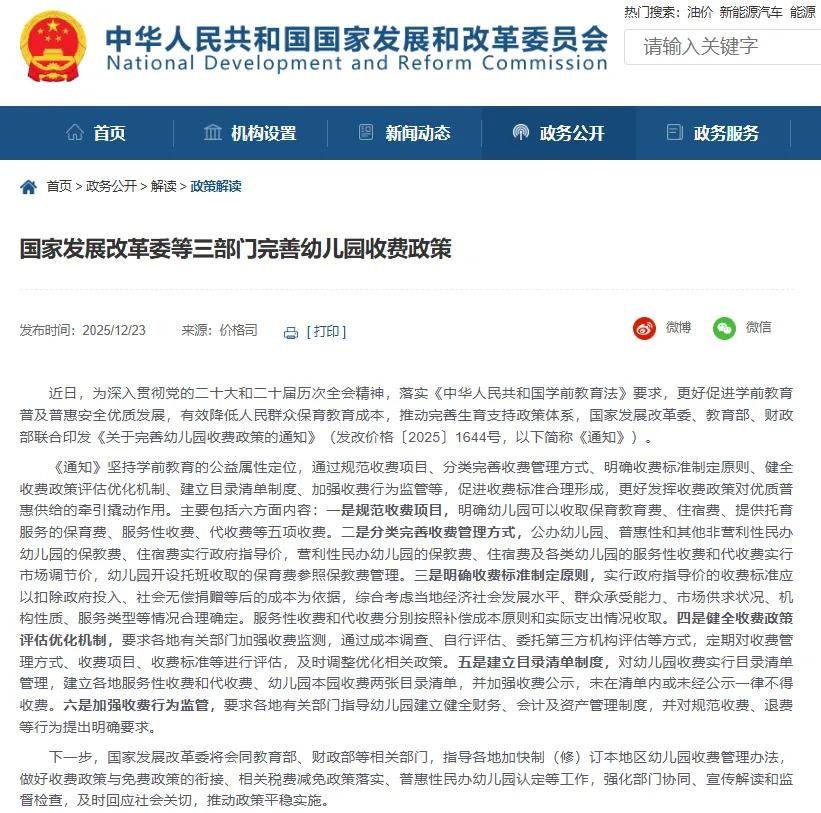
《通知》坚持学前教育的公益属性定位,通过规范收费项目、分类完善收费管理方式、明确收费标准制定原则、健 全收费政策评估优化机制、建立目录清单制度、加强收费行为监管等,促进收费标准合理形成,更好发挥收费政策 对优质普惠供给的牵引撬动作用。主要包括六方面内容: 一是规范收费项目,明确幼儿园可以收取保育教育费、住宿费、提供托育服务的保育费、服务性收费、代收费等五 项收费。 二是分类完善收费管理方式,公办幼儿园、普惠性和其他非营利性民办幼儿园的保教费、住宿费实行政府指导价, 营利性民办幼儿园的保教费、住宿费及各类幼儿园的服务性收费和代收费实行市场调节价,幼儿园开设托班收取的 保育费参照保教费管理。 近日,为深入贯彻党的二十大和二十届历次全会精神,落实《中华人民共和国学前教育法》要求,更好促进学前教 育普及普惠安全优质发展,有效降低人民群众保育教育成本,推动完善生育支持政策体系,国家发展改革委、教育 部、财政部联合印发《关于完善幼儿园收费政策的通知》(发改价格〔2025〕1644号,以下简称《通知》)。 三是明确收费标准制定原则,实行政府指导价的收费标准应以扣除政府投入、社会无偿捐赠等后的成本为依据,综 合考虑当地经济社 ...
规范幼儿园收费!三部门发文
中国基金报· 2025-12-23 11:30
来源:国家发展改革委网站 近日,为深入贯彻党的二十大和二十届历次全会精神,落实《中华人民共和国学前教育法》要 求,更好促进学前教育普及普惠安全优质发展,有效降低人民群众保育教育成本,推动完善生 育支持政策体系,国家发展改革委、教育部、财政部联合印发《关于完善幼儿园收费政策的通 知》(发改价格〔2025〕1644号,以下简称《通知》)。 《通知》坚持学前教育的公益属性定位,通过规范收费项目、分类完善收费管理方式、明确收 费标准制定原则、健全收费政策评估优化机制、建立目录清单制度、加强收费行为监管等,促 进收费标准合理形成,更好发挥收费政策对优质普惠供给的牵引撬动作用。主要包括六方面内 容: 一是规范收费项目 ,明确幼儿园可以收取保育教育费、住宿费、提供托育服务的保育费、服 务性收费、代收费等五项收费。 二是分类完善收费管理方式 ,公办幼儿园、普惠性和其他非营利性民办幼儿园的保教费、住 宿费实行政府指导价,营利性民办幼儿园的保教费、住宿费及各类幼儿园的服务性收费和代收 费实行市场调节价,幼儿园开设托班收取的保育费参照保教费管理。 les & FR 点击下载中国基金报客户端 ■ 中国基金报内容矩阵 ■ 巅峰对话 投 ...

规范幼儿园收费!三部门发通知
第一财经· 2025-12-23 09:55
Core Viewpoint - The article discusses the new notification issued by the National Development and Reform Commission, Ministry of Education, and Ministry of Finance regarding the improvement of kindergarten charging policies, aimed at promoting affordable and high-quality preschool education while reducing the financial burden on families [1][2]. Group 1: Standardization of Charging Items - Kindergarten charging items include care and education fees, accommodation fees, service fees, and agency fees, with care fees applicable for toddler classes [3]. - Care and education fees refer to the costs for providing preschool education, while accommodation fees are for boarding services [3]. Group 2: Classification and Improvement of Charging Management - Public and non-profit private kindergartens will have their care and education fees and accommodation fees regulated by government guidance prices, while for-profit private kindergartens will set prices based on market conditions [4]. - The management of care fees for toddler classes will follow the same principles as care and education fees, ensuring that costs are reasonable and meet community needs [4]. Group 3: Principles for Setting Charging Standards - Local authorities must base the charging standards for public and non-profit private kindergartens on cost audits, considering local economic conditions and community affordability [6]. - Service fees should be charged based on cost recovery principles, excluding government funding and donations [6]. Group 4: Establishing a Directory System - Local governments are required to create a directory of service and agency fees, which must be approved and publicly disclosed to ensure transparency [8]. - Kindergartens must maintain updated fee directories that include institution type, fee items, standards, and service content [8]. Group 5: Strengthening Supervision of Charging Behavior - Regulatory bodies must guide kindergartens in establishing financial management systems and ensure accurate record-keeping of costs and revenues [9]. - Kindergartens are prohibited from charging fees under various names that are not directly related to care and education [9]. Group 6: Improving Supporting Measures - Local governments should align financial support with charging policies to enhance the quality of preschool education and ensure the sustainability of kindergartens [11]. - Tax reductions and utility pricing for kindergartens should be implemented to support their operations [11]. Group 7: Strengthening Organizational Implementation - Coordination among regulatory bodies is essential for the effective implementation of the new policies, including the development of local charging management regulations [12]. - Public communication and response to community concerns are crucial for the smooth rollout of the new policies [12].

明年1月1日起 幼儿园不得以衔接班、兴趣班、课后培训等名义收取保教费、保育费以外的费用
Xin Lang Cai Jing· 2025-12-23 09:49
格隆汇12月23日|国家发展改革委、教育部、财政部发布完善幼儿园收费政策,自2026年1月1日起施 行。通知提到,要加强收费行为监管,各地发展改革、教育、财政部门要指导幼儿园建立健全财务、会 计及资产管理制度,区分不同班型完整准确记录收费项目的成本和收入情况,如实提供相关资料,配合 做好成本调查或监审工作。相关收费可按月、季度或学期收取,但不得跨学期预收。要指导幼儿园与家 长签订协议,列明收费标准、收费方式、退费办法,不得以幼小衔接班、兴趣班、课后培训和亲子特色 班等名义收取保教费、保育费以外的费用,不得以任何名义向幼儿家长收取与入园挂钩的捐资助学费 用,不得通过家委会收取任何费用,严禁引入第三方机构向幼儿家长直接收取费用。 ...