
幼儿园收费政策完善

Search documents
视频丨涉及社会民生多个领域 一批新规今起正式施行
Xin Lang Cai Jing· 2026-01-01 04:21
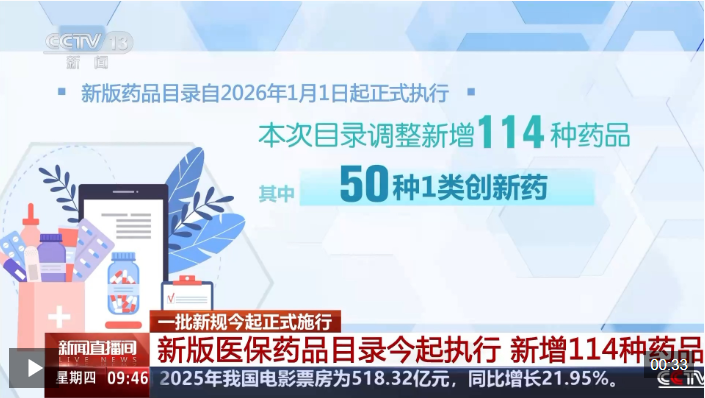
Group 1 - The new version of the National Basic Medical Insurance, Maternity Insurance, and Work Injury Insurance Drug Directory has been implemented, adding 114 new drugs to the reimbursement list [2][4] - The updated directory will officially take effect on January 1, 2026, increasing the total number of drugs in the directory to 3,253, including 1,857 Western medicines and 1,396 traditional Chinese medicines [4] - The adjustment enhances coverage for key areas such as cancer, chronic diseases, mental illnesses, rare diseases, and pediatric medications [4] Group 2 - The drug traceability code, which acts as an "electronic ID" for pharmaceuticals, is now required to be fully collected and uploaded by all medical institutions [5] - The National Medical Insurance Information Platform has collected 110.369 billion traceability codes, aiding in the resolution of multiple national counterfeit drug cases and addressing violations by 39,100 institutions [7] - The public can verify drug compliance through the National Medical Insurance Service Platform App, with over 5 million daily scans for drug verification [9] Group 3 - A new policy for kindergarten fees mandates a directory management system for charges, requiring public disclosure of service and additional fees [10] - The policy aims to prevent unauthorized charges by ensuring that only fees listed in the directory and publicly disclosed can be collected [10] Group 4 - The People's Bank of China has adjusted the one-time credit repair policy, allowing for automatic adjustments of overdue information under specific conditions [11] - Overdue debts incurred between January 1, 2020, and December 31, 2025, with amounts not exceeding 10,000 yuan, can be removed from credit reports if repaid by March 31, 2026 [11] Group 5 - The new Value-Added Tax Law and its implementation regulations have come into effect, with 14 out of 18 existing tax types now having legal frameworks [13]

国家发改委答南都:幼儿园乱收费从源头整治,清单之外无收费
Nan Fang Du Shi Bao· 2025-12-31 11:32
Core Viewpoint - The National Development and Reform Commission (NDRC) has issued a notification to improve kindergarten fee policies, addressing issues such as high fees, lack of transparency, and inadequate guidance for childcare services [1][2]. Group 1: Key Measures - The notification proposes four targeted measures to address the issues in kindergarten fee structures [1]. - The first measure involves implementing government-guided pricing for non-profit and inclusive private kindergartens, setting limits on tuition and accommodation fees to enhance their public welfare attributes [1]. - The second measure focuses on strengthening the regulation of fees in for-profit private kindergartens, potentially using cost surveys to curb excessive profit-seeking tendencies and guide reasonable pricing [1]. - The third measure provides a fee policy basis for kindergartens offering childcare services, allowing them to reference existing tuition standards and adjust based on cost differences, thereby encouraging the provision of childcare services [1]. Group 2: Governance and Transparency - The fourth measure emphasizes the need for source governance of irregular fee charging, establishing comprehensive fee lists for services and mandatory public disclosure to parents, ensuring no fees are charged outside the published lists [2]. - The NDRC plans to guide local authorities in revising regional kindergarten fee management methods and implementing tax relief policies, as well as recognizing inclusive private kindergartens to ensure smooth policy execution [2].
规范完善幼儿园收费是多赢之举 | 每周经济观察
Xin Lang Cai Jing· 2025-12-27 06:22
Group 1 - The core viewpoint of the news is the introduction of a new policy aimed at standardizing kindergarten fee structures in China, addressing concerns from parents regarding transparency and fairness in charges [1][2][3] - The policy emphasizes the public welfare nature of preschool education, ensuring that fee management aligns with the financial capabilities of families, particularly for public and non-profit kindergartens [2] - A directory system for service and additional fees will be established, promoting clear communication of costs to parents and enhancing regulatory oversight by the government [2][3] Group 2 - The adjustment from government pricing to government-guided pricing for public kindergartens is expected to encourage improvements in educational quality and responsiveness to cost changes [3] - The policy also aims to address the declining birth rate by allowing kindergartens to offer additional services, such as childcare, with flexible fee structures that reflect actual costs [3] - Regular evaluations of the fee standards every three years will help to optimize the fee management system, preventing excessive charges while allowing for necessary adjustments [2][3]

1月1日起施行,幼儿园只能收取这5类费用
Xin Lang Cai Jing· 2025-12-27 04:15
Core Viewpoint - The National Development and Reform Commission, Ministry of Education, and Ministry of Finance jointly issued a notice to improve kindergarten fee policies, addressing issues in fee management and proposing eight measures to clarify the boundaries of kindergarten fees, effective from January 1, 2026 [1]. Summary by Relevant Sections Fee Management - The notice specifies that kindergarten fees include care and education fees, accommodation fees, service fees, and agency fees, with care fees applicable for nurseries catering to children aged 2-3 years [2]. - Fees directly related to care and education, as well as those funded by the government, cannot be included in service or agency fees [2]. Fee Standardization - For public and non-profit private kindergartens, care and education fees and accommodation fees will follow government-guided pricing, while service and agency fees will generally be market-regulated, with government guidance applicable when necessary [2]. - Profit-oriented private kindergartens will set fees based on market conditions and operational costs [2]. Fee Directory Management - The notice mandates the establishment of a directory of service and agency fees, requiring kindergartens to maintain a clear fee list, prohibiting any charges outside this list [3][4]. - This directory aims to enhance transparency and accountability in fee collection, allowing parents to refuse any fees not listed [5]. Impact on Families and Education - The measures aim to alleviate the financial burden of kindergarten fees, ensuring that quality education is affordable and accessible, thereby addressing the "expensive enrollment" issue [5]. - The notice is expected to stimulate domestic demand by allowing families to allocate more funds to other consumption areas, while also reducing parenting anxiety for young families [5].
【每周经济观察】规范完善幼儿园收费是多赢之举
Xin Lang Cai Jing· 2025-12-26 23:07
Core Viewpoint - The recent notification from the National Development and Reform Commission and other departments aims to improve the kindergarten fee policy, addressing concerns from families and enhancing the quality of preschool education in China [2][3][4]. Group 1: Policy Implementation - The notification establishes a clear fee directory system to regulate charges, ensuring transparency and fairness in kindergarten fees [3][4]. - It emphasizes the principle of public welfare throughout the fee management process, categorizing institutions into public, non-profit, and for-profit to tailor fee structures accordingly [3][4]. - The introduction of a dynamic evaluation mechanism will allow for adjustments to fee standards every three years, balancing rigid constraints with flexible optimizations [3][4]. Group 2: Impact on Families and Institutions - The policy is expected to alleviate financial burdens on families while promoting the healthy development of kindergartens [4][5]. - By shifting from government pricing to government-guided pricing for public kindergartens, the policy encourages these institutions to improve their service quality [4]. - The notification also addresses the declining birth rate by allowing kindergartens to adjust their fee structures to better cover service costs, thereby enhancing their operational viability [4][5].

三部门发文完善幼儿园收费政策 让适龄儿童“上得起”“上好园”
Xin Hua Wang· 2025-12-24 23:34
Core Viewpoint - The recent notification issued by the National Development and Reform Commission, the Ministry of Education, and the Ministry of Finance aims to improve the kindergarten fee policy to better meet the public demand for affordable and quality early childhood education, reduce childcare costs, and enhance the fertility support policy system [1] Group 1: Fee Policy Framework - The notification emphasizes the public welfare nature of preschool education and aims to establish reasonable fee standards, including five specific chargeable items: childcare education fees, accommodation fees, childcare fees for nursery services, service fees, and additional fees [2] - It categorizes fee management methods, with public kindergartens and non-profit private kindergartens following government-guided pricing, while for-profit private kindergartens will have market-regulated pricing for their fees [2] - The principles for setting fee standards are based on costs after deducting government funding and donations, considering local economic conditions, public affordability, market demand, and service types [2] Group 2: Fee Management and Regulation - A directory list system will be established for kindergarten fees, requiring public disclosure of service fees and additional charges, with no fees allowed outside the approved list [3] - Strengthening supervision of fee collection practices is mandated, with requirements for kindergartens to establish sound financial management systems and clear guidelines for fee collection and refunds [3] Group 3: Quality Improvement and Cost Regulation - The notification aims to enhance the quality of public kindergartens by allowing them to set specific fee standards within a government-guided framework, thus encouraging better educational services [4] - It addresses the issue of excessive profit-seeking in for-profit private kindergartens by implementing stricter fee regulations and potential cost investigations to ensure reasonable pricing [4] Group 4: Encouragement of Childcare Services - The notification encourages kindergartens to provide nursery services, addressing the overall shortage of such services while allowing them to set fees based on the cost structure of childcare services [5] Group 5: Addressing Irregular Fee Practices - The notification highlights the existence of irregular fee practices in kindergartens, such as charging for various services through indirect means, and proposes measures to combat these practices [6][7] - It mandates the establishment of a comprehensive fee list for each region, ensuring that kindergartens can only charge for items listed and must publicly disclose their fee structures [7]
让适龄儿童“上得起”“上好园”(政策解读)
Ren Min Ri Bao· 2025-12-24 22:32
Core Viewpoint - The recent notification issued by the National Development and Reform Commission, Ministry of Education, and Ministry of Finance aims to improve the kindergarten fee policy to meet the growing public demand for affordable and quality early childhood education, thereby reducing the cost of childcare and education for families [1] Group 1: Fee Policy Framework - The notification emphasizes the public welfare nature of preschool education and aims to establish reasonable fee standards that promote quality and inclusive supply [2] - It specifies five types of fees that kindergartens can charge: childcare education fees, accommodation fees, childcare fees for nursery services, service fees, and agency fees [2] - Public kindergartens and non-profit private kindergartens will have their fees guided by the government, while for-profit private kindergartens will have market-regulated fees [2] Group 2: Fee Management and Evaluation - The notification outlines principles for setting fee standards, which should consider local economic conditions, community affordability, market demand, and the nature of the institution [2] - It mandates the establishment of a fee evaluation and optimization mechanism, requiring regular assessments of fee management practices and adjustments based on findings [3] Group 3: Transparency and Regulation - A directory management system for kindergarten fees will be implemented, requiring kindergartens to publicly disclose their fee structures [3] - The notification stresses the need for enhanced supervision of fee collection practices to prevent irregularities and ensure compliance with established guidelines [6][7] Group 4: Quality Improvement and Service Expansion - The notification encourages public kindergartens to improve educational quality by allowing them to set specific fee standards within a government-guided framework [4] - It also aims to stimulate the provision of nursery services by allowing kindergartens to set childcare fees based on the cost of services provided [5] Group 5: Addressing Irregular Fee Practices - The notification addresses existing irregularities in service and agency fees, emphasizing that kindergartens can only charge fees listed in their approved directories [7] - It prohibits charging fees under various names such as transition classes or extracurricular activities, and restricts the use of third-party organizations for fee collection [7]
三部门发文完善幼儿园收费政策 让适龄儿童“上得起”“上好园”(政策解读)
Ren Min Ri Bao· 2025-12-24 22:14
Core Viewpoint - The recent notification issued by the National Development and Reform Commission, the Ministry of Education, and the Ministry of Finance aims to improve the kindergarten fee policy to meet the growing public demand for affordable and quality early childhood education, thereby reducing the cost of childcare and education for families [1] Group 1: Fee Policy Framework - The notification emphasizes the public welfare nature of preschool education and aims to establish reasonable fee standards that promote quality and inclusive supply [2] - It specifies five types of fees that kindergartens can charge: childcare education fees, accommodation fees, childcare fees for nursery services, service fees, and agency fees [2] - Public kindergartens and non-profit private kindergartens will have their fees guided by the government, while for-profit private kindergartens will have market-regulated fees [2] Group 2: Fee Management and Evaluation - The notification outlines principles for setting fee standards, which should consider local economic conditions, community affordability, market demand, and the nature of the institution [2] - It mandates the establishment of a fee evaluation and optimization mechanism, requiring regular assessments of fee management practices and adjustments based on findings [2][3] Group 3: Transparency and Regulation - A directory management system for kindergarten fees will be implemented, requiring kindergartens to publicly disclose their fee structures [3] - The notification stresses the need for strict regulation of fee collection practices to prevent arbitrary charges and ensure compliance with established guidelines [6][7] Group 4: Quality Improvement and Support for Childcare Services - The notification aims to enhance the quality of public kindergartens by allowing them to set specific fee standards within a government-guided framework [4] - It encourages kindergartens to offer nursery services by allowing them to set childcare fees based on the cost of providing such services [5] Group 5: Addressing Malpractices - The notification addresses existing issues of arbitrary charges in kindergartens, emphasizing the need for clear fee lists and prohibiting fees for unapproved services [7] - It prohibits charging fees under various names, such as transition classes or extracurricular activities, and mandates that all fees must be publicly disclosed [7]
划红线!幼儿园今后只能收这五类费用
Xin Lang Cai Jing· 2025-12-23 18:05
Core Viewpoint - The joint notice issued by the National Development and Reform Commission, Ministry of Education, and Ministry of Finance aims to address prominent issues in kindergarten fee management by proposing eight measures to clarify the boundaries of kindergarten fees [1][2]. Summary by Relevant Sections Fee Management Regulations - The notice specifies that kindergarten fees include care and education fees, accommodation fees, service fees, and collection fees, with care fees applicable for those offering toddler classes. Service fees are for optional services chosen by parents, while collection fees are for services paid on behalf of parents [1]. Classification and Pricing of Fees - Public and non-profit private kindergartens will have their education and accommodation fees guided by government pricing, while service and collection fees will generally follow market pricing, with government guidance applicable when necessary. For profit-oriented private kindergartens, fees will be determined based on operational costs and market demand [1]. Standards for Fee Adjustment - Local authorities are required to base the adjustment of fees for public and non-profit private kindergartens on costs, considering the financial capacity of families to ensure reasonable fee standards [1]. Prohibition of Unlawful Charges - The notice sets strict boundaries against illegal charges, stating that fees can be collected monthly, quarterly, or per semester but not in advance for future terms. It prohibits charging fees under the guise of transition classes, interest classes, after-school training, or donations linked to enrollment [2]. Impact on Families and Education - Experts believe that the notice aims to alleviate the financial burden of early childhood education, enhance the quality of public education, and stimulate domestic consumption by allowing families to allocate more funds to other areas. This is expected to reduce anxiety among young families and reinforce the public nature of early education [2].
三部门完善幼儿园收费政策 加强收费行为监管
2 1 Shi Ji Jing Ji Bao Dao· 2025-12-23 13:33
Core Viewpoint - The National Development and Reform Commission, Ministry of Education, and Ministry of Finance have issued a notification to improve kindergarten charging policies, effective from January 1, 2026, emphasizing the need for enhanced regulation of charging practices in kindergartens [1] Group 1: Regulatory Measures - Local development reform, education, and finance departments are required to guide kindergartens in establishing sound financial, accounting, and asset management systems [1] - Kindergartens must accurately record the costs and income of different class types and provide relevant information for cost investigations or audits [1] Group 2: Charging Practices - Charges can be collected monthly, quarterly, or per semester, but advance collection across semesters is prohibited [1] - Kindergartens are instructed to sign agreements with parents detailing charging standards, methods, and refund policies [1] Group 3: Prohibited Fees - Kindergartens are not allowed to charge fees under the guise of transition classes, interest classes, after-school training, or parent-child specialty classes beyond the standard educational fees [1] - It is forbidden to collect any fees linked to enrollment under any name, including donations for educational assistance, and to collect fees through parent committees or third-party organizations [1]