打击贩毒集团

Search documents
美国国务卿高调放话:拦截贩毒船只没有用,炸毁才有用
Huan Qiu Wang· 2025-09-04 06:41
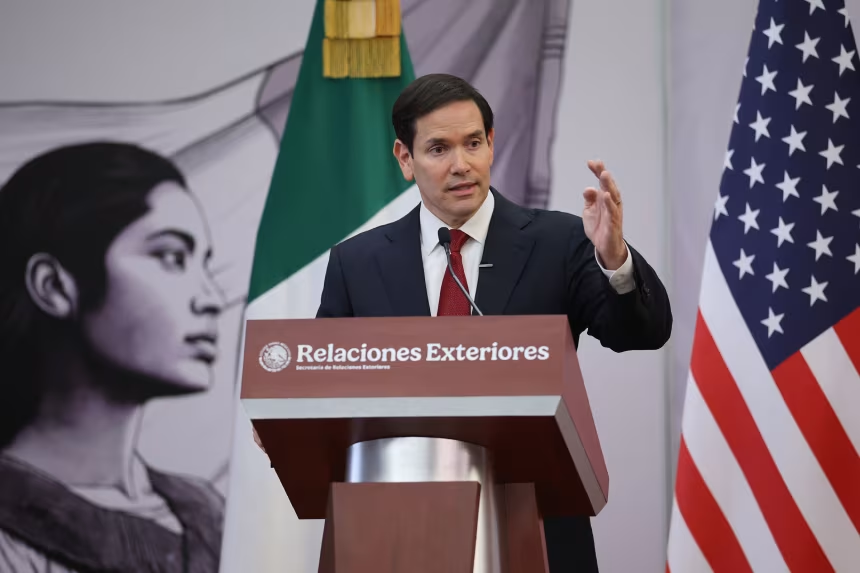
Group 1 - The core viewpoint of the article is that the U.S. government is escalating its military actions against drug trafficking organizations, indicating a significant shift in strategy by opting for direct military strikes rather than interception [1][3]. - U.S. Secretary of State Rubio stated that intercepting drug boats has proven ineffective, as drug cartels are willing to accept a 2% loss of their cargo, thus advocating for the destruction of these vessels instead [3]. - The recent military strike against a suspected drug trafficking vessel linked to the Venezuelan gang "Aragua Train" resulted in the death of 11 members, marking an unprecedented level of military engagement in drug enforcement [4]. Group 2 - The U.S. has deployed multiple naval vessels in the Caribbean near Venezuela under the pretext of combating drug trafficking, which has heightened tensions between the U.S. and Venezuela [3][4]. - Venezuelan President Maduro criticized the U.S. military presence, claiming it is an absurd attempt to exert extreme pressure on Venezuela under the guise of drug enforcement, while asserting that Venezuela is committed to fighting drug trafficking [4].

1200枚导弹瞄准委内瑞拉,马杜罗警告:特朗普将“血债累累”
Jin Shi Shu Ju· 2025-09-02 03:27
Core Viewpoint - The situation in Venezuela is escalating due to the U.S. military presence in the Caribbean, which President Maduro perceives as a significant threat to national sovereignty and security [2][3]. Military Deployment - Maduro claims that eight U.S. Navy ships, armed with 1,200 missiles, are currently positioned near Venezuela, marking the largest threat seen in the continent in a century [2]. - The U.S. has deployed two Aegis destroyers and additional naval vessels in the region, with plans to further increase military presence, including three amphibious assault ships and over 4,000 sailors and Marines [2][3]. Drug Trafficking Allegations - The U.S. government is intensifying its naval forces to combat drug trafficking from Latin American cartels, with Maduro being accused of leading a drug trafficking organization [3]. - Venezuelan Foreign Minister Yván Gil argues that the narrative of Venezuela as a primary route for cocaine trafficking is misleading, as 87% of Colombian cocaine exits through the Pacific, with only about 5% attempting to pass through Venezuela [3]. Political Context - Maduro's government faces accusations of electoral fraud, leading to a lack of recognition from the U.S. regarding his presidency [4]. - The opposition in Venezuela has been urging the U.S. and other nations to apply pressure on Maduro, with some leaders expressing support for U.S. military actions against his government [4]. International Relations - Maduro has indicated that his government maintains communication channels with the Trump administration, while also condemning the military deployment as a threat to a sovereign nation [4][5]. - He warns that any military action by the U.S. would result in significant consequences for the Trump administration, labeling it as a failed policy of regime change [5].
美被曝将部署一支两栖作战中队至南加勒比海
Yang Shi Xin Wen· 2025-08-21 00:31
Core Viewpoint - The U.S. has ordered an amphibious task force to the South Caribbean to support President Trump's efforts against Latin American drug trafficking organizations [1] Group 1: Military Deployment - Three ships, "San Antonio," "Iwo Jima," and "Fort Lauderdale," will carry approximately 4,500 U.S. military personnel, including 2,200 Marines, expected to arrive near Venezuela by the 24th [1] - The specific mission details have not been disclosed, but the deployment targets groups classified as "transnational drug terrorist organizations" [1] Group 2: Drug Trafficking Strategy - The Trump administration has designated the Sinaloa drug cartel in Mexico and Venezuela's "Aragua Train" gang as global terrorist organizations since February [1] - The fight against drug trafficking is viewed as a crucial part of immigration control and southern border security strategy [1] Group 3: Official Confirmation - On August 19, the White House spokesperson confirmed the deployment of three ships carrying 4,000 soldiers to the Caribbean waters near Venezuela [1]
墨西哥外交部:拒绝美军以打击毒品集团为由在墨境内进行军事干预
Huan Qiu Shi Bao· 2025-08-10 22:50
Core Points - The article discusses a secret executive order signed by President Trump authorizing military actions against drug cartels in Latin America, including Mexico [1][3] - Mexican President AMLO firmly stated that the U.S. will not send troops to Mexico, emphasizing that any military intervention is unacceptable [1][3] - The Mexican Foreign Ministry reiterated its stance against U.S. military involvement in Mexico, highlighting the importance of national sovereignty and cooperation based on mutual respect [3] Summary by Sections - **U.S. Actions**: The executive order provides a basis for military actions against drug cartels on foreign territories, marking a significant escalation in Trump's approach to combating drug trafficking [1][3] - **Mexican Response**: President AMLO and the Mexican Foreign Ministry have clearly rejected the idea of U.S. military presence, asserting that Mexico will handle its own security issues [3] - **Characterization of Drug Cartels**: U.S. Secretary of State Rubio has classified drug cartels as armed terrorist organizations, suggesting a shift in how the U.S. perceives and plans to address these groups [3]