
技术决定论

Search documents
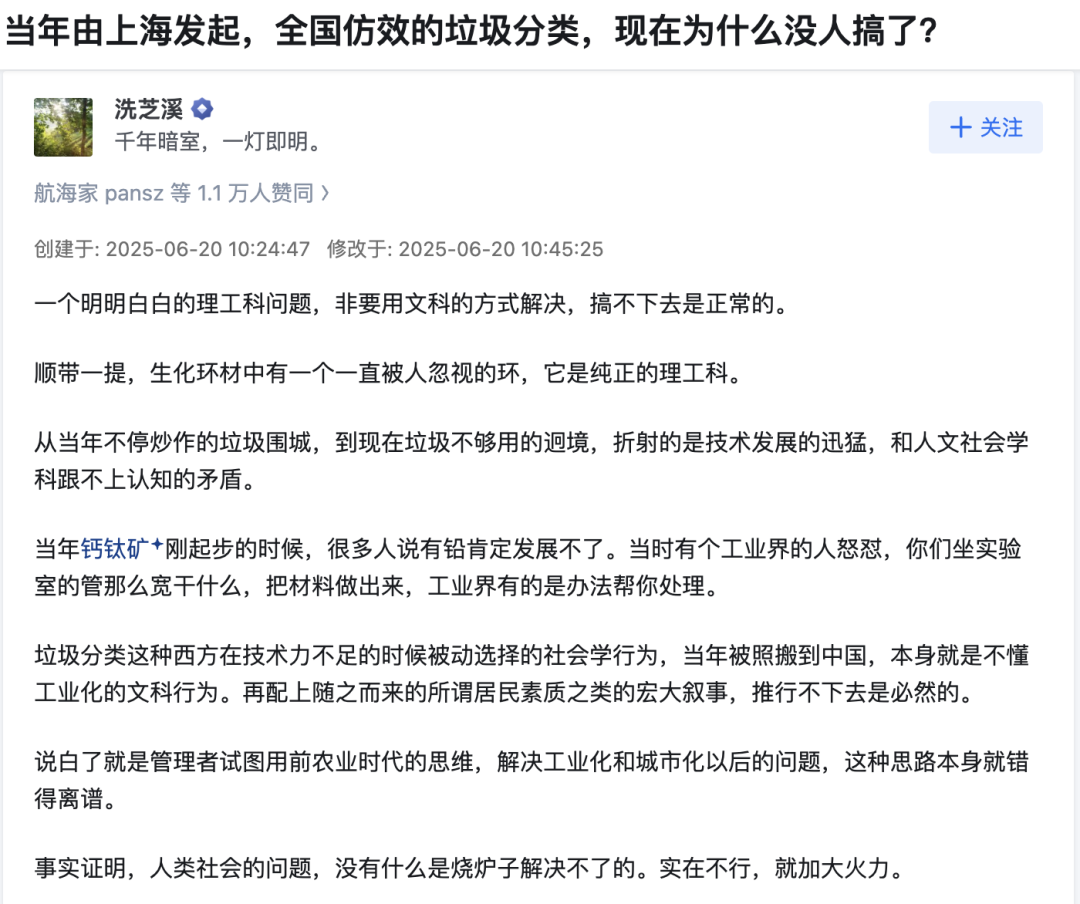
上海的垃圾分类,真的失败了吗?
Hu Xiu· 2025-06-24 09:00
Core Viewpoint - The article argues against the notion that Shanghai's waste classification system has failed, presenting evidence that the system has actually improved waste management and recycling rates. Group 1: Waste Classification Success - Since the implementation of the waste management regulations in July 2019, the recovery rate of recyclable materials has increased from approximately 4,000 tons per day to over 7,973 tons per day by 2024 [16] - The amount of dry waste collected has decreased from 21,500 tons per day in 2018 to 17,200 tons per day in 2024, indicating a reduction in waste generation [16] - The volume of wet waste has increased from about 9,000 tons per day to over 12,000 tons per day, showing effective separation and processing [16] Group 2: Misinterpretation of Data - The claim that incineration plants are "underutilized" is misleading; it reflects the success of waste classification, as less "other waste" is being sent for incineration [19][18] - The increase in incineration capacity from 13,300 tons per day to 28,000 tons per day, with the number of incineration facilities rising from 9 to 15, indicates proactive planning to handle future waste [20][21] - The reduction in "other waste" is a direct result of successful waste classification, not a failure of the system [19] Group 3: Importance of Waste Sorting - Effective waste sorting enhances the quality of fuel for incineration, improving energy recovery and reducing pollution [32][27] - The presence of contaminants in mixed waste can lead to increased emissions of harmful substances, making sorting essential for environmental protection [28][31] - The establishment of a comprehensive waste sorting system in Shanghai ensures that different types of waste are collected and processed appropriately [34] Group 4: Future Considerations - The article suggests that while current waste classification efforts are beneficial, future technological advancements may provide more efficient solutions for waste management [46][49] - The potential for AI and machine vision technologies to automate waste sorting could reduce the burden on residents and improve efficiency [43] - The development of biodegradable materials may eventually eliminate the need for extensive waste sorting, but such advancements are still in progress [44][49]

用好信息导航
Jing Ji Ri Bao· 2025-06-07 22:05
Core Insights - The article discusses how large language models (LLMs) enhance information collection and filtering capabilities, likening them to satellite navigation systems that help users navigate the information landscape [1][2] - It emphasizes the importance of active judgment and selection in utilizing LLMs, which is crucial for individuals in the technological age [4] Group 1: Relationship Between Technology and Society - There are two contrasting views on the relationship between new technology and human societal evolution: a pessimistic view that sees potential threats from breakthrough technologies, and an optimistic view that believes in the progressive benefits of technological advancement [5] - The authors argue against technological determinism, asserting that human wisdom allows for weighing choices and planning for various potential scenarios, thus emphasizing a balanced approach to technology [5] Group 2: Individual Empowerment Through Technology - The authors highlight that technology acts as an amplifier of human capabilities, enabling individuals to enhance their creativity, productivity, and influence through AI [6] - A framework is proposed in "AI Empowerment" that outlines ten principles for individuals to effectively collaborate with technology, ensuring they benefit from the new capabilities and the collective value created by all users [6]