
新型军国主义

Search documents
人民日报文章:高度警惕日本重拾核武装旧梦
Xin Lang Cai Jing· 2026-01-26 00:26
Core Viewpoint - Japan's intention to modify the "Three Non-Nuclear Principles" poses a significant challenge to global nuclear non-proliferation and could destabilize world peace, increasing the risk of nuclear proliferation [1][3]. Group 1: Japan's Nuclear Policy Shift - Japan's historical narrative has framed itself as a "nuclear victim," yet it has rarely reflected on its past as a "nuclear aggressor" during World War II [1]. - The recent statements from Japanese officials regarding potential nuclear armament signal a shift in Japan's security strategy, indicating that the "nuclear option," once a taboo, is now entering public political discourse [1][2]. Group 2: Motivations Behind the Shift - The push for nuclear policy discussions aims to weaken post-war constraints and accumulate political capital for Japan's ambition to become a "military power" [2]. - By testing public and international reactions to nuclear armament discussions, Japanese politicians are assessing the feasibility and resistance to such policies, laying the groundwork for future revisions [2]. - Japan seeks to enhance its autonomous deterrence capabilities and redefine its role within the U.S.-Japan alliance, viewing nuclear armament as a means to reduce dependency on allies [2]. - The strategy includes building offensive capabilities to exert strategic pressure on neighboring countries, thereby seeking a more advantageous position in regional power dynamics [2]. Group 3: Historical Context and Responsibilities - The "Three Non-Nuclear Principles" were established as a national policy reflecting Japan's remorse for wartime actions and its commitment to peace, rooted in the painful memories of Hiroshima and Nagasaki [3]. - Modifying these principles would undermine Japan's historical responsibilities and commitments to its neighbors, posing a serious threat to regional peace and stability [3]. - The international community must remain vigilant against Japan's potential return to nuclear armament and the resurgence of "new militarism" [3].
钟声:三问日本,撕开其所谓“和平国家”的假面
Ren Min Ri Bao· 2026-01-15 03:24
Group 1 - The core argument of the articles highlights the contradiction between Japan's self-portrayal as a "peaceful nation" and its actual military expansion and strategic shifts, raising concerns about its true intentions [1][4] - Japan's "Peace Constitution," which has historically restrained military expansion and promoted peaceful relations with neighboring countries, is increasingly viewed by right-wing factions as an obstacle to national normalization, leading to actions that undermine its original intent [2][3] - The Japanese government's inclination towards nuclear armament, including potential modifications to the "Three Non-Nuclear Principles," poses a significant threat to regional security and the global non-proliferation regime, as Japan has been a major producer and stockpiler of plutonium [3][4] Group 2 - Japan's recent actions, including interference in Taiwan issues and the promotion of "China threat" narratives, have exacerbated tensions with neighboring countries and raised alarms about its role in regional stability [3][4] - The historical context of Japan's militaristic past, particularly during World War II, is invoked to caution against its current trajectory towards militarization, which mirrors past strategies of deception and aggression [4] - The international community is urged to remain vigilant and recognize the underlying motives behind Japan's actions, as they may threaten both regional and global peace [4]
钟声丨三问日本,撕开其所谓“和平国家”的假面
Ren Min Ri Bao· 2026-01-15 00:50
Group 1 - Japan's Prime Minister, Fumio Kishida, is promoting a revision of the "Security Three Documents" to strengthen Japan's independence and peace, highlighting a contradiction between Japan's self-portrayal as a "peaceful nation" and its military expansion efforts [1] - The "Peace Constitution," effective since 1947, has historically constrained Japan's military expansion and fostered better relations with neighboring countries, but recent actions by the Japanese right-wing threaten to undermine this framework [2] - Japan's government is showing signs of nuclear ambitions by considering modifications to its "Three Non-Nuclear Principles," which could destabilize regional security and challenge international nuclear non-proliferation efforts [3] Group 2 - The current Japanese administration is exacerbating regional tensions by interfering in issues such as Taiwan and promoting the so-called "China threat," which complicates relations with neighboring countries [3] - Historical parallels are drawn between Japan's current military rhetoric and its past militaristic actions during World War II, suggesting a dangerous trajectory towards militarism under the guise of peace [4] - The international community is urged to remain vigilant and recognize the true intentions behind Japan's actions, as they may pose significant risks to regional and global stability [4]
三问日本,撕开其所谓“和平国家”的假面(钟声)
Ren Min Ri Bao· 2026-01-14 23:58
Core Viewpoint - Japan's current strategic direction poses significant risks, as the government promotes military expansion while publicly advocating for peace, revealing a stark contrast between rhetoric and actions [1][4]. Group 1: Japan's Military Expansion - Prime Minister Suga Yoshihide's push to revise the "Security Three Documents" aims to strengthen Japan's independence and peace, yet this contradicts the country's self-portrayal as a "peaceful nation" [1]. - Japan's right-wing factions view the "Peace Constitution" as an obstacle to national normalization, leading to actions that undermine its original intent, such as the relaxation of military restrictions and increased defense spending [2]. - The government is moving towards a "new militarism," with policies that effectively nullify the principles of self-defense and implicitly accept the right to engage in warfare [2]. Group 2: Nuclear Policy and Regional Stability - Japan's government is showing signs of a nuclear ambition by considering modifications to its "Three Non-Nuclear Principles," which could destabilize regional security and challenge international non-proliferation norms [3]. - The country has a significant stockpile of plutonium, far exceeding its civilian energy needs, raising concerns about its nuclear intentions and potential impacts on global strategic stability [3]. - Japan's involvement in regional tensions, particularly regarding Taiwan and its relations with neighboring countries, exacerbates conflicts and undermines peace efforts in Asia [3]. Group 3: Historical Context and International Perception - Japan's historical militarism and aggressive foreign policy during World War II serve as a cautionary tale, as current actions echo past strategies of deception and military buildup under the guise of peace [4]. - The international community is urged to remain vigilant and recognize the true intentions behind Japan's "peaceful" facade, as the country navigates a dangerous path towards militarization [4].
人民日报钟声:三问日本,撕开其所谓“和平国家”的假面
Xin Lang Cai Jing· 2026-01-14 22:46
Group 1 - Japan's Prime Minister, Sanae Takaichi, is promoting the revision of the "Security Three Documents" to strengthen Japan's "independence and peace," highlighting a contradiction between rhetoric and actions, revealing the dangerous direction of Japan's current strategy [1][2] - Japan has long portrayed itself as a "peaceful nation," attempting to whitewash its militaristic past, but recent actions raise doubts about its true intentions, including the gradual erosion of its "Peace Constitution" [2][3] - The "Peace Constitution," effective since 1947, has constrained Japan's military expansion and sent a "non-war" signal to neighboring countries, but right-wing factions view it as an obstacle to "normalizing" the nation, leading to actions that undermine its original intent [2][3] Group 2 - Japan's government is showing signs of nuclear ambitions by considering modifications to its "Three Non-Nuclear Principles," which could destabilize regional security and challenge the authority of international non-proliferation treaties [3][4] - The current Japanese administration is provoking tensions in the region, particularly regarding Taiwan, and is accused of stirring up "China threat" narratives, which complicate relations with neighboring countries [3][4] - Japan's historical militaristic tendencies are resurfacing, with parallels drawn to its actions before World War II, as it seeks to create conditions for strategic maneuvering under the guise of peace [4]
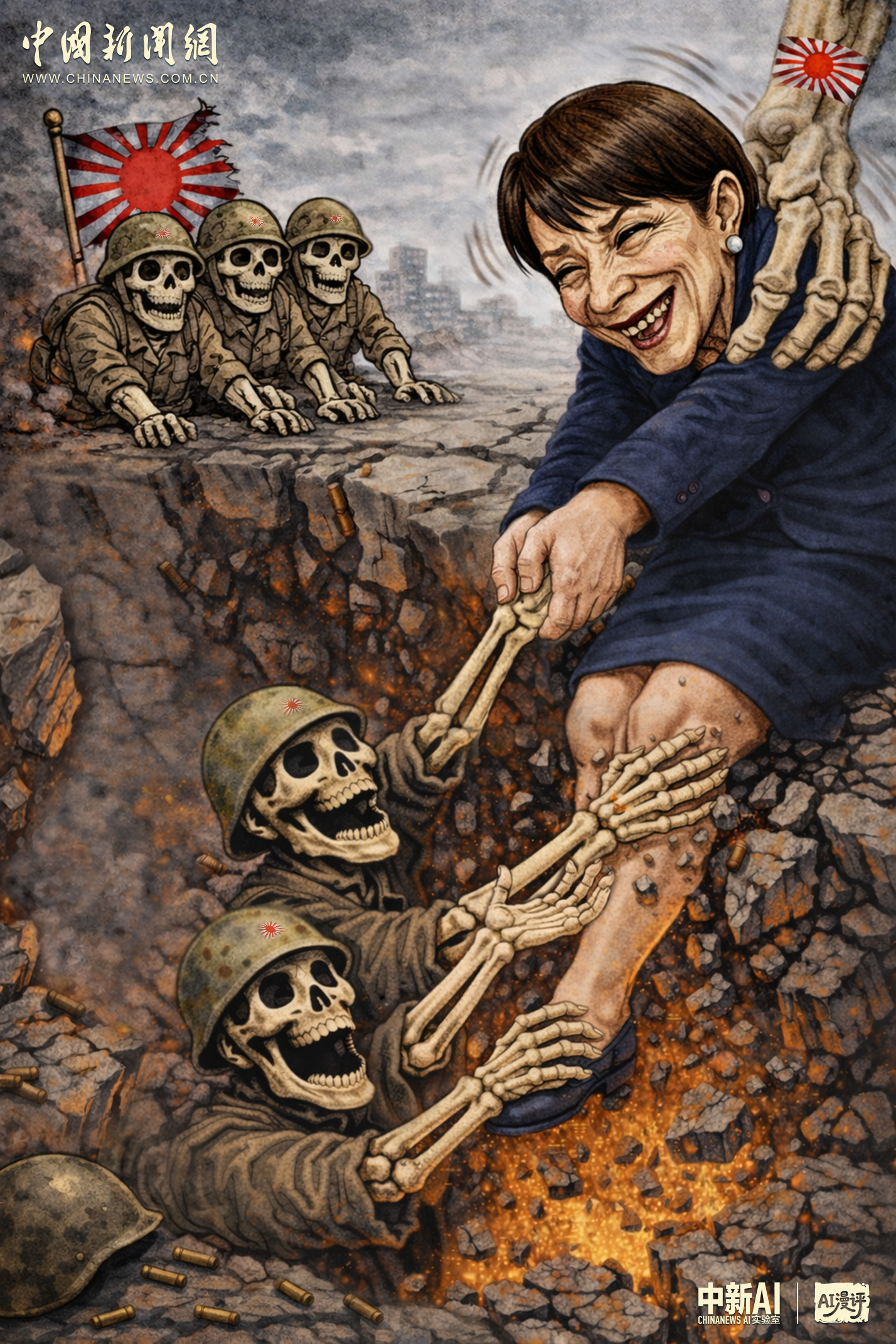
AI漫评|“自主防卫”幌子下,日本正被谁拖向危险歧途?
Zhong Guo Xin Wen Wang· 2026-01-12 07:55
Group 1 - The core viewpoint of the article highlights growing concerns in Japanese society regarding Prime Minister Suga Yoshihide's political direction, which is seen as deviating from the post-war peace established in Japan [3] - There is an increasing awareness among intellectuals that the narrative of strengthening "self-defense" and building a "capable military nation" is fostering a soil for a so-called "new militarism" [3] - The logic of escalating military spending through crisis narratives is blurring the boundaries of real risks and eroding the peace consensus that has underpinned Japan's post-war development [3] Group 2 - The article warns that Japan's future, as well as that of the region, is being dragged towards a more dangerous direction due to these developments [3]

钟声:“新型军国主义”将把日本再次引向深渊
Ren Min Ri Bao· 2026-01-09 03:13
Core Viewpoint - The article warns against Japan's shift towards militarism under the leadership of Prime Minister Fumio Kishida, suggesting that the government is creating a dangerous illusion for its citizens while increasing defense spending, reminiscent of pre-World War II Japan [1][2][3] Group 1: Historical Context - The article draws parallels between current Japanese militarism and the militaristic expansion of Japan before World War II, highlighting the deception used to rally public support for war [1] - It describes how militaristic leaders historically portrayed aggressive wars as noble causes, manipulating public sentiment through propaganda and education [1][2] Group 2: Current Military Spending and Public Sentiment - Japan's defense budget for the fiscal year 2026 is projected to reach 9.04 trillion yen, marking a historical high and sparking significant domestic opposition [3] - There is a growing public sentiment against military expansion, with citizens expressing a desire for government resources to focus on economic revitalization and social welfare instead [3] Group 3: Ideological Manipulation - The article discusses how right-wing factions in Japan are promoting a narrative of "national normalization" and external threats to justify military expansion and the abandonment of pacifist principles [2] - It highlights concerns that these factions are attempting to rewrite history and indoctrinate younger generations, aiming to erase the legacy of Japan's wartime actions [2] Group 4: Future Implications - The article emphasizes the need for vigilance among peace-loving Japanese citizens to prevent a return to militarism, advocating for a focus on historical accountability and peaceful relations with neighboring countries [3]
“新型军国主义”将把日本再次引向深渊(钟声)
Ren Min Ri Bao· 2026-01-09 00:17
Core Viewpoint - Japan's right-wing factions are pushing the country further down a militaristic path, attempting to draw citizens into a "new militarism" that poses significant risks to national security and regional stability [1][2][3]. Group 1: Historical Context - The article draws parallels between current Japanese militarism and the pre-World War II era, highlighting how the government deceived citizens about the nature of war, leading to national disaster [1][2]. - Historical narratives promoted by militarists framed aggressive wars as "just" and necessary for national revival, while suppressing the true costs of such actions [1][2]. Group 2: Current Military Budget and Public Sentiment - Japan's defense budget for the fiscal year 2026 is set to reach 9.04 trillion yen, marking a historic high and sparking significant domestic opposition [3]. - Amid economic stagnation and fiscal constraints, the public is increasingly advocating for prioritizing economic revitalization and social welfare over military expansion [3]. Group 3: Opposition to Militarism - There is a growing chorus of dissent within Japan against militaristic policies, with voices calling for a focus on peace and stable international relations rather than preparing for war [3]. - The article emphasizes the need for the Japanese populace to remain vigilant against the resurgence of militaristic ideologies that could lead to repeating past mistakes [3].
9万亿!再创新高!日本刚刚批准防卫预算!
Zheng Quan Shi Bao Wang· 2025-12-27 02:36
Core Viewpoint - Japan's government has approved a record defense budget exceeding 9 trillion yen for the fiscal year 2026, indicating a significant shift in its defense strategy towards "proactive deterrence" and enhancing its military capabilities, which may impact regional security dynamics [1][2][3]. Group 1: Defense Budget Details - The approved defense budget for fiscal year 2026 is over 9 trillion yen, marking a continuous increase in Japan's defense spending, which has surpassed 6 trillion, 7 trillion, and 8 trillion yen in previous years [2]. - The budget will fund the acquisition of long-range missiles and the development of a coastal defense system centered around attack drones, with an investment of approximately 100.1 billion yen for the latter [2]. - Japan plans to increase its total defense spending to about 43 trillion yen from 2023 to 2027, as outlined in the new "security three documents" approved in late 2022 [2]. Group 2: Strategic Implications - Experts suggest that the increase in defense spending signifies a transformation in Japan's military posture from "defensive" to "proactive deterrence," potentially redefining its post-war military identity and affecting regional security [3]. - Japan is also pursuing the development of nuclear-powered submarines, with plans to advance to the next generation of propulsion systems and possibly acquire nuclear submarines to enhance its defense capabilities [3]. - The country is collaborating with the UK and Italy to develop a next-generation fighter jet, with an investment of over 160 billion yen planned for this initiative, expected to be deployed by 2035 [3]. Group 3: Domestic and International Reactions - The increase in defense spending has raised concerns among various sectors in Japan, with public protests against military expansion and warnings from scholars about the economic burden on ordinary citizens [4][5]. - The Chinese Foreign Ministry has criticized Japan's military expansion, suggesting it reflects a dangerous trend towards militarism and a departure from its historically peaceful development path [4][5].
9万亿!日本,刚刚批准!
Zheng Quan Shi Bao Wang· 2025-12-27 01:50
Core Viewpoint - Japan's government has approved a record defense budget exceeding 9 trillion yen for the fiscal year 2026, indicating a significant shift in its defense strategy towards "proactive deterrence" and enhancing its military capabilities, which may impact regional security dynamics [1][2][3]. Group 1: Defense Budget Details - The approved defense budget for fiscal year 2026 is over 9 trillion yen, marking a new high [2]. - Japan's defense spending has consistently increased, surpassing 6 trillion yen, 7 trillion yen, and 8 trillion yen in previous fiscal years [2]. - The budget will fund long-range missiles and the development of an attack drone-based coastal defense system called "SHIELD," with an investment of approximately 100.1 billion yen [2]. Group 2: Strategic Implications - The increase in defense spending signifies a transformation in Japan's military posture from "defensive" to "proactive deterrence," potentially redefining its post-war military identity [1][3]. - Japan is also pursuing the development of nuclear-powered submarines and has plans to collaborate with the UK and Italy on a next-generation fighter jet, with over 160 billion yen allocated for this purpose [3]. Group 3: Domestic and International Reactions - The budget approval has raised concerns among various sectors in Japan regarding the implications of increased militarization [2]. - The Chinese Foreign Ministry has criticized Japan's military expansion, suggesting it reflects a dangerous trend towards militarism and a departure from its historical stance on peace [4][5].