
新能源汽车安全标准

Search documents
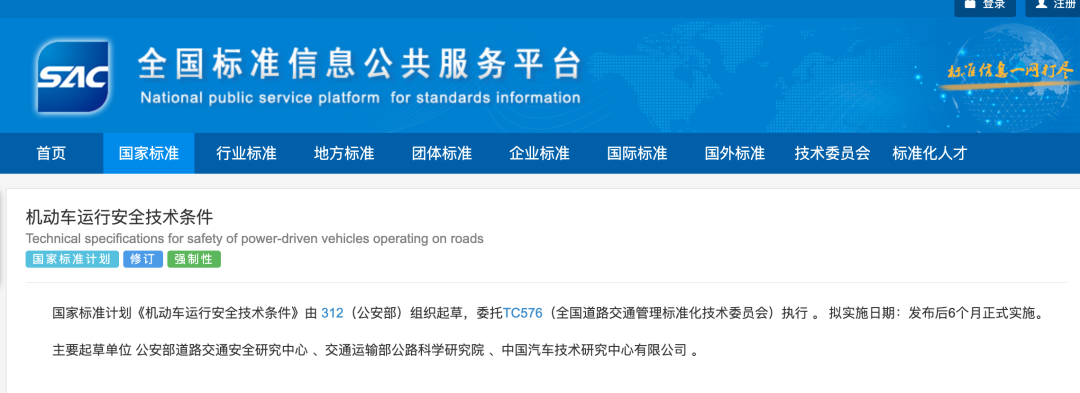
“乘用车默认百公里加速应不小于5秒,车门外把手应具备机械释放功能”,公安部起草的强制性国标征求意见
Mei Ri Jing Ji Xin Wen· 2025-11-13 02:33
Core Viewpoint - The Ministry of Public Security has drafted a national standard plan titled "Technical Conditions for Motor Vehicle Operation Safety," which is open for public consultation and aims to replace the existing GB 7258 standard within six months after the consultation period [1][3]. Group 1: Background and Necessity - The current GB 7258 standard, established in 2017, is deemed inadequate to meet the evolving demands of motor vehicle safety management and technological advancements in the automotive industry [3]. - The rapid increase in the penetration of new energy vehicles and vehicles with assisted driving functions has led to rising traffic safety concerns and accidents, highlighting the need for updated technical requirements [3]. Group 2: Key Changes in the Draft - The draft proposes enhanced safety requirements for new energy vehicles, including: - New requirements for regenerative braking systems and the regulation of "single pedal" mode [4]. - Introduction of a pedal misapplication suppression feature for electric and plug-in hybrid vehicles [4]. - Safety application requirements for in-vehicle entertainment systems, mandating the disabling of screens and entertainment functions when the vehicle exceeds 10 km/h [4]. - Safety requirements for power batteries in new energy vehicles, ensuring compliance with GB 38031 standards [4]. Group 3: Advanced Driver Assistance Systems (ADAS) - The draft includes new safety technical requirements for assisted driving vehicles, such as: - Conditions for activating and deactivating combined driving assistance systems [4]. - Requirements for detecting driver hand and gaze disengagement [4]. - Specifications for driver authorization to activate combined driving assistance features [4]. - Enhanced human-machine interaction requirements between the driver and the assistance system [4]. Group 4: Safety Mechanisms and Features - The draft establishes a multi-condition verification mechanism for system activation, requiring drivers to perform specific actions and meet several core conditions before activation [5]. - Continuous monitoring of driver engagement is mandated when the vehicle speed exceeds 10 km/h, potentially impacting the use of popular "hands-free" driving technologies [6]. Group 5: Additional Safety Measures - New requirements for passenger vehicles include: - Default settings for acceleration times of no less than 5 seconds for 100 km/h after ignition [8]. - Implementation of pedal misapplication suppression features to prevent unintended acceleration [8]. - The draft addresses safety concerns related to electronic door locks and emergency access, ensuring that doors unlock automatically during critical situations [9]. - Specifications for window glass and emergency escape features are outlined to enhance passenger safety [10].

《电动汽车安全要求》进一步提升安全底线——《电动汽车安全要求》(GB 18384)(征求意见稿)解读
Zhong Guo Qi Che Bao Wang· 2025-08-01 08:00
Core Viewpoint - The Ministry of Industry and Information Technology has released the draft of GB 18384 "Safety Requirements for Electric Vehicles," which aims to enhance safety standards for electric vehicles, reflecting the industry's need for improved safety measures and aligning with international standards [4][7]. Group 1: Key Revisions in the Draft - The draft emphasizes raising the safety baseline for electric vehicles, introducing stricter requirements for vehicle maintenance disconnection devices to ensure personnel safety during rescue or maintenance scenarios [5]. - The "one-key power-off" function has been revised to require a physical button instead of a soft switch, addressing the failure risks associated with soft switches in emergency situations [5]. - New requirements for vehicle bottom protection and scraping tests have been added, based on observed safety incidents and research data, with no existing international standards for reference [6]. Group 2: Industry Impact and Development - The draft aims to guide the development of higher-level technical solutions by encouraging companies to adopt safety measures that exceed the mandatory standards, thereby enhancing consumer safety [8]. - The revisions are part of a broader effort to synchronize with international standards, particularly with the ongoing revision of ISO 6469-3, ensuring that China's electric vehicle safety requirements are aligned with global practices [7]. - The automotive industry has shown increased awareness of vehicle safety, with many companies already implementing protective measures for battery systems, indicating a proactive approach to safety enhancements [8].
