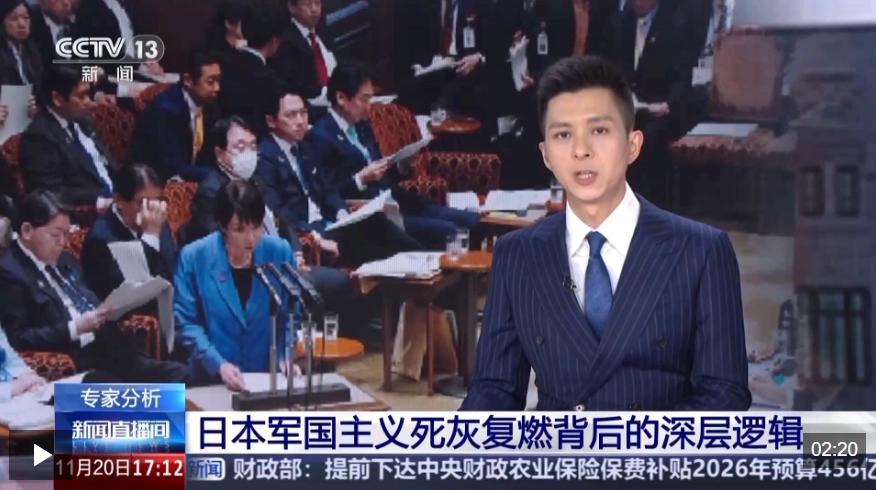
日本军国主义死灰复燃

Search documents
外交部回应“日本从网络防御转向网络进攻”
证券时报· 2025-12-26 09:46
Group 1 - The article highlights China's serious concerns regarding Japan's shift from cyber defense to cyber offense, as Japan's cabinet has authorized proactive countermeasures against cyber attacks, indicating a significant policy change [2] - Japan's defense budget for the fiscal year 2026 has been approved at approximately 9.04 trillion yen, marking a historical high, which reflects the rising militarization and intentions of Japan's right-wing forces [3] - China urges Japan to confront and reflect on its history of aggression, particularly in light of the 80th anniversary of the victory in the Chinese People's War of Resistance against Japanese Aggression, emphasizing the need for Japan to show remorse for its militaristic past [4] Group 2 - The article mentions that Japan's recent military security moves have drawn increasing criticism from the international community, yet Japan plans to significantly increase its defense budget, revealing its dangerous intentions [3] - China expresses appreciation for Russia's suggestion that Japan should build a memorial for victims of its militarism, reinforcing the call for Japan to acknowledge its historical wrongdoings [4] - The article emphasizes the importance of maintaining international peace and stability by preventing the resurgence of Japanese militarism, with China willing to collaborate with the international community to uphold the outcomes of World War II [4]


视频丨国际人士:应警惕日本军国主义死灰复燃
Yang Shi Xin Wen Ke Hu Duan· 2025-12-03 23:35
Core Viewpoint - Japanese Prime Minister Sanae Takaichi's remarks regarding Taiwan have sparked widespread criticism, signaling a potential resurgence of Japanese militarism that could threaten regional and global peace and stability [1][3][4][5][6] Group 1: International Reactions - International figures express concern that Takaichi's statements indicate a dangerous signal of Japan's militaristic revival, which could jeopardize peace in the region and beyond [3][4] - Davidson Mungandu, a Zambian lawmaker, emphasizes the desire for economic partnerships among nations and condemns Japan's provocative behavior as escalating tensions [3] - Daniel Gibson, a researcher at the University of Pretoria, describes Takaichi's remarks as incendiary and suggests that Japan's attempt to project a "tough stance" may be a risky strategy to enhance its value in the eyes of the Trump administration [4] Group 2: Historical Context and Legal Implications - Medard Musondia, a Congolese lawmaker, opposes Takaichi's comments, viewing them as a signal of Japan's attempt to revive militarism, recalling the historical atrocities committed by Japanese forces in Asia [5] - Javier Vadel, a professor at Minas Gerais Catholic University in Brazil, warns that Takaichi's statements violate international law by interfering in the internal affairs of other nations, with extreme outcomes potentially leading to war [6]

日本民众举行集会反对高市早苗错误言论 多国人士呼吁警惕日本军国主义死灰复燃
Yang Guang Wang· 2025-11-30 00:37
Group 1 - Protests have erupted across Japan in response to Prime Minister Kishi Nobuo's recent remarks regarding Taiwan, with demonstrators demanding a retraction of his statements [1] - Protesters express that Kishi's comments represent a declaration of Japan's intent to revive militarism and imperialism, reflecting on Japan's historical aggression towards China and Asia [1] - International figures emphasize that the Taiwan issue is an internal matter for China, and Kishi's statements indicate a lack of remorse for Japan's historical fascist crimes, urging vigilance against the resurgence of Japanese militarism [1][2] Group 2 - The Chairman of the Iraq-China Friendship Association, Haider Rubai, asserts that Japan's comments on Taiwan are baseless, reiterating that Taiwan is an inseparable part of China and opposing any foreign interference in China's internal affairs [2]
多国人士表示应警惕日本军国主义死灰复燃
Yang Shi Xin Wen Ke Hu Duan· 2025-11-29 08:31
Group 1 - The recent comments made by Japanese Prime Minister Sanae Takaichi regarding Taiwan have been criticized by multiple international figures, emphasizing that the Taiwan issue is purely an internal matter of China [1][5][7] - There is a growing concern that Japan's political figures show no remorse for historical fascist crimes, indicating a potential resurgence of militarism in Japan [1][3] - Various international representatives reaffirmed their commitment to the One China principle, rejecting any form of interference in China's internal affairs regarding Taiwan [5][7] Group 2 - The statements made by Japan regarding Taiwan are deemed baseless and unacceptable, with calls for Japan to reflect on its historical mistakes and avoid repeating militaristic ambitions [3][7] - The importance of the UN General Assembly Resolution 2758, which asserts that there is only one China and Taiwan is an inseparable part of it, was reiterated by several international leaders [7]

恪守“和平宪法”,日本才有立世之本(钟声)
Ren Min Ri Bao· 2025-11-25 22:42
Core Points - Japan is attempting to break free from the constraints of international law as a defeated nation in World War II, leading to a potential resurgence of militarism [1][3] - Recent actions by Japan, including the export of lethal weapons and discussions to revise security policies, indicate a departure from post-war international order [1][2] - The international community has expressed concern over Japan's shift away from its long-standing commitment to peace and adherence to international agreements [3][4] Summary by Sections Japan's Recent Actions - Japan has relaxed weapon export restrictions and is exporting lethal weapons for the first time since 2023 [1] - The ruling party is discussing revisions to the "security three documents" and plans to deploy offensive weapons in the southwestern islands near Taiwan [1][2] International Legal Obligations - International documents like the UN Charter and the Potsdam Declaration clearly outline Japan's obligations as a defeated nation, including disarmament and restrictions on military capabilities [2] - Japan's constitution and political agreements emphasize a commitment to peaceful development and conflict resolution through non-military means [2] Domestic and International Reactions - There is growing alarm among international scholars and governments regarding Japan's militaristic rhetoric and actions, which contradict its constitutional commitments [3] - Protests have emerged within Japan, with citizens demanding the Prime Minister retract controversial statements and uphold peace principles [3][4] Historical Context and Future Implications - The historical lessons from World War II highlight the importance of Japan adhering to international law and its own peace constitution to avoid repeating past mistakes [4] - The international community has a responsibility to uphold the post-war order and prevent the resurgence of Japanese militarism [4]
动向极其危险,国际社会需高度警惕
Ren Min Ri Bao· 2025-11-24 22:31
Core Viewpoint - The Chinese Foreign Ministry spokesperson criticized Japan's plans to deploy offensive weapons near Taiwan, labeling it as a deliberate attempt to create regional tension and provoke military confrontation [1] Group 1: Japan's Military Policy Changes - Japan has significantly adjusted its security policies in recent years, increasing its defense budget annually and relaxing restrictions on arms exports [1] - There are concerns that Japan is seeking to develop offensive weapons and abandon its "Three Non-Nuclear Principles" [1] - The rise of right-wing forces in Japan is seen as a threat to the peace constitution, pushing the country further down a militaristic path [1] Group 2: Historical Context and Regional Implications - This year marks the 80th anniversary of China's victory in the War of Resistance against Japan and the liberation of Taiwan, emphasizing the historical significance of the current tensions [1] - China firmly opposes any attempts by Japanese right-wing forces to reverse historical progress and will not allow external forces to interfere in Taiwan [1] - The Chinese government asserts its determination and capability to defend national territorial sovereignty [1]
日本部署中程导弹,中方:极其危险!
Xin Jing Bao· 2025-11-24 07:52
Core Viewpoint - The Chinese government expresses strong opposition to Japan's deployment of medium-range air defense missiles in the Ryukyu Islands, which are located only 110 kilometers from Taiwan, viewing this as a provocative action that heightens regional tensions [1] Group 1: Japan's Military Developments - Japan's Defense Minister announced the scheduled deployment of medium-range air defense missiles at a base in the Ryukyu Islands [1] - The Chinese government highlights that Japan's actions are part of a broader trend of increasing military capabilities, including a significant rise in defense budgets and the pursuit of offensive weapons [1] Group 2: Historical Context and Concerns - The Chinese spokesperson references the Potsdam Declaration, which prohibits Japan from rearming, and Japan's Peace Constitution, which establishes a principle of "defensive defense" [1] - There is a concern that Japan's right-wing forces are attempting to break free from the constraints of the Peace Constitution, leading the country down a path of militarization [1] Group 3: Regional Implications - The Chinese government warns that Japan's military actions could lead to disaster for both Japan and the region, emphasizing the need for vigilance from neighboring countries and the international community [1] - The statement also reflects China's determination to safeguard its territorial sovereignty and prevent any resurgence of Japanese militarism [1]
视频丨专家:高市言行是危险信号 暴露日本军国主义死灰复燃
Yang Shi Xin Wen Ke Hu Duan· 2025-11-21 02:23
Core Viewpoint - The recent remarks by Japanese Prime Minister Fumio Kishida indicate a potential revival of militarism in Japan, reflecting the influence of conservative right-wing forces and a distorted historical perspective [2][3]. Group 1: Historical Context and Ideological Shifts - The conservative right-wing ideology in Japan has roots in the incomplete post-World War II reforms led by the United States, which failed to fully purge militaristic elements, allowing them to coalesce into a dominant political force [3]. - The narrative of Japanese militarism has evolved from a defensive posture to an offensive one, with historical aggressions being reframed as self-defense and war criminals being glorified as national heroes [6]. Group 2: Current Political Dynamics - The current right-wing narrative aims to psychologically and legally free Japan from the constraints of the post-war international order, seeking to challenge the limitations imposed by the pacifist constitution [8]. - The recent discourse introduced by Kishida, particularly the concept of "survival crisis," closely resembles the rhetoric used during Japan's imperialist expansion, indicating a dangerous shift in political ideology [6][8].