生命演化

Search documents
【新华社】“老化石”里发现“新秘密”:新成果破解多项生命演化之谜
Xin Hua She· 2025-09-29 01:09
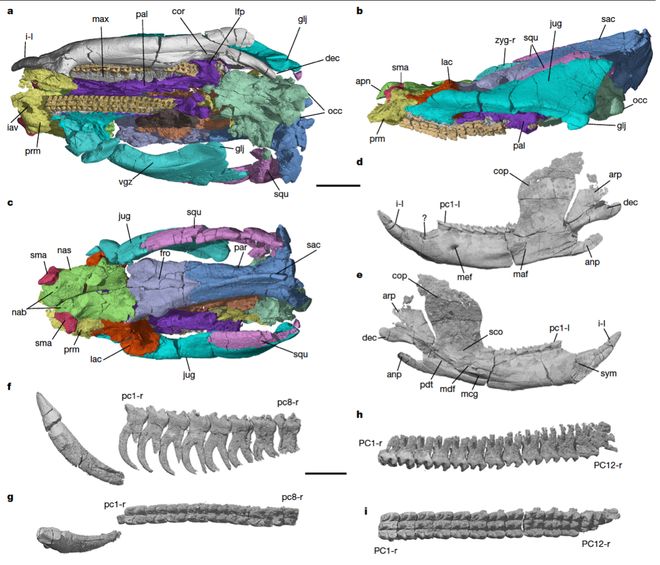
Core Insights - Recent studies by the Chinese Academy of Sciences have revealed new findings about human evolution and the evolutionary pathways of early mammals, utilizing advanced technologies to analyze ancient fossils [1][2][7]. Group 1: Human Evolution - The research on the Yuncheng Man skull, dated to approximately 1 million years ago, has clarified the human evolutionary lineage, indicating that multiple human groups had already diverged by that time [2][4]. - The study reconstructed the skull and identified features that suggest it belongs to an early representative of the Dragon Man lineage rather than Homo erectus, challenging previous classifications [2][4]. - The findings propose that the divergence of Homo sapiens, Dragon Man, and Neanderthals occurred earlier than previously recorded, thus reshaping the timeline of human evolution [2][4]. Group 2: Early Mammal Evolution - The research on the Sichuan Zizhong multi-toothed beast fossil, dating back 160 to 168 million years, has uncovered a unique jaw joint structure that indicates a significant evolutionary transition from reptiles to mammals [5][6]. - The study suggests that the multi-toothed beast's jaw joint adaptation was crucial for its burrowing lifestyle, providing insights into the evolutionary mechanisms of jaw structures in early mammals [5][6]. - Another fossil, the Lufeng quadruped from the early Jurassic period, has been identified as a transitional form in jaw joint evolution, filling gaps in the understanding of vertebrate evolution [6]. Group 3: Technological Innovations - Advanced technologies such as high-precision CT scanning and 3D reconstruction have been employed to analyze and reconstruct ancient fossils, enhancing the understanding of their morphology and evolutionary significance [7]. - The application of new statistical methods and high-resolution imaging has allowed researchers to validate their findings and improve the accuracy of fossil reconstructions [7]. - The ongoing use of innovative techniques is expected to continue revealing insights from previously dormant fossils, further enriching the understanding of life's history [8].

远古发现|“老化石”里发现“新秘密”:新成果破解多项生命演化之谜
Xin Hua She· 2025-09-28 03:52
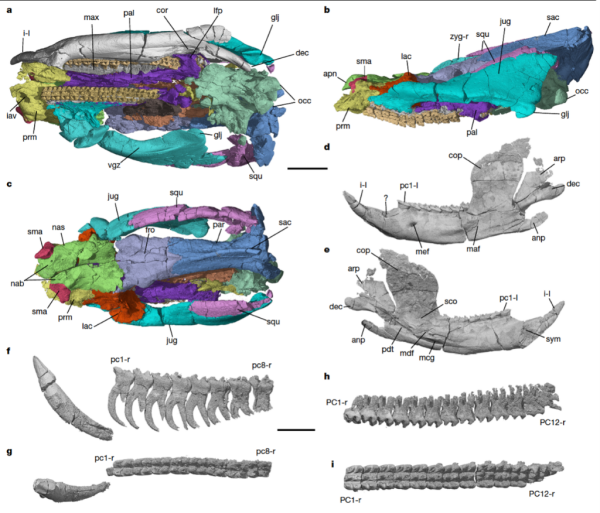
Core Insights - Recent studies by the Chinese Academy of Sciences have revealed new findings about human evolution and early mammal evolution through the analysis of ancient fossils using advanced technologies [1][2][3][6] Group 1: Human Evolution - The research on the Yuncheng Man skull, dated to approximately 1 million years ago, has redefined the human evolutionary timeline, indicating that multiple human groups had already diverged by that time [2] - The study found that the Yuncheng Man is not a representative of Homo erectus but rather an early representative of the Dragon Man lineage, suggesting earlier divergence of Homo sapiens, Dragon Man, and Neanderthals than previously recorded [2] - The findings challenge existing fossil records and provide a new evolutionary tree for the genus Homo, indicating a more complex evolutionary history [2] Group 2: Early Mammal Evolution - Research on the Chuan-nan Multicuspid Beast fossil, dating back 160 to 168 million years, has uncovered a unique jaw joint structure that indicates a significant evolutionary transition from reptiles to mammals [3][5] - The study suggests that the jaw joint of the Chuan-nan Multicuspid Beast allowed for greater chewing efficiency, marking a key difference between reptiles and mammals [3][5] - Another fossil, the Lufeng Quian Beast, dating back 201 to 184 million years, provides insights into the transitional forms of jaw joint evolution, filling gaps in the understanding of vertebrate evolution [5] Group 3: Technological Innovations - Advanced technologies such as high-precision CT scanning and 3D reconstruction have been employed to analyze and reconstruct ancient fossils, allowing researchers to gain new insights from previously studied specimens [6] - The application of these technologies has revitalized the study of ancient fossils, enabling a deeper understanding of evolutionary history [6] - The ongoing research aims to uncover more "sleeping" fossils, further enhancing knowledge of life's history [6]
不断探索生命的奇迹(院士新语)
Ren Min Ri Bao· 2025-08-31 22:32
Core Insights - The ongoing research in paleontology continues to provide clues for understanding the evolution of life, particularly the relationship between dinosaurs and birds, which has been debated since Darwin proposed the theory of evolution [1][2][3] Group 1: Evidence of Evolution - Key evidence supporting the hypothesis that birds evolved from dinosaurs includes the discovery of feathered dinosaur fossils in China, which confirmed that feathers were present before the evolution of birds [1][2] - The fossil of "Guanlong," discovered in 2003, showed limb structures similar to bird feathers, indicating a crucial stage in the evolution of flight [1] - The largest feathered dinosaur fossil, found in Inner Mongolia in 2005, further demonstrated the importance of feathers in the evolutionary process, challenging the previous notion that dinosaurs were solely covered in scales [1] Group 2: Structural Similarities - Studies comparing the skeletal structures of dinosaurs and early birds revealed significant similarities, such as the claw structure of "Velociraptor" and the feather arrangement of "Microraptor," which align closely with early birds like "Archaeopteryx" [2] - The continuity in skeletal structure supports the theory that birds are a lineage of theropod dinosaurs [2] Group 3: Technological Advancements - Advances in technology have enhanced paleontological research, allowing for the use of satellite navigation data, geological data, and computer models to better predict fossil distribution [2][3] - Techniques such as CT scanning and synchrotron radiation enable scientists to observe the internal structures of fossils, revealing details about the physiological changes during the evolution from dinosaurs to birds [3] Group 4: Multidisciplinary Approaches - The integration of paleontology with developmental biology and molecular biology has provided strong support for the evolutionary connection between birds and dinosaurs, particularly through the study of gene sequences related to feather development and flight capabilities [3] - Ongoing research continues to yield significant findings, enhancing the understanding of life's evolution and the mysteries of Earth's biological history [3]
于生命长河照见“我是谁”
Ren Min Ri Bao· 2025-05-22 22:02
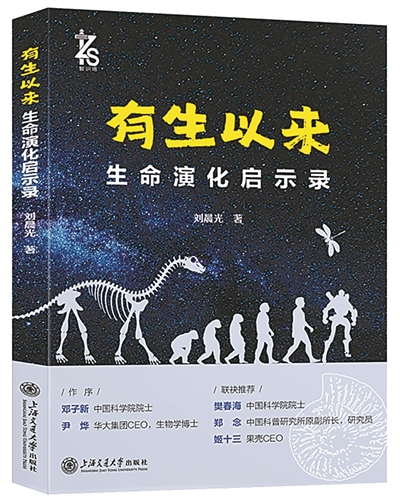
Core Insights - The book "A Life of Its Own: Insights into Evolution" by Liu Chengguang explores the breakthroughs in life sciences, including synthetic biology, gene technology, and artificial intelligence, and their implications for understanding the evolution of life [2] - It presents a comprehensive narrative of life's evolution, from single-celled organisms to complex life forms, and addresses key scientific concepts such as the origin of life, species formation, and human evolution [2] Summary by Sections - **Scientific Knowledge**: The book discusses core theories of evolution, including the development of evolutionary theory, phenotypic and behavioral evolution, and genetic and chromosomal evolution, making complex scientific knowledge accessible through engaging examples [3] - **Human Impact**: It highlights the significant impact of human activities on biological evolution, noting that the current extinction rate of species is 1,000 times higher than before humans appeared, with projections indicating that over 25% of species may face extinction or be endangered by 2050 [4] - **Technological Advances**: The rapid development of biotechnology, including synthetic biology, gene editing, and cloning, raises ethical considerations, prompting discussions on the nature of life and the potential for creating life after resolving technical challenges [5] - **Philosophical Reflections**: The book elevates evolutionary theory from a historical footnote to a methodology for shaping the future, emphasizing that "survival of the fittest" is not only a biological instinct but also a crucial logic for the continuity of civilization [5]