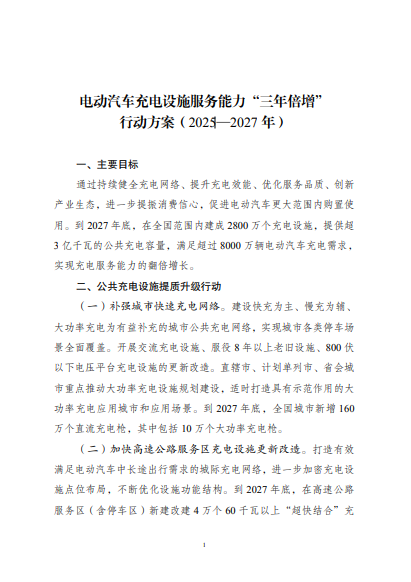
电动汽车充电设施服务能力三年倍增

Search documents
重磅利好!六部门发布
Zhong Guo Ji Jin Bao· 2025-10-15 09:29
Core Viewpoint - The National Development and Reform Commission, along with other departments, has issued the "Three-Year Doubling Action Plan for Electric Vehicle Charging Facility Service Capacity (2025-2027)" to enhance the electric vehicle charging infrastructure and promote wider adoption of electric vehicles [1][4]. Summary by Sections Main Goals - The plan aims to establish 28 million charging facilities nationwide by the end of 2027, providing over 300 million kilowatts of public charging capacity to meet the charging needs of more than 80 million electric vehicles, effectively doubling the charging service capacity [4][8]. Public Charging Facility Quality Upgrade Actions - Strengthening urban fast charging networks by adding 1.6 million direct current charging guns, including 100,000 high-power charging guns by 2027 [6][9]. - Accelerating the renovation of charging facilities in highway service areas, with plans to build 40,000 "super fast combination" charging guns of 60 kilowatts or more by 2027 [6][10]. - Addressing the shortfall in rural charging facilities by adding at least 14,000 direct current charging guns in townships without public charging stations by 2027 [6][10]. Residential Charging Condition Optimization Actions - Increasing the scale of private charging facility construction in new residential areas, ensuring all fixed parking spaces are equipped with charging facilities or conditions for installation [6][11]. - Promoting a "unified construction and service" model for residential charging facilities, aiming to establish 1,000 pilot communities by 2027 to enhance the management and safety of private charging piles [6][11]. Vehicle-Grid Interaction Application Promotion Actions - Expanding the pilot scope of vehicle-grid interaction, with plans to add over 5,000 bidirectional charging and discharging (V2G) facilities and achieve a reverse discharge volume of over 20 million kilowatt-hours by 2027 [6][13]. Power Supply Capacity and Service Improvement Actions - Accelerating the upgrade and renovation of the distribution network to accommodate charging facility demands, focusing on urban core areas and highway service zones [6][14]. - Enhancing the efficiency of power supply services for electric vehicle charging facilities through streamlined application processes and improved service channels [6][14]. Charging Operation Service Quality Improvement Actions - Improving the quality and reliability of public charging stations by upgrading old equipment and enhancing user experience through better service standards [6][15][16]. Guarantee Mechanisms - The National Development and Reform Commission and other relevant departments will oversee the implementation of the action plan, ensuring effective coordination and support for the construction of charging facilities [6][17]. - Local authorities are encouraged to develop tailored three-year action plans for charging facility construction, addressing specific regional needs and promoting market competition [6][17].

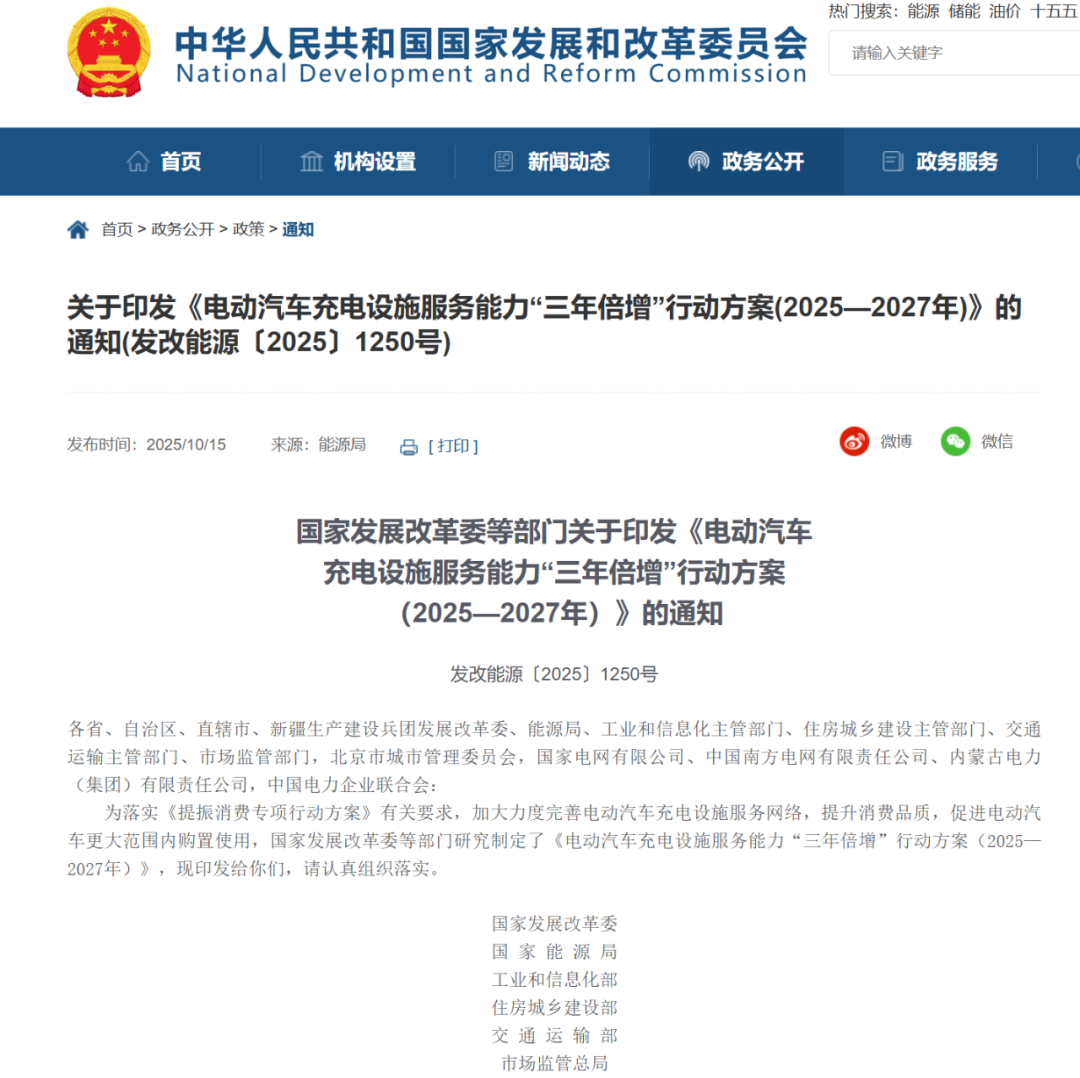
重磅利好!六部门发布
中国基金报· 2025-10-15 09:28
Core Viewpoint - The "Three-Year Doubling Action Plan for Electric Vehicle Charging Infrastructure Service Capacity (2025-2027)" aims to enhance the electric vehicle charging network, boost consumer confidence, and promote wider adoption of electric vehicles in China [1][3]. Summary by Sections Action Plan Goals - The main objective is to establish 28 million charging facilities nationwide by the end of 2027, providing over 300 million kilowatts of public charging capacity to meet the charging needs of over 80 million electric vehicles, effectively doubling the service capacity [3]. Key Content of the Action Plan - **Urban Fast Charging Network**: Build a public charging network focused on fast charging, with a target of adding 1.6 million direct current charging guns in cities by 2027, including 100,000 high-power charging guns [4]. - **Highway Service Area Upgrades**: Construct and renovate 40,000 charging guns of 60 kilowatts or more in highway service areas to support intercity travel needs [5]. - **Rural Charging Infrastructure**: Add at least 14,000 direct current charging guns in townships without public charging stations by 2027, ensuring comprehensive coverage in rural areas [8]. - **Private Charging Facilities**: New residential areas must install charging facilities in all designated parking spaces, while existing areas should enhance charging capabilities [9]. - **Unified Construction and Service Model**: Promote a model where operators handle the planning, construction, and maintenance of charging facilities in residential areas, aiming to establish 1,000 pilot communities by 2027 [9]. - **Vehicle-to-Grid Interaction**: Expand the scale of vehicle-to-grid (V2G) applications, adding over 5,000 V2G facilities and achieving a reverse discharge volume of over 20 million kilowatt-hours by 2027 [10]. Supply Capacity and Service Improvement Actions - **Distribution Network Upgrades**: Integrate charging facility demands into distribution network planning, focusing on urban core areas and highway service zones [11]. - **Service Efficiency Enhancements**: Streamline the application process for residential charging facilities and improve service efficiency through digital channels [11]. Quality of Charging Operations - **Service Quality Improvement**: Enhance the quality and reliability of public charging stations, ensuring a better user experience through upgraded facilities and improved operational standards [12][13]. Implementation and Safety Management - **Organizational Leadership**: Various government departments will coordinate the implementation of the action plan, ensuring effective execution at local levels [14]. - **Safety Management**: Strengthen safety management for charging facilities, ensuring compliance with national standards and enhancing public safety [15]. Public Awareness and Communication - **Policy Promotion**: Increase awareness of the action plan through media channels, ensuring timely updates on charging infrastructure developments [15].

国家发改委、国家能源局等六部门发布重要行动方案
中国能源报· 2025-10-15 09:19
Core Viewpoint - The "Three-Year Doubling Action Plan for Electric Vehicle Charging Facility Service Capacity (2025-2027)" aims to enhance the charging network, improve charging efficiency, optimize service quality, and innovate the industrial ecosystem to boost consumer confidence and promote wider adoption of electric vehicles. By the end of 2027, the plan targets the establishment of 28 million charging facilities nationwide, providing over 300 million kilowatts of public charging capacity to meet the charging needs of over 80 million electric vehicles, achieving a doubling of charging service capacity [4][5][6]. Summary by Sections 1. Main Goals - The plan aims to establish 28 million charging facilities and provide over 300 million kilowatts of public charging capacity by the end of 2027, meeting the charging needs of over 80 million electric vehicles, thereby doubling the charging service capacity [4]. 2. Public Charging Facility Quality Upgrade Actions - Strengthening urban fast charging networks with a focus on fast charging and supplementing with slow charging, targeting the addition of 1.6 million direct current charging guns in cities by 2027, including 100,000 high-power charging guns [5]. - Accelerating the renovation of charging facilities in highway service areas, with a goal of constructing 40,000 "super-fast combination" charging guns of 60 kilowatts or more by 2027 [6]. - Expanding charging infrastructure in rural areas, aiming to add at least 14,000 direct current charging guns in townships without public charging stations by 2027 [6]. 3. Residential Charging Condition Optimization Actions - Increasing the scale of private charging facility construction in new residential areas, ensuring all fixed parking spaces are equipped with charging facilities or pre-installed for future installation [7]. - Promoting a "unified construction and service" model for residential charging facilities, with a target of establishing 1,000 pilot communities by 2027 to enhance the accessibility and safety management of private charging piles [7]. 4. Vehicle-Grid Interaction Large-Scale Application Promotion Actions - Expanding the scope of vehicle-grid interaction pilot projects, with a goal of adding over 5,000 bidirectional charging and discharging (V2G) facilities and achieving a reverse discharge volume of over 20 million kilowatt-hours by 2027 [9]. 5. Power Supply Capacity and Service Improvement Actions - Accelerating the upgrade and renovation of the distribution network to accommodate charging facility demands, focusing on urban core areas, highway service areas, and old residential communities [10]. - Enhancing the efficiency of electricity connection services for electric vehicle charging facilities, simplifying application processes, and improving service efficiency [10]. 6. Charging Operation Service Quality Improvement Actions - Improving the service quality of public charging stations by upgrading old equipment and optimizing station environments, pricing standards, and operational methods to enhance user experience [11][12]. 7. Guarantee Mechanism - Strengthening organizational leadership to ensure the effective implementation of the action plan, with various departments responsible for different aspects of charging facility development [13]. - Encouraging local authorities to develop tailored three-year action plans for charging facility construction, identifying weak links, and ensuring the effective implementation of the "doubling action" [13].

国家发展改革委等部门:到2027年底全国城市新增160万个直流充电枪
Yang Shi Wang· 2025-10-15 08:53
Core Viewpoint - The National Development and Reform Commission has developed a "Three-Year Doubling Action Plan for Electric Vehicle Charging Facility Service Capacity (2025-2027)" to enhance the electric vehicle charging infrastructure and promote wider adoption of electric vehicles [1] Group 1: Urban Charging Network - Strengthening the urban fast charging network by constructing a public charging network primarily focused on fast charging, supplemented by slow charging and high-power charging [2] - Aiming to add 1.6 million direct current charging guns by the end of 2027, including 100,000 high-power charging guns [2] Group 2: Highway Charging Facilities - Accelerating the update and renovation of charging facilities in highway service areas to meet the intercity travel needs of electric vehicles [3] - Plans to build or renovate 40,000 "super-fast combined" charging guns with a capacity of over 60 kilowatts by the end of 2027 [3] Group 3: Rural Charging Infrastructure - Addressing the shortcomings in rural charging facility construction by expanding the coverage of charging networks in rural areas [4] - Targeting the addition of at least 14,000 direct current charging guns in townships without public charging stations by the end of 2027 [4]
《电动汽车充电设施服务能力“三年倍增”行动方案(2025—2027年)》印发
Xin Jing Bao· 2025-10-15 08:52
Core Viewpoint - The National Development and Reform Commission (NDRC) and other departments have issued the "Three-Year Doubling Action Plan for Electric Vehicle Charging Facility Service Capacity (2025-2027)" to enhance the electric vehicle charging infrastructure and promote wider adoption of electric vehicles [1][2]. Summary by Sections Charging Infrastructure Expansion - The plan aims to significantly increase the number of charging facilities, particularly in rural areas, with a target of adding at least 14,000 direct current charging guns in townships without public charging stations by the end of 2027 [4]. Residential Charging Optimization - New residential areas are required to install charging facilities in all fixed parking spaces or reserve conditions for future installations. Existing residential areas will also be upgraded to enhance charging capabilities [5]. Vehicle-Grid Interaction - The initiative includes expanding vehicle-grid interaction pilot programs, with a goal of adding over 5,000 bidirectional charging and discharging (V2G) facilities and achieving a reverse discharge volume exceeding 20 million kilowatt-hours by the end of 2027 [6]. Power Supply Improvement - The plan emphasizes upgrading the distribution network to accommodate charging facility demands, particularly in urban core areas and old residential communities, while promoting smart and orderly charging [7]. Charging Service Quality Enhancement - There will be efforts to improve the quality of public charging stations by upgrading old equipment, optimizing station environments, and standardizing pricing to enhance user experience [9]. Implementation and Safety Management - The NDRC and other relevant departments will oversee the implementation of the action plan, ensuring that local authorities develop tailored three-year action plans for charging facility development [10][11]. Safety management will be reinforced through adherence to national standards in the design and construction of charging stations [11]. Public Awareness and Communication - The plan includes strategies for increasing public awareness of charging facility developments and policies through various media channels, fostering a supportive environment for electric vehicle consumption and infrastructure improvement [11].