社保基金保值增值

Search documents
基本养老保险基金,已连续8年为你悄悄挣钱了!
Zheng Quan Ri Bao Wang· 2025-09-26 06:06
Core Insights - The social security fund's preservation and appreciation are crucial for the interests of insured individuals and the sustainable development of social security [1] Group 1: Fund Performance and Growth - The basic pension insurance fund has achieved steady appreciation, with an investment operation scale of 2.6 trillion yuan, doubling since the end of the 13th Five-Year Plan. The fund has realized positive returns for eight consecutive years, with an average annual investment return rate of 5.15% [1] - The enterprise (occupational) annuity fund has expanded to 7.56 trillion yuan, an increase of 4.02 trillion yuan since the end of the 13th Five-Year Plan. During the 14th Five-Year Plan period, the investment income of the enterprise annuity fund exceeded 756 billion yuan [2] - The national social security fund, as a long-term reserve, has reached a scale of 3.22 trillion yuan, with an average annual investment return rate of 7.55% since its establishment in 2000. Additionally, the transfer of state-owned capital and cash income to the social security fund amounts to 2.26 trillion yuan, enhancing the sustainability of the social security system [2] Group 2: Future Plans and Regulatory Framework - The Ministry of Human Resources and Social Security plans to steadily expand the fund's operational scale and further improve the preservation and appreciation system, ensuring long-term stability and value growth of the fund [3]
人力资源社会保障部:基本养老保险基金连续8年实现正收益 年均投资收益率5.15%
Sou Hu Cai Jing· 2025-09-26 05:44
Core Insights - The Ministry of Human Resources and Social Security has been expanding the scale of entrusted investment and improving investment returns during the 14th Five-Year Plan period [1][3] - The scale of basic pension insurance fund investment operations has reached 2.6 trillion yuan, doubling compared to the end of the 13th Five-Year Plan [1][3] - Since the launch of investment operations at the end of 2016, the basic pension insurance fund has achieved positive returns for eight consecutive years, with an average annual investment return rate of 5.15% [1][3] Investment Fund Management - The Ministry is enhancing the management of fund operations, strengthening risk prevention, improving information disclosure, and refining long-term assessment mechanisms [3] - The scale of enterprise (occupational) annuity funds has reached 7.56 trillion yuan, an increase of 4.02 trillion yuan compared to the end of the 13th Five-Year Plan [3] - During the 14th Five-Year Plan period, the investment income of enterprise (occupational) annuity funds exceeded 756 billion yuan [3] Future Plans - The scale of fund operations is expected to continue to expand steadily, with a focus on improving the safety and value preservation system of social security funds [3] - The Ministry aims to ensure the long-term stability and value preservation of the funds [3]

基本养老保险基金 已连续8年为你悄悄挣钱了!
Zheng Quan Ri Bao· 2025-09-26 05:39
Core Insights - The social security fund's preservation and appreciation are crucial for the interests of insured individuals and the sustainable development of social security [1][2][3] - The Ministry of Human Resources and Social Security (MoHRSS) emphasizes safe, compliant, and market-oriented operations to enhance the fund's long-term support capabilities [1][3] Group 1: Basic Pension Insurance Fund - The basic pension insurance fund has achieved steady appreciation, with an investment operation scale of 2.6 trillion yuan, doubling since the end of the 13th Five-Year Plan [1] - The fund has realized positive returns for eight consecutive years since its investment operation began in 2016, with an average annual investment return rate of 5.15% [1] Group 2: Enterprise (Occupational) Annuity Fund - The enterprise (occupational) annuity fund has expanded to 7.56 trillion yuan, an increase of 4.02 trillion yuan since the end of the 13th Five-Year Plan [2] - During the 14th Five-Year Plan period, the investment income of enterprise (occupational) annuity funds exceeded 756 billion yuan [2] Group 3: National Social Security Fund - The National Social Security Fund, established to address population aging and enhance the sustainability of the pension system, has a scale of 3.22 trillion yuan as of the end of August [2] - The fund has achieved an average annual investment return rate of 7.55% since its establishment in 2000, with an additional 2.26 trillion yuan from the transfer of state-owned capital and cash income [2] Group 4: Future Outlook - The MoHRSS plans to steadily expand the fund's operational scale and improve the preservation and appreciation system, ensuring long-term stability and growth [3]
人社部:基本养老保险基金连续8年正收益,年均投资收益率5.15%
Zhong Guo Zheng Quan Bao· 2025-09-26 05:00
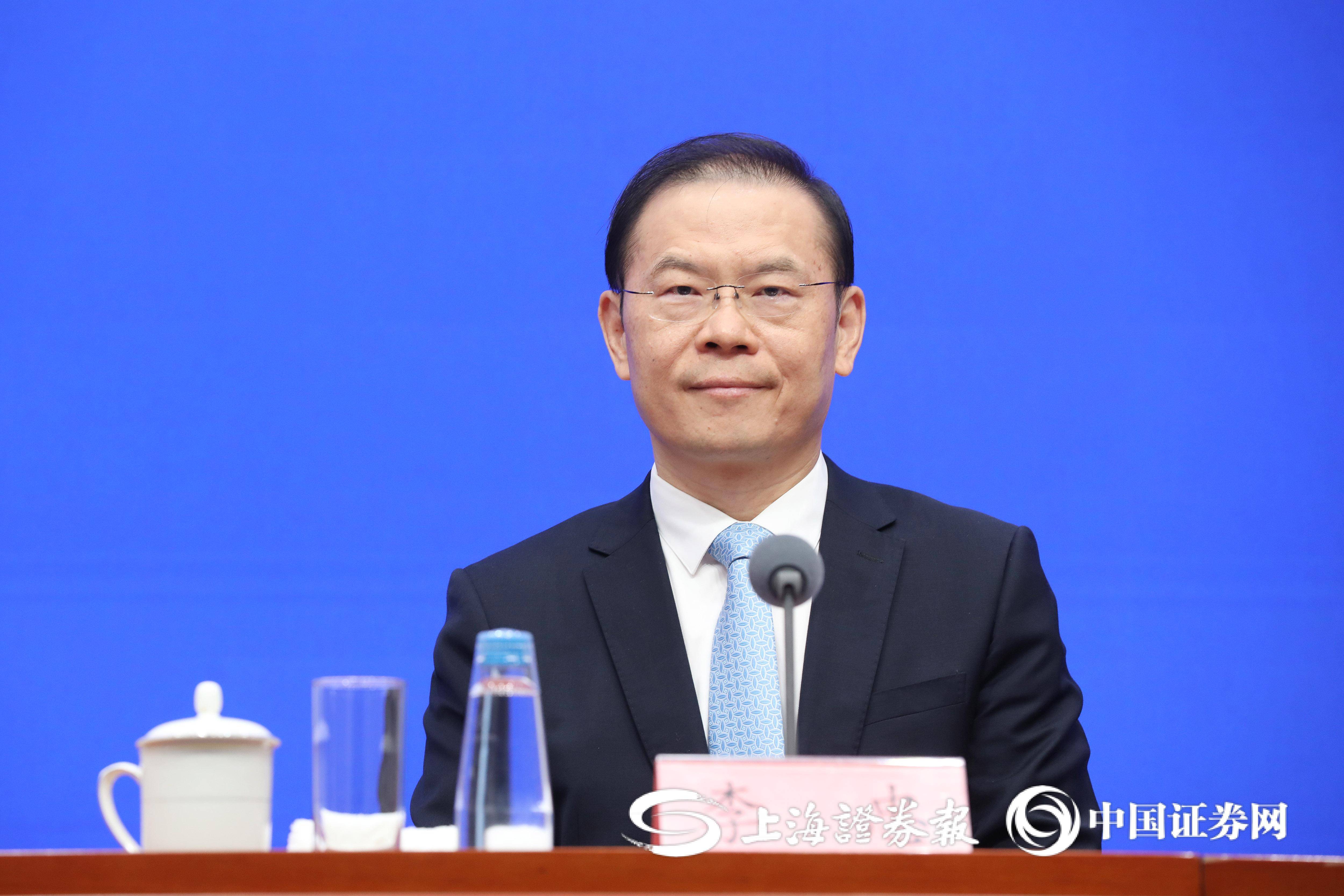
9月26日,国新办举行"高质量完成'十四五'规划"系列主题新闻发布会。人力资源社会保障部副部长李 忠在会上表示,社保基金保值增值事关广大参保人员的切身利益,是提高基金长期支撑能力、推动社会 保障事业高质量可持续发展的重要举措。 储备基金提供长期保障。设立全国社会保障基金、实施划转国有资本充实社保基金,是我国积极应对人 口老龄化、增强养老保险制度可持续性的重要举措。"十四五"期间,全国社会保障基金持续做大做强, 划转充实社保基金国有股权承接和运营工作稳步推进。作为长期储备的全国社会保障基金,规模为3.22 万亿元,该基金从2000年成立以来,年均投资收益率7.55%,此外还有中央层面划转充实社保基金的国 有资本及现金收益2.26万亿元,这些资金都将为进一步增强社会保障制度的可持续性发挥积极作用。 基本养老保险基金实现稳健增值。"十四五"期间,人社部持续扩大委托规模、提升投资收益,扎实做好 基本养老保险基金委托投资运营各项工作。目前,基本养老保险基金投资运营规模2.6万亿元,比"十三 五"期末翻了一番。基本养老保险基金自2016年底启动投资运营以来,连续8年实现正收益,年均投资收 益率5.15%,较好实现了保值增 ...
事关社保基金!税收利好政策来了→
Jin Rong Shi Bao· 2025-09-04 06:23
Core Viewpoint - The recent tax policy notification aims to enhance the management of state-owned equity and cash income for social security funds, providing four key tax incentives to stimulate investment and improve returns [1][2]. Group 1: Tax Incentives - The first incentive exempts value-added tax on all interest and income from financial products obtained through loans related to the transferred state-owned equity and cash income [2]. - The second incentive classifies income from the transfer of state-owned equity and cash income investments as non-taxable income for corporate income tax purposes [2]. - The third incentive exempts stamp duty for the transfer of non-listed state-owned equity by the receiving entities [2]. - The fourth incentive implements a "first collect, then refund" policy for stamp duty on the transfer of listed state-owned equity and securities transactions using cash income, effectively reducing short-term trading costs [2][7]. Group 2: Impact on Investment Behavior - Experts indicate that these measures will significantly enhance investment returns and motivate receiving entities to diversify their asset allocations, moving from traditional low-risk assets to equities, REITs, or cross-border investments [4][6]. - The tax incentives lower the cost of trial and error, encouraging entities to engage more actively in the capital market, thereby injecting long-term funds and stabilizing market confidence [6][7]. Group 3: Long-term Stability of Social Security Fund - The policy aims to enhance the long-term stability of social security fund operations and the sustainability of the basic pension insurance system [8]. - The notification aligns with previous government initiatives to transfer 10% of state-owned equity from central and local state-owned enterprises to address pension fund shortfalls [8]. - The overall framework established by the 2017 plan, the 2024 operational guidelines, and the current tax policies collectively support the sustainable growth of capital from transfer to appreciation [9].
四大免税政策,释放社保基金红利!最新解读来了
券商中国· 2025-09-02 23:15
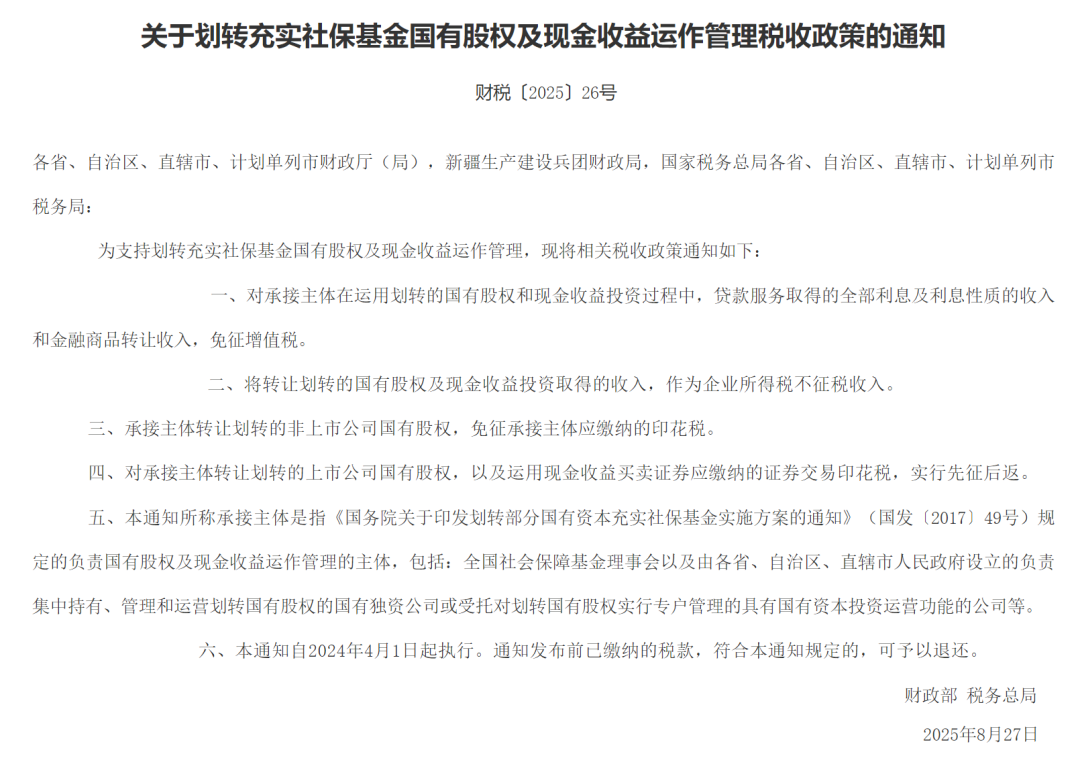
Core Viewpoint - The article discusses the implementation of tax exemption measures to enhance the net income of entities managing the social security fund, which is expected to transform the capital market from short-term speculation to long-term value investment [2][6]. Tax Exemption Measures - Four tax exemption measures are outlined to support the management of state-owned equity and cash income for the social security fund, effective from April 1, 2024 [3][4][5]. - The measures include: 1. Exemption from VAT on all interest and interest-like income from loans and financial product transfers [3]. 2. Income from the transfer of state-owned equity and cash income investments will not be subject to corporate income tax [4]. 3. Exemption from stamp duty on the transfer of non-listed state-owned equity [5]. 4. For listed state-owned equity transfers and securities transactions using cash income, a system of prior collection and subsequent refund of stamp duty will be implemented [5]. Impact on Investment Behavior - The tax incentives are expected to lower transaction costs and encourage entities to diversify their investments beyond traditional low-risk assets, potentially increasing returns [6]. - The measures aim to enhance the investment motivation of the entities managing the social security fund, thereby improving overall investment returns [5][6]. Policy Signals - The policy sends three significant signals to the market: 1. "Stabilizing expectations" by reinforcing the long-term stability of the social security fund amidst increasing pension payment pressures due to aging demographics [7]. 2. "Promoting reform" by indicating the government's acceleration of state-owned enterprise reform linked to the social security system [8]. 3. "Stabilizing the market" by reducing investment costs for managing entities, encouraging them to allocate more to the capital market, thus injecting long-term capital into markets like A-shares [9]. Sustainable Policy Framework - The transfer of state-owned capital to bolster the social security fund is a crucial measure for enhancing the sustainability of the basic pension insurance system [10]. - The article highlights the evolution of policies from the initial 2017 plan to the 2024 operational guidelines, culminating in the current tax incentives, which collectively form a sustainable framework for capital transfer and appreciation [11].

财政部、税务总局重磅发布!4项免税政策释放社保基金红利
Zheng Quan Shi Bao· 2025-09-02 13:55
Core Viewpoint - The Ministry of Finance and the State Administration of Taxation have announced four tax exemption measures to support the transfer and management of state-owned equity and cash income to bolster the social security fund, effective from April 1, 2024 [1][2]. Group 1: Tax Exemption Measures - The first measure exempts value-added tax on all interest and interest-like income from loans and financial product transfer income obtained by the receiving entities during the investment process [2]. - The second measure classifies income from the transfer of state-owned equity and cash income investments as non-taxable income for corporate income tax purposes [3]. - The third measure exempts the stamp duty that the receiving entities should pay when transferring non-listed state-owned equity [4]. - The fourth measure implements a "first collect, then return" policy for stamp duty on the transfer of listed state-owned equity and securities transaction stamp duty incurred from cash income [4]. Group 2: Implications for Investment - These tax incentives are expected to significantly enhance the net income space for receiving entities, encouraging them to diversify their investments beyond traditional low-risk assets like government bonds to include equities, REITs, and cross-border investments [5]. - The measures are anticipated to improve investment returns and motivate receiving entities to engage more actively in the capital market, potentially stabilizing market confidence and shifting focus from short-term speculation to long-term value [5]. Group 3: Policy Framework and Background - The transfer of state-owned capital to enrich the social security fund is a crucial initiative aimed at enhancing the sustainability of the basic pension insurance system, as outlined in the 2017 implementation plan [6][7]. - The 2024 operational guidelines specify that at least 50% of the cumulative cash income from local entities will be entrusted to the National Social Security Fund Council for investment, while the remaining portion will be managed by local entities within specified limits [7]. - The tax exemption policy directly addresses the core contradictions of "preserving and increasing the value" of the social security fund and "intergenerational equity," forming a sustainable policy framework from "capital transfer" to "capital appreciation" [7].
财政部、税务总局,重磅发布!4项免税政策释放社保基金红利
Zheng Quan Shi Bao· 2025-09-02 12:52
Core Viewpoint - The Ministry of Finance and the State Taxation Administration have issued a notification to implement four tax exemption measures to support the transfer and management of state-owned equity and cash income for the social security fund, effective from April 1, 2024 [1][2]. Tax Exemption Measures - The first measure exempts value-added tax on all interest and interest-like income from loans and financial product transfer income obtained by the receiving entities during the investment process of transferred state-owned equity and cash income [2]. - The second measure classifies income from the transfer of state-owned equity and cash income as non-taxable income for corporate income tax purposes [3]. - The third measure exempts the stamp duty that the receiving entities should pay when transferring non-listed state-owned equity [4]. - The fourth measure implements a "first collect, then return" policy for stamp duty on the transfer of listed state-owned equity and on securities transactions using cash income [4]. Impact on Investment Dynamics - The tax incentives are expected to enhance the net income space for receiving entities, thereby increasing their investment returns and encouraging them to diversify their asset allocation beyond traditional low-risk assets [5]. - The measures are anticipated to transform the social security fund into a long-term institutional investor in the capital market, promoting a shift from short-term speculation to long-term value investment [5]. Policy Significance - The notification signals a commitment to stabilize expectations, promote reforms, and support the market by reducing investment costs for receiving entities, thereby injecting long-term capital into the market [5]. - The policy aims to address the sustainability of the basic pension insurance system amid increasing aging population pressures and to enhance public confidence in the social security system [5]. Historical Context - The transfer of state-owned capital to supplement the social security fund is a significant initiative by the central government, aimed at addressing the pension fund shortfall by transferring 10% of state-owned equity from major enterprises and financial institutions [7]. - The operational framework for managing the cash income from these transfers has been established, with a focus on market-oriented and professional management principles [8].
财政部、税务总局,重磅发布!4项免税政策释放社保基金红利
证券时报· 2025-09-02 12:48
Core Viewpoint - The article discusses the recent tax policy issued by the Ministry of Finance and the State Administration of Taxation, which introduces four tax exemption measures to support the transfer and management of state-owned equity and cash income for the social security fund, effective from April 1, 2024. These measures are expected to enhance the net income of the receiving entities and position the social security fund as a long-term institutional investor in the capital market, promoting a shift from short-term speculation to long-term value investment [1][6]. Tax Exemption Measures - The four tax exemption measures include: 1. Exemption from value-added tax on all interest and interest-like income from loan services and financial product transfer income obtained during the investment process of transferred state-owned equity and cash income [3]. 2. Income from the transfer of state-owned equity and cash income investments will be classified as non-taxable income for corporate income tax purposes [4]. 3. Exemption from stamp duty for the transfer of non-listed state-owned equity by the receiving entities [5]. 4. For the transfer of listed state-owned equity and the securities transaction stamp duty incurred from cash income investments, a system of prior collection and subsequent refund will be implemented [5]. Impact on Investment Dynamics - The tax incentives are expected to directly enhance the net income space for the receiving entities. For instance, the exemption from value-added tax can lower transaction costs, allowing investment returns to be fully realized. The stamp duty exemption encourages participation in the non-listed equity market, while the non-taxable status of transfer income amplifies the actual retention ratio of investment returns. These measures are anticipated to significantly improve investment return rates and motivate the receiving entities to invest more actively [6][8]. Broader Policy Implications - The introduction of these tax incentives sends three key policy signals: 1. "Stabilizing expectations" by reinforcing the long-term stability of the social security fund and alleviating pension payment pressures due to an aging population [8]. 2. "Promoting reform" by indicating the government's acceleration of state-owned enterprise reform in conjunction with the social security system [8]. 3. "Stabilizing the market" by reducing investment costs for receiving entities, indirectly encouraging increased allocation to the capital market, thus injecting long-term funds into markets like A-shares [8]. Sustainable Policy Framework - The transfer of part of the state-owned capital to bolster the social security fund is a significant measure taken by the central government to enhance the sustainability of the basic pension insurance system. The framework established in 2017 aimed to address the pension fund gap by transferring 10% of state-owned equity from major state-owned enterprises and financial institutions. With the completion of the transfer process, the receiving entities are now positioned to manage and operate these assets effectively [10][11]. - The recent tax policy is seen as a crucial execution guarantee that complements the foundational framework established in 2017 and the operational guidelines set in 2024, creating a closed loop from "capital transfer" to "capital appreciation" [11].