资本市场长期投资

Search documents
券商股盘中爆发 沪指重返4000点,证券ETF(159841)、创业板ETF天弘(159977)涨约2%
Mei Ri Jing Ji Xin Wen· 2025-10-29 04:59
Group 1 - The A-share market showed strong performance in the morning session, with the Shanghai Composite Index returning to 4000 points and the ChiNext Index rising over 1% [1] - Broker stocks experienced significant gains, with Huazhong Securities hitting the daily limit and Northeast Securities rising over 8% [1] - As of October 28, 14 brokerage firms disclosed their Q3 performance, with 13 comparable firms reporting a total net profit attributable to shareholders of approximately 46.726 billion yuan, a year-on-year increase of 46.42% [1] Group 2 - Three brokerage firms reported a net profit that doubled year-on-year, while eight firms had growth rates between 50% and 100% [1] - Analysts believe that short-term policy synergy will accelerate the long-term valuation repair process of A-shares, while a more inclusive and attractive capital market will strengthen long-term investment logic [1] - The ChiNext Index is expected to become a core stage for incremental capital inflow, benefiting from a balanced distribution of sectors [1] Group 3 - The recent market activity has been robust, with active leverage funds and a recovery in Hong Kong IPOs, which is expected to drive the ROE of brokerage firms higher [2] - It is recommended to focus on the leading securities ETF in the Shenzhen market for capturing investment opportunities in the bull market for the brokerage sector [2]



财政部、税务总局,重磅发布!4项免税政策释放社保基金红利
Zheng Quan Shi Bao· 2025-09-02 12:52
Core Viewpoint - The Ministry of Finance and the State Taxation Administration have issued a notification to implement four tax exemption measures to support the transfer and management of state-owned equity and cash income for the social security fund, effective from April 1, 2024 [1][2]. Tax Exemption Measures - The first measure exempts value-added tax on all interest and interest-like income from loans and financial product transfer income obtained by the receiving entities during the investment process of transferred state-owned equity and cash income [2]. - The second measure classifies income from the transfer of state-owned equity and cash income as non-taxable income for corporate income tax purposes [3]. - The third measure exempts the stamp duty that the receiving entities should pay when transferring non-listed state-owned equity [4]. - The fourth measure implements a "first collect, then return" policy for stamp duty on the transfer of listed state-owned equity and on securities transactions using cash income [4]. Impact on Investment Dynamics - The tax incentives are expected to enhance the net income space for receiving entities, thereby increasing their investment returns and encouraging them to diversify their asset allocation beyond traditional low-risk assets [5]. - The measures are anticipated to transform the social security fund into a long-term institutional investor in the capital market, promoting a shift from short-term speculation to long-term value investment [5]. Policy Significance - The notification signals a commitment to stabilize expectations, promote reforms, and support the market by reducing investment costs for receiving entities, thereby injecting long-term capital into the market [5]. - The policy aims to address the sustainability of the basic pension insurance system amid increasing aging population pressures and to enhance public confidence in the social security system [5]. Historical Context - The transfer of state-owned capital to supplement the social security fund is a significant initiative by the central government, aimed at addressing the pension fund shortfall by transferring 10% of state-owned equity from major enterprises and financial institutions [7]. - The operational framework for managing the cash income from these transfers has been established, with a focus on market-oriented and professional management principles [8].
财政部、税务总局,重磅发布!4项免税政策释放社保基金红利
证券时报· 2025-09-02 12:48
Core Viewpoint - The article discusses the recent tax policy issued by the Ministry of Finance and the State Administration of Taxation, which introduces four tax exemption measures to support the transfer and management of state-owned equity and cash income for the social security fund, effective from April 1, 2024. These measures are expected to enhance the net income of the receiving entities and position the social security fund as a long-term institutional investor in the capital market, promoting a shift from short-term speculation to long-term value investment [1][6]. Tax Exemption Measures - The four tax exemption measures include: 1. Exemption from value-added tax on all interest and interest-like income from loan services and financial product transfer income obtained during the investment process of transferred state-owned equity and cash income [3]. 2. Income from the transfer of state-owned equity and cash income investments will be classified as non-taxable income for corporate income tax purposes [4]. 3. Exemption from stamp duty for the transfer of non-listed state-owned equity by the receiving entities [5]. 4. For the transfer of listed state-owned equity and the securities transaction stamp duty incurred from cash income investments, a system of prior collection and subsequent refund will be implemented [5]. Impact on Investment Dynamics - The tax incentives are expected to directly enhance the net income space for the receiving entities. For instance, the exemption from value-added tax can lower transaction costs, allowing investment returns to be fully realized. The stamp duty exemption encourages participation in the non-listed equity market, while the non-taxable status of transfer income amplifies the actual retention ratio of investment returns. These measures are anticipated to significantly improve investment return rates and motivate the receiving entities to invest more actively [6][8]. Broader Policy Implications - The introduction of these tax incentives sends three key policy signals: 1. "Stabilizing expectations" by reinforcing the long-term stability of the social security fund and alleviating pension payment pressures due to an aging population [8]. 2. "Promoting reform" by indicating the government's acceleration of state-owned enterprise reform in conjunction with the social security system [8]. 3. "Stabilizing the market" by reducing investment costs for receiving entities, indirectly encouraging increased allocation to the capital market, thus injecting long-term funds into markets like A-shares [8]. Sustainable Policy Framework - The transfer of part of the state-owned capital to bolster the social security fund is a significant measure taken by the central government to enhance the sustainability of the basic pension insurance system. The framework established in 2017 aimed to address the pension fund gap by transferring 10% of state-owned equity from major state-owned enterprises and financial institutions. With the completion of the transfer process, the receiving entities are now positioned to manage and operate these assets effectively [10][11]. - The recent tax policy is seen as a crucial execution guarantee that complements the foundational framework established in 2017 and the operational guidelines set in 2024, creating a closed loop from "capital transfer" to "capital appreciation" [11].


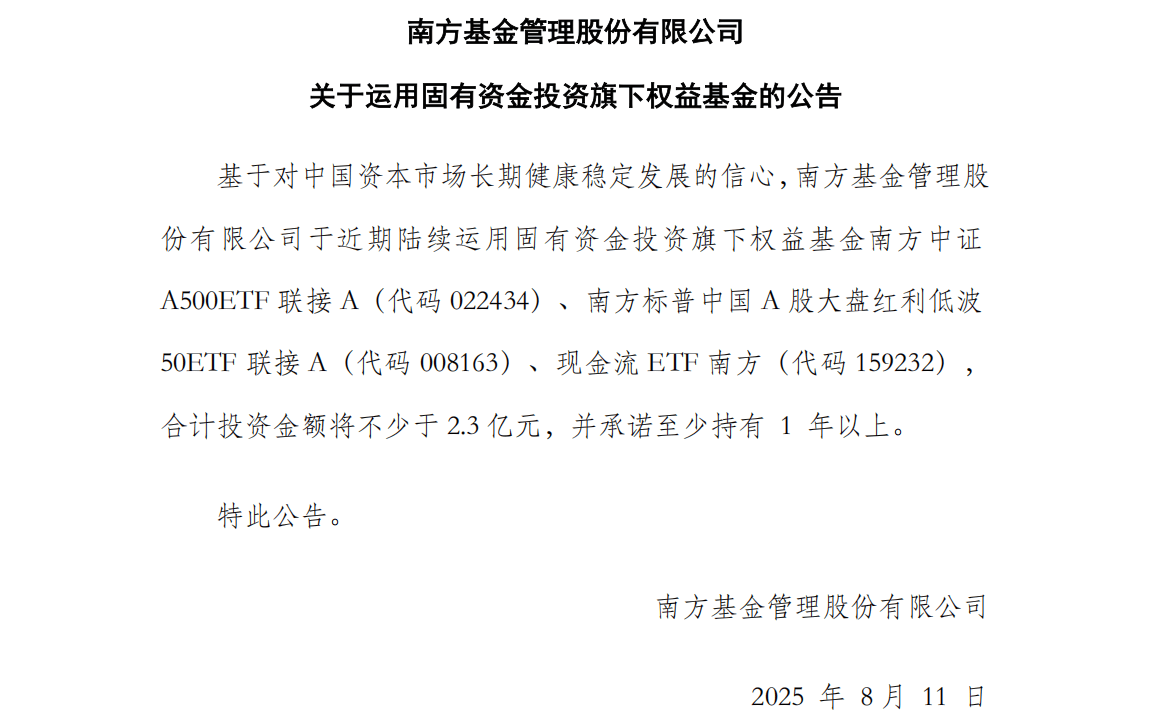
南方基金2.3亿元自购旗下三只权益ETF 传递长期市场信心
Sou Hu Cai Jing· 2025-08-13 03:36
Core Viewpoint - Southern Fund Management Co., Ltd. has announced a significant investment of at least 230 million yuan in three equity ETF linked funds, reflecting confidence in the long-term stability and health of the Chinese capital market [1][5]. Group 1: Investment Details - The three funds involved in the buyback are Southern CSI A500 ETF Linked A (022434), Southern S&P China A-Share Large Cap Dividend Low Volatility 50 ETF Linked A (008163), and Southern Cash Flow ETF (159232) [4]. - The CSI A500 ETF has a scale of 16.681 billion yuan, ranking third among its peers, while the S&P China A-Share Large Cap Dividend Low Volatility 50 ETF has a scale of 13.749 billion yuan [4]. - The cash flow ETF focuses on high-dividend assets, aligning with current market demand for stable income assets [4]. Group 2: Market Context - China's GDP grew by 5.3% year-on-year in the first half of the year, indicating steady macroeconomic progress [5]. - As of August 6, the price-to-earnings ratio of the CSI 300 Index was 13.93 times, and the Hang Seng Index was 11.83 times, significantly lower than the S&P 500 (26.89 times) and Nikkei 225 (18.88 times), positioning A-shares and Hong Kong stocks as undervalued globally [5]. - The new "National Nine Articles" policy is expected to promote long-term capital inflows into the market, further enhancing institutional confidence [5]. Group 3: Institutional Behavior - A total of 21 public fund institutions have announced buybacks this year, amounting to 74.7 million yuan, with nearly 40% of this in equity funds [5]. - Southern Fund's buyback of 230 million yuan is the largest among these institutions, with others like ICBC Credit Suisse and Jianxin also exceeding 100 million yuan [5]. - The buyback actions are typically accompanied by a commitment to hold for at least one year, aimed at enhancing investor trust and promoting a long-term investment philosophy [5].