稀土贸易

Search documents
消息人士:印度要求国营矿业公司停止向日本出口稀土材料。
news flash· 2025-06-13 10:33
Core Viewpoint - India has requested its state-owned mining companies to halt the export of rare earth materials to Japan [1] Group 1 - The decision is likely to impact the supply chain of rare earth materials, which are critical for various high-tech industries [1] - This move may be part of India's broader strategy to secure its own supply of rare earths and reduce dependency on foreign markets [1] - The halt in exports could lead to increased prices and potential shortages in Japan, which relies on these materials for manufacturing [1]
美国商会证实:中国并没有阻止稀土出口
Sou Hu Cai Jing· 2025-06-03 03:46
Group 1 - The issue of rare earth exports, crucial for high-tech production, has become a focal point in US-China trade negotiations [1] - The US Chamber of Commerce reported that China has begun to gradually relax its rare earth export controls, although the process is slower than expected due to the implementation of a new approval system [3] - Rare earths are essential materials for the production of various semiconductors and military equipment, with China accounting for nearly 70% of global rare earth production in 2024 [5] Group 2 - Barclays highlighted that China holds a near-monopoly in rare earth refining, which was evident during the export controls implemented in April 2025, leading to a threefold increase in rare earth prices within a week [6] - The global rare earth mineral trade is highly concentrated, with approximately 89% of trade relationships being concentrated, and 43% relying on five or fewer suppliers [6] - In 2023, over 90% of US rare earth imports came from China, a significant increase from 70% in 2013, primarily because only China can meet the current scale of demand [6]

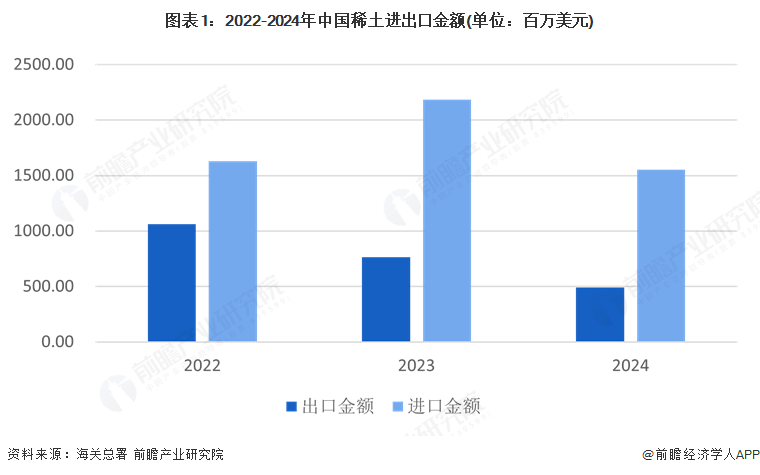
2025年中国稀土行业贸易分析:中国稀土进口规模大于出口,美国稀土需求对华依赖严重
Qian Zhan Wang· 2025-05-28 02:06
Core Insights - China's rare earth imports have surpassed exports in recent years, driven by increased domestic demand for high-tech industries and strategic resource enhancement [1][2] - The U.S. heavily relies on China for rare earth elements, with approximately 70% of its imports coming from China, highlighting the need for the U.S. to diversify its supply sources [4][9] Import and Export Trends - In the first quarter of 2025, China imported 24,679.1 tons of rare earths worth 1.87 billion yuan, a decrease of 30.9% in quantity and 30.2% in value compared to the previous year [2] - During the same period, China exported 14,177.6 tons of rare earths valued at 920 million yuan, with a 5.1% increase in quantity but a 9.8% decrease in value year-on-year [2] U.S. Dependency and Strategic Moves - The U.S. is a major consumer of rare earths, particularly for defense applications, which account for 35% of its usage, significantly higher than the global average of 8% [9] - The U.S. government has initiated several measures to reduce reliance on Chinese rare earths, including contracts with companies like Lynas USA to establish domestic processing facilities [11] Government Actions and Policies - The U.S. Department of Defense signed a contract worth $120 million with Lynas in June 2022 to build a heavy rare earth separation facility in Texas, which was later increased to approximately $258 million [11] - The U.S. has also passed legislation to encourage domestic mining and processing of critical minerals, aiming to reduce dependence on foreign imports [11] International Cooperation and Future Outlook - The U.S. is exploring partnerships with other countries to develop rare earth projects, including discussions with Greenland for resource access [11] - The U.S. is considering regulatory changes to expedite deep-sea mining for critical minerals, reflecting a strategic shift towards enhancing domestic resource development [11]