
稀土

Search documents
锡矿供应或生变数-继续看好稀土-钨板块
2026-04-01 09:59
Summary of Key Points from Conference Call Records Industry Overview - **Industry Focus**: Tin, Rare Earths, and Tungsten sectors are highlighted for their current market dynamics and investment opportunities [1][2][4][5]. Tin Market Insights - **Inventory Reduction**: Global tin ingot visible inventory decreased by approximately 3,000-4,000 tons over two weeks, with LME inventory down by 300-400 tons and domestic social inventory down by nearly 2,000 tons [2][3]. - **Price Dynamics**: Tin prices fluctuated from 450,000 CNY/ton to a low of 340,000 CNY/ton, maintaining an average above 350,000 CNY/ton, indicating strong market support despite price volatility [2][3]. - **Demand Structure**: Emerging demands from sectors like AI servers and PCBs show higher price tolerance compared to traditional sectors, suggesting a structural shift in demand [2][3]. - **Indonesian Supply Issues**: Indonesian tin trading volume shifted from a year-on-year increase of 10% to a decrease of 10%, attributed to stricter regulations and approval delays [2][3]. - **Energy Crisis Impact**: The ongoing energy crisis may affect tin mining and shipping in key regions like the Democratic Republic of Congo and Myanmar, which together account for nearly 15% of global tin supply [3]. Rare Earth Market Insights - **Supply and Demand Changes**: Domestic rare earth production decreased by about 2% year-on-year in early 2026, while exports increased by 8%, indicating a tightening supply and strong demand [4]. - **Price Outlook**: Rare earth prices have stabilized and are expected to rise, potentially approaching historical highs due to the dual factors of supply contraction and robust demand from electric vehicles [4]. Tungsten Market Insights - **Market Conditions**: The tungsten market is nearing a price turning point, with a decrease in the supply of recycled tungsten and low overall inventory levels [5]. - **Price Recovery Expectations**: Once recycled tungsten prices stabilize, the downward pressure on tungsten concentrate prices is expected to ease, leading to a potential price increase [5]. Investment Recommendations - **Tin Investment Targets**: Recommended companies include Xinjing Road, Huaxi Nonferrous, and Xiyu Co. [1][4]. - **Rare Earth Investment Focus**: North Rare Earth is highlighted as a top pick, with additional interest in China Northern Rare Earth Group [4]. - **Tungsten Investment Focus**: Zhongtung High-tech is noted as a strong investment candidate due to its straightforward investment logic and reasonable valuation [5].
广发宏观:高频数据下的3月经济:价格篇
GF SECURITIES· 2026-04-01 07:54
Price Index Trends - The Business Price Index (BPI) rose significantly in March, reaching 1103 points, a month-on-month increase of 16.4% compared to the end of February[3] - The energy index increased by 25.3%, while the chemical index surged by 32.4%, but the non-ferrous index fell by 9.5% month-on-month[4] Commodity Price Movements - In the week of March 16-20, five energy commodities saw price increases of over 5%, accounting for 35.7% of the monitored items[4] - The average price of coal in the Bohai Rim region increased by 1.7%, while the chemical price index surged by 33.8% month-on-month[5] Real Estate Market - As of March 23, the second-hand housing price indices in Beijing, Shanghai, Guangzhou, and Shenzhen decreased by 1.0%, 1.8%, 1.4%, and 0.8% respectively[5] - The second-hand housing prices in these cities have seen significant highs over the past year, with peaks recorded at 159.44, 192.67, 181.71, and 251.13 points[6] Emerging Industries - The photovoltaic industry composite index fell by 13.2% in March, with significant declines in prices for battery cells and polysilicon[6] - Lithium carbonate futures prices decreased by 4.9% month-on-month, while DRAM spot prices fell between 5.3% and 8.9%[9] Shipping and Logistics - The China Container Freight Index (CCFI) rose by 9.0% in the fourth week of March, with significant increases in shipping rates to Los Angeles and New York[7] - The Baltic Dry Index (BDI) decreased by 5.1% month-on-month, indicating a mixed outlook for shipping costs[8] Food Prices - The average wholesale price of pork fell by 12.7% in March, while key vegetable prices dropped by 10.9%[9] - The price index for non-food items, represented by the ICPI, decreased slightly to 99.67, reflecting a month-on-month decline of 0.2%[10]
金属行业周报:中东铝厂受损减产,支撑铝价偏强运行-20260331
BOHAI SECURITIES· 2026-03-31 10:28
Investment Rating - The report maintains a "Positive" rating for the steel industry and the non-ferrous metals industry, with "Buy" ratings for specific companies including Luoyang Molybdenum, Zhongjin Gold, Huayou Cobalt, Zijin Mining, and China Aluminum [5]. Core Views - The Middle East geopolitical situation is a key factor affecting global aluminum prices, with recent production cuts and damages in Middle Eastern aluminum plants expected to provide upward momentum for prices [3][40]. - The domestic copper market shows decent fundamentals, with potential support for copper prices as some smelters may enter maintenance periods [3][34]. - The report highlights the importance of monitoring the speed of steel inventory reduction, which could boost steel prices if seasonal demand expectations are validated [5][17]. Industry Summary Steel - The production of five major steel products has slightly decreased, with total inventory also declining, indicating a potential for price increases if demand strengthens [17][25]. - As of March 27, the capacity utilization rate for blast furnaces was 86.63%, an increase of 1.10 percentage points from the previous week [22]. Copper - The global refined copper market experienced a surplus of 17,000 tons in January 2026, down from a surplus of 168,000 tons in December 2025, indicating a tightening supply situation [34]. - On March 27, the LME copper spot price was $12,000 per ton, reflecting a 0.20% increase from the previous week [37]. Aluminum - The LME aluminum spot price on March 27 was $3,300 per ton, a decrease of 1.11% from the previous week, while domestic aluminum inventory continues to accumulate [41]. - The report anticipates that the aluminum price may remain strong in the short term due to the geopolitical situation in the Middle East and the gradual release of domestic demand [40]. Precious Metals - Gold prices are currently under pressure due to high oil prices, but there is potential for a rebound if geopolitical tensions ease or inflation concerns diminish [46]. - As of March 27, the COMEX gold closing price was $4,521.30 per ounce, a 0.65% increase from the previous week [46]. New Energy Metals - Concerns over potential production cuts in Australian lithium mines due to energy issues may lead to a supply shortage, with lithium carbonate prices rising to 159,500 yuan per ton [52]. - The report emphasizes the need to monitor production dynamics in Australia and export policies in Zimbabwe [51]. Rare Earths and Minor Metals - The rare earth market is facing pressure due to weak demand from downstream enterprises, with prices expected to remain volatile [66]. - As of March 27, the price of light rare earth oxide neodymium praseodymium was 712,500 yuan per ton, reflecting a 1.42% increase from the previous week [66].





哪些战略资源品更具投资价值?
Guoxin Securities· 2026-03-30 11:23
Core Conclusions - Some resource products already possess strategic attributes, with resource-rich countries seeking pricing power in the industrial chain and a growing trend of resource nationalism, while consuming countries enhance strategic reserves of key resources and strengthen supply chain security [1][2] - The scarcity of strategic resource reserves, along with the high concentration of production and processing stages, forms the basis for industrial and national defense security, and is crucial for energy transition and technological development [1][3] - The market for strategic resources is driven not only by short-term shocks but also by long-term supply-demand dynamics that support price increases, with mid-term trends expected to continue upward [1][4] Strategic Attributes of Resource Products - Since 2025, prices of copper, aluminum, lithium, and cobalt have significantly increased in the global commodity market, driven by supply-demand factors and the growing concept of national security, leading to intensified competition and geopolitical struggles over strategic minerals [2][13] - Resource-rich countries are changing their policy directions, increasingly adopting resource nationalism through export controls, tax increases, and nationalization to gain more economic benefits and move up the value chain [2][15] - Major consuming countries like the US, EU, and Japan are incorporating resource security into their national and economic security frameworks, establishing strategic reserves and creating new supply chain systems through alliances [2][18] Definition of Strategic Resource Products - Strategic resource products are characterized by their scarcity, with uneven global distribution and concentration in a few countries, and long production cycles that result in slow supply growth, highlighting their importance in great power competition [3][23] - The stability of strategic resource supply is fundamental to industrial and national defense security, as high-end manufacturing and defense technologies rely heavily on the performance and stable supply of key materials [36][37] Supply-Demand Dynamics Driving Price Trends - The current market for strategic resources has seen significant returns, particularly in heavy asset and low-elimination sectors, although recent volatility has raised concerns about the sustainability of this trend [4][41] - Long-term capital expenditure shortages, rising resource nationalism, and increasing operational risks are constraining the supply of strategic resources, with exploration investments declining for two consecutive years [41][43] - The demand for strategic resources is being shaped by trends in AI and new energy industries, with significant growth expected in the demand for copper, aluminum, lithium, and cobalt [47][48]

策略专题研究:哪些战略资源品更具投资价值?
Guoxin Securities· 2026-03-30 07:10
Core Conclusions - Certain resource commodities have already acquired strategic attributes, with resource-rich countries seeking pricing power in the industrial chain and a tendency towards resource nationalism, while consuming countries strengthen strategic reserves of key resources and enhance supply chain security [1][2] - The scarcity of strategic resource reserves, along with the high concentration of production and processing stages, forms the basis for industrial and national defense security, and is crucial for energy transition and technological development [1][3] - The market for strategic resources is driven not only by short-term shocks but also by long-term supply-demand dynamics that support price increases, with mid-term trends expected to continue upward [1][4] Group 1: Strategic Resource Attributes - Since 2025, prices of commodities such as copper, aluminum, lithium, and cobalt have significantly increased, driven by supply-demand factors and the growing concept of national security, which has intensified competition and geopolitical struggles over strategic minerals [2][13] - Resource-rich countries are changing their policy directions, increasingly adopting resource nationalism through export controls, tax increases, and nationalization to gain more economic benefits and move up the value chain [2][15] - Major consuming countries like the US, EU, and Japan are incorporating resource security into their national and economic security frameworks, establishing strategic reserves and creating new supply chain systems through alliances [2][18] Group 2: Definition of Strategic Resources - Strategic resources are defined by their scarcity, with reserves unevenly distributed globally and concentrated in a few countries, leading to their significant role in great power competition [3][23] - The production and processing stages of strategic resources exhibit high concentration, with countries like China dominating the processing of many strategic resources, thus influencing global resource governance [3][25] Group 3: Supply-Demand Dynamics and Price Trends - The current market for strategic resources has seen a "HALO trading" trend, with significant excess returns in heavy asset sectors represented by strategic resources, despite recent market volatility [4][39] - Long-term capital expenditure shortages, rising resource nationalism, and operational risks are constraining the supply of strategic resources, while the demand for these resources is being driven by trends in AI and renewable energy [4][39][45] - The demand for strategic resources is expected to grow due to the expansion of AI infrastructure and the transition to green energy, with significant increases in demand for copper, lithium, and cobalt anticipated [4][45][36]
金属-会议-关注地缘扰动下的布局机会
2026-03-30 05:15
Summary of Key Points from Conference Call on Metal Sector Industry Overview - The metal sector is currently in an upward cycle, with short-term geopolitical disturbances providing opportunities for low-cost investments. The long-term logic is shifting from traditional cycles to being driven by new energy and AI [1][2]. Core Insights and Arguments - **Gold Market**: Long-term support for gold prices is driven by central bank purchases and issues related to U.S. Treasury bonds. A liquidity crisis is nearing its end, suggesting an increase in holdings of high-elasticity stocks like Zhongjin Gold and Shandong Gold [1][4]. - **Copper and Aluminum**: The recent price corrections for copper and aluminum are seen as sufficient, with AI and grid updates expected to elevate copper price levels. Geopolitical tensions in the Middle East threaten 4%-5% of global electrolytic aluminum capacity, indicating a fragile supply side [1][3]. - **Lithium Market**: Attention is drawn to Zimbabwe's export policy disruptions, which may lead to significant supply gaps in April. Recommended domestic resource stocks include Salt Lake Co. and Yongxing Materials [1][7]. - **Rare Earths**: The growth rate of rare earth quotas has dropped to single digits, with stricter control over gray production. Demand from robotics and low-altitude economies is expected to become a second growth driver, supporting price increases [1][3]. - **Steel Supply Gap**: The conflict in the Middle East has led to the shutdown of key Iranian steel mills, potentially creating a global supply gap of 34 million tons, which could benefit Chinese steel exports [1][3][28]. Additional Important Insights - **Uranium Market**: Long-term contracts for natural uranium are showing an upward trend, with prices rising. The supply-demand balance appears optimistic, with a significant price increase for tantalum due to geopolitical issues in the Democratic Republic of Congo [1][17][19]. - **Market Volatility**: The metal sector is experiencing significant volatility, primarily influenced by Middle Eastern geopolitical issues, which affect oil prices, inflation expectations, and monetary policy liquidity. Despite short-term disturbances, the upward cycle of the metal sector remains intact [2][3]. - **Investment Recommendations**: The report suggests focusing on growth-oriented or core resource products during low-price periods. If short-term tensions ease, liquidity may return, leading to a potential V-shaped recovery in the metal sector [2][4]. Specific Metal Sub-Sector Insights - **Industrial Metals**: Optimism is noted for copper and aluminum, with copper valued at approximately 10 times earnings and aluminum even lower [4]. - **Energy Metals**: The focus remains on lithium due to supply disruptions and long-term demand for new energy [4][7]. - **Precious Metals**: The long-term logic for gold remains intact, with current conditions suggesting a good time to increase holdings in gold and related stocks [4][6]. - **Steel Industry**: Recent data indicates a recovery in production and demand, with profitability improving among steel companies [26][27]. Conclusion - The metal sector is poised for growth driven by new energy and AI, despite short-term geopolitical risks. Investment strategies should focus on resilient companies and sectors that can capitalize on these trends while navigating the current volatility.
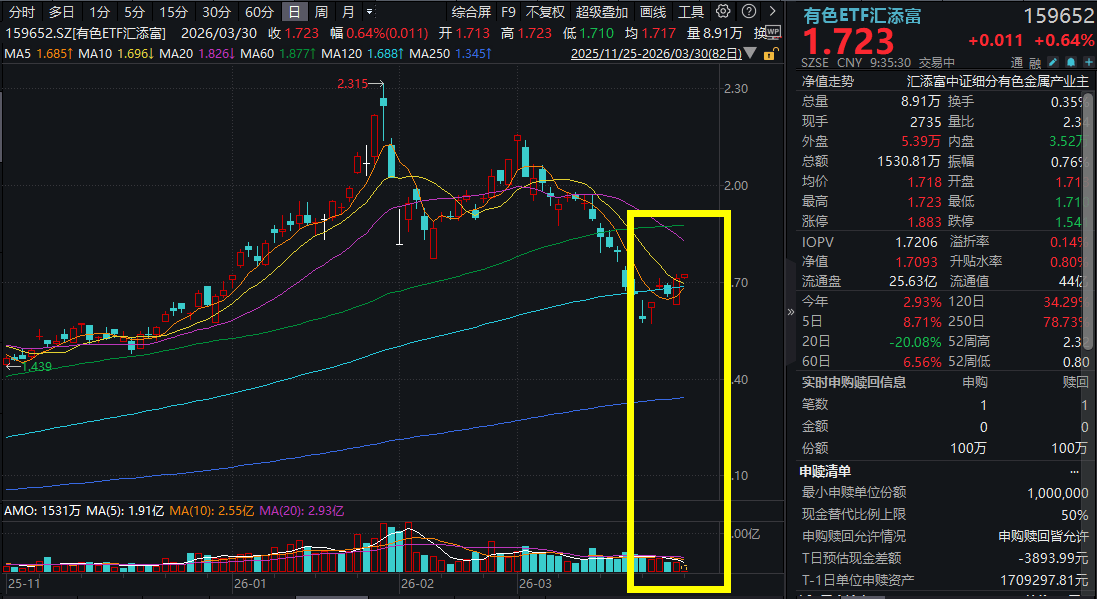
中东两大铝厂遇袭,铝价狂涨超4%!天山铝业涨停,一季度业绩预增107%!有色ETF汇添富(159652)冲击两连阳!中信证券:铝价或超预期上涨
Sou Hu Cai Jing· 2026-03-30 02:25
Core Viewpoint - The A-share market experienced fluctuations on March 30, with the non-ferrous metals sector rising against the trend, particularly the aluminum stocks, driven by supply chain disruptions and strong earnings reports from leading companies [1][3][6]. Group 1: Market Performance - The non-ferrous ETF Huatai (159652) rose by 0.64% as of 9:36 AM, aiming for a second consecutive day of gains [1]. - Major component stocks of the non-ferrous ETF saw significant increases, with Tianshan Aluminum hitting the daily limit, Yun Aluminum rising over 6%, and China Aluminum increasing by over 4% [3]. Group 2: Supply Chain Disruptions - Recent attacks on two major aluminum plants in Bahrain and the UAE by Iranian forces have raised concerns about supply disruptions, as these regions account for approximately 10% of global aluminum supply [6]. - Tianshan Aluminum reported a revenue of 29.502 billion yuan for 2025, a year-on-year increase of 5.03%, and a net profit of 4.818 billion yuan, up 8.13% [6][7]. Group 3: Dividend and Earnings Outlook - Tianshan Aluminum announced a cash dividend plan of 2.5 yuan per 10 shares, totaling 1.147 billion yuan, with a commitment to maintain a dividend payout ratio of no less than 50% of net profit for 2026 [7]. - The aluminum sector is expected to face significant supply risks due to the recent attacks, which could lead to prolonged production disruptions and potential price increases [8]. Group 4: Investment Opportunities - The non-ferrous ETF Huatai (159652) is positioned to benefit from a comprehensive layout across various metal sectors, including gold, copper, aluminum, lithium, and rare earths, capitalizing on the ongoing super cycle in non-ferrous metals [10][12]. - The ETF has a leading "gold-copper content" of 45% among its peers, with a high concentration of leading companies in strategic and supply-deficient core varieties [12][14].



有色金属行业双周报:地缘冲突持续扰动,有色金属全面下跌
Guoyuan Securities· 2026-03-25 05:24
Investment Rating - The report suggests a cautious approach to seeking investment opportunities in the non-ferrous metals sector due to ongoing geopolitical conflicts and fluctuating expectations regarding interest rate cuts by the Federal Reserve [5]. Core Insights - The non-ferrous metals industry index has decreased by 15.08% over the past two weeks, ranking last among 31 primary industries in the Shenwan index, indicating significant market concerns regarding supply and demand dynamics [2][12]. - Precious metals have experienced a notable decline, with COMEX gold prices falling by 13.30% and COMEX silver prices dropping by 19.94% in the same period, reflecting pressures from inflation concerns and a strong dollar [20]. - The tungsten market shows strong upward momentum, with black tungsten concentrate prices increasing by 11.44% over the past two weeks, driven by geopolitical tensions and domestic policy constraints [36]. Summary by Sections Market Review - The non-ferrous metals industry index fell by 15.08% from March 9 to March 20, 2026, with all sub-sectors, including small metals (-18.50%), precious metals (-12.52%), and industrial metals (-16.07%), showing declines [2][12]. Precious Metals - As of March 20, COMEX gold closed at $4,492.00 per ounce, down 13.30% over two weeks, while COMEX silver closed at $67.81 per ounce, down 19.94% [20]. - The report highlights the impact of geopolitical tensions and regulatory tightening on market liquidity, which has pressured precious metal prices [20]. Industrial Metals - LME copper prices were $12,021.50 per ton, down 6.14% over two weeks, while domestic copper prices averaged 95,470 yuan per ton, down 5.60% [30]. - The report anticipates a weak balance in copper prices due to macroeconomic pressures and cost support [30]. Small Metals - Black tungsten concentrate prices rose to 1,023,000 yuan per ton, up 11.44% over two weeks, with a year-to-date increase of 123.85% [36]. - The report notes that the tungsten market is influenced by global supply chain disruptions and domestic production constraints [36]. Rare Earths - The China Rare Earth Price Index was 255.31, down 13.58% over two weeks, but up 17.64% year-to-date [45]. - The report indicates that demand from downstream sectors is slowing, impacting the rare earth market [45]. Energy Metals - The average price of electrolytic cobalt was 431,000 yuan per ton, down 0.12% over two weeks, while lithium carbonate prices averaged 149,000 yuan per ton, down 4.03% [54]. - The report highlights the cautious market sentiment regarding the electric vehicle sector and supply chain dynamics [54].

有色金属行业双周报:地缘冲突持续扰动,有色金属全面下跌-20260325
Guoyuan Securities· 2026-03-25 02:53
Investment Rating - The report indicates a cautious approach towards investment opportunities in the non-ferrous metals sector due to ongoing geopolitical conflicts and fluctuating expectations regarding interest rate cuts by the Federal Reserve [5]. Core Insights - The non-ferrous metals industry index has decreased by 15.08% over the past two weeks, ranking last among 31 primary industries in the Shenwan index, reflecting significant market concerns regarding supply and demand dynamics [2][12]. - Precious metals have experienced a notable decline, with COMEX gold prices falling by 13.30% and COMEX silver prices dropping by 19.94% in the same period, influenced by inflation fears and a strong dollar [20]. - The tungsten market shows strong upward momentum, with black tungsten concentrate prices increasing by 11.44% over the past two weeks, driven by geopolitical tensions and domestic policy constraints [36]. Summary by Sections Market Review - The non-ferrous metals industry index fell by 15.08% from March 9 to March 20, 2026, with all sub-sectors, including small metals (-18.50%), precious metals (-12.52%), and industrial metals (-16.07%), showing declines [2][12]. Precious Metals - As of March 20, COMEX gold closed at $4,492.00 per ounce, down 13.30% over two weeks, while COMEX silver closed at $67.81 per ounce, down 19.94% [20]. - The report highlights the impact of geopolitical tensions and regulatory tightening on market liquidity, which has pressured precious metal prices [20]. Industrial Metals - LME copper prices were $12,021.50 per ton, down 6.14% over two weeks, while domestic copper prices averaged ¥95,470 per ton, down 5.60% [30]. - The report suggests that copper prices may seek a weak balance between macroeconomic pressures and cost support [30]. Small Metals - Black tungsten concentrate prices rose to ¥1,023,000 per ton, up 11.44% over two weeks, with a year-to-date increase of 123.85% [36]. - The report notes that the demand for high-end gallium products continues to rise, contributing to a 5.19% price increase for gallium [36]. Rare Earths - The China Rare Earth Price Index fell to 255.31, down 13.58% over two weeks, while praseodymium-neodymium oxide prices decreased by 17.35% [45]. - The report indicates that the rare earth sector is facing significant valuation pressure due to slowing demand growth [45]. Energy Metals - As of March 20, the average price of electrolytic cobalt was ¥431,000 per ton, down 0.12% over two weeks, while lithium carbonate prices averaged ¥149,000 per ton, down 4.03% [54]. - The report highlights the cautious market sentiment regarding the electric vehicle sector's growth [54]. Major Events - The report discusses the tightening of gold trading policies by several banks in response to market volatility, which may impact trading dynamics in the precious metals market [69]. - It also notes the recent government policies aimed at resource security and green transformation, which are expected to support the non-ferrous metals industry [70].



金属全品种会议
2026-04-15 02:35
Summary of Key Points from the Conference Call Industry Overview - The conference call primarily discusses the non-ferrous metals industry, focusing on aluminum, gold, silver, tin, rare earths, nickel, antimony, tungsten, and silicon iron. Core Insights and Arguments Aluminum - Geopolitical disturbances in the Middle East have triggered a reduction in electrolytic aluminum production by approximately 650,000 tons, accounting for about 0.86% of global output, which is expected to support aluminum prices in the short term [2][4] - The cost of energy constitutes about 40% of aluminum production costs, and rising energy prices or supply shortages could lead to further production cuts [3] - Historical data shows that during energy price surges, aluminum has demonstrated significant price elasticity, outperforming copper due to its high energy consumption nature [5] Gold and Silver - Gold is expected to maintain a positive long-term outlook, driven by U.S. fiscal expansion and changes in dollar credit, despite short-term fluctuations due to geopolitical events and liquidity issues [2][9] - Silver is anticipated to have a higher rebound elasticity compared to gold, supported by tight physical supply [10] Tin - Tin supply is constrained, with AI data centers contributing a 2.3% increase in demand. The company 兴业银锡 is highlighted as a top pick due to its expected capacity doubling by 2028, which could lead to a 200% increase in silver and tin production [2][17] Rare Earths - The supply-demand balance for rare earths remains tight, with production disruptions in Myanmar and domestic regulatory constraints supporting price increases. 北方稀土 is favored for trading strategies [2][19] - The demand for rare earths in 2026 is expected to be slightly weaker than in 2025, primarily due to slower growth in electric vehicles, but industrial robots and wind power sectors are projected to remain strong [21] Nickel - Nickel supply is under strong constraints due to reduced quotas in Indonesia and environmental policies. The company 利星资源 is noted for its high cost-performance ratio [2][14][15] Antimony and Tungsten - Antimony is gaining strength due to its strategic value in military applications, with potential for over 50% price appreciation compared to rare earths [2][18] - Tungsten prices are expected to remain stable due to strong demand from tool manufacturers, with limited new supply expected until late 2026 [23] Additional Important Insights - The impact of geopolitical events on the supply chain, particularly in the Middle East, is a significant concern for the aluminum market, affecting both raw material imports and finished product exports [3] - The overall sentiment in the precious metals market is shifting towards a recovery phase after recent volatility, with expectations of a V-shaped rebound in prices [8] - The strategic value of metals like antimony and rare earths is becoming increasingly recognized in the context of global geopolitical tensions, which may lead to higher valuations [18][22] This summary encapsulates the key points discussed in the conference call, providing insights into the current state and future outlook of various metals within the industry.