
美日贸易协定

Search documents
植田和男谨慎表态难阻市场押注 日本央行加息时点或大幅提前至10月
智通财经网· 2025-08-04 01:41
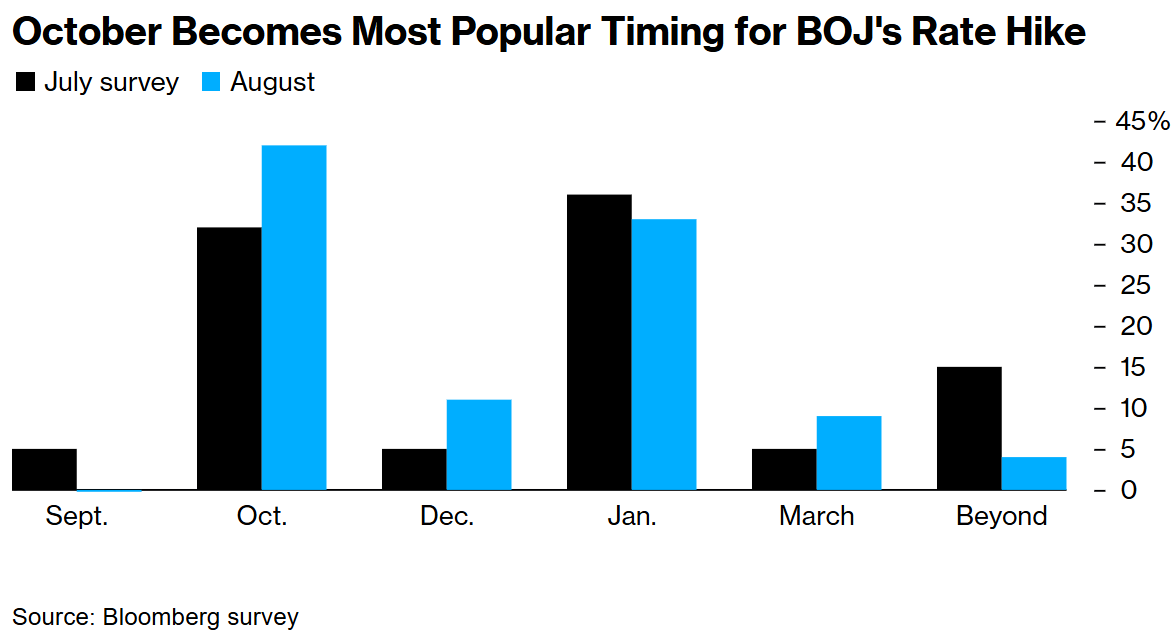
Group 1 - The market's expectations for Japan's trade outlook have become clearer following U.S. President Trump's announcement of multiple agreements, including the U.S.-Japan trade agreement, leading to increased predictions for a Bank of Japan (BOJ) interest rate hike in October [1] - A recent survey of 45 economists indicated that approximately 42% expect the BOJ to raise rates in October, a significant increase from 32% in the previous survey [1] - The BOJ's recent upward revision of inflation forecasts and adjustments to risk assessments are seen as paving the way for a potential rate hike [4] Group 2 - The BOJ's quarterly outlook report raised the inflation forecast for the current fiscal year from 2.2% to 2.7%, indicating a shift in the bank's perception of price risks [4] - Despite the hawkish signals from the BOJ's report, Governor Kazuo Ueda emphasized the need for caution, suggesting that there is no immediate necessity for a rate hike [5] - Approximately 44% of economists believe that the weakening yen is increasingly becoming a key factor prompting a rate hike, while 35% disagree [6] Group 3 - Political uncertainty following Prime Minister Shigeru Ishiba's significant defeat in the July 20 Senate elections may pose challenges to the BOJ's monetary policy operations [6] - About 71% of economists think that if Ishiba is replaced by a pro-monetary easing advocate, the BOJ may not be able to raise rates this year [6] - Some analysts question whether the BOJ will have sufficient data to support another rate hike within the year, given the need for careful analysis of economic data [7]

荷兰国际:日本参议院选举结果加剧日元的不确定性
news flash· 2025-07-21 07:43
Core Viewpoint - The results of the Japanese Senate elections have increased uncertainty regarding the future of the Japanese yen, as political dynamics may shift in response to economic pressures [1] Group 1: Election Impact - The Japanese Prime Minister, Shigeru Ishiba, has pledged to remain in office and continue negotiations on the US-Japan trade agreement, but opposition parties may advocate for expansionary fiscal policies to address public welfare concerns [1] - These expectations have already put pressure on Japanese government bonds prior to the elections, negatively impacting the yen [1] Group 2: Political Risks - There is a risk that Shigeru Ishiba could be replaced by more conservative factions, which may call for the Bank of Japan to slow down interest rate hikes [1] - The current upward trend of the yen lacks clear support, indicating potential volatility in the currency's performance [1]