融涨

Search documents
小心乐极生悲!华尔街大佬警告:美股或重回融涨模式
Jin Shi Shu Ju· 2025-07-01 11:21
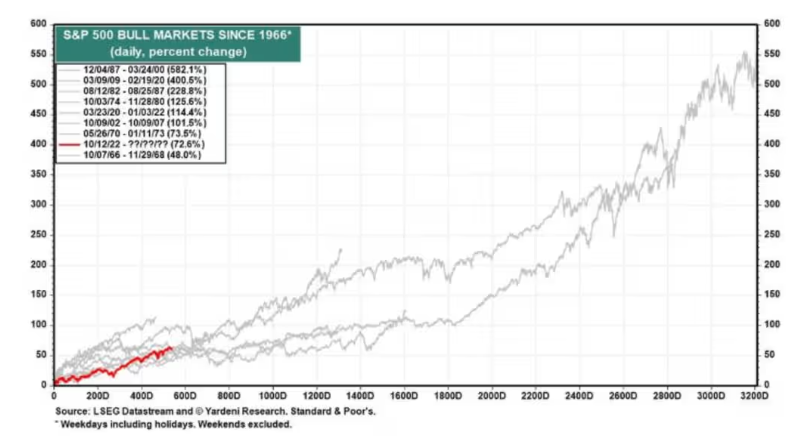
Group 1 - The S&P 500 index has reached a new high, indicating a potential melt-up mode driven by market sentiment, which typically involves rapid short-term gains and increased investor participation [1] - Ed Yardeni, president of Yardeni Research, warns that the current primary risk may be the stock market entering a speculative bubble, similar to the state observed four and a half months ago when the latest round of corrections began [1] - Yardeni maintains a year-end target of 6,500 points for the S&P 500 index and a target of 10,000 points by the end of 2029, suggesting a bullish outlook for the market [1] Group 2 - The current bull market's return rate is comparable to some of the best bull markets since the mid-1960s [2] - Following an 18.9% correction from February to early April, the S&P 500 index has regained support due to optimism surrounding tariff agreements and significant investments from AI companies [3] - Earnings expectations for companies peaked at 22.2 on April 4, dropped to 18.1 by April 25, and have now rebounded to 21.9, indicating a recovery in market sentiment [3] Group 3 - Yardeni expects second-quarter corporate earnings to exceed expectations, similar to the first quarter, as analysts have ceased downgrading earnings forecasts for the remainder of the year [3] - Since the bull market began in October 2022, the company has favored sectors such as information technology, communication services, industrials, and financials, which have performed well [3] - The energy sector was previously recommended but has since been abandoned by Yardeni [3]

机构投资者才刚跑步入场,美股本季度或华丽收官!
Jin Shi Shu Ju· 2025-06-10 02:53
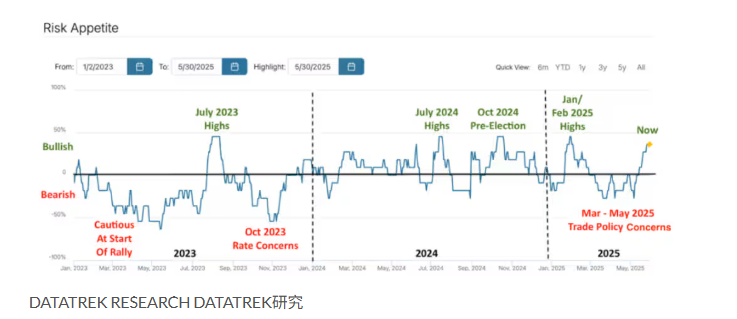
Core Viewpoint - Institutional investors are increasingly optimistic about the U.S. stock market as the S&P 500 index attempts to stabilize above 6000 points and approach its historical high from February [1] Group 1: Institutional Investor Sentiment - DataTrek's Nicholas Colas reports that institutional investors are just beginning to embrace the recent market rally, indicating potential for further gains as the quarter progresses [1] - The State Street Institutional Investor Risk Appetite Index shows that institutional investors have been reducing risk exposure since March 2025, marking the longest de-risking period since September to December 2023 [1] - Colas notes that the current risk appetite is nearing levels consistent with short-term peaks, which may manifest later in June [1] Group 2: Market Performance and Valuation - The S&P 500 index closed at 6000.36 points, just 2.3% below its historical closing high from February 19, indicating a strong recovery despite previous concerns over tariffs [1] - Holding large-cap U.S. stocks requires confidence that the forward price-to-earnings ratio, currently at 22.7 times, will continue to rise [1] - DataTrek warns that unless the U.S. economy avoids recession, the general earnings expectations for the S&P 500 index tend to decline throughout the year, making the index increasingly "expensive" over time [1] Group 3: Risk Appetite Trends - Colas observes that institutional investors have recently shifted from a cautious stance to a more aggressive approach, entering a "catch-up mode" to correct previous over-caution [2] - The peaks of the State Street Risk Appetite Index often coincide with short-term highs in the S&P 500 index, suggesting a pattern that has been consistent since the fourth quarter of 2022 [2] - Historical patterns indicate that similar peaks occurred in July 2023, July 2024, and January to February 2025, with the exception of the pre-election rally in October 2024 [2]