资产通证化

Search documents
股市新物种:“股票代币”概念爆火,HOOD能否改写散户命运?
Jin Rong Jie· 2025-07-14 07:52
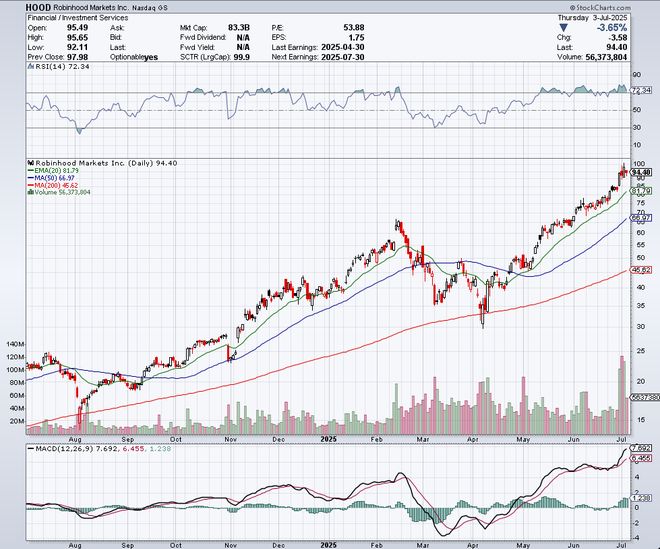
Group 1 - Robinhood has launched a new service called "stock tokens" in the European market, allowing users to trade over 200 U.S. stocks and ETFs, including Nvidia, Apple, and Microsoft [1] - The company plans to introduce tokens linked to private company stocks, including OpenAI and SpaceX, aiming to provide retail investors access to these private unicorns [1] - Following the announcement, Robinhood's stock price surged by 12.77% on June 30 and reached a historical high of $100.88 on July 2, indicating strong market expectations for its tokenization business [1] Group 2 - OpenAI issued a statement clarifying that the "OpenAI tokens" do not represent equity in the company and that they have not authorized any equity transfer, which negatively impacted Robinhood's stock price [3][5] - Following OpenAI's statement, Robinhood's stock price fell by 3.65% on July 3, closing at $94.40, with intraday losses nearing 6% [5] Group 3 - Stock tokens are a blockchain-based representation of securities, allowing for the tokenization of stocks, where holders receive economic rights but not direct ownership [6] - Advantages of stock tokens include 24/7 trading, decentralized custody, participation in DeFi activities, and breaking down barriers to private market access [7] - However, risks include the lack of real ownership, unclear legal status, opacity of underlying assets, and high technical barriers for retail investors [8][9] Group 4 - Robinhood's market capitalization exceeds $83.3 billion, surpassing over 370 companies in the S&P 500, yet it has not been included in the index [10][11] - The reasons for this exclusion include insufficient consistent profitability and the complexity of the company's structure, particularly with its non-traditional token business [12] Group 5 - Robinhood's stock tokenization initiative represents a bold experiment in fintech, aiming to democratize access to private market investments for ordinary investors [13] - Despite its innovative approach, the execution and legality of the initiative remain in a gray area, requiring time and regulatory consensus for validation [13]


起底香港稳定币的「四方暗战」
华尔街见闻· 2025-06-21 11:26
Core Viewpoint - The article discusses the rapid growth and competitive landscape of stablecoins, particularly in Hong Kong, highlighting the involvement of major players and regulatory developments in the sector [2][3][4]. Group 1: Market Growth and Regulatory Environment - Over the past six years, the global stablecoin market has expanded 45 times, evolving from a cryptocurrency anchor to a tool for cross-border payments [3]. - Recent regulatory frameworks, such as the U.S. "Genius Act" and Hong Kong's "Stablecoin Ordinance," have clarified the qualifications for stablecoin issuers and established compliance requirements [4][8]. Group 2: Key Players in Hong Kong's Stablecoin Market - Four main forces are competing for stablecoin issuance in Hong Kong: internet capital from mainland China (e.g., JD.com, Ant Group), third-party entities like Yuan Coin Innovation, and local financial institutions such as Standard Chartered and Hong Kong Telecom [7][8][9]. - JD.com has been proactive, establishing JD Coin Chain and entering the first batch of sandbox testing for stablecoin issuance [15][16][20]. Group 3: JD.com's Strategy and Partnerships - JD.com aims to leverage stablecoins to reduce cross-border payment costs by up to 90% and enhance payment efficiency to under 10 seconds [23][24]. - The company has formed partnerships with Airstar Bank for reserve asset custody and is exploring collaborations with major compliant exchanges for retail payment integration [23][24]. Group 4: Ant Group's Position and Plans - Ant Group is preparing to apply for stablecoin licenses in Hong Kong, focusing on cross-border payment scenarios to enhance transaction efficiency and reduce costs [30][31][32]. - The company has established strategic partnerships with Deutsche Bank for reserve management, indicating a strong commitment to the stablecoin market [32][33]. Group 5: Yuan Coin Innovation's Unique Approach - Yuan Coin Innovation, founded by former HKMA president Chen Delin, is backed by significant capital from the cryptocurrency and internet finance sectors, positioning it as a strong contender in the stablecoin space [45][46][51]. - The company plans to utilize stablecoins for various applications, including cross-border payments and asset tokenization [52][53]. Group 6: Traditional Financial Institutions' Involvement - A consortium of traditional financial players, including Standard Chartered, Animoca Brands, and Hong Kong Telecom, is also entering the stablecoin market, leveraging their established networks and expertise [61][62][68]. - The collaboration aims to combine traditional finance's stability with innovative Web3 applications, although details on their operational plans remain limited [69][72]. Group 7: Future Outlook - Analysts predict that the number of stablecoin issuers in Hong Kong could reach around ten, indicating a competitive environment with more capital poised to enter the market [75].