
银行业数字化转型

Search documents
手机银行竞争格局深化 微众、网商银行淡出TOP50
Jing Ji Guan Cha Wang· 2025-11-13 04:14
Core Insights - The overall monthly active users (MAU) of mobile banking apps in China remained stable between 650 million and 720 million in Q3 2025, indicating a saturation in market growth and a shift towards intensified competition among existing players [2][16] - User engagement metrics, such as daily usage time and app launch frequency, continued to decline, highlighting a decrease in user stickiness [2][16] - The competitive landscape is undergoing significant restructuring, with state-owned banks solidifying their dominance, while private banks struggle to maintain relevance [2][15] State-Owned Banks - The six major state-owned banks captured six of the top seven spots in the mobile banking MAU rankings, with Agricultural Bank of China leading at over 250 million MAU [3][6] - All major state-owned banks reported positive MAU growth, with Industrial and Commercial Bank of China leading at a 6.1% quarter-on-quarter increase [6][10] - The robust performance of state-owned banks is attributed to their strong digital strategies and comprehensive service offerings, enhancing user engagement [6][10] Joint-Stock Banks - Joint-stock commercial banks showed overall stability, with China Merchants Bank leading this category with over 70 million MAU, ranking fifth overall [7][9] - There is a noticeable internal differentiation among joint-stock banks, with some like Everbright Bank and CITIC Bank showing significant growth, while others like Minsheng Bank faced declines [10][15] - The competitive edge of China Merchants Bank stems from its focus on digital transformation and wealth management services [10] City Commercial Banks - City commercial banks emerged as a highlight in Q3 2025, with 17 banks entering the top 50 list, led by Ningbo Bank with a remarkable 43.9% growth in MAU [11][14] - The growth of city commercial banks is linked to their targeted regional strategies and tailored services for specific customer segments [14][16] - However, some city banks experienced declines in MAU, indicating that regional advantages do not guarantee growth [14] Private Banks - Private banks are facing a collective decline, with no representatives in the top 50 MAU rankings for Q3 2025, marking a significant shift in the competitive landscape [15][16] - The challenges faced by private banks are attributed to their inability to compete with traditional banks that have strengthened their digital capabilities and customer trust [15][16] - The decline of private banks signals a transition in the industry from rapid user acquisition to deepening engagement with existing customers [15][16] Agricultural and Rural Banks - Seventeen agricultural and rural banks made it to the top 50 list, with Fujian Rural Credit leading at 781.6 million MAU [16] - Most of these banks reported positive growth, indicating a successful strategy in their respective markets [16] - The performance of agricultural banks reflects the ongoing restructuring and competitive dynamics within the banking sector [16]




凌志软件筹划收购凯美瑞德 “AI+”打开未来成长新维度
Zheng Quan Shi Bao Wang· 2025-11-12 14:45
Core Viewpoint - Lingzhi Software's proposed acquisition of leading domestic financial IT supplier Kaimiride is a significant asset restructuring plan aimed at creating a comprehensive fintech service ecosystem covering multi-tier capital markets, which is expected to substantially enhance the company's performance [1] Group 1: Company Overview - Kaimiride primarily provides software products and services in areas such as fund trading, risk management, liquidity management, digital transformation, and AIGC to over 100 domestic and international financial institutions, including major banks and non-bank financial entities [2] - The company's strong client base, which includes six major state-owned commercial banks and various other financial institutions, provides a solid foundation for sustained revenue growth [2] Group 2: Revenue Characteristics - Kaimiride's revenue recognition exhibits significant seasonality, with IT spending in the banking sector typically showing a "front-low, back-high" pattern, leading to higher revenue recognition in the fourth quarter [2][3] - Analysis of listed banking IT companies indicates that a substantial portion of annual revenue and net profit is concentrated in the fourth quarter, suggesting that investors should focus on annual performance rather than quarterly results [3] Group 3: Industry Trends - The banking IT sector is experiencing positive fundamentals, benefiting from the deepening of financial innovation and the accelerated digital transformation within the banking industry [3] - The ongoing advancements in artificial intelligence, particularly in deep learning and natural language processing, are driving innovation in the AIGC space, prompting Lingzhi Software to upgrade its AI strategy from application to ecosystem building [4] Group 4: Strategic Implications - The integration of Kaimiride is expected to enhance Lingzhi Software's product matrix across various systems in financial institutions, addressing the needs for self-control, digital transformation, and AI applications [4] - This acquisition is anticipated to create a more robust "AI+" ecosystem, potentially serving as a new growth engine for the company's high-quality development [4]

银行整合旗下信用卡、直销银行App 折射数字化转型新趋势
Zheng Quan Ri Bao· 2025-11-11 16:12
Core Insights - The trend of "thinning" bank apps is becoming increasingly significant, with independent credit card apps and direct banking apps being the main categories for shutdown and integration [1][2] - Several banks, including China Bank, are consolidating their credit card app functionalities into their main banking apps, reflecting a shift towards centralized services [1] - The closure of direct banking apps is also on the rise, with Beijing Bank announcing the cessation of its direct banking app and website, migrating functionalities to its main app [1] Industry Trends - The decline in the proportion of credit card business within banks' credit structures and the redundancy of functions in independent apps are driving the integration trend [2] - The shift from a multi-app operation model to a focus on a single, comprehensive app is aimed at reducing maintenance costs and meeting user demand for one-stop services [2][3] - Regulatory pressures for financial client app registration are also prompting banks to streamline redundant applications, enhancing the usage frequency and data security of main platforms [2] Digital Transformation - The banking industry's digital transformation is characterized by three new trends: moving from "many and complete" to "focused and specialized," shifting from product-oriented to user-oriented services, and evolving from isolated online services to integrated ecosystems [3] - Challenges in the app integration process include technical compatibility, user habit migration, and data security [3] - Recommendations for banks include optimizing mobile ecosystems, enhancing digital capabilities, exploring diversified services, and ensuring compliance and security during data migration [3]


越南银行业数字化转型取得积极成果
Shang Wu Bu Wang Zhan· 2025-10-31 16:40
Core Insights - Vietnam's banking sector is experiencing significant digital transformation, with non-cash payment transactions and electronic identity verification showing strong growth [1][2] Group 1: Digital Payment Growth - Non-cash payment transaction volume increased by 43.32% and transaction value grew by 24.23% compared to the same period in 2024 [1] - Internet payment transaction volume rose by 51.2% and transaction value increased by 37.17% [1] - Mobile payment transaction volume grew by 37.37% and transaction value increased by 21.79% [1] - QR code payment transaction volume surged by 61.63% and transaction value skyrocketed by 150.67%, making it the fastest-growing payment channel [1] - ATM transaction volume decreased by 16.77% and transaction value fell by 5.74%, indicating a significant reduction in cash usage [1] Group 2: Financial Inclusion - As of September 2025, Vietnam had 10.89 million mobile payment accounts, with approximately 70% belonging to users in rural, mountainous, island, and border areas [1] - Total transaction volume exceeded 290 million, with a transaction value of 85.11 trillion VND, significantly promoting financial inclusion and reducing regional digital gaps [1] - The State Bank of Vietnam has issued payment service licenses to 53 institutions, with 49 providing e-wallet services [1] Group 3: Digital Transformation in Banking - Nearly all basic banking services have been digitized, with 95% of transactions completed through digital channels [2] - Banks are integrating seamlessly with various services such as electricity, water, telecommunications, healthcare, education, e-commerce, tourism, and public administration [2] - Financial institutions are actively utilizing artificial intelligence and big data for customer behavior analysis and credit assessment, automating business processes [2] Group 4: Electronic Identity Verification - By October 10, 2025, over 132 million individual and 1.4 million institutional customer profiles had undergone biometric verification [2] - 57 banks and 39 payment intermediaries have connected to the citizen ID chip authentication system [2] - 28 banks and 4 intermediaries have linked social security accounts with bank accounts through VNeID, facilitating pension and benefit payments for the public [2]
第一百家支行落地 民生银行北京分行精准服务首都经济建设
Xin Jing Bao· 2025-10-16 01:48
Core Insights - Minsheng Bank's Beijing Huairou Branch officially opened on October 16, marking the establishment of the bank's 100th standard branch in the capital, enhancing its service capabilities for the capital's economic development [1][2] - The bank is expanding its branch network despite the general trend of contraction in physical bank locations, focusing on transforming branches from transaction-oriented to service-oriented [1][2] - The establishment of the Huairou Branch fills a gap in the bank's network in the area and aligns with the strategic development needs of Beijing [2] Network Expansion - The opening of the 100th branch in Huairou is a strategic move for Minsheng Bank to integrate deeper into the capital's development framework [2] - The bank has signed strategic cooperation agreements with multiple districts, including Miyun and Tongzhou, to enhance government-bank collaboration and meet the capital's development demands [2] - The bank's branch layout is guided by Beijing's "14th Five-Year Plan" and 2035 vision, focusing on regional economic trends for network planning [2] Service Model Transformation - Minsheng Bank is upgrading both the soft and hard infrastructure of its branches, aiming to transform them into "ecological integration centers," "customer experience centers," and "complex product marketing centers" [3] - The bank is focusing on integrating channel advantages, technological capabilities, and social credibility to expand its "bank+" diversified business scenarios [3] Community Banking - The bank has pioneered the "community bank" model, focusing on the needs of key demographics such as the elderly and children [4] - It has implemented measures like setting up care stations and adapting branches for elderly accessibility, addressing the digital divide faced by older customers [4][5] - The bank collaborates with local communities to enhance financial literacy and safety, establishing a dual mechanism for education and fraud prevention [5] Support for Small and Micro Enterprises - Minsheng Bank has established 26 small and micro enterprise financial centers to provide integrated financial and non-financial services [6] - The bank has restructured its approval teams to enhance efficiency and risk management for small and micro businesses [6] - It actively engages with government departments to facilitate financing for small enterprises and supports local economic activities [6] Technology and Innovation Focus - The bank has developed a "3+6+16" organizational structure for technology finance, with specialized branches and centers to serve key industrial clusters [7] - This network covers major industries such as information technology and healthcare, creating a 5-kilometer service radius [7] - The bank offers a comprehensive financial product system tailored to the lifecycle of technology enterprises, supporting various stages from startup to maturity [8] Future Outlook - Minsheng Bank plans to continue expanding its network in alignment with major strategic initiatives, focusing on green finance and technology finance to support regional ecological and industrial upgrades [8]

又一直销银行将“退场” 银行业从“渠道竞争”转型“生态竞争”
Zheng Quan Ri Bao· 2025-10-10 15:53
Group 1 - Postal Savings Bank of China has announced the absorption and merger of Postal Huinong Bank, which was approved by the shareholders' meeting [1] - The merger aims to achieve strategic integration, optimize resource allocation, and reduce management costs, enhancing overall operational efficiency [1] - Industry experts indicate that this integration model lowers operational costs and enables centralized management and analysis of customer data, facilitating cross-selling and precise services [1] Group 2 - Several banks have recently announced the shutdown or integration of their direct banking services, indicating a trend towards merging these services into traditional banking platforms [2] - The independent direct banking model has not formed a complete service ecosystem or unique competitive advantages, leading to resource waste for traditional banks [2] - Following the merger, only one independent direct bank, Baixin Bank, remains in the country, highlighting a shift towards integrated development within the banking sector [2] Group 3 - The evolution of direct banks reflects the digital transformation of the banking industry, with mobile banking upgrades fulfilling user needs and rendering direct banks as transitional entities [3] - The ultimate goal of financial digitalization is not merely channel innovation but a profound ecological restructuring within the banking sector [3] - Traditional banks are encouraged to leverage their service channels and explore integration into various scenarios while utilizing digital technology to enhance management [3]

第17届“香港银行家峰会”聚焦新一代银行业转型
Xin Hua Cai Jing· 2025-09-26 15:51
Group 1 - The 17th "Hong Kong Banker Summit 2025" was held with over 800 participants focusing on digital transformation, international uncertainty, and changing customer demands [1][2] - Hong Kong was ranked as the third leading financial center globally and first in Asia, with its fintech ranking rising from fourth to first [1] - The Hong Kong government aims to enhance its role in the international financial landscape and promote innovation in the banking sector [1] Group 2 - The Hong Kong Monetary Authority (HKMA) emphasizes the need for innovation in the banking sector to build market trust and ensure responsible development [2] - Collaboration among banks, fintech companies, and market participants is essential for managing risks while seizing new opportunities [2] - The HKMA has introduced measures like regulatory sandboxes and incubators to foster a secure and sustainable financial ecosystem [2] Group 3 - The summit featured a "CEO Dialogue" discussing how banks can adapt to rising customer expectations, rapid technological advancements, and macroeconomic fluctuations [3] - The Hong Kong Institute of Bankers awarded honors to banking leaders for their contributions to financial talent development [3] - The HKIB also presented the "HKIB Talent Development Excellence Award" to nine financial institutions for their forward-looking talent strategies and sustainable training systems [3]
邮储银行将吸收合并旗下直销银行
Zheng Quan Shi Bao· 2025-09-24 18:05
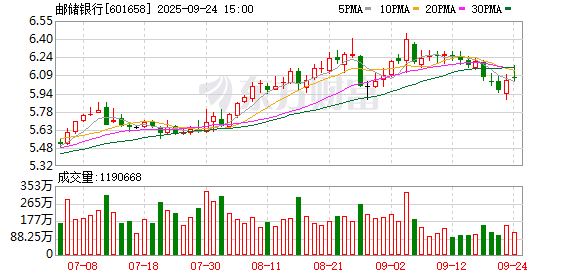
Group 1 - Postal Savings Bank of China (PSBC) is merging its wholly-owned subsidiary, Postal Savings Bank Huinong Bank, to optimize management and business structure, resulting in the latter's legal status being canceled [1] - Postal Savings Bank Huinong Bank was established in January 2022 with a registered capital of 5 billion yuan and aimed to provide digital inclusive financial services [1] - As of June 2023, Postal Savings Bank Huinong Bank had total assets of 12.005 billion yuan and over 20 million registered users [1] Group 2 - The merger of Postal Savings Bank Huinong Bank reflects a broader trend in the banking industry towards digital transformation and consolidation, moving from initial experimentation to comprehensive integration [2] - Other banks, such as China Merchants Bank, have also withdrawn independent digital bank applications, indicating a shift in strategy within the industry [2] - The banking sector is transitioning into a new phase of deep integration in digital development, as many banks consolidate their digital financial subsidiaries [2]
银行业数字化转型加速,邮储银行宣布吸收合并全资直销银行子公司
Guan Cha Zhe Wang· 2025-09-24 08:57
Core Viewpoint - China Postal Savings Bank announced a strategic merger with its wholly-owned subsidiary, Postal Savings Bank of China Huinong Bank, marking a significant shift from decentralized pilot projects to centralized integration in its digital transformation process [1][5] Group 1: Strategic Goals - The merger aims to achieve strategic integration, optimize resource allocation, and reduce management costs [1][4] - The independent operation of the direct bank subsidiary has led to overlapping business functions with the parent company, necessitating improved resource allocation efficiency [1][4] Group 2: Financial Performance - As of June 2025, Postal Savings Bank of China Huinong Bank had a net asset of 4.042 billion and a deposit scale of 7.2 billion, indicating that its asset scale is relatively small compared to the overall size of Postal Savings Bank [2] - Despite serving over 20 million customers, the marginal benefits of the independent operation model are diminishing from an asset return and cost-effectiveness perspective [2] Group 3: Industry Trends - The merger reflects a broader trend in the banking industry towards digital transformation, moving from independent direct banks to integrated digital operations within parent companies [5][6] - The number of independent legal direct banks is decreasing, with only a few remaining operational, indicating a shift in the strategic value of such models [6] Group 4: Future Implications - The strategic adjustment by Postal Savings Bank signals a transition in the banking sector's digital development from initial "multiple experiments" to a new phase of "deep integration" [7] - Future competition in the banking industry will focus more on overall service capabilities, risk control levels, and customer experience rather than just channel innovation or product differentiation [7]
直销银行退场,邮储银行为何吸收合并邮惠万家银行?
3 6 Ke· 2025-09-24 07:57
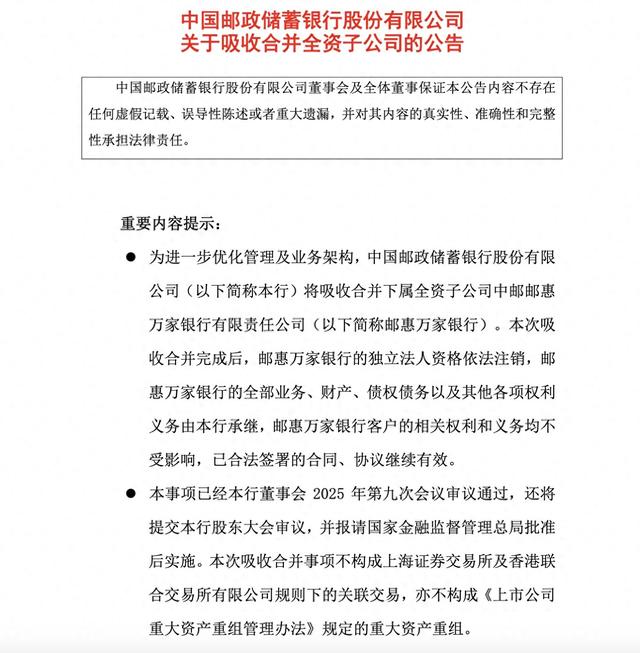
Core Viewpoint - Postal Savings Bank of China (PSBC) announced the absorption and merger of its wholly-owned subsidiary, Postal Huinong Bank, reflecting a broader trend in the banking industry towards digital transformation and integration of direct banks [1][2][3] Company Summary - The merger will result in the cancellation of Postal Huinong Bank's independent legal status, with all its business, assets, debts, and rights transferred to PSBC, ensuring that customer rights remain unaffected [1][2] - The merger is part of PSBC's strategy to optimize management and business structure, enhancing its digital banking capabilities and reducing operational costs [4][5][6] - Postal Huinong Bank, established in January 2022, faced challenges in maintaining its independent value due to the rise of mobile banking and increased competition in the financial services market [3][4][8] Industry Summary - The banking industry is witnessing a shift from "extensive channel expansion" to "refined ecological cultivation," indicating a new phase of deep integration in digital banking [1][2] - Over 20 banks have shut down or integrated their direct banking operations in recent years, highlighting the trend towards unified operations [2][3] - The digital transformation of banks is driven by the need for enhanced customer experience and operational efficiency, with a focus on integrating technology and data into business models [9][10] Financial Metrics - As of the end of 2024, Postal Huinong Bank reported total assets of 12.828 billion yuan, a loss of 415 million yuan, and a non-performing loan ratio of 6.66% [8] - PSBC's capital adequacy ratio stood at 14.57% and its core tier 1 capital adequacy ratio at 10.52% as of June 2025, reflecting a year-on-year improvement [11]