银行业数字化转型

Search documents
流量红利枯竭 存量博弈下银行APP被迫断臂求生
Jing Ji Guan Cha Wang· 2026-02-18 05:44
Core Insights - The Chinese mobile banking market is transitioning from "scale expansion" to "value cultivation," indicating a saturation of user growth and the end of the traffic dividend period [2] - Different types of banks are exhibiting varied development trends in this new landscape [2] State-Owned Commercial Banks - The six major state-owned banks dominate the mobile banking market, with Agricultural Bank of China leading with over 250 million monthly active users (MAUs) [2] - The top three banks, including Industrial and Commercial Bank of China and China Construction Bank, have MAUs of nearly 200 million and over 100 million, respectively [2] - All six major banks reported positive month-on-month growth in MAUs, with ICBC leading at a 6.1% growth rate [2] Joint-Stock Commercial Banks - Joint-stock banks are seeking to carve out a niche in the saturated market, with China Merchants Bank leading among them with over 70 million MAUs [3] - Some banks like Everbright Bank and CITIC Bank showed significant month-on-month growth rates of 11.0% and 9.2%, respectively [3] - The performance of joint-stock banks is mixed, with some experiencing negative growth [3] Urban Commercial Banks - Urban commercial banks are growing rapidly, with 17 banks making it to the top 50 list, led by Ningbo Bank with 3.644 million MAUs and a growth rate of 43.9% [3] - The growth is attributed to localized strategies that enhance customer engagement [3] Rural Commercial Banks and Credit Cooperatives - Rural commercial banks and credit cooperatives also performed well, with 17 banks in the top 50, led by Fujian Rural Credit with 781.6 thousand average MAUs [4] - 12 out of these 17 banks reported positive month-on-month growth [4] Private Banks - Private banks are facing significant challenges, with only WeBank making it to the top 50 list in the first half of 2025, experiencing a 27.3% decline in MAUs [4] - The competitive landscape has shifted, making it difficult for online-only private banks to maintain their initial advantages [4] Conclusion - State-owned banks leverage "ecosystem" advantages to solidify their market position, while joint-stock banks focus on "professional" opportunities [5] - Urban commercial banks establish a strong local presence, whereas private banks struggle to survive in the competitive environment [5] - The future of banking will require a focus on creating irreplaceable value for users through technology and insights into user behavior [5]





银行“上星”拓展金融服务新空间
Jing Ji Ri Bao· 2026-02-01 22:01
Core Viewpoint - The successful launch of satellites by major Chinese banks marks a significant step in enhancing their financial services through advanced technology, particularly in risk management and data communication capabilities [1][2][3]. Group 1: Satellite Launches and Technology - China Merchants Bank launched the "Zhaoyin Jinkui" satellite, while Shanghai Pudong Development Bank launched the "Puyin Shuzhi" satellite, contributing to the formation of a low-orbit satellite communication matrix [1][2]. - The satellites are part of the "Tianqi Constellation," which aims to provide integrated IoT data communication services globally, enhancing capabilities in various sectors such as energy and agriculture [2]. Group 2: Risk Management and Financial Services - Satellite technology enhances banks' risk management capabilities by providing reliable financial information, thus addressing issues of information asymmetry [3]. - China Merchants Bank's self-developed risk management system utilizes high-resolution satellite imagery to monitor construction progress with over 95% accuracy, improving traditional post-loan inspection efficiency [3]. Group 3: Applications in Financial Services - Satellite technology can expand the coverage and precision of financial services, particularly in supply chain finance, rural finance, and green finance [4]. - Ping An Bank uses IoT devices monitored by satellites to track dairy cattle, addressing collateral issues and improving post-loan management [4]. Group 4: Resilience and Stability in Financial Infrastructure - Satellite communication technology helps banks maintain operations during ground communication disruptions, enhancing the resilience of financial infrastructure [5]. - China Merchants Bank is testing low-orbit satellite communication for disaster recovery systems, ensuring critical financial services can be quickly restored in extreme scenarios [5]. Group 5: Digital Transformation and Industry Impact - The satellite launches reflect the deepening digital transformation of the banking sector, enhancing communication systems and supporting the commercial satellite industry [6]. - Participation in the aerospace industry allows banks to improve their financial service capabilities in strategic areas while creating technological barriers [7]. Group 6: Challenges and Future Trends - While satellite technology offers unique advantages, it may lead to data monopolies and compliance risks, necessitating clear legal frameworks [7]. - The trend may result in a tiered ecosystem where major banks develop their satellite constellations, while smaller banks rely on data procurement from third-party services [7].



精准管控 高效体验:解析自助餐称重结算方案在银行智慧食堂的核心应用
Sou Hu Cai Jing· 2026-01-09 03:05
Core Insights - The digital transformation in the banking industry emphasizes the upgrade of smart canteens as a key approach to optimize logistical support [1] - The self-service weighing and settlement solution focuses on "demand-based meal selection and precise pricing" to address traditional cafeteria issues such as long queues, significant waste, and management difficulties [1] Hardware Configuration - The hardware system utilizes integrated smart devices to create a seamless dining experience, featuring the LN-JL-03RT intelligent weighing machine with 1-gram precision sensors [2] - An 8-inch full-view display shows real-time weight and pricing, enhanced by warm LED lighting for better food presentation [2] - Each dining line is equipped with over 20 devices to support efficient service for more than 500 people, integrating multi-modal payment options like facial recognition, card swiping, and QR code scanning [4] Settlement Software - The settlement software is designed with "efficiency, compatibility, and intelligence" at its core, enabling weight detection and pricing within 3 seconds after placing the meal tray [5] - The payment success rate reaches 99.9%, and the system is tailored to meet banking needs by integrating with internal apps and meal subsidy systems [5] - It supports various payment methods, including dynamic QR codes and order push notifications [5] Backend Data Management - The backend data management system establishes a comprehensive control framework, collecting real-time data on ingredient consumption and dish sales to generate multi-dimensional reports [8] - It enables precise forecasting of meal demand, leading to an 80% reduction in kitchen waste and a 30% decrease in costs for institutions like the Jiangxi branch of China Construction Bank [8] - The system features a local and cloud dual-backup architecture, ensuring data integrity and compatibility with financial systems for a complete procurement-settlement-accounting loop [8] Overall Impact - The self-service weighing and settlement solution, through "hardware foundation, software efficiency, and data empowerment," aligns with the banking industry's need for efficient and precise management while promoting a green and humanistic approach [8] - It has become a core engine for the construction of smart canteens in banks, continuously driving logistical upgrades in financial institutions, as evidenced by benchmark cases from Agricultural Bank of China and Industrial and Commercial Bank of China [8]
正式获批解散!这家国有大行合并旗下直销银行
券商中国· 2026-01-07 00:59
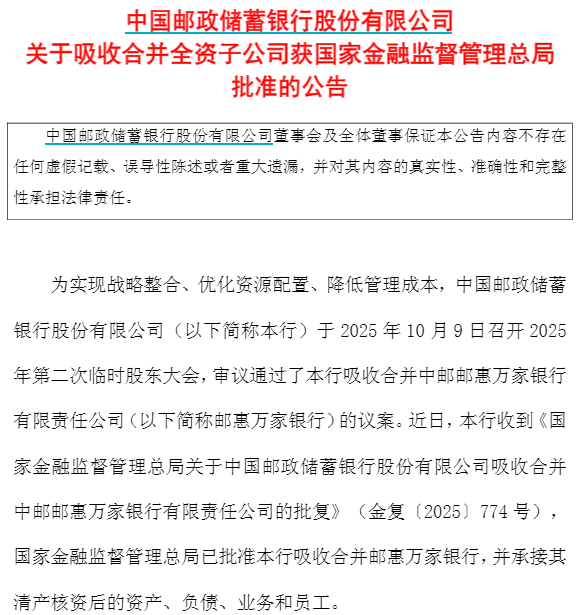
Core Viewpoint - Postal Savings Bank of China (PSBC) has received regulatory approval to absorb and merge with its wholly-owned direct bank, Postal Huinong Bank, marking the end of the first independent legal direct bank controlled by a state-owned commercial bank in China [2][3]. Group 1: Merger Announcement and Rationale - The merger is aimed at optimizing resource allocation, reducing management costs, and enhancing operational efficiency, as stated by PSBC [3][4]. - The direct bank was initially established as a "testbed for digital transformation," but its independent value has diminished due to the rapid development of mobile banking [2][4]. - The merger will integrate Postal Huinong Bank's online operational experience into PSBC, providing new momentum for its development [4]. Group 2: Financial Performance of Postal Huinong Bank - Postal Huinong Bank, established in January 2022 with a registered capital of 5 billion yuan, has accumulated over 20 million users but has not achieved profitability since its inception [5][6]. - The bank reported revenues of 101 million yuan, 355 million yuan, and 243 million yuan from 2022 to 2024, with net losses of 162 million yuan, 263 million yuan, and 415 million yuan during the same period [5][6]. - As of June 2025, Postal Huinong Bank's total assets were 12.005 billion yuan, with a significant portion of its loans directed towards small and micro enterprises [6]. Group 3: Industry Context and Future Outlook - The independent legal direct bank model has faced challenges due to the increasing overlap in functionality with mobile banking apps, leading to a decline in the independent value of direct banks [7]. - Following the merger, only one independent legal direct bank, Citic Baixin Bank, remains operational in China, highlighting a trend of consolidation in the sector [7]. - Citic Baixin Bank has shown signs of recovery, achieving a net profit of 652 million yuan in 2024, although it experienced a decline of 23.74% year-on-year [7][8].


国有大行唯一直销银行吸收合并获批!独立法人直销银行仅剩一家
Sou Hu Cai Jing· 2025-12-30 14:44
Group 1 - The core point of the news is that China Postal Savings Bank has received approval to absorb and merge its wholly-owned subsidiary, Postal Huinong Bank, which will leave only Citic Baixin Bank as the remaining independent legal direct bank in China [1][3]. - The merger is expected to optimize management and business structure, enhance digital transformation effectiveness, improve operational efficiency, and reduce management costs for China Postal Savings Bank [3]. - Postal Huinong Bank, established in 2022 with a registered capital of 5 billion yuan, was intended as a testing ground for the digital transformation of China Postal Savings Bank [3]. Group 2 - In 2024, Postal Huinong Bank reported a revenue of 243 million yuan and a net loss of 415 million yuan, with total assets of 12.828 billion yuan and total liabilities of 8.669 billion yuan by the end of 2024 [3]. - The non-performing loan ratio for Postal Huinong Bank was 6.66%, with a provision coverage ratio of 239.55% [3]. - The trend of merging or shutting down direct banking operations has been observed across multiple banks since 2017, with several banks like Ping An Bank and Shanghai Pudong Development Bank closing or integrating their direct banking channels [4]. Group 3 - Regulatory tightening is a significant reason for the decline in direct banking operations, with increased scrutiny on financial institutions to return to core operations and maintain risk isolation [4]. - The tightening of regulations regarding data security, personal information protection, and internet loans has limited the business models that direct banks previously relied on, making innovation more challenging [4]. - The once-prominent role of direct banks as a key tool for traditional banks to counter the impact of internet finance has diminished significantly [4].
53岁张曼接棒长沙银行董事长,33年金融生涯的逆袭之路
Sou Hu Cai Jing· 2025-12-22 14:21
Group 1: Leadership Transition - Zhang Man has officially taken over as the new chairman of Changsha Bank, marking a significant leadership change and becoming the only female chairman among A-share listed city commercial banks [2] - Her appointment reflects the gradual increase in the proportion of female executives in China's financial industry [2][6] Group 2: Career Background - Zhang Man's career spans 33 years, starting in 1992 at Agricultural Bank of China, where she gained 14 years of grassroots experience before joining Changsha Bank in 2006 [3] - Over nearly 20 years at Changsha Bank, she has held various positions, including branch manager and vice president, showcasing a clear and steady career progression [3] Group 3: Current Financial Status - As of the end of Q3 2025, Changsha Bank's total assets reached 1.24 trillion yuan, with operating income of 19.721 billion yuan and net profit of 6.618 billion yuan, while maintaining a non-performing loan ratio of 1.18% and a provision coverage ratio of 311.88% [4] - The bank is facing challenges such as deepening interest rate marketization, accelerated digital transformation, and intensified regional competition [4] Group 4: Legacy of Zhao Xiaozhong - The former chairman Zhao Xiaozhong left a significant mark on Changsha Bank, achieving county-level coverage in Hunan and surpassing the 1 trillion yuan asset milestone during his tenure [5] - His experience in risk control and strategic planning has provided a solid foundation for his successor [5] Group 5: Gender Diversity in Leadership - Zhang Man's rise increases the number of female chairpersons in A-share and H-share listed banks to four, indicating a slow but steady change in gender structure within the financial industry [6] - The presence of female leaders like Zhang Man highlights the importance of professional capability over gender in career advancement [6] Group 6: Future Directions for Changsha Bank - Established in 1997, Changsha Bank has evolved from 16 city credit cooperatives to a trillion-yuan city commercial bank, with Zhang Man's leadership potentially signaling new development strategies [7] - The bank may focus on deepening its local market presence, enhancing inclusive finance, and accelerating technological empowerment as viable directions for future growth [7]


辽宁农商银行14家分支机构获批终止营业
Jin Rong Jie· 2025-12-11 02:08
Core Viewpoint - The recent approval for the termination of operations at 14 branches of Liaoning Rural Commercial Bank reflects a significant trend in the banking industry towards optimizing physical branch networks amid digital transformation efforts [1][4]. Group 1: Termination of Branch Operations - Liaoning Rural Commercial Bank has received approval to terminate operations at 14 of its branches within a two-day period [1]. - On December 9, the Panjin Financial Regulatory Bureau approved the closure of four branches, including Dawa Xinyu Branch and Dawa Liaoyou Branch [2]. - On December 10, the Chaoyang Regulatory Bureau approved the closure of ten additional branches, including Jianping Guangming Branch and Lingyuan Yangzhangzi Branch [3]. Group 2: Background of Liaoning Rural Commercial Bank - Liaoning Rural Commercial Bank was established based on Shenyang Rural Commercial Bank and 30 other rural credit cooperatives, with a registered capital of 20.7 billion yuan [4]. - The bank is the first provincial-level rural commercial bank in China, with 25 departments and 833 operating outlets [4]. - In June 2024, the bank was approved to absorb and merge with 36 other rural small and medium-sized banks, taking over their effective assets, liabilities, and operations [4]. Group 3: Industry Trends - The pace of physical bank branch closures has accelerated significantly, with over 9,000 branches approved for shutdown this year, marking an increase of over 200% compared to 2,533 closures in 2024 [4].

银行业ATM机五年缩减25万台,数字化转型与渠道优化成破局关键
Jin Rong Jie· 2025-12-10 08:40
Core Insights - The number of ATMs in China has decreased significantly, with a reduction of approximately 14,800 machines in Q3 2023 compared to the end of Q2 2023, totaling 760,900 ATMs nationwide. Over the five years from 2020 to 2025, the total decrease exceeds 250,000 ATMs, indicating a structural shift in consumer financial behavior towards digital channels [1][2]. Group 1: Industry Trends - The decline in ATM numbers reflects a deep change in consumer behavior, with more customers opting for digital channels such as internet banking, banking apps, and WeChat mini-programs for their financial needs. This shift has led to a decrease in the necessity and frequency of ATM usage [1][2]. - The trend is not indicative of industry decline but rather a necessary transformation within the banking sector, emphasizing the need for banks to adapt to changing consumer behaviors through digital channel upgrades and service model transformations [3]. Group 2: Strategic Recommendations - Banks should enhance their digital channel offerings by improving product diversity and service convenience, ensuring that all core financial needs can be met digitally, from basic transactions to complex services like investment advice and loan applications [2]. - Urban bank branches should transition from a transaction-focused model to a service-oriented approach, concentrating on complex services such as consulting and retirement planning, thereby improving operational efficiency and meeting diverse customer needs [2]. - There is a need to expand and upgrade rural bank branches, considering the demographic challenges and digital divide in these areas. Banks should invest in rural branches to provide not only traditional banking services but also additional functionalities like logistics and e-commerce support, positioning them as comprehensive service platforms for rural revitalization [2].
昆山农商银行:数字赋能,重塑远程信贷模式
Jiang Nan Shi Bao· 2025-11-23 13:23
Core Viewpoint - Kunshan Rural Commercial Bank is initiating a strategic innovation in remote credit business starting January 2024, aiming to integrate traditional credit risk control with the convenience of internet services, marking a significant systemic transformation in its operations [1][3]. Group 1: Mechanism and Efficiency - The remote credit model innovatively employs a "one on-site, one in-house" collaborative approach, enhancing resource optimization and significantly improving work efficiency [1]. - The complete imaging and video documentation generated during the process can be directly stored in the credit system, providing comprehensive and real-time evidence for approval decisions, thereby reducing operational risks and ensuring compliance [1]. - A fault-tolerant and due diligence exemption mechanism has been established to encourage credit managers to take calculated risks within a compliant framework, supporting business innovation [1]. Group 2: Technology and Innovation - The boundaries of remote banking services are continuously expanding, with ongoing optimization of the technology platform to achieve a closed-loop risk control process [2]. - An efficient decision-making mechanism is formed through immediate feedback from the approval end in case of anomalies, enhancing collaborative efficiency [2]. - The appointment system has been optimized to adjust the appointment slots dynamically based on seat availability, significantly improving customer service experience [2]. Group 3: Strategic Positioning - The remote credit business represents a transition from online channels to a new digital financial model, focusing on data as a key production factor and technology as the core driving force [2]. - The bank aims to build core competitiveness for the future by establishing a platform ecosystem [2]. - The remote model effectively addresses the challenges of "difficult and expensive financing" for small and micro enterprises, individual businesses, and farmers, thereby facilitating smoother financial support for the real economy [2]. Group 4: Systemic Transformation - The innovation in remote credit business is a profound systemic reshaping rather than a mere technological upgrade, enhancing the bank's core competitiveness and innovative vitality in the digital economy era [3].

数字金融竞速 多家银行密集招标
Bei Jing Shang Bao· 2025-11-16 15:53
Core Viewpoint - The digital transformation in the banking sector has shifted from an optional choice to a necessary requirement for survival, prompting a competitive race focused on technology, human resources, and ecosystem development [1][6]. Group 1: Technology Procurement Trends - Multiple banks, including Shanghai Pudong Development Bank, China Construction Bank, China CITIC Bank, Industrial Bank, and Guilin Bank, have recently announced technology procurement tenders, indicating a significant increase in technology investment and service optimization [3][4]. - Shanghai Pudong Development Bank plans to select 12-18 suppliers for IT outsourcing services from 2025 to 2028, with a service period of three years, to alleviate the shortage of developers and enhance IT construction efficiency [3]. - China Construction Bank's Hubei branch has set an annual tender control price of 22.5 million yuan for software development and technical services, aiming to select three suppliers for a three-year collaboration [3]. Group 2: Strategic Implications of Digital Transformation - The concentrated technology procurement by banks signals that the digital transformation is entering a "deep water zone," moving beyond basic system maintenance to strategic planning for future competition [4][5]. - The high entry barriers set by banks for suppliers reflect a shift in demand from basic supply to high-quality matching, indicating a need for long-term collaborative partners with deep financial business understanding and complex project experience [5][6]. - The current wave of technology investment is driven by multiple competitive pressures, including narrowing net interest margins and challenges from fintech companies and internet platforms, necessitating banks to leverage technology for differentiation and cost control [6]. Group 3: Future Focus Areas for Technology Investment - Future technology investments in the banking sector are expected to focus on three core areas: data security and application, compliance and risk control system upgrades, and comprehensive solutions for intelligent financial transformation [6].