
银行股增持

Search documents
买买买!7万亿股份行股东,出手增持!
证券时报· 2025-11-28 04:27
Core Viewpoint - CITIC Financial Asset has increased its stake in Everbright Bank, reflecting a broader trend of significant share purchases in the banking sector, indicating confidence in the banks' future prospects and value recovery [1][4][9]. Group 1: Shareholding Changes - CITIC Financial Asset increased its holdings in Everbright Bank by 1% from July 24 to November 27, raising its total stake to 9% [1][3]. - The total shares acquired by CITIC Financial Asset during this period include 275 million A-shares and 315 million H-shares [3]. - This is not the first increase in 2025; previously, from January 20 to July 22, CITIC Financial Asset raised its stake from 7.08% to 8% by acquiring 264 million A-shares and 279 million H-shares [4]. Group 2: Financial Performance - As of September 30, 2025, Everbright Bank's total assets reached 7.22 trillion yuan, marking a year-on-year growth of 4.84% [3]. - CITIC Financial Asset's annual report indicated a significant increase in its equity in joint ventures and associates, totaling 216.325 billion yuan, up 191% from the previous year [5]. Group 3: Broader Market Trends - Since October, there has been a wave of share purchases across listed banks, with notable increases from major shareholders and executives [7][8]. - The trend of share buybacks is seen as a shift from a defensive strategy to proactive market value management, driven by expectations of economic recovery and stable interest margins [9].


银行股增持潮起股东用资本投票
Zhong Guo Zheng Quan Bao· 2025-11-25 20:27
Core Viewpoint - The recent surge in share buybacks by shareholders and executives in A-share banks, particularly city commercial banks like Nanjing Bank and Chengdu Bank, reflects strong confidence in the banks' fundamentals and a market preference for high-dividend assets [1][2]. Group 1: Shareholder and Executive Buybacks - Nanjing Bank announced that BNP Paribas (QFII) increased its stake by 12.8 million shares, raising its total holding from 17.02% to 18.06% [1]. - Chengdu Bank's major shareholders, Chengdu Industrial Capital Group and Chengdu Xintianyi, collectively spent 611 million yuan to buy 3.4247 million shares, with plans for further purchases [2]. - Executives from Changshu Bank and Shanghai Rural Commercial Bank also announced their intentions to buy shares, indicating a commitment to their banks' long-term value [2]. Group 2: Market Conditions and Valuation - The increase in buybacks is attributed to expectations of economic recovery, improved performance, and valuation corrections, with 38 out of 42 A-share listed banks seeing stock price increases this year [2][3]. - The banking sector's overall price-to-book ratio remains at historical lows, suggesting potential for valuation recovery [2][3]. Group 3: Investment Outlook - Analysts express optimism regarding the banking sector, highlighting the appeal of high-dividend, low-valuation characteristics of bank stocks, especially during periods of economic stagnation [4]. - Investment strategies focus on banks with regional advantages and strong performance certainty, particularly in areas like Jiangsu, Shanghai, Chengdu, Shandong, and Fujian [4].

曹中铭:银行股掀增持潮 估值空间还有多大?
Xin Lang Cai Jing· 2025-11-25 07:19
Core Viewpoint - The recent surge in bank stock purchases by major shareholders indicates strong confidence in the potential and long-term investment value of bank stocks, particularly among city commercial banks in China [1][2]. Group 1: Bank Stock Performance - Bank stocks have shown impressive performance, with a significant index increase from 2535.75 points on October 31, 2022, to a peak of 4632.44 points on July 11, 2023, marking a maximum increase of 82.69% [2]. - Agricultural Bank of China has been a standout performer, with its stock price rising from 2.07 yuan on October 31, 2022, to a high of 8.68 yuan by November 14, 2023, representing a growth of over 300% [2]. Group 2: Reasons for Shareholder Purchases - Major shareholders are increasing their stakes in bank stocks due to their attractive dividend yields, which are often higher than one-year deposit rates, making bank stocks a preferred investment over traditional savings [2]. - The strong dividend-paying capability of bank stocks, often referred to as "cash cows," is appealing to investors seeking cash returns, with many banks implementing annual and even mid-year dividends [3]. Group 3: Profitability and Valuation - The profitability of bank stocks is robust, as demonstrated by Agricultural Bank's non-GAAP net profit growth from 216.5 billion yuan in 2020 to an expected 281.6 billion yuan in 2024, indicating a consistent upward trend [3]. - The valuation of bank stocks is closely tied to their profitability; despite previous neglect by large funds, a re-evaluation of bank stocks is underway, transforming them from "market orphans" to desirable investments [4]. Group 4: Market Trends - The valuation of individual bank stocks is influenced not only by their earnings but also by overall market trends; in a bullish market, bank stock valuations tend to rise, while they may decline in a bearish market [4].

24家A股银行将现金分红超2600亿元
2 1 Shi Ji Jing Ji Bao Dao· 2025-11-24 12:56
Core Viewpoint - The recent surge in stock prices of major Chinese banks is driven by their mid-term dividend announcements, with a total cash dividend amounting to 2637.90 billion yuan for 2025, indicating significant investment potential in the banking sector [2][4]. Dividend Announcements - As of November 24, 2025, 24 A-share listed banks have disclosed their mid-term dividend plans, with a total cash dividend of 2638 billion yuan [4]. - Notably, seven banks, including Industrial Bank, Changsha Bank, and Ningbo Bank, are implementing mid-term dividends for the first time since their listings [2]. - The six major state-owned banks are expected to distribute over 2046 billion yuan in dividends [5]. Dividend Yield - The average dividend yield for listed banks as of November 24 is 4.48%, with 12 banks yielding over 5% and 26 banks exceeding 4% [6]. - Specific banks like Bank of Communications and China Construction Bank have dividend yields of 4.18% and 3.93%, respectively [6]. Shareholder and Executive Buybacks - There has been a notable increase in share buybacks by major shareholders and executives of listed banks, signaling positive market sentiment [8]. - For instance, Chengdu Bank's major shareholders have collectively bought approximately 34.25 million shares, investing 6.11 billion yuan from August 27 to November 21 [8]. - Nanjing Bank reported that foreign shareholder BNP Paribas increased its stake by over 128 million shares, raising its ownership to 18.06% [9]. Overall Market Sentiment - The banking sector has seen a net increase in holdings exceeding 9 billion yuan, with significant buybacks from shareholders and executives across multiple banks [10]. - The proactive buyback activities reflect confidence in the banks' future strategies and growth prospects, with the banking sector ranking second in shareholder buybacks this year, only behind the transportation sector [10].




国有行2046亿分红将落地催热市场 股价迭创新高年内市值增2.45万亿
Chang Jiang Shang Bao· 2025-11-24 00:32
Core Viewpoint - The A-share banking sector is experiencing a strong "buying frenzy" driven by market style shifts and substantial mid-term dividend distributions, with Agricultural Bank of China leading the surge with a nearly 60% increase year-to-date [1][4]. Market Performance - As of November 21, 2023, the total market capitalization of the six major state-owned banks reached 10.61 trillion yuan, accounting for 69.5% of all listed banks, with an increase of 2.45 trillion yuan compared to the end of 2024 [1][4]. - The average dividend yield for listed banks is 4.47%, with 12 banks yielding over 5% [1][8]. Dividend Distribution - A total of 24 listed banks have announced mid-term dividend plans, with a combined payout of 263.8 billion yuan, of which the six major state-owned banks plan to distribute over 204.6 billion yuan [6][8]. - The mid-term dividend distribution is occurring earlier than in 2024, with the record date set for mid-December [8]. Stock Performance - Agricultural Bank of China has seen a year-to-date increase of 57.9%, while other major banks like Industrial and Commercial Bank of China and China Bank have also performed well, with respective increases of 24.77% and 16.73% [4][6]. - As of November 21, 2023, the stock price of China Bank reached 6.29 yuan per share, with a year-to-date increase of 19.41%, ranking eighth among 42 listed banks [2][4]. Investment Trends - Recent increases in shareholdings by significant stakeholders in various banks signal positive market sentiment [9]. - The banking sector's performance is supported by a stable fundamental outlook, high dividend yields, and low valuations, making it an attractive investment option [5][6].


布局窗口期!多家地方银行获董监高大手笔增持
Guo Ji Jin Rong Bao· 2025-11-22 09:15
Core Viewpoint - Local listed banks are experiencing a surge in share buybacks by executives and board members, indicating confidence in their long-term investment value and potential for growth [1][2][4]. Group 1: Executive Buybacks - Changshu Bank announced plans for executives to collectively buy at least 550,000 shares within six months, with the president planning to purchase no less than 200,000 shares [2]. - Executives from Hu Nong Commercial Bank purchased a total of 259,100 shares between November 13 and November 17, spending over 2.3 million yuan [2]. - Qilu Bank reported that its executives had already completed 90% of their planned buyback amount, totaling approximately 3.15 million yuan [3]. Group 2: Investment Value - The recent buybacks are attributed to multiple factors, including the valuation prediction window, market characteristics of bank stocks, and supportive policy effects [4]. - The end of the year is seen as a favorable time for bank stock valuation, with increased certainty in bank profits and clearer bad debt pressures [4]. - New policies enhancing dividend stability and predictability have provided additional support for high-dividend bank stocks, making them attractive for buybacks [4]. Group 3: Market Performance - The banking index has risen by 10.93% this year, with several regional banks showing significant gains, such as Xiamen Bank and Qingdao Bank, which increased by 27.37% and 27.69%, respectively [5]. - Despite the strong performance, many regional banks remain undervalued, with price-to-book ratios below 1, indicating a significant undervaluation in the market [4][5]. - The current low-interest-rate environment has made regional banks with high dividend yields (over 4%) appealing as low-risk investment options [4][6].
银行股增持潮持续升温,“国信系”跃居青岛银行第一大股东
Nan Fang Du Shi Bao· 2025-11-10 11:17
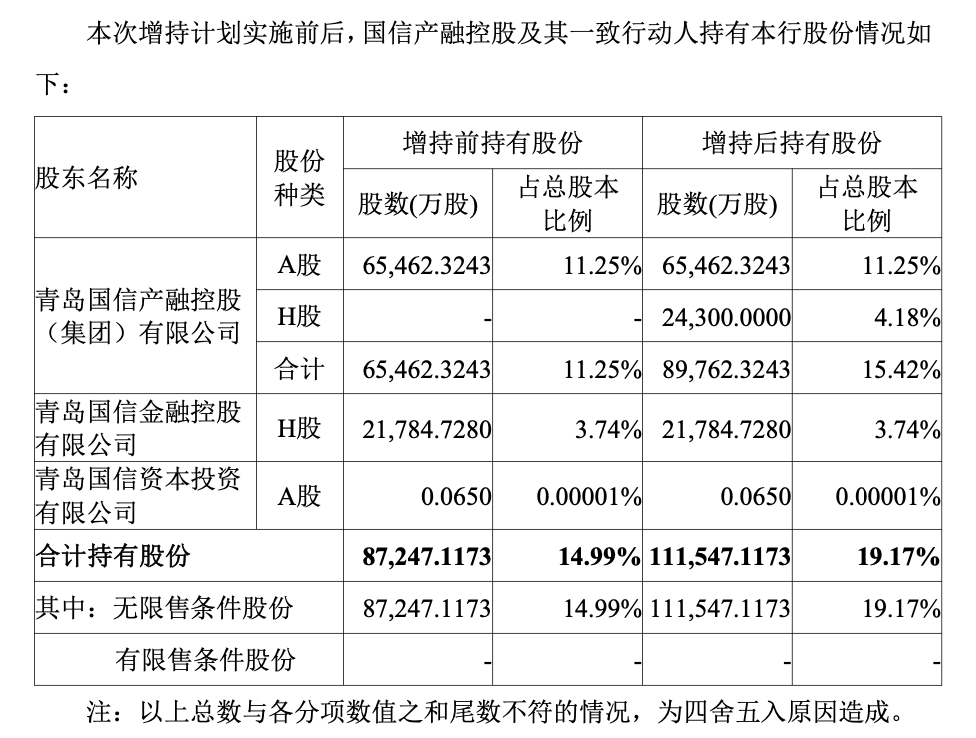
Core Viewpoint - Local state-owned enterprises are significantly increasing their stakes in listed banks, indicating a strategic move to enhance control over regional financial resources and support local economic development [2][8]. Group 1: Shareholding Changes - Qingdao Bank announced that its largest shareholder, Guoxin Industrial Investment Holding Group Co., Ltd., has increased its stake to 19.17%, surpassing previous major shareholders [2][3]. - The shareholding increase was executed through a rapid four-round acquisition, raising the stake from 11.26% to 15.42% within two months, demonstrating a strategic approach to financial resource allocation [3]. Group 2: Financial Performance - Qingdao Bank reported a net profit of 3.992 billion yuan for the first three quarters of 2025, a year-on-year increase of 15.54%, with total revenue reaching 11.013 billion yuan, up 5.03% [4]. - The bank's total assets grew to 765.571 billion yuan, reflecting a 10.96% increase from the previous year, while the non-performing loan ratio improved to 1.10% [4]. Group 3: Challenges and Market Conditions - Despite strong performance, Qingdao Bank faces challenges, including a slight decline in third-quarter revenue and a 10.72% drop in non-interest income [5]. - The bank's capital adequacy ratios have decreased, with the core tier one capital ratio at 8.75%, down 0.36 percentage points from the previous year [5]. Group 4: Broader Market Trends - Several banks, particularly city commercial banks, have seen significant shareholding increases from major stakeholders, indicating a trend of confidence in the banking sector [6][7]. - The overall performance of listed banks has been positive, with over 60% reporting year-on-year revenue growth, contributing to a favorable environment for shareholding increases [7].

青岛银行股权结构重塑 国信系成第一大股东
Jing Ji Guan Cha Wang· 2025-11-09 06:38
Core Viewpoint - The recent shareholding increase by Qingdao Bank's major shareholder, Guoxin Chanin Holdings, marks a significant shift in the bank's equity structure and reflects a broader trend of capital reallocation within the banking sector in 2025 [1][6]. Group 1: Shareholding Increase Details - Guoxin Chanin Holdings and its concerted actions have raised their combined shareholding in Qingdao Bank to 19.17% within a few months, showcasing a well-structured and strategic approach to capital investment [1][4]. - The shareholding increase was executed through a series of transactions from September 15 to November 5, with the shareholding rising from 11.26% to 15.42% during this period [2][3]. - The increase was completed without triggering a mandatory tender offer and did not alter the bank's governance status, which maintains no controlling shareholder [1][2]. Group 2: Financial Performance and Shareholder Confidence - Qingdao Bank's third-quarter report for 2025 indicated a total asset growth of 10.96% year-on-year, with a net profit increase of 15.54% for the first three quarters [4]. - The bank's non-performing loan ratio decreased to 1.10%, and the provision coverage ratio improved to 269.97%, providing a solid foundation for the shareholder's confidence in the bank's long-term value [4][9]. - The commitment from Guoxin Chanin Holdings to hold the shares for at least five years reflects a long-term investment perspective rather than a short-term financial strategy [4]. Group 3: Broader Industry Trends - The shareholding increase at Qingdao Bank is part of a larger trend in the banking sector, where several banks have seen significant capital inflows from major shareholders throughout 2025 [6][8]. - Regional banks, particularly in economically vibrant areas, have experienced notable increases in shareholding, indicating strong local capital support for financial institutions [6][8]. - The current environment of improved bank profitability expectations and a stabilizing macroeconomic backdrop has led to a redefinition of bank stocks as core assets with safety margins and dividend appeal [8][9].
年内11家银行股东宣布增持
2 1 Shi Ji Jing Ji Bao Dao· 2025-09-30 11:27
Core Viewpoint - Nanjing Bank has seen significant shareholding increases from major stakeholders, indicating strong confidence in the bank's long-term value and stability in dividend payouts [2][4][11] Group 1: Shareholding Increases - BNP Paribas increased its stake in Nanjing Bank by acquiring 108 million shares, raising its total holding from 16.14% to 17.02% [2] - Zijin Group's subsidiary, Zijin Trust, raised its stake in Nanjing Bank from 12.56% to 13.02% by purchasing 56.78 million shares [4][5] - Another major shareholder, Nanjing Gaoke, increased its holding from 8.94% to 9.00% by acquiring 7.51 million shares [5] Group 2: Broader Market Trends - A total of 11 A-share listed banks have seen shareholding increases from shareholders or executives this year, reflecting a trend of confidence in bank valuations at historical lows [7] - The banking sector has been characterized by high dividend yields and low valuations, making it an attractive option for long-term investments [11] Group 3: Dividend Announcements - 17 A-share listed banks have announced mid-term dividend plans for 2025, with state-owned banks contributing over 200 billion yuan in dividends [9] - Industrial and Commercial Bank of China plans to distribute approximately 50.40 billion yuan in cash dividends, maintaining a payout ratio above 30% [10] - Other major banks, including China Construction Bank and Agricultural Bank of China, have also announced significant dividend payouts, reinforcing the sector's appeal to investors [10]
工商银行股价盘中一度跌逾2%,跌破半年线
Xin Lang Cai Jing· 2025-09-19 04:04
Group 1 - The banking sector in A-shares has recently experienced a pullback after a strong rally, with the banking index dropping nearly 1% before rebounding to close up 0.28% at midday on September 19 [1] - Individual stocks such as Chongqing Rural Commercial Bank and Agricultural Bank saw declines of over 1%, while Industrial and Commercial Bank dropped nearly 1%, marking its first drop below the six-month moving average in a year [1] - Since July 11, the banking sector has shown a downward trend, with Agricultural Bank's stock price falling from a historical high of 7.55 yuan to around 6.7 yuan [1] Group 2 - The concentrated dividend distribution period in July has led to short-term pressure on stock prices due to arbitrage funds exiting after dividends [1] - Credit demand has been weak, with social financing and credit data for July and August falling below expectations, indicating insufficient expansion momentum for banks' asset sides [1] - The Federal Reserve announced a 25 basis point rate cut on September 18, raising expectations for potential further rate cuts in China, which may pressure banks' future interest margins [1] Group 3 - Several bank shareholders and executives have announced plans to increase their holdings in their respective banks, citing recognition of the long-term investment value and support for the banks' development [1] - The increase in holdings has positively impacted stock prices, with Qilu Bank, which recently completed executive buybacks, leading the gains with an increase of over 2.5% [2]