
银行业转型

Search documents
11家上市银行2025年业绩报告:变革中的机遇与2026年展望
Sou Hu Cai Jing· 2026-02-12 10:30
Core Viewpoint - The banking industry is undergoing an unprecedented transformation cycle in 2025, driven by macroeconomic stability, interest rate declines, regulatory upgrades, digital iteration, and a consensus on "anti-involution," pushing listed banks to accelerate their shift from "scale expansion" to "value prioritization" [2][10]. Performance Overview - As of February 10, 2026, 11 out of 42 listed banks in A-shares have reported their 2025 performance, all achieving year-on-year growth in net profit attributable to shareholders, reflecting "stable volume, quality improvement, and structural enhancement" [2][13]. - Among these banks, 10 achieved both revenue and net profit growth, with only CITIC Bank experiencing a slight revenue decline of 0.55%, breaking the market's pessimistic expectations regarding industry profitability [14]. Institutional Performance - City commercial banks showed remarkable performance, with Qingdao Bank's net profit increasing by 21.66%, leading the group; Qilu Bank and Hangzhou Bank also exceeded 10% growth, at 14.58% and 12.05% respectively [3][14]. - In the joint-stock bank category, Shanghai Pudong Development Bank achieved a net profit growth rate of 10.52%, the only institution in this category to reach double-digit growth; other banks like China Merchants Bank, CITIC Bank, and Industrial Bank had relatively modest growth rates of 1.21%, 2.98%, and 0.34% respectively [3][14]. Asset Quality and Risk Management - The 11 banks have increased their risk management efforts, with core asset quality indicators showing improvement; 6 banks reported a decrease in non-performing loan (NPL) ratios compared to the previous year [3][15]. - Qingdao Bank saw the most significant decline in NPL ratio, down 17 basis points to 0.97%; Qilu Bank and Shanghai Pudong Development Bank also saw declines of 14 and 10 basis points, respectively [4][15]. - Despite 8 banks experiencing a decline in provision coverage ratios, the overall level remains high, indicating solid risk resistance capabilities; Qingdao Bank and Qilu Bank saw increases in their coverage ratios [4][15]. Industry Transformation - The banking industry is accelerating its transformation, moving beyond scale expansion to seek balance among efficiency, safety, and value, driven by various policies and practices [6][17]. - Regulatory bodies have encouraged financial institutions to support key sectors of the real economy, with structural monetary policy tools effectively implemented [6][17]. - The introduction of consumer loan interest subsidies aims to stimulate domestic demand, with banks lowering consumer loan rates significantly [7][18]. Future Trends - The banking industry is expected to maintain a stable asset quality in 2026, with NPL ratios remaining steady and risk resistance capabilities strong [10][21]. - The differentiation among institutions will become more pronounced, with large state-owned banks and quality joint-stock banks maintaining low NPL ratios, while some smaller banks may face pressure [11][21]. - Investment logic will focus on "high dividend, defensive" and "high quality, growth" dual lines, with high-dividend banks likely to attract continued investment [12][22].

营收滑坡、不良率高企,青农商行47岁“新帅”如何应对挑战
Nan Fang Du Shi Bao· 2026-01-19 13:04
Core Viewpoint - Qingdao Rural Commercial Bank is set to appoint Liang Yanbo, aged 47, as its executive director candidate, potentially making him the youngest chairman among A-share listed banks if approved [2][5]. Group 1: Leadership Transition - Liang Yanbo has extensive experience in the Shandong rural credit system, having held various leadership positions in multiple rural commercial banks before becoming the party secretary of Qingdao Rural Commercial Bank in December 2025 [3][5]. - The previous chairman, Wang Xifeng, retired due to age, and Liang's appointment comes at a time when the bank faces significant challenges in performance and compliance [5][6]. Group 2: Financial Performance - Qingdao Rural Commercial Bank's revenue has been declining, with a reported operating income of 8.028 billion yuan in the first three quarters of 2025, a decrease of 4.92% year-on-year, and a trend of quarterly worsening [6][7]. - The bank's net profit for the same period was 3.318 billion yuan, showing a growth of 3.57%, but the growth rate has been slowing down compared to earlier quarters [6]. Group 3: Asset Quality - The bank has the highest non-performing loan (NPL) ratio among A-share rural commercial banks at 1.73%, despite a decrease from 1.79% at the end of 2024 [8][9]. - The NPL generation rate has remained above 2% for four consecutive years, indicating ongoing risk management challenges [8]. Group 4: Compliance Issues - Qingdao Rural Commercial Bank has faced multiple regulatory penalties in 2025 for various violations, highlighting significant compliance shortcomings that need to be addressed under Liang Yanbo's leadership [10]. - Experts emphasize the necessity for the bank to strengthen its compliance framework to mitigate risks and ensure sustainable growth [10]. Group 5: Strategic Focus - The bank plans to enhance its focus on agricultural and small micro-loans, aligning with its strategic positioning to support rural development and small enterprises [11][12]. - There is an emphasis on promoting inclusive finance and green finance to support economic restructuring and high-quality development [12].


超过9000家网点停止营业,工行、建行也赫然在列,这是啥情况?
Sou Hu Cai Jing· 2026-01-10 17:10
Core Viewpoint - The closure of over 9,000 bank branches in China by the end of 2025 signifies a major transformation in the banking industry, driven by technological advancements and changing consumer behavior, ultimately aimed at providing better services to the public [1][3]. Group 1: Reasons for Bank Branch Closures - The majority of banking services can now be conducted through mobile apps, reducing the necessity for physical branches [5]. - Reducing the number of branches helps lower operational costs, as maintaining numerous locations incurs significant expenses such as rent, salaries, and utilities [6][8]. - The reduction in branch numbers is part of a strategic reallocation, focusing on optimizing branch locations by closing less profitable branches while opening new ones in densely populated areas [9][11]. Group 2: Impact on Services - Banks are implementing measures to ensure that elderly and rural residents continue to receive adequate financial services, such as maintaining service windows at remaining branches and simplifying mobile banking operations [11][13]. - Initiatives like mobile service vehicles are being introduced to assist rural communities with banking needs, including pension distribution [13].

陕国投拟8亿“入局”长安银行增资 区域银行资本补充潮起
Jing Ji Guan Cha Wang· 2026-01-08 03:18
Group 1: Core Insights - Shaanxi International Trust Co., Ltd. (Shaanxi Guotou) plans to invest up to 800 million yuan in Chang'an Bank's capital increase, acquiring no more than 209 million shares at a price of 3.83 yuan per share, which will be used to supplement core Tier 1 capital [1] - The capital increase is part of a broader trend where regional banks are receiving shareholder support to strengthen their capital bases amid intensified regulatory constraints and competitive pressures [1][7] - The investment by Shaanxi Guotou reflects a strategic shift from being a provider of financial products to becoming a long-term shareholder in core financial institutions, aiming to stabilize income and enhance influence within the regional financial system [2][3] Group 2: Financial Performance and Challenges - Chang'an Bank faces significant capital pressure, with its core Tier 1 capital adequacy ratio declining from 9.15% at the end of 2024 to 8.23% by September 2025, indicating a growing tension between asset expansion and capital replenishment [4] - The bank's revenue and net profit have shown a downward trend, with revenue decreasing from 9.779 billion yuan in 2023 to 9.461 billion yuan in 2024, and net profit dropping from 2.445 billion yuan in 2023 to 2.315 billion yuan in 2024 [4] - The bank's provision coverage ratio has decreased from 191.15% at the end of 2023 to 151.77% by September 2025, although it remains above regulatory requirements, indicating a buffer against potential asset quality fluctuations [5] Group 3: Strategic Implications - The pricing strategy for the capital increase reflects a discount to the book value, indicating a cautious market valuation of regional bank equities in the current economic environment [6] - The collective action of the Shaanxi state-owned enterprises in this capital increase is not merely a financial investment but a strategic move by the local government to maintain regional financial stability and enhance collaboration between finance and industry [6] - The ongoing capital increase trend among regional banks signifies a shift from "blood transfusion" to "blood production," highlighting the need for banks to convert capital advantages into sustainable competitive strengths amid structural changes in the banking environment [8]

近半高风险机构“出清”!专家解读《中国金融稳定报告(2025)》:银行业改革化险成效超预期
Jin Rong Jie· 2026-01-05 09:46
Core Insights - The People's Bank of China released the "China Financial Stability Report (2025)", highlighting the overall stability of the financial sector and the controllable nature of financial risks [1] Group 1: Financial Stability Overview - The report indicates that China's financial sector is operating steadily, with financial risks generally receding and remaining manageable [1] - The central bank's rating system categorizes banks into 11 tiers, with the majority of national and foreign banks performing well and falling into the "green zone" [2] - 68% of city commercial banks are in the green zone, indicating better health compared to rural commercial banks and village banks, which face higher risks concentrated in specific regions [2] Group 2: Risk Concentration and Trends - Rural small financial institutions represent a significant risk concentration, accounting for 96% of high-risk institutions, although the number of high-risk institutions has decreased from approximately 600 in 2020 to over 310 in 2025 [3] - The risk landscape is showing three main trends: convergence of risks, quality improvement, and accelerated digital transformation [4] - The distribution of risks is shifting from widespread to localized, with an increase in provinces having no red zone banks [4] Group 3: Regulatory and Policy Measures - The report emphasizes the importance of coordinated regulatory and policy efforts to maintain financial stability, including two reductions in the reserve requirement ratio and policy interest rates [5] - The approach to risk management is evolving from individual institution strategies to province-wide coordinated strategies for small financial institutions [5] - The new capital management framework categorizes banks based on size and complexity, allowing for more flexible policies for smaller banks [5]
年轻人青睐“新三金”
Sou Hu Cai Jing· 2025-11-24 23:16
Core Insights - The article discusses the shift in asset allocation strategies among young investors in response to declining deposit interest rates, moving from traditional gold jewelry to more diversified financial products like money market funds, bond funds, and gold funds [1][4]. Group 1: Changes in Deposit Products - Several small and medium-sized banks are adjusting their deposit product structures, moving away from long-term high-interest deposits, as evidenced by a village bank's cancellation of a 5-year fixed deposit product [2]. - The People's Bank of China reported an increase of 23.32 trillion yuan in RMB deposits over the first ten months of 2025, with household deposits rising by 11.39 trillion yuan [2]. - There is a notable shift in household savings towards other asset classes, indicating a reallocation of assets by residents [2][3]. Group 2: Young Investors' Preferences - Young investors are increasingly favoring a "new three golds" investment strategy, which includes money market funds, bond funds, and gold funds, as a more stable approach to wealth management [4][6]. - A 95-born fund industry worker shared their investment strategy, dividing funds into three categories: liquid, stable, and long-term, reflecting a growing awareness of personal risk tolerance [4][6]. - The popularity of the "new three golds" is seen as a defensive evolution in financial management, focusing on stable returns rather than high-risk investments [4][6]. Group 3: Asset Management Market Growth - China's total asset management scale has surpassed 170 trillion yuan, making it the second-largest wealth management market globally [3]. - The trend of reallocating funds from bank deposits to capital markets is contributing to the growth of non-bank financial institutions [4]. Group 4: Banking Industry Transformation - The banking sector is undergoing a transformation from scale-driven strategies to optimizing structures and focusing on comprehensive service competition due to sustained pressure on net interest margins [7][8]. - Banks are shifting towards wealth management and investment banking services, aiming to provide comprehensive financial solutions to retain customers and stabilize funding [7][8]. - Community banks are actively engaging in financial education initiatives, such as financial literacy classes and resources for different demographics, to adapt to changing financial needs [8].

银行ETF易方达(516310)震荡走强涨超1%,银行三季度净利改善延续,板块基本面呈现边际企稳态势
Sou Hu Cai Jing· 2025-11-19 03:16
Core Viewpoint - The banking sector is experiencing a positive trend, supported by a moderately loose monetary policy and ongoing reforms, which are expected to enhance banks' operational stability and their ability to support high-quality economic development [1]. Group 1: Market Performance - As of November 19, 2025, the CSI Bank Index (399986) rose by 1.14%, while the E Fund Bank ETF (516310) increased by 1.24%, with a transaction volume of 52.8 million yuan [1]. - Over the past three months, the E Fund Bank ETF (516310) has seen an increase in scale by 808 million yuan [1]. Group 2: Policy and Economic Context - The central bank emphasizes a scientific approach to financial total indicators and maintaining a reasonable interest rate relationship, which is beneficial for banks' stable operations and their alignment with economic development [1]. - The introduction of the 14th Five-Year Plan is driving transformation in the banking sector, with improvements in net profits observed in the third quarter [1]. Group 3: Investment Outlook - According to Shenwan Hongyuan Research, the banking sector is at the beginning of a long-term recovery, with the overall price-to-book (PB) ratio around 0.7 times, indicating a solid foundation for valuation uplift [1]. - The current low interest rate environment is encouraging long-term capital, such as insurance funds, to increase allocations to high-dividend assets, making bank stocks attractive [1]. - Public fund holdings have dropped to the lowest level in nearly a decade, suggesting significant room for recovery [1]. - Looking ahead to 2026, the central bank aims to support banks in stabilizing net interest margins, which could lead to positive growth in net interest income, especially for banks with ample provisions and strong internal capital capabilities [1].

重要信号,农业银行、工商银行齐创历史新高!双百亿银行ETF(512800)稳步三连阳,近5日超7亿资金抢跑
Xin Lang Ji Jin· 2025-11-12 06:02
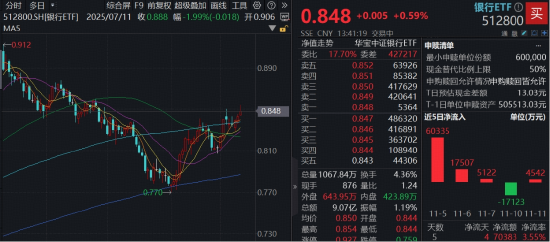
Core Viewpoint - The banking sector continues to show strong performance, with Agricultural Bank and Industrial and Commercial Bank reaching historical highs, indicating robust market interest in bank ETFs [1][3]. Group 1: Market Performance - Agricultural Bank's stock rose over 3%, while Industrial and Commercial Bank's stock increased nearly 2%, both hitting record highs [1]. - The bank ETF (512800) saw a price increase of over 1% at one point, currently up 0.59%, marking three consecutive days of gains [1]. - The bank ETF has accumulated a net inflow of over 700 million yuan in the past five days, reflecting increased investor interest [3]. Group 2: Investment Appeal - The banking sector is expected to attract more market attention due to its stable and high dividend characteristics, supported by long-term capital from insurance funds, state-owned enterprises, and public funds [3]. - The bank ETF (512800) tracks the CSI Bank Index, which has a price-to-book ratio (PB) of only 0.72, placing it in the lower range of the past decade [3]. - The dividend yield of the index stands at 4.02%, exceeding the 10-year government bond yield by 2.22 percentage points, highlighting its "quasi-fixed income" appeal [3]. Group 3: Fund Characteristics - The bank ETF (512800) has a scale exceeding 20.6 billion yuan and an average daily trading volume of over 800 million yuan, making it the largest and most liquid bank ETF in A-shares [4]. - The ETF passively tracks the CSI Bank Index, which includes 42 listed banks in A-shares, serving as an efficient investment tool for the banking sector [4].


光大银行控股股东再增持 信心传递还是市场博弈?
Jing Ji Guan Cha Wang· 2025-09-12 04:18
Core Viewpoint - The recent shareholding increase by China Everbright Group in Everbright Bank reflects a potential recovery in market confidence towards the banking sector, despite the bank's stock price showing a slight decline [1][2]. Group 1: Shareholder Actions - Everbright Group has increased its stake in Everbright Bank by acquiring 13,970,000 A-shares, amounting to approximately 51.66 million yuan, which represents 0.02% of the total share capital [1][3]. - The ongoing shareholding increase is part of a broader trend in the banking industry, with several banks, including Postal Savings Bank and Huaxia Bank, also announcing similar plans [2][8]. - Everbright Group's total investment in Everbright Bank has exceeded 400 million yuan over multiple rounds of share purchases, raising its ownership from 47.19% to 47.42% [1][3]. Group 2: Market Performance and Valuation - As of September 12, Everbright Bank's stock price was 3.69 yuan, down 0.27%, with a price-to-earnings ratio of approximately 5.2 and a price-to-book ratio of about 0.45, indicating a cautious market sentiment towards bank valuations [1][4]. - The bank's revenue for the first half of 2025 was 65.9 billion yuan, a year-on-year decrease of 5.57%, while net profit increased slightly by 0.55% to 24.6 billion yuan [5]. Group 3: Strategic Intent and Market Signals - The shareholding increase by Everbright Group is not merely a financial investment but also reflects strategic intentions to strengthen its control and support for Everbright Bank amid a complex macroeconomic environment [6][10]. - The actions of significant shareholders like Citic Financial Asset Management indicate a recognition of Everbright Bank's investment value, despite its low price-to-book ratio [7][10]. - The trend of shareholder increases across various banks signals a collective confidence in the banking sector, which may help stabilize market sentiment during periods of volatility [9][10].
