5G专网

Search documents
亚信科技预计全年利润优于上年 AI大模型应用与交付爆发式增长
Zheng Quan Shi Bao Wang· 2025-08-05 04:48
Core Viewpoint - The company reported a decline in overall revenue due to cost-cutting pressures in the telecommunications industry, but experienced explosive growth in AI model applications and delivery, as well as continued development in 5G private networks and applications [1][2]. Group 1: Financial Performance - The company's revenue for the first half of the year was approximately RMB 2.598 billion, a year-on-year decrease of 13.2% [1]. - Gross profit was about RMB 783 million, representing a year-on-year increase of 6.1%, with a gross margin of 30.1%, up 5.4 percentage points year-on-year [1]. - The company achieved a 35.3% improvement in operating cash flow year-on-year, with a net loss of approximately RMB 48 million after excluding one-time severance costs [1]. Group 2: AI Model Applications - In the first half of 2025, the company signed contracts worth approximately RMB 70 million for AI model applications, a year-on-year increase of 78 times, with revenue from this segment reaching about RMB 26 million, up 76 times year-on-year [2]. - The company has partnered with major firms like Alibaba Cloud and NVIDIA to develop end-to-end solutions for various industries, establishing itself as a key player in the AI model application market [2]. Group 3: 5G Private Networks - The company’s 5G private network and application business signed contracts worth approximately RMB 82 million in the first half of 2025, a year-on-year increase of 51.7% [2]. - Revenue from the 5G private network segment was approximately RMB 47 million, reflecting a year-on-year decline of 26.3% due to delays in nuclear power orders and revenue recognition [2]. Group 4: Nuclear Power Sector - The company has expanded its presence in the nuclear power sector, signing a contract for a 5G private network project at the Hainan Changjiang Nuclear Power Plant, covering 29 units across 7 nuclear power bases nationwide [3]. - The nuclear power sector is expected to continue growing, with over RMB 200 billion in new investments approved in the first half of 2025 [3]. Group 5: Non-telecom Sector Orders - Overall orders in non-telecom sectors increased by 18.2% year-on-year, with significant growth in the financial sector (48.3%), automotive sector (5.3%), and consumer sector (4.4%) [3]. Group 6: Strategic Focus and Future Outlook - The company plans to maintain a steady growth strategy, focusing on AI model applications, 5G private networks, and smart operations as key growth engines while accelerating order conversion [5]. - The company expects significant performance improvement in the second half of the year compared to the first half [5].
亚信科技上半年营收25.98亿元 同比下降13.2% AI大模型业务增长76倍 毛利率30.1%
Sou Hu Cai Jing· 2025-08-05 03:11
Core Insights - Company experienced a 13.2% decline in revenue for the first half of 2025, totaling approximately RMB 25.98 billion, primarily due to a drop in traditional ICT support business [1] - Emerging business sectors showed significant growth, particularly in AI large model applications, which saw a revenue increase of 76 times year-on-year, reaching approximately RMB 0.26 billion [3] Revenue Breakdown - ICT support business revenue was approximately RMB 21.18 billion, down 14.7% year-on-year [1] - Smart operation business revenue was approximately RMB 4.08 billion, down 8.8% year-on-year [1] - Despite a 26.3% decline in revenue from 5G private networks and applications to RMB 0.47 billion, order amounts increased by 51.7% to approximately RMB 0.82 billion [3] Cost Management and Profitability - Company implemented effective cost control measures, resulting in a gross profit of approximately RMB 7.83 billion, a 6.1% increase year-on-year, with a gross margin of 30.1%, up 5.4 percentage points [4] - Operating cash flow improved with a net outflow reduction of 35.3% year-on-year [4] Net Loss and Future Outlook - The net loss for the reporting period was approximately RMB 2.02 billion, but adjusted for one-time severance costs, the loss narrowed to about RMB 0.48 billion, an improvement from RMB 0.7 billion in the previous year [5] - Management expressed cautious optimism for the second half of the year, anticipating a significant performance improvement [8] Business Transformation Challenges - Traditional ICT support business faces ongoing transformation pressures, with revenue under strain due to cost-cutting measures from telecom clients [7] - Company is focusing on three growth engines: AI large model applications, 5G private networks, and smart operations, while also solidifying its foundation in the telecom sector [7] Shareholder Returns - The board proposed a dividend policy indicating a payout of 40% of annual net profit for the 2025 fiscal year, reflecting confidence in future profitability [8] - Financial data shows a total revenue of RMB 66.46 billion for 2024, a decrease from RMB 78.91 billion in 2023, with a return on equity of 8.20% [8]


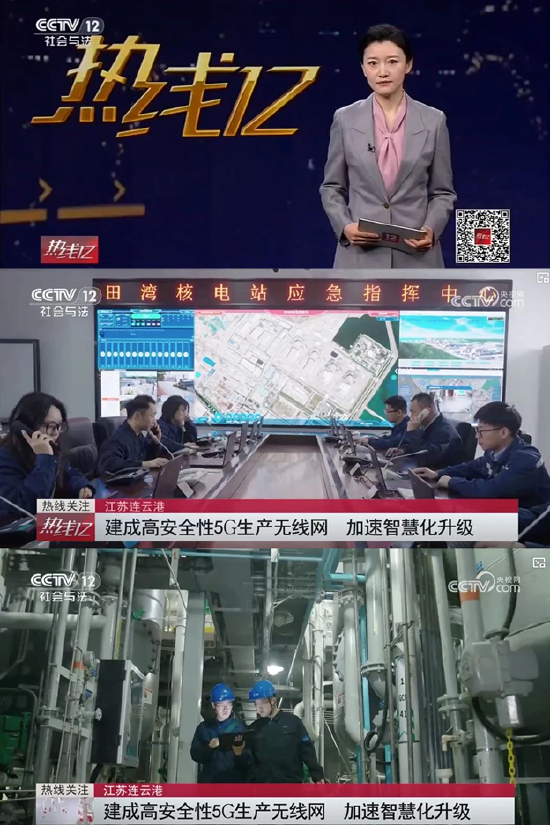
给力!中央电视台报道江苏田湾核电5G专网,科技鼎力建设
Xin Lang Zheng Quan· 2025-07-23 07:59
Core Insights - The Tianwan Nuclear Power Plant's 5G production wireless network project is a significant initiative in response to China's strategy for large-scale 5G application [1][3] - The project is a collaboration between China Mobile, China National Nuclear Engineering, and AsiaInfo Technology, marking another "billion-level" project in the energy sector [1][4] - The 5G network enhances operational efficiency and safety at the nuclear power plant, contributing to energy security and the achievement of carbon neutrality goals [3][4] Group 1: Project Overview - The Tianwan Nuclear Power Plant is the largest nuclear power station in terms of total installed capacity globally, both operational and under construction [3] - The 5G production wireless network supports various applications, including digital overhaul management, smart operation platforms, and comprehensive safety monitoring [4][5] - AsiaInfo Technology has developed customized base stations to meet the stringent requirements of the nuclear energy sector, ensuring high performance and reliability [4][5] Group 2: Technological Applications - The 5G network facilitates mobile communication, data transmission, personnel positioning, and IoT integration across the production and office areas of the plant [5] - The implementation of 5G technology enables unmanned operations, intelligent inspections, and smart warehousing, enhancing overall operational efficiency [4][5] - AsiaInfo's 5G solutions incorporate AI, big data, and edge computing, aligning with national standards and widely applied across various energy sectors [5][7] Group 3: Company Profile - AsiaInfo Technology, listed on the Hong Kong Stock Exchange, is a leading provider of software and hardware products, solutions, and services [8][9] - The company focuses on digital transformation across multiple industries, including energy, leveraging advanced technologies like 5G, cloud computing, and AI [9] - AsiaInfo aims to deepen partnerships and drive cost reduction and efficiency improvements through its 5G private network solutions [7][9]
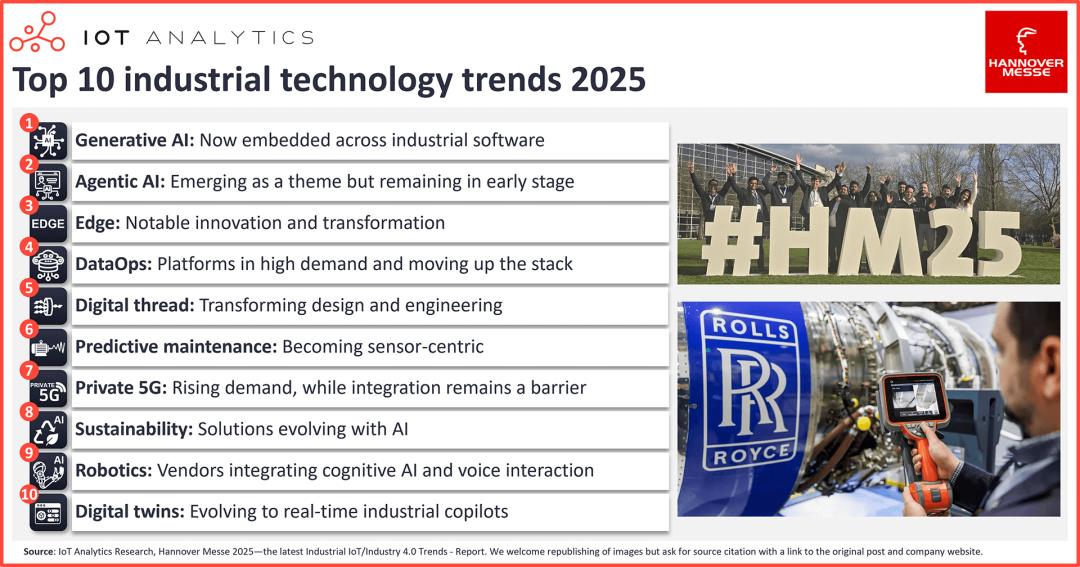
2025汉诺威十大工业物联技术风向:生成式AI全面融入,代理型AI初露头角
3 6 Ke· 2025-06-06 11:49
Core Insights - The 2025 Hannover Messe showcased the ongoing transformation in the industrial sector driven by artificial intelligence, particularly generative AI, although no groundbreaking technologies were introduced [1] - The report by IoT Analytics highlighted that generative AI has become an integral part of industrial software, moving beyond being a buzzword to a common feature in major industrial software products [3][4] - Agentic AI is emerging as the next significant trend in the industry, although it remains in its early stages of development [7][9] Trend Summaries Trend 1: Generative AI Fully Integrated into Industrial Software - Generative AI has transitioned from a focus on coding to being embedded across industrial software, with major software vendors showcasing integrated functionalities [3] - Leading companies like Siemens and ABB have developed various industrial assistants that leverage generative AI for tasks such as design, planning, and operational support [4][6] Trend 2: Emergence of Agentic AI - Agentic AI is viewed as a significant future opportunity, with many vendors promoting its capabilities, although practical applications are still limited [7][9] - Companies are exploring multi-agent frameworks, but these remain in early exploratory phases without substantial real-world validation [8] Trend 3: Significant Innovations in Edge Computing - Edge computing is evolving to integrate AI technology stacks, enhancing local processing capabilities and responsiveness [10] - Companies like Bosch Rexroth are demonstrating platforms that support AI model deployment at the edge, optimizing for specific industrial scenarios [10][11] Trend 4: Growing Demand for DataOps Platforms - DataOps is becoming essential for managing the increasing volume of data in industrial settings, with platforms expanding their capabilities to support AI lifecycle management [13][14] - Companies are focusing on data governance to ensure compliance with regulations like GDPR, enhancing data observability and tracking [14] Trend 5: AI-Driven Digital Threads Transforming Design and Engineering - Digital threads are reshaping engineering processes by ensuring data continuity throughout the product lifecycle, as demonstrated by Siemens' new solutions [17] - Autodesk's Project Bernini showcases how generative AI can enhance early design processes, promoting a multi-modal design approach [17] Trend 6: Sensorization of Predictive Maintenance - Predictive maintenance solutions are increasingly integrating custom hardware with analytics models, focusing on sensor quality and system compatibility [18][19] - New solutions are extending predictive maintenance capabilities to previously overlooked asset categories, enhancing monitoring and fault detection [18] Trend 7: Rising Demand for Private 5G Networks - The demand for private 5G networks is growing, particularly in the US and Asia, but integration with existing infrastructure remains a significant challenge [21][22] - Companies are developing solutions that combine generative AI, edge computing, and private 5G for real-time industrial safety and asset monitoring [22] Trend 8: Sustainable Solutions Enhanced by AI - AI is improving carbon emissions tracking and compliance efficiency, with various applications being upgraded to enhance data visibility and accuracy [23] - Collaborative efforts, such as those between Microsoft and Accenture, are optimizing compliance processes through AI integration [23] Trend 9: Cognitive Capabilities Empowering Robotics - Robotics manufacturers are incorporating cognitive AI and voice interaction features, allowing users to control robots through voice commands [24] - This trend aims to enhance flexibility and reduce the need for specialized skills in manufacturing and logistics [24] Trend 10: Digital Twins Evolving into Real-Time Industrial Co-Pilots - Digital twins are transitioning from static models to dynamic tools that assist in operations, training, and quality control [25] - Companies like EDAG Engineering and Siemens are showcasing how AI-driven digital twins can optimize processes and enhance training efficiency [25]