MaaS模式

Search documents
押注智能化的确定性,火山引擎做对了什么?
远川研究所· 2025-12-19 11:03
Core Insights - The article discusses the evolution of AI from a centralized, isolated system, as depicted in Stanley Kubrick's "2001: A Space Odyssey," to a more integrated and collaborative role in various industries, emphasizing AI as an "intelligent external brain" rather than a controlling entity [2] - The rapid adoption of AI technologies, particularly large models, is reshaping industry standards and operational frameworks, with a significant increase in token usage reflecting the growing demand for AI services [2][3] Industry Trends - In the first half of this year, the total number of tokens called in China's public cloud services for large models reached 536.7 trillion, with Volcano Engine holding over 49% market share [2] - The shift towards AI cloud-native architecture is highlighted, where models become the core of software, and the use of tokens represents a new metric for measuring AI service consumption [3][5] Investment Landscape - Major tech companies are significantly increasing their capital expenditures on AI, with Google raising its guidance by $8 billion and Meta by $4 billion, leading to an overall industry spending exceeding $200 billion [7][9] - Concerns are raised about the sustainability of this investment, questioning the actual demand and business value generated from such capital expenditures [7][9] Business Model Transformation - The transition from selling computing power (IaaS) to selling tokens (MaaS) represents a fundamental shift in cloud service providers' business models, focusing on delivering productivity rather than just resources [13][14] - The MaaS model allows for direct access to model capabilities, reducing the need for extensive infrastructure development and maintenance, thus enhancing efficiency and scalability [14][15] Application Across Industries - The adoption of AI models, particularly the Doubao model from Volcano Engine, has been significant in the automotive industry, with 90% of major car manufacturers integrating this technology [18] - Various sectors, including automotive, electronics, and food service, are leveraging AI to enhance user experiences and operational efficiencies, demonstrating the versatility and applicability of AI technologies [21][22] Future Outlook - The article emphasizes that the demand for AI capabilities is expected to grow, with token consumption serving as a key indicator of industry health and AI integration [24] - As industries continue to embrace AI, the focus will shift towards achieving measurable outcomes and optimizing investment returns through the effective use of tokens [23][24]


狂飙的算力基建,如何实现「价值闭环」?丨GAIR 2025
雷峰网· 2025-12-18 10:10
Core Viewpoint - The key to achieving a commercial closed loop in the computing power industry is to provide "convenient, easy to use, and inexpensive" computing power [3][12]. Group 1: Current State of Computing Power Infrastructure - The average utilization rate of computing power in intelligent computing centers is below 40%, indicating a significant issue with computing power consumption [4]. - The demand for reasoning has shifted as large model training has declined, leading to fragmented reasoning scenarios that need to be addressed [4][25]. - The industry is transitioning from a focus on construction to a focus on usability and cost-effectiveness, emphasizing the need for clear user scenarios before building [9][12]. Group 2: Commercial Closed Loop in Computing Power - The commercial closed loop is defined as the ability for AI solutions to be implemented in business scenarios and generate profit [12][14]. - Key conditions for achieving this closed loop include the ease of use and low cost of computing power, which allows creators and developers to fully leverage their capabilities [12][14]. - The MaaS (Model as a Service) model has emerged as a solution to enhance the usability and cost-effectiveness of computing power [12][18]. Group 3: Future Trends and Opportunities - The AI reasoning market is on the verge of a significant explosion, with predictions of a 10-fold growth in the coming year [5][25]. - The integration of multi-modal applications is expected to drive the next wave of growth in computing power demand, with advancements in image and video generation technologies [25][27]. - The widespread adoption of AI glasses and other hardware products could lead to a dramatic increase in token consumption, potentially reaching hundreds of billions [35][36]. Group 4: Key Milestones and Industry Developments - The rise of DeepSeek has reshaped public and industry perceptions of AI, highlighting the importance of AI infrastructure software [31][32]. - Domestic companies are making strides in the super-node architecture, which could lead to breakthroughs in computing power capabilities [33][34]. - The introduction of AI glasses is expected to accelerate data collection and model training processes, marking a significant milestone in the data dimension [34][35].
2025年中国人工智能代理行业商业模式分析 从“SaaS铁三角”到园区竞速的万亿赛道博弈【组图】
Qian Zhan Wang· 2025-09-16 04:13
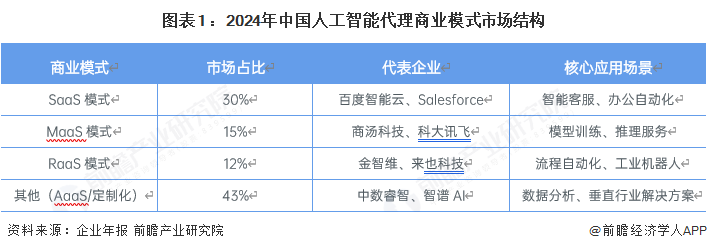
Core Viewpoint - The Chinese AI agent industry has established a "SaaS-MaaS-RaaS" tripartite business model, driven by technology, policy, and ecosystem factors, accelerating the commercialization of a trillion-level market through regional differentiated competition [1]. Business Model Summary - The AI agent industry in China can be categorized into three main models based on service form, deployment method, and application scenario: - **SaaS Model**: Dominates the market with a 30% share, driven by the demand for standardized intelligent tools. It operates on a subscription basis, focusing on efficiency improvement through basic subscription fees and value-added services [3][12]. - **MaaS Model**: Fastest growth at 15%, reflecting the acceleration of model-as-a-service commercialization. It relies on computational power and model innovation for customer acquisition, with significant cost advantages, such as SenseTime's model inference cost being 60% lower than the industry average [3][8]. - **RaaS Model**: Accounts for 12% of the market, focusing on human-machine collaborative automation in sectors like manufacturing and finance, with notable improvements in operational efficiency [3][8]. Market Dynamics - The AI agent industry is experiencing a competitive race among innovation parks, with Shanghai's Xuhui District housing over 1,000 companies and offering substantial computational subsidies. SenseTime's generative AI revenue reached 2.4 billion yuan in 2024, constituting 63.7% of its total revenue [4]. - The industry is supported by policy initiatives, such as the Ministry of Industry and Information Technology promoting "AI + manufacturing" actions and various cities providing computational vouchers and project subsidies to foster ecosystem development [7][8]. Financial Metrics - **SaaS Model**: Average gross margin of 60%-80%, customer retention rate of 75%-90%, and annual customer spending between 50,000 to 500,000 yuan [11][12]. - **MaaS Model**: Average gross margin of 40%-60%, customer retention rate of 60%-75%, and annual customer spending between 100,000 to 2 million yuan [11][12]. - **RaaS Model**: Average gross margin of 30%-50%, customer retention rate of 50%-65%, and annual customer spending between 200,000 to 1 million yuan [11][12].