Producer Price Index (PPI)

Search documents
European markets set to open in mixed territory; traders await ECB update
CNBC· 2025-09-11 05:10
Market Overview - European stocks are expected to open in mixed territory as investors await the European Central Bank's (ECB) rate decision and update [1] - The U.K.'s FTSE index is projected to open 0.13% higher, Germany's DAX 0.14% lower, France's CAC 40 flat, and Italy's FTSE MIB slightly lower [2] Economic Indicators - The ECB is not expected to change its key deposit facility rate, which remains at 2% [2] - Market participants are focused on the ECB's macroeconomic projections for the euro area and the global economy [2] - In the U.S., S&P 500 futures were flat as the market anticipates the August consumer price index (CPI) data [3] - Economists expect the CPI to rise by 0.3% month-over-month, leading to an annual gain of 2.9% [3] - The core CPI, excluding food and energy, is projected to increase by 0.3% from July and 3.1% year-over-year [3] - The producer price index (PPI) showed an unexpected decline of 0.1% month-over-month, with a 12-month increase of 2.6% [3] Regional Market Performance - Japan's Nikkei 225 index reached a record high, reflecting gains seen on Wall Street [4]
Bitcoin Taps $114,000 Following Producer Price Inflation Data: Can This Rally Continue?
Yahoo Finance· 2025-09-10 16:46
Core Insights - Bitcoin briefly reached $114,000 following cooler-than-expected PPI data, raising speculation about the sustainability of this rally [1] - Key support levels for Bitcoin are identified at $110,600, $107,500–$106,800, and $104,000–$100,000, while resistance levels are at $112,775, $113,700–$114,600, $116,000, and $118,300 [2] - The market is expected to trade between $106,800–$118,300 unless there are significant surprises from CPI or FOMC [2] - A broader market rally for altcoins is contingent on Bitcoin breaking the $120,000–$125,000 range and Ethereum surpassing its all-time high [3] - The recent PPI data showed a 0.1% month-over-month drop, contrasting with the expected growth of 0.3%, and an annual change of 2.6% year-over-year compared to a forecast of 3.3% [4] - Bitcoin liquidations in the past 24 hours amounted to $37.95 million, with short liquidations at $34.96 million due to traders closing short positions amid the price spike [5]
Action Plan for Prudent Investors After Eye Popping Oracle AI Numbers and PPI Shocker - Oracle (NYSE:ORCL)
Benzinga· 2025-09-10 16:13
Core Insights - Oracle's stock is experiencing a significant premarket increase of over 30% following earnings reports, which is unusual for a large company [8] - The company has made ambitious projections for its cloud infrastructure revenue, expecting it to rise from $10 billion last year to $18 billion this year, and reaching $144 billion by 2030 [8] - Oracle's remaining performance obligations have surged to $455 billion, marking a 359% year-over-year increase [8] - The company's MultiCloud revenue has skyrocketed by 1529% in Q1, indicating rapid growth expectations [8] Financial Performance - Oracle reported earnings that were lower than both consensus and whisper numbers, but the focus has shifted to its future projections [8] - The Producer Price Index (PPI) data showed a headline PPI of -0.1% against a consensus of 0.3%, which may influence future monetary policy [8] Market Context - Positive money flows were noted in major tech stocks such as Alphabet, NVIDIA, Microsoft, and Tesla, while Apple and Amazon saw negative flows [7] - The article highlights the importance of understanding money flows in ETFs like SPY and QQQ for investment strategies [8] Economic Indicators - The article discusses the implications of inflation data from China and its impact on U.S. investors, given the significant import relationship [6] - It also mentions the potential for a 50 basis points rate cut, depending on upcoming Consumer Price Index (CPI) data [8]



Producer prices fall, bolstering argument for Fed rate cut
Yahoo Finance· 2025-09-10 15:55
Group 1 - The latest Producer Price Index (PPI) data indicates a slight decline, which contrasts with persistent price pressures above the Federal Reserve's target [3][7] - Core inflation, measured by the personal consumption expenditures price index excluding food and energy, increased to 2.9% in July, while the core consumer price index rose at a 3.1% annual rate [3][5] - The PPI unexpectedly decreased by 0.1% in August, with service costs falling by 0.2%, while the annual increase was 2.6%, surpassing the Fed's long-term inflation target of 2% [7] Group 2 - Traders in interest rate futures have raised the likelihood of a 0.75 percentage point cut in the benchmark interest rate by December, with a 73% probability noted [4] - Fed officials have shown concern regarding signs of weakness in the job market and are leaning towards loosening monetary policy despite inflation being above target [5] - Import duties are expected to raise prices by 1% to 1.5% temporarily, with the impact fading by the second half of 2026 [6]
PPI Cools Notably: Is a 50 bps Rate Cut in the Works?
ZACKS· 2025-09-10 15:35
Core Insights - The Producer Price Index (PPI) for August showed a month-over-month decrease of -0.1%, indicating a cooling of inflation compared to expectations of +0.3% [1][2] - Revisions to the previous month's PPI were also downward, from +0.9% to +0.7%, marking the highest level in three years but suggesting a halt in inflationary pressures [2] - Year-over-year PPI decreased to +2.6% from a revised +3.1%, with core PPI also dropping to +2.8% from +3.4%, reflecting a significant cooling trend [3] Market Reaction - Pre-market futures reacted positively to the PPI data, with the S&P 500 and Nasdaq showing gains of +32 and +125 points respectively, while the Dow remained flat [5] - The small-cap Russell 2000 index also saw a slight increase of +6 points [5] Federal Reserve Implications - The Federal Open Market Committee (FOMC) is set to meet next week, with expectations of a potential interest rate cut, possibly more than the widely anticipated 25 basis points [6][7] - The cooling inflation metrics may lead the Fed to reconsider its previous stance on employment and inflation, with the upcoming Consumer Price Index (CPI) data being crucial for understanding consumer cost impacts [7][8]

5 takeaways from the producer price inflation report with another key reading on tap
CNBC· 2025-09-10 13:57
Core Insights - The producer price index (PPI) in the U.S. experienced an unexpected decline of 0.1% in August, indicating potential easing in inflationary pressures [1] - The upcoming Consumer Price Index (CPI) report is anticipated to have significant implications for Federal Reserve policy, particularly regarding interest rate cuts [1][2] - The year-over-year inflation rate has dropped below 3%, which, combined with weak job data, supports the case for rate cuts by the Federal Reserve [2] Economic Implications - The muted inflationary pressure reflected in the PPI suggests that the Federal Reserve may proceed with a 25 basis point rate cut in September and continue with similar cuts in subsequent meetings [3] - Market sentiment is leaning towards an easing cycle, influenced by recent economic data, although the immediate impact of the PPI decline on market sentiment remains uncertain [1][2]
US producer prices dip 0.1% in August, boosting odds of Fed's first rate cut in 2025
Invezz· 2025-09-10 13:05
Core Viewpoint - The Producer Price Index (PPI) for final demand decreased by 0.1% in August, providing the Federal Reserve with potential flexibility to consider interest rate cuts in the upcoming meeting [1] Economic Indicators - The PPI decline contrasts sharply with Wall Street expectations, which anticipated a 0.3% increase for the month, as per economists surveyed by Reuters [1]
美国:生产者价格指数数据显示 7 月核心个人消费支出通胀可能小幅加速-US_ PPI data suggest core PCE inflation likely accelerated modestly in July
2025-08-18 02:52
Summary of Key Points from the Conference Call Industry Overview - The conference call primarily discusses the **North American economic outlook**, focusing on **core PCE inflation** and **PPI data**. Core Points and Arguments 1. **Revised Core PCE Inflation Estimate**: The tracking estimate for July core PCE inflation has been revised up by 6 basis points to **0.307%** from a previous estimate of **0.243%** [2][9] 2. **June Core PCE Inflation Revision**: Backward revisions to PPI data suggest that June core PCE inflation will likely be revised up by **2 basis points** [2] 3. **Three-Month Annualized Core Inflation**: If the forecast materializes, the three-month annualized pace of core inflation is expected to increase to **3.22%** in July from **2.70%** in June [2][8] 4. **PPI Components Performance**: PPI's portfolio management and investment prices rose sharply by **5.4%** month-over-month, significantly higher than the forecasted **2.7%** increase [6][9] 5. **Airline Fares Impact**: The increase in portfolio management prices was only partially offset by a decline in airline fares, which fell by **2.3%** month-over-month [12][9] 6. **Federal Reserve Rate Cut Expectation**: The expectation remains for the Federal Reserve to deliver a **25 basis point** cut at the upcoming September meeting, despite the upside surprise in portfolio management prices [9][20] 7. **Core PCE Tracking**: Core PCE is tracking close to the Fed's year-end forecast of **3.1%**, allowing officials to focus on downside risks to growth and employment data [9][20] 8. **Inflation Above Target**: Inflation is currently running well above the Fed's **2%** target, making a **50 basis point** cut unlikely [21] Additional Important Insights 1. **Broadening Price Pressures**: There are signs of broadening price pressures beyond the components that directly feed into core PCE inflation [12] 2. **Final Demand Services Growth**: Final demand services grew by **1.1%** month-over-month, marking the largest advance since March 2022, primarily driven by margins for final demand trade services [13] 3. **PPI's Finished Consumer Goods Prices**: The price index for finished consumer goods continued to rise in July, consistent with factory survey reports [13][18] This summary encapsulates the critical insights from the conference call, highlighting the economic indicators and expectations surrounding inflation and Federal Reserve policy.
'An early warning shot.' Wholesale prices surge as companies eat tariff costs, for now
MSNBC· 2025-08-15 04:02
Inflation & Economic Indicators - Producer Price Index (PPI) surged nearly 1% last month, the biggest monthly jump in over 3 years, signaling potential future inflation spikes [1] - Consumer Price Index (CPI) usually lags PPI, suggesting a high chance of inflation increase in the coming months as producers pass increased wholesale prices to consumers [2][3] - Markets barely reacted to the PPI news because they are future discounting mechanisms estimating various outcomes, and the economy inherited by the president is robust with strong corporate balance sheets and profits [6][7] - Tariffs could cost American manufacturers like John Deere $600 million in 2025, potentially impacting profits or consumer prices [8] Market Dynamics & Government Intervention - S&P 500 companies derive 50% of their revenues from around the world, mitigating the impact of US tariffs, and tax cuts and deregulations are driving the market [10] - The Trump administration's policies create a "Trump collar" effect, where market performance influences the implementation of economic ideas and interventions [11] - The Trump White House is considering a stake in Intel, reminiscent of "capitalism with Trump characteristics" or state capitalism, where the government demands a share of revenue [12][13] - The proposed government stake in companies like Nvidia and Intel is viewed as a 15% tax on revenue, raising questions about legality and potential litigation [17][18] Cryptocurrency & Banking - Banks are increasingly interested in cryptocurrency due to rule changes under the Trump administration that make it more profitable [21][22][23] - BlackRock's Bitcoin ETF has $80 billion in it, generating fees for the company, indicating the growing financial interest in crypto [23]
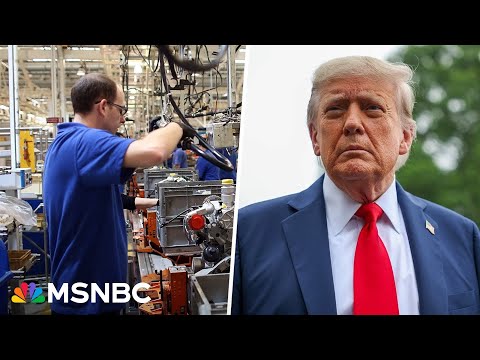
Wholesale inflation surges at fastest rate in 3 years
NBC News· 2025-08-14 22:00
Inflation & Tariffs Impact - Wholesale prices rose by 09% last month, exceeding Wall Street estimates, marking the largest monthly increase in over three years [1][2] - Tariffs are impacting prices, with the government raising $27 billion in tariffs in July, equivalent to an annual rate of $250-300 billion [3][5] - Companies may absorb some tariff costs in profit margins or spread them across other costs to avoid raising prices significantly [4][6] - A surge in imports ahead of tariffs means some inventory was sold at old prices, but retailers will eventually sell goods at new tariff prices, impacting margins or consumer prices [8][9] Consumer Price Implications - Increased wholesale prices could lead to higher prices at the checkout counter [6] - Strategies to mitigate price increases include absorbing costs or spreading them across other areas [6] - Consumer choice influences the extent to which companies pass along tariff costs [7] Federal Reserve Considerations - The Fed faces a difficult situation with pressure to lower rates while needing to manage inflation related to tariffs [10] - The Fed must ensure tariff-related price increases do not lead to broader inflation [10]