Quantitative Investment

Search documents
低调许久后,幻方量化重新站到聚光灯下
Xin Lang Cai Jing· 2025-12-25 10:46
Core Viewpoint - Quantitative private equity has evolved from being perceived as a cold trading machine to a highly industrialized and sustainable profit-generating system [2][20]. Group 1: Performance and Profitability - The latest allocation results for the Sci-Tech Innovation Board's new stock, Moer Technology, show that Huanshan Quantitative secured 61,300 shares, amounting to approximately 7.0059 million yuan, with an IPO price of 114.28 yuan per share [3][21]. - The stock reached a peak price of 941 yuan per share, leading to a single share floating profit of approximately 826.72 yuan, resulting in a total floating profit of nearly 50.68 million yuan, over 7 times the initial investment [3][21]. - Even with a more conservative median price estimate of 700 yuan per share, the floating profit would still exceed 5 times the initial investment, amounting to approximately 35.90 million yuan [4][22]. Group 2: Advantages of Quantitative Institutions - The advantages of quantitative institutions in the Sci-Tech Innovation Board's new stock subscription are amplified due to the alignment of rules with quantitative systems [6][24]. - Huanshan Quantitative utilized around 160 products for the subscription, while other firms like Jiukun Investment and Ruanfu Investment also deployed a significant number of products, showcasing the scale of participation [6][24]. - The key advantage lies not just in the number of products but in the ability of quantitative institutions to maximize rule efficiency, particularly in account diversification and precise fund allocation [8][26]. Group 3: Company Strategy and Market Position - Huanshan Quantitative has adopted a low-profile approach over the past two years, reducing management scale while maintaining its position among the top private equity firms [9][27]. - The firm has chosen not to compete on scale but has demonstrated a clear upward trend in the net value curve of its representative products this year, outperforming peers in the quantitative sector [12][30]. - The self-operated investment capacity of top quantitative institutions is significant, often enjoying higher strategic priority and flexible risk budgets, which are less affected by external pressures [13][31]. Group 4: Integration of Quantitative Investment and Technology - The combination of quantitative investment and DeepSeek represents a powerful narrative, showcasing both a highly engineered financial system and cutting-edge AI technology [15][33]. - This integration signals a strong capability in the Chinese market to deconstruct and stabilize complex systems, indicating a new expression of strength for Chinese investment institutions on the global stage [17][35]. - The consistent performance of Huanshan Quantitative, where substantial returns appear as a natural outcome of system operations, reflects the industrialization of profit generation in investment [17][35].


我的2025|基金投顾第三年
天天基金网· 2025-12-25 09:29
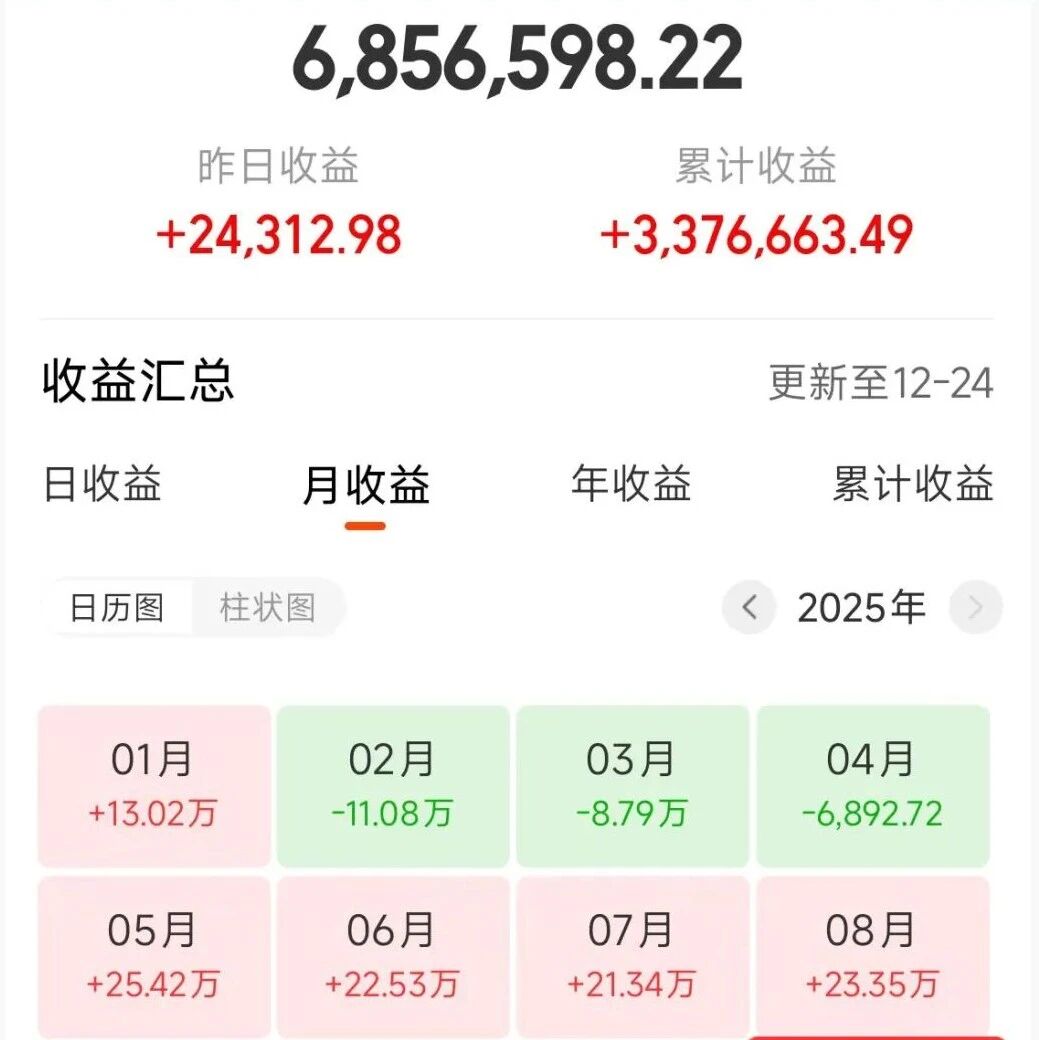
Core Insights - The article emphasizes the effectiveness of diversified investment strategies, showcasing a significant return on investment and a focus on steady growth rather than high-risk bets [2][4]. Group 1: Investment Performance - The total account value reached a historical high of 3.37 million, with a daily gain of 24,312.98 and a cumulative gain of 3,376,663.49 [3]. - The investment strategy has consistently maintained a full allocation with diversified assets, resulting in reduced volatility while keeping returns stable [4]. Group 2: Strategy Analysis - The equity portfolio, which includes a variety of asset types, outperformed major indices like the CSI 800 and CSI 300, with lower volatility and drawdowns [7]. - The strategy includes a mix of assets such as AI, Hong Kong tech stocks, CPOs, and gold ETFs, ensuring exposure to various market trends without missing out on potential gains [7]. Group 3: Risk Management - The "solid income plus" strategy is designed to allocate short-term funds into stable investments, showing resilience during market downturns while gradually increasing in value [9][11]. - The "super stable star" strategy focuses on maintaining low volatility (targeting 2%) through a structured approach that combines fixed income and equity assets, achieving a maximum drawdown of only 2.05% [22][27]. Group 4: Investment Philosophy - The investment approach is characterized by a dual strategy of "trend chasing" and "reversal betting," allowing for dynamic balance and adaptability to market changes [15][19]. - The article highlights the importance of systematic investment and discipline, advocating for a long-term perspective rather than attempting to time the market [32].
AVIV: International ETF Blending Value And Quality
Seeking Alpha· 2025-12-22 10:03
Core Insights - The article discusses the expertise of Fred Piard, a quantitative analyst with over 30 years in technology, focusing on data-driven systematic investment strategies since 2010 [1] Group 1: Expertise and Background - Fred Piard has authored three books and runs an investing group called Quantitative Risk & Value, which focuses on quality dividend stocks and innovative tech companies [1] - He provides various market strategies, including market risk indicators, real estate, bond, and income strategies in closed-end funds [1]

风格快速切换之下,量化私募业绩全面开花
私募排排网· 2025-12-20 03:51
Core Viewpoint - The A-share market in 2025 is characterized by "index upward, structural activity," with significant performance differentiation among private equity funds, where quantitative private equity has emerged as a standout strategy [2]. Group 1: Performance of Quantitative Private Equity - As of December 5, 2025, the quantitative long strategy index has increased by 34.97%, while the quantitative stock selection strategy index has risen by 29.28% [7]. - The performance of quantitative private equity has been particularly strong due to the active nature of small and mid-cap stocks, which have outperformed large-cap indices, providing ample beta space for strategies [9]. - The ability of quantitative strategies to adapt to market fluctuations and maintain stable risk-return characteristics has been highlighted, especially during periods of market volatility [12][13]. Group 2: Market Environment and Strategy Adaptation - The market in 2025 has shown a tendency for frequent style rotation, with technology and growth sectors remaining central, allowing various strategies to thrive [12]. - Quantitative strategies have demonstrated their advantages in capturing structural opportunities through factor diversification and dynamic adjustment of positions, rather than relying on a single market direction [14]. - The overall improvement in quantitative private equity performance is attributed to effective adaptation to changing market conditions rather than short-term style bets [13]. Group 3: Future Outlook - Looking ahead, the macro environment is expected to remain characterized by weak recovery trends and high uncertainty, making it challenging for the market to revert to a single mainline-driven structure [14]. - Emphasizing discipline, diversification, and risk control, quantitative strategies are anticipated to continue providing high allocation value, particularly in volatile conditions [14].

基金经理量化收益榜揭晓!幻方徐进、陆政哲,九坤王琛等居前!
Sou Hu Cai Jing· 2025-12-17 11:00
Core Insights - Quantitative fund managers are professionals focused on quantitative investment, utilizing mathematical models, algorithms, and big data analysis to manage portfolios and create long-term value for investors [1] - The demand for quantitative talent has surged globally due to advancements in AI, leading to a "talent war" among quantitative institutions [1] - Quantitative private equity funds favor highly educated individuals, with 69.11% of quantitative fund managers holding master's or doctoral degrees compared to 56.42% in subjective private equity [1] Performance Overview - As of November, there are 1,637 quantitative products with a total scale of approximately 135.11 billion, achieving an average return of 27.29% from January to November, significantly outperforming the market [2] - Among the 99 billion-yuan quantitative fund managers, the average return is 34.42%, yielding an excess return of 14.04% [2] Performance by Fund Size - For funds over 100 billion: - 386 products with a total scale of 53.81 billion, average return of 34.42%, and excess return of 14.04% [2][3] - For funds between 50-100 billion: - 165 products with a total scale of 17.49 billion, average return of 25.23%, and excess return of 10.31% [2][7] - For funds between 20-50 billion: - 220 products with a total scale of 22.56 billion, average return of 26.62%, and excess return of 12.21% [2][10] - For funds between 10-20 billion: - 176 products with a total scale of 12.60 billion, average return of 25.37%, and excess return of 10.10% [2][12] - For funds between 5-10 billion: - 224 products with a total scale of 12.15 billion, average return of 25.75%, and excess return of 10.84% [2][14] - For funds under 5 billion: - 466 products with a total scale of 16.52 billion, average return of 23.88%, and excess return of 11.19% [2][16] Notable Fund Managers - In the 100 billion category, all fund managers achieved positive returns, with 31 out of 50 managers having returns over 30% [3] - Notable managers include Xu Jin and Wang Chen, both holding doctoral degrees, with significant product performance [3][5] - In the 50-100 billion category, top managers include Shi En and Huang Bo, with average returns of 25.23% [7][9] - In the 20-50 billion category, top managers include Mo Bo and Nie Shouhua, with average returns of 26.62% [10][12] - In the 10-20 billion category, Wu Yintong leads with a strong performance [12][14] - In the 5-10 billion category, Yan Xuejie and Zeng Shuliang are among the top performers [14][15] - In the 0-5 billion category, Xie Libo leads with a notable performance [16][17]

基金经理年度10强进入冲刺期!韩广斌、颜学阶进入前5
Sou Hu Cai Jing· 2025-12-16 10:34
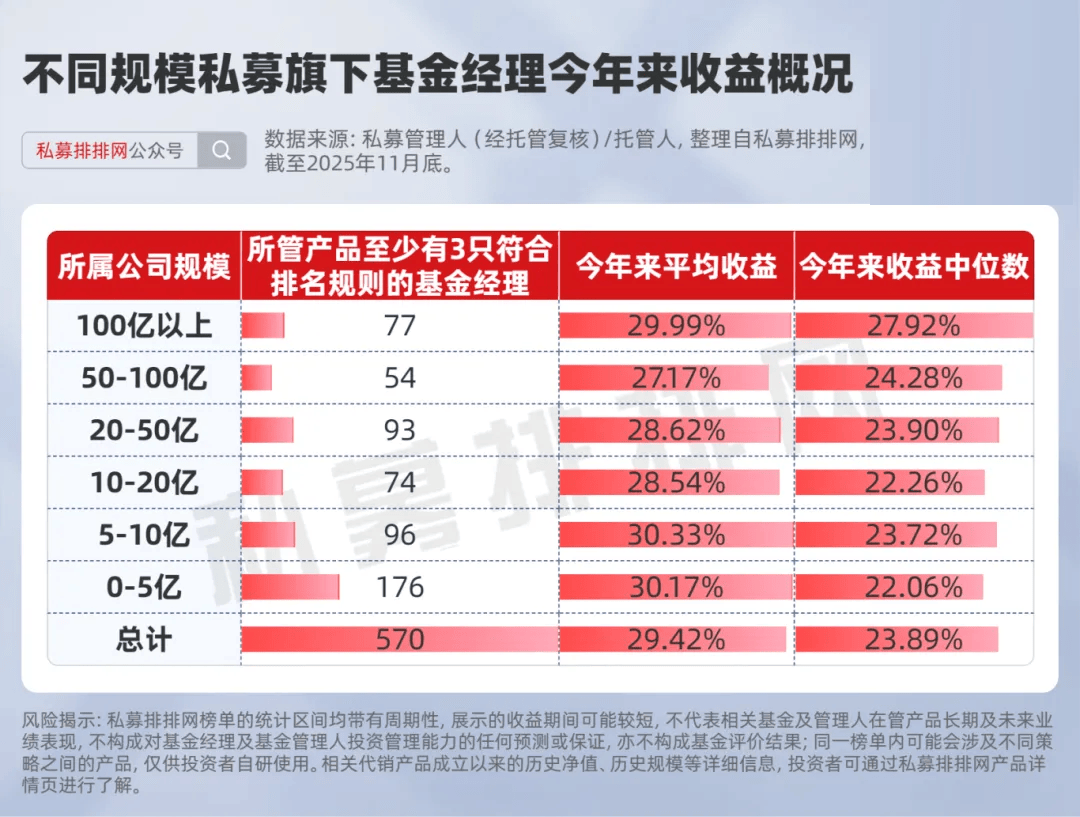
Core Insights - The annual performance ranking of private fund managers is in its final stages as of December, with 570 managers having at least three qualifying products, achieving average and median returns of 29.42% and 23.89% respectively for the year-to-date [1][2]. Group 1: Performance Overview - Among the 570 fund managers, 346 focus on stock strategies, representing 60.7% of the total, with average and median returns of 35.26% and 31.1%, outperforming the Shanghai and Shenzhen 300 Index by 17.94% [1]. - Fund managers employing multi-asset strategies and futures/derivatives strategies number 82 and 65 respectively [1]. - The median return for managers overseeing funds of 100 billion and above is 27.92%, while those managing funds between 5-10 billion have an average return of 30.33% [2]. Group 2: Manager Profiles - In the 100 billion and above category, the top 10 fund managers include six from quantitative firms, with all having over 10 years of experience, and four exceeding 20 years [3][6]. - Notable managers include Lu Hang from Fusheng Asset, who ranks third and has a 20-year career, expressing optimism about the market and the undervaluation of the RMB [6]. - Two managers from Ningbo Huansheng Quantitative, Xu Jin and Lu Zhengzhe, also made the top 10, with their average returns exceeding ***% [6]. Group 3: Performance by Fund Size - In the 50-100 billion category, the top 10 fund managers predominantly consist of subjective fund managers, with eight out of ten being from this category [8]. - The 20-50 billion category features seven subjective fund managers in the top 10, with the top five all being subjective [12]. - The 10-20 billion category has all managers with over 10 years of experience, with the top five being from subjective firms [16]. Group 4: Emerging Managers - In the 5-10 billion category, the only quantitative manager to make the top 10 is Yan Xuejie, while the majority are subjective managers [19]. - The 0-5 billion category sees nine subjective managers in the top 10, with half having 10-20 years of experience [23].
3 Well-Positioned AI Stocks From Steven Cress (undefined:MU)
Seeking Alpha· 2025-12-03 18:45
Core Insights - The podcast discusses the volatility in the market during November and highlights three AI stocks as strong investment opportunities, emphasizing their solid fundamentals and reasonable valuations [5][6][11]. Market Overview - November experienced significant market fluctuations, starting strong, then selling off, and finally recovering, indicating a volatile environment for investors [5][24]. - The S&P 500 and NASDAQ reached new highs before experiencing a correction, with the market reacting to concerns about interest rates and the valuation of AI stocks [21][24][30]. Quantitative Analysis - The quant system employed by the company utilizes data, math, and algorithms to identify investment opportunities, focusing on fundamental analysis and a diversified approach [12][14][17]. - The quant strong buys have shown a significant performance advantage over Wall Street strong buys and the S&P 500 over a five-year period, with a 227% increase compared to 33% and 66% respectively [19]. Stock Recommendations - **Micron Technology (MU)**: Market cap of approximately $271 billion, ranked first in the semiconductor industry. The stock has improved in valuation and growth metrics, with a forward revenue growth of 36% and EPS growth of 191% [34][39][41]. - **CommScope Holding (COMM)**: A mid-cap company with a market cap of about $3.66 billion, ranked second in the IT sector. It has shown strong profitability improvements and positive analyst revisions, with a PEG ratio at a 51% discount to the sector [42][44][49]. - **Seagate Technology (STX)**: The stock has performed well year-to-date, with a 212% increase over the last six months. It boasts strong growth metrics, including a 102% EPS growth rate compared to the sector [52][56]. Investment Strategy - The discussion emphasizes the importance of focusing on value, growth, and profitability rather than being deterred by stocks near their 52-week highs. Historical performance suggests that investing in stocks at their highs can yield better returns than those at lows [47][50][51]. - The company also highlights the significance of analyst revisions, with positive revisions indicating confidence in the companies' future performance [41][44].




3 Well-Positioned AI Stocks From Steven Cress
Seeking Alpha· 2025-12-03 18:45
Core Insights - The podcast discusses the volatility in the market during November and highlights three strong buy stocks in the AI sector: Micron Technology, CommScope, and Seagate Technology [5][6][34]. Market Overview - November experienced significant market fluctuations, starting strong, then selling off, and finally recovering [5][25]. - The S&P 500 and NASDAQ reached new highs before experiencing a correction, influenced by concerns over interest rates and the AI bubble [21][23][25]. - The market has shown signs of recovery, with a recent uptick from a low of 652 to around 682 [24][25]. Stock Analysis - **Micron Technology (MU)**: - Market cap of approximately $271 billion, ranked 1 out of 538 in the IT sector and 1 out of 67 in semiconductors [34]. - Valuation metrics show a P/E ratio of 15, significantly lower than the sector average of 30, indicating a 50% discount [38]. - Strong growth prospects with a forward revenue growth of 36% and EPS growth of 191% compared to sector averages of 8% and 10% respectively [39]. - Analysts have positively revised earnings estimates, with 29 upgrades in the last 90 days [41]. - **CommScope Holding (COMM)**: - Market cap of about $3.66 billion, ranked 2 out of 538 in the IT sector and 1 out of 39 in communications equipment [42]. - The stock has a PEG ratio at a 51% discount to the sector, with a cash amount per share of $3.18, 42% higher than the sector average [43]. - Profitability has improved, with an A grade compared to a C+ six months ago [44]. - **Seagate Technology (STX)**: - Year-to-date performance shows a 212% increase, with a 126% rise over the last six months [52]. - The company has strong growth metrics, with EPS growth of 102% versus the sector's 10.5% [54]. - Valuation remains fair, with a PEG ratio at a 63% discount to the sector [55]. Investment Strategy - The discussion emphasizes a diversified investment approach, focusing on value, growth, and profitability metrics rather than solely on stock price movements [48][49]. - The quant system employed allows for daily updates and analysis of approximately 5,000 stocks, enhancing the ability to identify strong investment opportunities [12][15]. Performance Metrics - The quant system has shown a strong track record, with simulated trades yielding a 227% return over five years compared to 33% for Wall Street strong buys and 66% for the S&P 500 [19].

RSSB: A Leveraged 50/50 Portfolio
Seeking Alpha· 2025-12-01 21:16
Core Insights - The article discusses the expertise of Fred Piard, a quantitative analyst with over 30 years in technology, focusing on data-driven systematic investment strategies since 2010 [1]. Group 1: Expertise and Background - Fred Piard has authored three books and runs an investing group called Quantitative Risk & Value, which focuses on quality dividend stocks and tech innovation companies [1]. - He provides various market strategies, including market risk indicators, real estate, bond strategies, and income strategies in closed-end funds [1].



百亿级私募数量增至108家,量化机构成新晋主力
Xin Hua Cai Jing· 2025-10-29 02:21
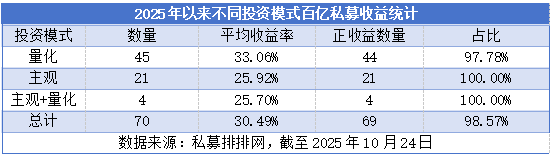
Core Insights - The number of billion-level private equity firms has increased to 108 as of October 28, 2025, up from 96 at the end of September 2025, marking an increase of 12 firms [1] - Quantitative private equity firms have emerged as the new main players, with 8 out of the 13 new entrants being quantitative firms [1][2] - The average return for billion-level private equity firms this year is 30.49%, with 98.57% of these firms achieving positive returns [3][4] Group 1: Growth of Billion-Level Private Equity Firms - The number of billion-level private equity firms has risen by 17 compared to the end of 2024, with 31 new entrants and 14 exits [2] - Among the new entrants, 18 are quantitative firms, 9 are subjective firms, and 3 are mixed [2] - Notable new entrants include firms like Xiyue Investment and Square Harmony Investment, while familiar names like Honghu Private Equity and Shanghai New Equation have returned [2] Group 2: Performance Metrics - Quantitative private equity firms have an average return of 33.06%, outperforming subjective firms, which have an average return of 25.92% [4] - Of the 70 billion-level private equity firms with performance data, 69 achieved positive returns, with 35 firms yielding returns between 30% and 49.99% [3][4] - The performance distribution shows that 39 firms have returns exceeding 30%, with the majority being quantitative firms [4]