Fed rate cuts

Search documents
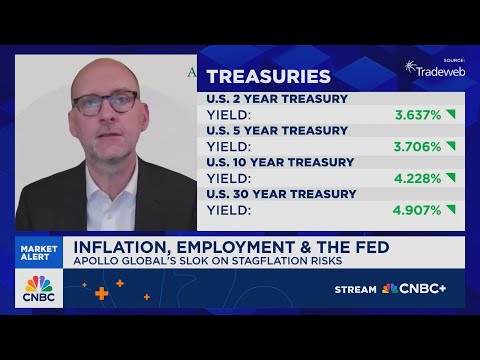
Slok: If labor slows and inflation rises, that's stagflation
CNBC Television· 2025-08-29 11:18
Labor Market & Inflation - The labor market is slowing down, potentially due to headwinds from tariffs and trade wars [2][7] - PCE inflation is at 29%, the highest level since February, while the Fed's target is 2% [3] - Inflation expectations one year out are predicting 34%, significantly higher than the 2% target [9] - A quarter of a million less jobs than previously expected in May and June [6] Monetary Policy & Economic Outlook - The Fed faces a dilemma: whether to focus on the weaker labor market (suggesting rate cuts) or rising inflation (suggesting rate hikes) [4] - Chris Waller suggests focusing on the labor market [4] - The market is pricing in more rate cuts than the Fed may be able to deliver due to persistent inflation [8][10] - GDP on the second read came in at 33% [5] Market Dynamics - The stock market's performance is largely driven by the AI story and the "Magnificent 7," which constitute 40% of the index [11][12] - Nvidia alone accounts for 8% of the S&P 500, an unprecedented concentration for a single stock in the last 50 years [12][13] - The bond market narrative is focused on inflation and the labor market, presenting an inconsistent picture compared to the stock market [13] - The yield curve is steepening, partly due to inflation and fiscal challenges, raising concerns that the Fed might accept permanently higher inflation [9][13]

美国策略更新 - 关键观点摘要-US Strategy Update_ Summary of key views
2025-08-26 13:23
Summary of Key Points from the Conference Call Industry Overview - The conference call focuses on the US rates market and the Federal Reserve's monetary policy outlook, particularly in light of fiscal and trade uncertainties being reduced and labor market risks increasing [2][3]. Core Views and Arguments 1. **Federal Reserve Rate Cuts**: - A total of 75 basis points (bp) of Fed cuts are expected through early 2026, bringing the fed funds rate to a nominal neutral level of 3.5-3.75% [2]. - Current pricing for a September cut is approximately 22bp, which is considered fair based on recent remarks from Chair Powell and upcoming employment and inflation data [2]. 2. **Inflation and Economic Growth**: - Higher tariffs and lower immigration are seen as negative supply shocks, leading to higher inflation and slower growth, but not a recession [3]. - Spot inflation is projected to rise to 3.5%, influenced by tariffs, a weakening dollar, and a potentially dovish Fed [9]. 3. **Yield Curve Dynamics**: - A hawkish Fed outlook is expected to flatten the yield curve, but higher term premia may steepen forward curves [4]. - Political pressure for easier Fed policy could lead to a twist-steepening in spot curves, with long-end yields absorbing inflation and fiscal risks [4]. 4. **Treasury Issuance**: - Anticipated increases in nominal coupon sizes starting in May 2026, with net coupon issuance expected to reach $1.6-1.8 trillion per year over the next several years [11]. 5. **Quantitative Tightening (QT)**: - QT is expected to conclude by the end of Q1 2026, with MBS principal payments likely reinvested into short-dated Treasuries at a pace of $15-20 billion per month [12]. 6. **Swap Spreads**: - Modest widening in medium and long-end SOFR swap spreads is expected, with a steeper spread curve anticipated [8]. Additional Important Insights - **Funding Markets**: - Fed ONRRP balances are expected to fall to $0-30 billion by the end of Q3, with SOFR potentially moving above IORB due to higher opportunity costs for banks [10]. - **Regulatory Reforms**: - Regulatory reforms are seen as a potential tailwind for Treasury demand, with shifts in Treasury issuance likely to ease pressure on longer-term yields [8]. - **Market Risks**: - Key risks to the investment thesis include labor market slowdowns, debt-management policies, and regulatory measures to bolster domestic demand for USTs [3]. - **Analyst Certification**: - The views expressed in the report reflect the personal views of the lead analysts, with no compensation received for specific recommendations [16]. This summary encapsulates the critical insights and projections regarding the US rates market and the Federal Reserve's monetary policy, highlighting potential investment opportunities and risks.
X @Cointelegraph
Cointelegraph· 2025-08-26 09:00
🇺🇸 NEW: Morgan Stanley has revised its outlook, predicting 25 bps Fed rate cuts in both September and December 2025. https://t.co/y2hwd4bfm3 ...
X @Bitcoin Archive
Bitcoin Archive· 2025-08-22 14:21
Market Expectations - Traders are fully pricing in two Fed rate cuts in 2025 [1]
X @Bitcoin Archive
Bitcoin Archive· 2025-08-21 14:06
🚨JUST IN: Traders reduce bets on two Fed rate cuts this year.All eyes on Powell’s Jackson Hole speech tomorrow for clues. https://t.co/qBYdSVRrwu ...
GOVT: Treasury Volatility Falls To Multi-Year Lows Ahead Of Fed Rate Cuts
Seeking Alpha· 2025-08-14 18:36
Group 1 - The ICE BofA MOVE Index, which measures implied volatility in the Treasury market, has reached its lowest level since early 2022, indicating a significant reduction in bond market volatility [1] - This decline in volatility occurs as the Federal Reserve prepares for upcoming monetary policy decisions, suggesting a potential shift in market dynamics [1] Group 2 - The article emphasizes the importance of understanding macro drivers affecting various asset classes, including stocks, bonds, commodities, currencies, and cryptocurrencies [1] - It highlights the role of empirical data in shaping investment narratives and the necessity for clear communication of financial information to diverse audiences [1]

IAT: Rate Cuts Back In Play, Regional Banks Poised To Benefit
Seeking Alpha· 2025-08-14 03:58
Group 1 - The markets are anticipating Federal Reserve rate cuts, with a probability exceeding 90% for a quarter-point reduction in the upcoming meeting [1] - The CME FedWatch Tool indicates that the FOMC is likely to resume its cutting cycle next month [1] Group 2 - The article emphasizes the importance of macro drivers affecting various asset classes, including stocks, bonds, commodities, currencies, and cryptocurrencies [1]

Small-Cap ETFs Outperform on Inflation Data
ZACKS· 2025-08-13 16:31
Market Performance - Small-cap stocks outperformed major U.S. stock market indices on August 12, with the Russell 2000 Index gaining nearly 3%, marking its largest one-day rally since May [1] - The iShares Russell 2000 ETF (IWM) also saw a jump of about 3% [1] Inflation and Economic Indicators - The Consumer Price Index rose 2.7% year over year in July, slightly below the forecast of 2.8%, while core inflation increased to 3.1% from June's 2.9% [3] - The softer inflation data has strengthened the case for potential Fed rate cuts in September, with futures markets pricing in a 94% chance of a quarter-point cut [3] Small Business Sentiment - Optimism among small business owners increased in July, with the small business optimism index climbing to 100.3, the highest level since February and above the 52-year average of 98 [5] - This rise in optimism may indicate a stabilizing business environment, positively impacting small-cap stocks and ETFs [5] ETF Performance - Invesco S&P SmallCap Industrials ETF (PSCI) rose 3.8%, focusing on 93 small-cap companies in industrial sectors [6] - Invesco S&P SmallCap Information Technology ETF (PSCT) increased by 3.7%, providing exposure to 69 small-cap tech companies [7] - Invesco S&P SmallCap Value with Momentum ETF (XSVM) gained 3.6%, tracking 122 stocks with high value and momentum scores [8] - Invesco S&P SmallCap Quality ETF (XSHQ) also rose 3.6%, holding 121 stocks with high quality scores [9][10] - First Trust Small Cap Value AlphaDEX Fund (FYT) increased by 3.5%, tracking 262 stocks from the Nasdaq US 700 Small Cap Value Index [11] Sector Trends - Financials, industrials, and consumer discretionary stocks, which make up over half of the Russell 2000, are experiencing strong rebounds [13] - Regional banks are stabilizing as credit risks recede, while manufacturing and transportation sectors benefit from improved supply chains and infrastructure spending [13] M&A Activity - There is an uptick in dealmaking within healthcare, biotech, and tech services, with large-cap companies targeting small and mid-sized firms for growth [14] - This M&A momentum is attracting active managers and hedge funds, injecting fresh liquidity into the small-cap space [14] Valuation Trends - Large-cap valuations have become stretched after a prolonged rally, while small-caps remain relatively discounted, prompting institutional investors to rotate into under-owned segments like small-caps [12]

Aggressive Fed rate cuts to drive gold back to record highs by year-end - ING's Manthey
KITCO· 2025-08-12 20:39
Core Insights - The article discusses the current trends and developments in the financial sector, particularly focusing on investment opportunities and market dynamics [4]. Group 1 - The financial sector has seen significant changes in recent years, with a shift towards digitalization and technology-driven solutions [4]. - Companies are increasingly adopting innovative strategies to enhance their competitive edge and meet evolving consumer demands [4]. - The article highlights the importance of staying informed about market trends to identify potential investment opportunities [4].


Fed rate cuts will stoke inflation, so invest in alternative and non-U.S. assets – JP Morgan's Kelly
KITCO· 2025-08-11 18:17
Group 1 - The article discusses the impact of inflation on the market and investment strategies [1][2] - It highlights the role of J.P. Morgan in analyzing inflation trends and their implications for various asset classes [1][2] - The report emphasizes the importance of understanding inflation dynamics for making informed investment decisions [1][2] Group 2 - The author, Ernest Hoffman, has extensive experience in market reporting and analysis, contributing to the credibility of the insights presented [3] - The article aims to provide a comprehensive overview of current inflation trends and their potential effects on the economy [1][2] - It serves as a resource for investors looking to navigate the complexities of inflation in their investment strategies [1][2]