AI Bubble

Search documents
AI Stocks Dispel Bubble Talk. Capital Spending Is Booming, With No End In Sight.
Investors· 2025-10-31 20:28
Core Insights - The artificial intelligence megatrend remains robust, with major tech companies signaling continued investment despite concerns about an AI bubble [1][2][30] - Big Tech companies, including Meta, Microsoft, Google, Amazon, and Apple, reported strong earnings and indicated plans to increase capital expenditures significantly in AI-related infrastructure [5][7][11] Company Earnings and Investments - Microsoft reported a capital expenditure of $35 billion, up 74% year-over-year, and expects continued growth in AI investments [8][12] - Google announced a capital expenditure of $24 billion, an 83% increase from the previous year, and raised its full-year spending targets [7][11] - Meta's capital expenditures reached $19.4 billion, more than double the previous year's spending, with expectations for even larger investments in 2026 [7][16] - Amazon's third-quarter results exceeded expectations, with cash capital expenditures of $34.2 billion and a total of $89.9 billion spent in 2025, projecting $125 billion for the year [8][21] AI Infrastructure and Market Impact - The construction of AI-capable data centers is projected to require $5.2 trillion in capital expenditures, indicating a significant economic impact [10] - Major tech companies collectively account for over $24 trillion in market capitalization, representing more than 40% of the S&P 500 [11] - Microsoft plans to increase its AI capacity by over 80% this year and double its data center footprint in the next two years [12] Market Reactions and Analyst Perspectives - Meta's increased spending plans led to a significant stock drop, highlighting investor concerns about rising operating expenses [16][18] - Amazon's strong performance in its cloud business alleviated concerns about market share losses to competitors [19][20] - Analysts express mixed sentiments regarding the AI megatrend, with some cautioning about potential over-investment and the sustainability of returns [30][32] AI Ecosystem Developments - Nvidia is positioning itself for significant growth in data center revenue, with projections exceeding $300 billion, contributing to its market valuation [22] - Other companies in the AI infrastructure space, such as Vertiv Holdings and Celestica, reported strong earnings, while Super Micro Computer faced challenges with lower sales guidance [23][24] - Strategic alliances are forming in the AI sector, with Google potentially adding Anthropic as a client, which could benefit companies like Broadcom [25][26] Future Outlook - The AI megatrend is expected to drive a tech capital expenditure supercycle, with significant investments anticipated in the coming years [32] - OpenAI's expansion and its role in the AI landscape are under close scrutiny, with analysts questioning its ability to fund its ambitious plans [27][28]





The AI boom is over — here’s your bubble survival guide
Yahoo Finance· 2025-10-31 11:31
Core Insights - The AI bubble is deflating gradually, with significant differences in outcomes for various market tiers, leading to a separation of winners and losers in the next 18 to 24 months [3][30] - Tier 1 hyperscalers like Microsoft, Alphabet, and Amazon are well-positioned due to their substantial capital expenditures and strong cash flows, allowing them to weather disappointing AI returns [2][9][10][11] - Tier 2 companies, including unicorns like OpenAI and Anthropic, face existential questions regarding their ability to justify high valuations amidst competition from hyperscalers and cheaper models [1][3] - Tier 3 companies are experiencing mass casualties, with increased startup shutdowns and failed AI pilots, indicating a challenging environment for less established firms [6][28] Tier 1 Hyperscalers - Microsoft is projected to have a $13 billion annual run rate in AI, with a 175% year-over-year increase, supported by $72 billion in annual free cash flow [9] - Amazon's AWS is growing at 17.5% year over year, reaching a $123 billion annual run rate, allowing for significant investment in AI infrastructure [10] - Alphabet's revenue is heavily reliant on internet-search advertising, with an operating margin of 32.4% and estimated capital expenditures of $85 billion for AI and data-center infrastructure [11] Tier 2 Unicorns - Companies like OpenAI are valued at $500 billion, but face scrutiny over whether they can deliver returns that justify such valuations [1][7] - The AI bubble is not comparable to the dot-com crash, as the current situation involves a slow deflation rather than a sudden collapse [4][3] Tier 3 Companies - Startup shutdowns surged by 26% year over year in 2024, and 95% of enterprise AI pilots failed to show measurable P&L impact within six months of launch [6][3] - The number of down rounds in venture deals reached a decade high at 15.9% in 2025, indicating a challenging funding environment [3] Investment Strategies - Investors are advised to buy Tier 1 hyperscalers during corrections of 15% to 20%, as these companies have strong fundamentals and cash flow to support AI investments [9][10][11] - Investing in data centers is recommended due to projected power constraints, with Gartner forecasting that 40% of AI data centers could face power-availability issues by 2027 [13][14] - Companies like Dominion Energy are positioning themselves as essential players in the AI infrastructure landscape, with significant investments planned [15][20] Profitable Companies - Companies that automate back-office processes, such as UiPath and BlackLine, are highlighted for their strong ROI and profitability, making them attractive investment opportunities [21][22] - Enterprise SaaS leaders like Atlassian and DocuSign are leveraging AI to enhance their products, maintaining strong customer bases and financial performance [23][25][26]
How the Federal Reserve Could Inflate or Pop an AI Bubble
Yahoo Finance· 2025-10-30 10:00
Core Insights - The Federal Reserve has cut its benchmark interest rate for the second consecutive month, but Chair Jerome Powell indicated that further cuts this year are not guaranteed [1][7] - Concerns about a potential AI bubble are emerging, with some analysts suggesting that the focus should be on monetary policy decisions made by the Federal Open Market Committee in Washington, D.C. [2][5] - Historical patterns indicate that financial bubbles often form during periods of low interest rates and burst when rates rise, as seen in past bubbles like the Dotcom and housing bubbles [3][5][7] AI Market Dynamics - Artificial intelligence stocks have reached record highs, but recent circular deals among major players like Nvidia and OpenAI have raised concerns reminiscent of the 1990s vendor financing agreements [4][6] - The concentration of the stock market is evident, with the "Magnificent Seven" companies accounting for 35% of the S&P 500, and the index's price-to-earnings ratio nearing the peak levels of the Dotcom Bubble [4][6] - Despite high valuations in the AI sector, some analysts believe that prices could continue to rise if the Federal Reserve aggressively cuts interest rates to stimulate a weakening economy [7]
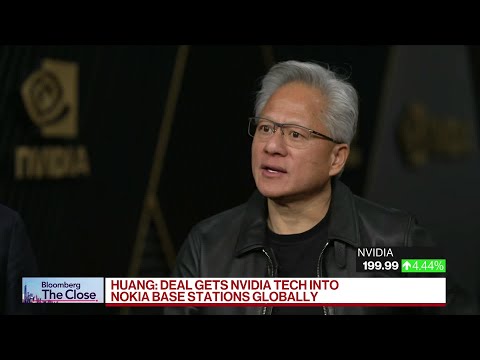
Nvidia's Huang Says He Doesn't Believe There's an AI Bubble
Bloomberg Television· 2025-10-28 19:46
AI Market & Investment - AI 现在具有足够的推理、研究和思考能力,可以生成值得付费的智能 [2] - 公司正在从基于通用计算的旧计算模型自然过渡到加速计算 [1] - 公司正在为各种 AI 模型和 AI 服务支付大量资金,并乐于这样做 [2][3] Technology & Scalability - 讨论了摩尔定律的终结或未终结,以及扩展以满足需求的必要性 [1] - 公司不认为存在泡沫,因为正在经历从通用计算到加速计算的自然过渡 [1]

An AI Boom Is Catapulting Markets And Raising Fears A Bubble Is Near
Forbes· 2025-10-28 10:00
Core Insights - The current market enthusiasm for artificial intelligence (AI) is leading to soaring valuations and significant investments, with hundreds of billions of dollars being funneled into this transformative technology [1][2] - There are concerns about whether this growth is sustainable or if it resembles a bubble that could potentially erase $40 trillion in value from the Nasdaq [2][6] - OpenAI is a central figure in the AI boom, with its partnerships and deals contributing to the industry's expansion and raising questions about the long-term viability of such valuations [3][4] Group 1: Market Dynamics - The AI sector is undergoing a structural transformation, with advancements across all layers of technology, from power generation to enterprise software [2] - OpenAI's partnerships with major companies like Nvidia, Oracle, and AMD are seen as foundational to the AI economy, driving innovation and infrastructure investment [4][6] - The demand for AI infrastructure is leading to a global boom in data centers, indicating a robust growth trajectory for the industry [6] Group 2: Risks and Comparisons - There are early warning signs that the AI market may be entering a phase reminiscent of the dot-com bubble, with high concentration among leading tech stocks raising concerns [7][8] - The so-called "Magnificent Seven" stocks, which include key AI players, now account for over a third of the S&P 500, increasing market risk [7] - The primary concern is not about AI's long-term potential but rather about inflated expectations that could lead to a sharp market correction [8]

Invitation Homes: Brace For AI Bubble - Buy American Homes Hand Over Fist (NYSE:INVH)
Seeking Alpha· 2025-10-27 21:19
Core Insights - Invitation Homes (NYSE: INVH) is perceived as a stock that may not traditionally be associated with generating alpha, yet it has attracted investor interest due to its potential for growth [1]. Group 1: Company Overview - Invitation Homes is a company that focuses on acquiring and managing single-family rental homes, which positions it well within the real estate sector [1]. - The company is led by a management team that emphasizes strong balance sheets and long-term growth potential, aligning with the investment philosophy of seeking undervalued companies [1]. Group 2: Investment Strategy - The investment approach highlighted involves identifying companies with secular growth and robust management, which is a key factor in the evaluation of Invitation Homes [1]. - The strategy combines growth-oriented principles with strict valuation criteria, aiming to enhance the margin of safety for investors [1].


Invitation Homes: Brace For AI Bubble - Buy American Homes Hand Over Fist
Seeking Alpha· 2025-10-27 21:19
Core Insights - Invitation Homes (NYSE: INVH) is perceived as a stock that may not traditionally be associated with generating alpha, yet it has attracted investor interest for its potential [1] Group 1: Company Overview - Invitation Homes is a company that operates in the residential real estate sector, focusing on single-family rental homes [1] - The company is seen as having a strong balance sheet and management team, which are critical factors for long-term growth [1] Group 2: Investment Strategy - The investment approach emphasizes finding undervalued companies with secular growth potential, which aligns with the characteristics of Invitation Homes [1] - The strategy combines growth-oriented principles with strict valuation hurdles to enhance the margin of safety for investors [1]

Are Markets Headed for an AI Bubble?
Bloomberg Technology· 2025-10-27 21:13
Give us the fundamental underpinnings that gives you confidence that this isn't some tech rack rewritten. So I think what's really interesting is we actually look at the equities landscape a little bit different than everybody else. So everything we do is through a thematic lens or a thesis driven.So we actually carve out the equities landscape into AI, decentralized energy grid tech space. And you guys are talking about a few minutes ago space quantum computing. So when we think about tech or we think abou ...

Who Will Survive the AI Bubble?
20VC with Harry Stebbings· 2025-10-27 15:00
I do think we're in an AI bubble. You can see the fragility. Everybody can see the fragility.The thing that I think is more interesting is who's going to survive the bubble. Consumers of compute benefit from a bubble because if we overproduce compute, prices go down, your COGS goes down, and your gross margin goes up. The lesson that punches you in the stomach in venture is you can't make a company succeed.How would you respond to Sequoia were asleep at the wheel when it came to defense not being in Helsing ...