Consumer Spending

Search documents
We are flying in darkness,' with no govt economic data available: Economist Torsten Sløk
Yahoo Finance· 2025-10-05 16:00
Inflation Concerns - Service sector inflation is showing signs of life, with prices paid by service sector companies for inputs increasing, suggesting upside risks to service sector inflation [1] - Services make up 60% of the CPI index, so a higher rise in service sector inflation suggests that overall inflation may be more sticky and elevated [1] - The consensus forecast expects inflation to be 3% for the next 12 months, while the Fed's target is 2%, indicating a potential upside risk to inflation if the economy doesn't slow down [2] - Goods inflation is moving higher partly because of tariffs, and service sector inflation is also showing upward pressure, leading to the conclusion that a pause in rate cuts may be warranted to assess alternative inflation indicators [2] - If inflation stays higher for longer, consumers will face higher prices, impacting real spending, especially for price-sensitive consumers [2] Economic Outlook - The absence of government data on non-farm payrolls and inflation makes it challenging for markets and the Fed to assess the true state of the economy [1] - Economists have been predicting slowdowns that haven't materialized, and the delayed negative effects of the trade war may not arrive, suggesting the economy may not slow down as expected [1] - Alternative data sources to watch in the absence of government data include Redbook same-store retail sales (weekly), OpenTable restaurant data (daily), and Star hotel data (weekly) [1] AI Impact - The AI story now makes up 35% of the S&P 500, with the 10 biggest stocks accounting for almost 40% of the overall S&P, indicating a high concentration [2] - Larger companies are beginning to report a slowdown in their adoption rate of AI, posing a risk to the economic outlook if the AI story starts to fade [3] - There is a very high concentration in the AI story that's driving the stock market forward, which is somewhat disconnected from what's going on in the economic outlook [5]


Why 'buy now, pay later' may threaten Big Banks
CNBC· 2025-10-05 15:00
Market Trends & Adoption - Buy Now Pay Later (BNPL) usage continues to grow across consumer segments and is becoming ubiquitous in online and in-store shopping [1] - The industry observes widespread adoption of alternatives to credit cards, presenting a significant opportunity to disrupt the US credit card industry [3] - In 2024, an estimated 865 million Americans used BNPL, and this number is projected to rise to 915 million in 2025 [4] Impact on Financial Institutions - BNPL plans are changing consumer spending habits by offering short-term installment options as an alternative to credit cards [2] - Big banks and financial institutions have reasons to be cautious of consumers using BNPL plans, especially with the growing number of users [3] - BNPL represents a significant gap in understanding consumer credit quality [4] Challenges & Opportunities - Credit cards have struggled to adapt to consumers' needs [2] - The industry is in a transition period with skepticism and uncertainty surrounding new products like BNPL, as traditional institutions protect their own products [4]

'We've Seen This Movie Before' | US Shutdown Impact
Bloomberg Television· 2025-10-03 13:29
Government Shutdown Impact - The fiscal impact of the government shutdown is expected to be minimal initially, but the focus is on the potential impact on the labor market [1] - Approximately 40% of federal workers, around 900,000, may face furlough, and all federal workers could experience pay delays [2] - Delayed employment information, initially expected on October 3rd, adds to the uncertainty [3] - Historically, shutdowns have had a limited effect on bonds and stocks, but stretched equity valuations could make this time different [3][4] Equity Market Concerns - The stock market's high price-to-earnings (P/E) ratio, around 22 times during the year, raises concerns about future returns [5][6] - Historically, buying into the S&P 500 with a forward P/E multiple of around 22 has resulted in muted returns of plus 2% to minus 2% over the next ten years [6] - Investors' patience may wane as the shutdown continues, potentially leading to a shift from stocks to credit [5][6] Private Credit Market Dynamics - Strong demand exists for alternatives in credit, particularly private credit, due to its contractual nature in a volatile market [7] - Rapid growth in private credit has raised concerns about the market overheating and attracted regulatory scrutiny in some European countries [8] - Increased demand from asset managers with private credit funds and private equity sponsors requires careful deal selection [9] - There has been a degradation in underwriting quality and covenant terms, along with compressing spreads, indicating a need for caution [10] - High yield bonds have seen significant issuance, reaching $60 billion this month, twice the normal monthly amount and levels not seen since 2021, indicating demand in both public and private markets [10] Economic Indicators - Soft data has recovered from April lows, but hard data, such as monthly spending, shows a bifurcation, with higher-income consumers still spending while lower-income consumers may be in a recession [13] - Relatively weak data for travel in August and hotel occupancy could signal that higher-end consumers are becoming more cautious [14]

Top 10% of Americans add $5 trillion to wealth in the second quarter
CNBC Television· 2025-10-02 20:00
Well, the ultra wealthy just got ultra wealthier. I'm CNBC's Robert Frank. The top 10% of Americans added over $5 trillion to their wealth in the second quarter.That was driven mainly by the stock market. All wealth groups saw gains in the quarter with the bottom half of Americans adding about $150 billion to their wealth. But the fastest growth is at the very top.The top.1%, those are folks worth $46 million or more. They have seen their wealth nearly double since 2020 to over $23 trillion. Stocks were the ...

US has a stagnant labor market, ADP’s Richardson says #shorts #economy #markets #labormarket #jobs
Bloomberg Television· 2025-10-02 16:24
Labor Market Assessment - September hiring estimated at negative 32,000, indicating a slowdown in hiring momentum [1] - Hiring momentum has slowed since the beginning of the year, leading to a weak labor market in terms of hiring [2] - The labor market is stagnant, characterized by a strong stock but weak flow into and out of the market [3][4] Economic Implications - Consumer spending that fueled Q2's 3.8% growth rate was supported by the labor market [4] - The current level of economic productivity lacks the dynamism needed for consistent job creation [5]

Growth & Large-Cap ETFs Worth Considering to Power Your Portfolio
ZACKS· 2025-10-01 15:01
Economic Growth - The U.S. economy expanded at a 3.8% annualized rate in the second quarter, marking the fastest growth in nearly two years, driven by robust consumer spending and solid business investment [1] - The Organisation for Economic Co-operation and Development (OECD) raised its growth expectations for the U.S. to 1.8% in 2025, up from 1.6% in June, but forecasts for 2026 are projected at 1.5%, indicating a notable drop from 2.8% in 2024 [2] Consumer Spending - Consumer spending, which constitutes over two-thirds of economic activity, rose by 2.5% in the second quarter, revised up from a previous estimate of 1.6% [3] - In the last month, consumer spending increased by 0.6%, following a 0.5% gain in July [3] Household Wealth - Household wealth reached a record $176.3 trillion in the second quarter, although lower-income families face challenges from rising import-driven prices [4] Investment Trends - U.S. equity funds experienced a net inflow of $12.06 billion in the week ending September 24, reversing two weeks of outflows, with large-cap equity funds attracting $16.94 billion, the largest weekly inflow since April 9 [5] - Large-cap ETFs are recommended as a balanced investment strategy to capture growth potential while maintaining a defensive stance amid economic uncertainty [6] ETF Recommendations - Suggested large-cap ETFs include Vanguard S&P 500 ETF (VOO), SPDR S&P 500 ETF Trust (SPY), iShares Core S&P 500 ETF (IVV), and Vanguard Total Stock Market ETF (VTI) [7] - Growth ETFs such as Vanguard Growth ETF (VUG), iShares Russell 1000 Growth ETF (IWF), iShares S&P 500 Growth ETF (IVW), SPDR Portfolio S&P 500 Growth ETF (SPYG), and iShares Core S&P U.S. Growth ETF (IUSG) are also recommended for investors seeking higher growth potential [9]

Misra: If data worsens, the Fed can cut faster
CNBC Television· 2025-10-01 12:11
Bond Market Reaction & Fed Policy - The long end of the curve is considered cheap based on valuation metrics, but the front end could also move if economic data weakens due to a prolonged shutdown [2] - The market is pricing in gradual Fed cuts to neutral, but a worsening economy (unemployment rate above 45%) could lead to more aggressive Fed action [2] - An independent Fed is responding to data and aiming to reduce the level of restrictiveness, making bonds attractive [6] - The Fed is expected to cut rates to 3%, which is close to neutral, even without a significant slowdown [8] Auction & Demand - End-user demand for Treasury auctions remains strong, indicating structural positives in the US economy [5] - Structural positives in the US economy, such as AI capex and strong corporate fundamentals, are driving demand for US bonds [6] - People look at 55%-6% in high-quality bonds and they like it [6] Investment Strategy & Risk Hedge - The 5 to 10-year part of the curve is considered a sweet spot, offering a balance between yield and duration risk [3][14][15] - Bonds are still considered a hedge, especially with the Fed likely to cut rates more aggressively [12][13] - Investors may diversify into other assets like gold and cryptocurrency, but US Treasuries remain a safe haven [9][10][11][12] - High-yield market can offer yields higher than 5%-6% without taking on that much duration risk [15]
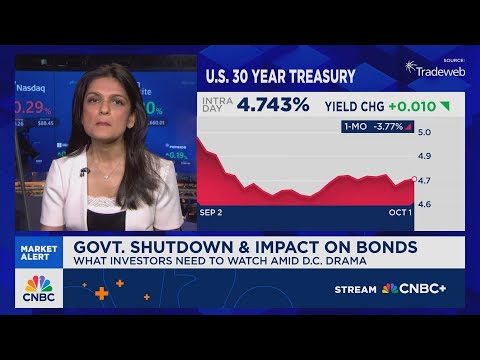
Macro headwinds make a Nike turnaround hard, says Barclays’ Adrienne Yih
CNBC Television· 2025-10-01 11:14
Nike shares uh up nicely today about 4%. Profit and revenue beat Wall Street expectations signaling turnaround efforts that the company may be taking hold. Uh sales grew about 1% from the same quarter a year ago.Surprising analysts. Nike expects current quarter revenue revenue though to fall by low singledigit uh percentages in line with where the street was. Anyway, on the topic of tariffs, and that's has a lot to do with this, Nike said it expects a hit of $1.5% billion uh and a gross margin impact of 1.2 ...

'Fast Money' traders talk market impacts of cracks in the consumer
CNBC Television· 2025-09-30 22:05
Consumer Credit Concerns - Credit scores are falling at the fastest pace since the global financial crisis [2] - 90-day plus delinquency rates for credit cards are north of 12%, the highest in 14 years, with an average rate of about 215% and $12 trillion [2] - CarMax reported increased loan loss reserves due to subprime customers (FICO scores under 550) having the most trouble [9] - A significant portion of thericcolor bankruptcy borrowers had no credit scores or scores around 600, highlighting concerns about lower-quality consumers [10] Market and Bank Performance - Despite consumer credit concerns, the market (HYG) has remained resilient [3] - Banks experienced pressure, possibly due to rebalancing or concerns about access to credit [4] - American Express, expected to perform well due to its higher-end demographic, was surprisingly hard hit [13][14] - Mastercard and Visa held up relatively well [14] - JP Morgan and Capital One earnings will provide insights into different customer segments [12][15] Buy Now Pay Later (BNPL) - BNPL options are prevalent for online purchases, potentially unique to this cycle [5] - Affirm (a firm) experienced a post-IPO pop but quickly broke price, indicating potential investor concerns [5][6] - The lower-end consumer is particularly relevant to the BNPL sector [8][9] Economic Outlook - The push and pull between the Fed's dual mandate (full employment and stable prices) continues [7] - PCE data was "sticky," and the upcoming jobs number may shift focus to the lower-end consumer [7][8] - The economy is perceived as "doing okay," with a good employment picture, though a government shutdown could cause disruption [12]

U.S. consumers are pulling back while higher-income households keep spending, says JLL’s Jaggi
CNBC Television· 2025-09-30 21:49
Consumer Spending Trends - Overall consumer spending is pulling back, with less money spent this year compared to last year [2] - The top 10-20% of household earners in the US are expected to spend more, while the bottom 50-70% are holding back [3] - Only 50% of US households are actively participating in the market, impacting their spending behavior [3] - Consumers are prioritizing needs over wants due to global stress factors like wars [9] Retailer Strategies and Outlook - Retailers are making real estate decisions for openings in 2027 and 2028, focusing on the long-term consumer outlook [6] - Retailers are generally bullish on the consumer in the long haul, not focusing on short-term market fluctuations [7] - Concerns about a soft job market and constant talk of tariffs are scaring consumers from spending [7][8] - Most retailers believe the US consumer will not shift heavily to online-only shopping, with roughly 84% preferring brick-and-mortar stores [10][11] Real Estate Market Dynamics - There is a historical supply shortage in retail real estate space, a problem not seen in about 40 years [11] - Current real estate space delivery is less than 40 million square feet per year, significantly lower than the 200 million plus square feet per year during the 2000s [12] - From 2010 to 2023, less than 1 billion square feet of real estate space was delivered, compared to 1 billion between 2002 and 2007 [12] - Retailers are primarily looking at second-generation space due to the lack of new development, with significant development mainly in Florida, Georgia, and Texas [13]