
地区和平稳定

Search documents
外交部:中方呼吁巴阿两国继续通过对话协商处理矛盾分歧
Jing Ji Guan Cha Wang· 2025-12-09 07:54
Core Viewpoint - The Chinese government emphasizes the importance of dialogue and cooperation between Afghanistan and Pakistan to resolve conflicts and maintain regional stability [1] Summary by Relevant Sections - **Conflict Overview** - A recent clash occurred on December 5 between Afghan and Pakistani armed forces near the border, resulting in civilian casualties, marking a return to conflict after a ceasefire agreement in mid-October [1] - **China's Position** - China recognizes both Afghanistan and Pakistan as traditional friendly neighbors and expresses a desire to facilitate dialogue and cooperation between the two nations [1] - The Chinese government calls for both countries to address their differences through negotiation to de-escalate tensions and promote peace in the region [1] - **International Cooperation** - China expresses its willingness to work with the international community to play a constructive role in improving and developing relations between Afghanistan and Pakistan [1]
高市宣称:强烈抗议,但还是要冷静应对
Guan Cha Zhe Wang· 2025-12-08 09:32
Core Viewpoint - The article discusses the recent tensions between China and Japan, particularly focusing on Japan's claims of Chinese military aircraft engaging in radar illumination of Japanese fighter jets, which China vehemently denies and counters with strong diplomatic responses [1][10][24]. Group 1: Incident Overview - On December 6, Japan's Ministry of Defense confirmed that Chinese J-15 fighter jets from the Liaoning aircraft carrier conducted radar illumination on Japanese F-15 jets over international waters southeast of Okinawa [1][19]. - Japanese Prime Minister Kishi Nobuo expressed strong regret over the incident and demanded that such actions not occur again, labeling them as dangerous behavior [1][10]. - The Japanese government has lodged multiple protests against China regarding this incident, emphasizing the need for vigilance and communication to maintain regional peace [3][15]. Group 2: Chinese Response - The Chinese Navy stated that the Liaoning carrier group was conducting routine flight training in the Miyako Strait, and accused Japanese aircraft of interfering with their operations, which posed risks to flight safety [10][22]. - Chinese officials, including the spokesperson for the Ministry of Defense, rejected Japan's claims as unfounded and accused Japan of misrepresenting the situation [10][24]. - China's Ambassador to Japan, Wu Jianghao, formally protested against Japan's actions, demanding an end to what he described as irresponsible provocations [11][23]. Group 3: Broader Implications - The article highlights Japan's increasing military assertiveness, including plans to raise defense spending to 2% of GDP by 2025 and potential deployment of offensive weapons near Taiwan [12][24]. - A commentary from the PLA pointed out that Japan's actions contradict its post-war pacifist constitution and could destabilize regional peace and security [12][24]. - There are concerns within Japan about the potential for similar incidents to recur, with some advocating for a cautious approach to avoid escalating tensions further [7][20].


日本屡越红线,中方“亮剑”:日方胆敢越雷池半步给自己招事惹事,必将付出惨痛代价
Huan Qiu Shi Bao· 2025-11-27 22:41
Group 1 - The Chinese government has issued strong warnings against Japan's recent military actions and statements regarding Taiwan, emphasizing that any aggression will be met with severe consequences [1][2] - China's military capabilities are highlighted as being robust enough to counter any threats, with specific mention of targeting Japanese military installations if Japan intervenes in Taiwan [2][3] - The ongoing tensions are exacerbated by Japan's attempts to revise its defense policies and increase military spending, which China views as a significant threat to regional stability [1][2] Group 2 - There is a growing concern in Japan regarding the potential economic impacts of the deteriorating diplomatic relations with China, particularly affecting Japanese companies operating in China and the decline in Chinese tourists visiting Japan [3] - The historical context of Taiwan's status is reiterated, with references to international agreements that affirm China's sovereignty over Taiwan, indicating that the issue was resolved post-World War II [3] - The Chinese government has already implemented countermeasures affecting Japan's tourism sector, signaling that further actions may be taken if Japan continues its current trajectory [3]
严重越线挑衅,高市早苗终将自食其果
Ren Min Ri Bao· 2025-11-27 22:30
Core Viewpoint - The recent provocative remarks by Japanese Prime Minister Sanae Takaichi regarding Taiwan have escalated tensions, suggesting potential military intervention in the Taiwan Strait, which has been met with strong opposition from China [1][2][3][4]. Group 1: Provocation and Sovereignty - Takaichi's statements are seen as a serious provocation against China's sovereignty and territorial integrity, marking the first time a Japanese leader has linked Taiwan's situation to Japan's collective self-defense [1]. - The remarks contradict established international agreements that affirm China's sovereignty over Taiwan, including the Cairo Declaration and the Potsdam Proclamation [1]. Group 2: Historical Context and National Sentiment - This year marks the 80th anniversary of both the victory in the Chinese People's Anti-Japanese War and the recovery of Taiwan, highlighting the historical grievances stemming from Japan's colonial rule over Taiwan [2]. - Takaichi's comments are viewed as an affront to the collective memory of the suffering caused by Japan's wartime actions, which included significant atrocities against Chinese and Asian peoples [2]. Group 3: Military Expansion and International Relations - Takaichi's linkage of Taiwan's situation to Japan's collective self-defense is perceived as a pretext for military expansion, raising concerns about a resurgence of militarism in Japan [2][3]. - The remarks have drawn widespread criticism within Japan, with public protests indicating a significant portion of the population opposes Takaichi's stance [3]. Group 4: International Order and Legal Principles - Takaichi's statements challenge the post-World War II international order and Japan's pacifist constitution, which restricts military actions [3][4]. - The inconsistency in Japan's foreign policy regarding Taiwan undermines its credibility on the international stage, potentially isolating Japan diplomatically [3][4]. Group 5: Regional Stability and Global Reactions - The assertion that "Taiwan's issues are Japan's issues" poses a threat to regional peace and stability, with international figures expressing concern over the implications of Takaichi's remarks [4]. - The potential for Japan to become a destabilizing factor in the region is highlighted by reactions from other countries, emphasizing the need for Japan to reflect on its historical actions [4].
南部战区权威发布
Xin Jing Bao· 2025-11-16 22:58
Core Viewpoint - The Southern Theater Command of the People's Liberation Army conducted routine patrols in the South China Sea, emphasizing the need to maintain regional peace and stability amidst rising tensions with the Philippines [1] Summary by Relevant Sections - **Military Operations** - On November 14, the Southern Theater Command organized a bomber formation for routine patrols in the South China Sea [1] - **Regional Tensions** - The Philippines is reportedly engaging with external forces to conduct so-called "joint patrols," which are viewed as actions that undermine regional peace and stability [1] - **Official Stance** - The Southern Theater Command issued a warning to the Philippines to cease actions that provoke tensions and escalate conflicts [1] - The command maintains a high state of readiness to defend national sovereignty and ensure peace in the South China Sea, asserting that any attempts to infringe upon these will not succeed [1]
南部战区发声!
中国基金报· 2025-11-16 04:31
Core Viewpoint - The spokesperson of the Southern Theater Command emphasizes the importance of maintaining national sovereignty and regional stability in the South China Sea amidst rising tensions due to the Philippines' actions [2] Summary by Relevant Sections - Military Operations - On November 14, the People's Liberation Army Southern Theater Command organized a bomber formation for routine patrols in the South China Sea [2] - Regional Tensions - The Philippines is reportedly engaging with external forces to conduct so-called "joint patrols," which are seen as actions that undermine regional peace and stability [2] - Warnings and Stance - The Southern Theater Command warns the Philippines to cease actions that provoke tensions and escalate conflicts, asserting that any attempts to infringe upon sovereignty will not succeed [2]

解放军轰炸机编队位南海例行巡航
财联社· 2025-11-16 04:11
Group 1 - The Southern Theater Command of the People's Liberation Army conducted routine patrols in the South China Sea with bomber formations on November 14, emphasizing the importance of maintaining regional peace and stability [1] - The Philippines is accused of frequently seeking external forces for so-called "joint patrols," which are seen as actions that undermine regional stability [1] - The Southern Theater Command maintains a high level of readiness to defend national sovereignty and security in the South China Sea, asserting that any attempts to infringe upon these will not succeed [2]

南部战区发声!
21世纪经济报道· 2025-11-16 03:58
Core Viewpoint - The article emphasizes the ongoing military activities of the Southern Theater Command of the People's Liberation Army (PLA) in the South China Sea, highlighting the need to maintain national sovereignty and regional stability amidst perceived provocations from the Philippines and external forces [1]. Group 1 - The Southern Theater Command organized a bomber fleet for routine patrols in the South China Sea on November 14 [1]. - The Philippines is accused of frequently engaging with external forces to conduct so-called "joint patrols," which are seen as destabilizing actions that threaten regional peace [1]. - The Southern Theater Command warns the Philippines to cease actions that escalate tensions and provoke conflicts in the region [1]. Group 2 - The military remains on high alert to defend national sovereignty and ensure peace in the South China Sea [1]. - The article asserts that any attempts to infringe upon China's rights or create disturbances will not succeed [1].

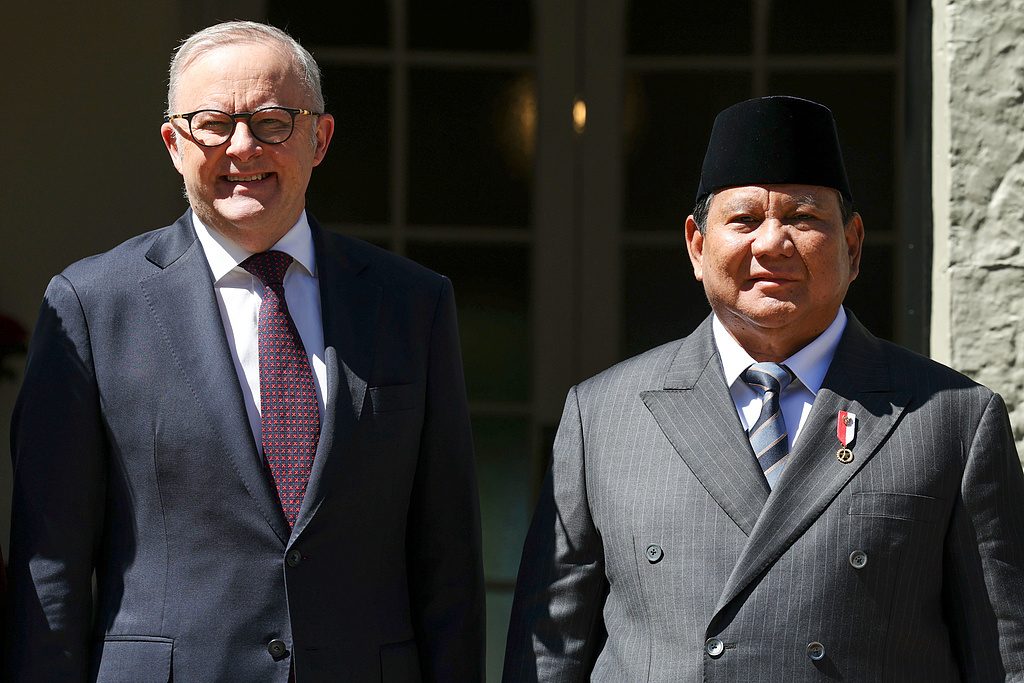
澳大利亚印尼宣布将签署新安全条约,深化两国防务合作
Huan Qiu Shi Bao· 2025-11-12 23:05
Core Points - Australia and Indonesia have agreed to sign a new bilateral security treaty aimed at deepening defense cooperation, marking a new era in their relationship according to Australian Prime Minister Albanese [1][3] - The treaty builds on the 1995 bilateral defense agreement and includes a consultation mechanism for military responses if either party's security interests are threatened [3] - The treaty is expected to be formally signed next year and emphasizes friendship, trust, and mutual respect between the two nations [3] Summary by Sections - **Bilateral Security Treaty**: The new treaty is based on the 1995 defense agreement and aims to enhance military cooperation, with provisions for consultations and joint military responses [3] - **Political Significance**: Analysts suggest that the treaty serves more as a political symbol to demonstrate improved relations rather than containing substantial commitments [4] - **Regional Context**: The treaty is seen as a crucial step in strengthening security ties amid increasing regional tensions, with experts highlighting its importance in the current geopolitical climate [3][4]
外交部:支持巴基斯坦和阿富汗发展彼此双边关系
Jing Ji Guan Cha Wang· 2025-11-12 08:00
Core Viewpoint - The Chinese government expresses support for the bilateral relations between Pakistan and Afghanistan, emphasizing the importance of regional peace and stability [1] Group 1 - The Chinese government considers Pakistan and Afghanistan as neighboring countries and aims to foster their bilateral relations [1] - The Chinese government commits to playing a constructive role in maintaining regional peace and stability [1]